

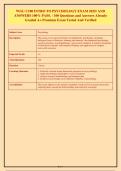
WGU C180 INTRO TO PSYCHOLOGY EXAM 2025/ AND
ANSWERS 100% PASS. - 100 Questions and Answers Already
Graded A+ Premium Exam Tested And Verified
Subject Area Psychology
Description This exam covers advanced topics in introductory psychology, including
biological bases of behavior, learning and memory, developmental psychology,
social psychology, psychopathology, and research methods. It requires integration
of theoretical concepts with empirical findings and application to complex
real-world scenarios.
Expected Grade A+
Total Questions 100
Duration 3 hours
Learning Outcomes 1. Critically evaluate major theoretical perspectives in psychology
2. Apply psychological principles to novel situations
3. Analyze research methodology and interpret data
4. Synthesize knowledge across different subfields of psychology
Accreditation This exam adheres to the rigorous standards of top-tier US research universities,
requiring deep conceptual understanding and analytical reasoning.
Page 1
,1. In a neuroimaging study, participants performed a working memory task while
undergoing fMRI. The researchers observed increased activation in the dorsolateral
prefrontal cortex (DLPFC) and the posterior parietal cortex. Which of the following
best explains the role of the DLPFC in this context?
Answer: It is primarily responsible for the manipulation and monitoring of
information held in working memory.
The DLPFC is critical for executive functions, including the manipulation and
monitoring of information in working memory. Option A describes the phonological
loop, which involves the temporoparietal junction and Broca's area, not DLPFC.
Option C incorrectly attributes memory consolidation to DLPFC; the hippocampus is
key for long-term consolidation. Option D describes early visual processing in occipital
and temporal regions.
2. A researcher designs a study to test the efficacy of a new cognitive-behavioral
therapy (CBT) for social anxiety disorder. Participants are randomly assigned to
either CBT or a wait-list control group. The researcher measures social anxiety
symptoms using a validated scale before and after treatment. Which of the following
is the most appropriate statistical test to compare the post-treatment scores between
the two groups, controlling for pre-treatment scores?
Answer: Analysis of covariance (ANCOVA) with pre-treatment score as covariate
ANCOVA is used to compare post-treatment scores between groups while statistically
controlling for pre-treatment differences, increasing statistical power. Option A ignores
pre-treatment scores, which may introduce bias if groups differ initially. Option B only
assesses within-group change, not between-group differences. Option D could be used
but is less efficient when the primary interest is post-treatment comparison controlling
for baseline; ANCOVA directly addresses this.
Page 2
,3. In a study of classical conditioning, a tone is paired with a mild electric shock to
the wrist. After several pairings, the tone alone elicits a galvanic skin response
(GSR). Later, the tone is presented repeatedly without the shock, and the GSR
gradually diminishes. However, after a 24-hour break, the tone again elicits a small
GSR. This phenomenon is best explained by:
Answer: Spontaneous recovery
Spontaneous recovery is the reappearance of a conditioned response after a delay
following extinction. Stimulus generalization involves responding to similar stimuli. The
renewal effect occurs when the context changes after extinction. Reinstatement involves
presenting the unconditioned stimulus again. Here, the CR reappears after a time
delay, which is spontaneous recovery.
4. A patient with damage to the ventromedial prefrontal cortex (vmPFC) shows
normal performance on the Iowa Gambling Task in terms of overall net score, but
exhibits abnormal skin conductance responses (SCRs) before making
disadvantageous choices. Which of the following best accounts for this pattern?
Answer: The vmPFC is critical for integrating somatic markers into
decision-making; the patient may use compensatory cognitive strategies.
The somatic marker hypothesis posits that vmPFC integrates emotional signals
(somatic markers) to guide decision-making. Normal net scores suggest the patient may
use conscious reasoning to compensate, but lack of anticipatory SCRs indicates
impaired somatic signaling. Option A is incorrect because vmPFC damage impairs both
conscious and unconscious processes. Option C is false; vmPFC is involved. Option D is
not supported by the data.
Page 3
, 5. A researcher is studying memory consolidation in mice. After training on a fear
conditioning task, the mice are injected with a protein synthesis inhibitor in the
hippocampus either immediately after training or 6 hours later. The immediate
injection group shows impaired memory when tested 24 hours later, but the 6-hour
delay group shows normal memory. Which of the following conclusions is most
consistent with these findings?
Answer: Memory consolidation occurs within the first few hours after learning and
requires de novo protein synthesis.
The results show that blocking protein synthesis immediately after training impairs
memory, but delaying the injection has no effect, indicating a critical window for
consolidation that requires new protein synthesis. Option B is contradicted by the effect
of hippocampal injection. Option C is incorrect because retrieval was tested after
consolidation. Option D is not directly tested; the amygdala is also involved, but the
hippocampus is crucial for contextual fear conditioning.
6. In a cross-sectional study of cognitive aging, researchers compare performance on
a test of processing speed across three age groups: 20-30, 40-50, and 60-70 years.
They find a linear decline with age. However, when the same participants are
followed longitudinally for 10 years, the decline within individuals is less steep than
the cross-sectional differences. Which of the following is the most likely explanation
for this discrepancy?
Answer: All of the above.
Cross-sectional studies compare different cohorts, which may differ in education,
health, and other factors (cohort effects). Longitudinal studies suffer from practice
effects (improvement with repeated testing) and selective attrition (healthier
participants remain), all of which can make decline appear less steep. Thus, all three
factors contribute to the discrepancy.
Page 4
ANSWERS 100% PASS. - 100 Questions and Answers Already
Graded A+ Premium Exam Tested And Verified
Subject Area Psychology
Description This exam covers advanced topics in introductory psychology, including
biological bases of behavior, learning and memory, developmental psychology,
social psychology, psychopathology, and research methods. It requires integration
of theoretical concepts with empirical findings and application to complex
real-world scenarios.
Expected Grade A+
Total Questions 100
Duration 3 hours
Learning Outcomes 1. Critically evaluate major theoretical perspectives in psychology
2. Apply psychological principles to novel situations
3. Analyze research methodology and interpret data
4. Synthesize knowledge across different subfields of psychology
Accreditation This exam adheres to the rigorous standards of top-tier US research universities,
requiring deep conceptual understanding and analytical reasoning.
Page 1
,1. In a neuroimaging study, participants performed a working memory task while
undergoing fMRI. The researchers observed increased activation in the dorsolateral
prefrontal cortex (DLPFC) and the posterior parietal cortex. Which of the following
best explains the role of the DLPFC in this context?
Answer: It is primarily responsible for the manipulation and monitoring of
information held in working memory.
The DLPFC is critical for executive functions, including the manipulation and
monitoring of information in working memory. Option A describes the phonological
loop, which involves the temporoparietal junction and Broca's area, not DLPFC.
Option C incorrectly attributes memory consolidation to DLPFC; the hippocampus is
key for long-term consolidation. Option D describes early visual processing in occipital
and temporal regions.
2. A researcher designs a study to test the efficacy of a new cognitive-behavioral
therapy (CBT) for social anxiety disorder. Participants are randomly assigned to
either CBT or a wait-list control group. The researcher measures social anxiety
symptoms using a validated scale before and after treatment. Which of the following
is the most appropriate statistical test to compare the post-treatment scores between
the two groups, controlling for pre-treatment scores?
Answer: Analysis of covariance (ANCOVA) with pre-treatment score as covariate
ANCOVA is used to compare post-treatment scores between groups while statistically
controlling for pre-treatment differences, increasing statistical power. Option A ignores
pre-treatment scores, which may introduce bias if groups differ initially. Option B only
assesses within-group change, not between-group differences. Option D could be used
but is less efficient when the primary interest is post-treatment comparison controlling
for baseline; ANCOVA directly addresses this.
Page 2
,3. In a study of classical conditioning, a tone is paired with a mild electric shock to
the wrist. After several pairings, the tone alone elicits a galvanic skin response
(GSR). Later, the tone is presented repeatedly without the shock, and the GSR
gradually diminishes. However, after a 24-hour break, the tone again elicits a small
GSR. This phenomenon is best explained by:
Answer: Spontaneous recovery
Spontaneous recovery is the reappearance of a conditioned response after a delay
following extinction. Stimulus generalization involves responding to similar stimuli. The
renewal effect occurs when the context changes after extinction. Reinstatement involves
presenting the unconditioned stimulus again. Here, the CR reappears after a time
delay, which is spontaneous recovery.
4. A patient with damage to the ventromedial prefrontal cortex (vmPFC) shows
normal performance on the Iowa Gambling Task in terms of overall net score, but
exhibits abnormal skin conductance responses (SCRs) before making
disadvantageous choices. Which of the following best accounts for this pattern?
Answer: The vmPFC is critical for integrating somatic markers into
decision-making; the patient may use compensatory cognitive strategies.
The somatic marker hypothesis posits that vmPFC integrates emotional signals
(somatic markers) to guide decision-making. Normal net scores suggest the patient may
use conscious reasoning to compensate, but lack of anticipatory SCRs indicates
impaired somatic signaling. Option A is incorrect because vmPFC damage impairs both
conscious and unconscious processes. Option C is false; vmPFC is involved. Option D is
not supported by the data.
Page 3
, 5. A researcher is studying memory consolidation in mice. After training on a fear
conditioning task, the mice are injected with a protein synthesis inhibitor in the
hippocampus either immediately after training or 6 hours later. The immediate
injection group shows impaired memory when tested 24 hours later, but the 6-hour
delay group shows normal memory. Which of the following conclusions is most
consistent with these findings?
Answer: Memory consolidation occurs within the first few hours after learning and
requires de novo protein synthesis.
The results show that blocking protein synthesis immediately after training impairs
memory, but delaying the injection has no effect, indicating a critical window for
consolidation that requires new protein synthesis. Option B is contradicted by the effect
of hippocampal injection. Option C is incorrect because retrieval was tested after
consolidation. Option D is not directly tested; the amygdala is also involved, but the
hippocampus is crucial for contextual fear conditioning.
6. In a cross-sectional study of cognitive aging, researchers compare performance on
a test of processing speed across three age groups: 20-30, 40-50, and 60-70 years.
They find a linear decline with age. However, when the same participants are
followed longitudinally for 10 years, the decline within individuals is less steep than
the cross-sectional differences. Which of the following is the most likely explanation
for this discrepancy?
Answer: All of the above.
Cross-sectional studies compare different cohorts, which may differ in education,
health, and other factors (cohort effects). Longitudinal studies suffer from practice
effects (improvement with repeated testing) and selective attrition (healthier
participants remain), all of which can make decline appear less steep. Thus, all three
factors contribute to the discrepancy.
Page 4


