

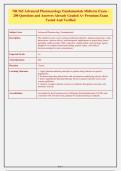
NR 565 Advanced Pharmacology Fundamentals Midterm Exam -
200 Questions and Answers Already Graded A+ Premium Exam
Tested And Verified
Subject Area Advanced Pharmacology Fundamentals
Description This midterm exam covers advanced pharmacokinetics, pharmacodynamics, drug
interactions, adverse effects, and therapeutic applications of major drug classes
including cardiovascular, CNS, endocrine, antimicrobial, and oncology agents.
Emphasis on evidence-based prescribing, patient safety, and clinical
decision-making for nurse practitioners.
Expected Grade A+
Total Questions 200
Duration 3 hours
Learning Outcomes 1. Apply pharmacokinetic principles to predict drug behavior in special
populations.
2. Evaluate drug-drug interactions and mechanisms underlying adverse effects.
3. Select appropriate pharmacotherapy based on patient-specific factors and
current guidelines.
4. Analyze complex clinical scenarios to optimize therapeutic outcomes and
minimize toxicity.
Accreditation Accredited by the Commission on Collegiate Nursing Education (CCNE) and
consistent with US university graduate-level pharmacology standards.
Page 1
,1. A patient with refractory hypertension is on a regimen including lisinopril,
amlodipine, and hydrochlorothiazide. Despite adherence, blood pressure
remains elevated. The provider considers adding an aldosterone antagonist.
Which of the following best explains why spironolactone may be more effective
than eplerenone in this setting?
A. Spironolactone has higher selectivity for the mineralocorticoid receptor, reducing
off-target effects.
B. Spironolactone undergoes extensive hepatic metabolism via CYP3A4, leading to
active metabolites with longer half-life.
C. Spironolactone has additional antihypertensive effects through androgen receptor
antagonism.
D. Spironolactone exhibits greater bioavailability due to minimal first-pass
metabolism.
Answer: B. Spironolactone undergoes extensive hepatic metabolism via
CYP3A4, leading to active metabolites with longer half-life.
Spironolactone is metabolized to active metabolites (e.g., canrenone) that prolong
its duration of action, contributing to sustained aldosterone blockade. Eplerenone
has a shorter half-life and no active metabolites. Spironolactone's androgen
receptor antagonism causes side effects (gynecomastia) but does not enhance
antihypertensive efficacy. Both have similar bioavailability and mineralocorticoid
receptor selectivity, though spironolactone is less selective.
Page 2
,2. A patient with atrial fibrillation requires anticoagulation. The provider
considers apixaban versus warfarin. Which of the following pharmacokinetic
differences most strongly supports choosing apixaban for a patient with
moderate hepatic impairment (Child-Pugh class B)?
A. Apixaban is primarily eliminated unchanged in urine, avoiding hepatic metabolism.
B. Apixaban is a substrate of CYP3A4 and P-glycoprotein, but hepatic impairment
does not significantly alter its clearance.
C. Warfarin's anticoagulant effect is more predictable in hepatic impairment due to
reduced vitamin K-dependent factor synthesis.
D. Apixaban has a narrower therapeutic window, requiring more frequent monitoring
in hepatic impairment.
Answer: B. Apixaban is a substrate of CYP3A4 and P-glycoprotein, but
hepatic impairment does not significantly alter its clearance.
Apixaban is partially metabolized by CYP3A4 and is a P-gp substrate; however,
studies show that mild-to-moderate hepatic impairment does not significantly
affect its pharmacokinetics, and it is not contraindicated in Child-Pugh B.
Warfarin's effect is potentiated in hepatic impairment due to decreased synthesis
of clotting factors, increasing bleeding risk. Apixaban is primarily eliminated via
multiple pathways including renal and hepatic, not solely renal. Apixaban has a
wider therapeutic window and does not require routine monitoring.
3. A patient with type 2 diabetes and chronic kidney disease stage 3b (eGFR 35
mL/min/1.73 m²) is on metformin. Despite maximal tolerated dose, HbA1c
remains 8.5%. The provider considers adding a second agent. Which of the
following combinations requires the most cautious dosing adjustment due to
altered pharmacokinetics in renal impairment?
A. Metformin + canagliflozin
B. Metformin + liraglutide
C. Metformin + sitagliptin
D. Metformin + insulin glargine
Answer: C. Metformin + sitagliptin
Sitagliptin is primarily excreted unchanged by the kidney, and its clearance
decreases with declining renal function, necessitating dose reduction (e.g., 25 mg
daily for eGFR 30-45). Canagliflozin also requires dose adjustment but is less
dependent on renal elimination; liraglutide is not renally cleared; insulin glargine
is titrated based on glucose levels, not renal function per se. Metformin is
contraindicated if eGFR <30, but at stage 3b it can be used with dose reduction.
Page 3
, 4. A patient with major depressive disorder is started on venlafaxine. After 2
weeks, the patient reports nausea, insomnia, and increased anxiety. The
provider considers switching to a different antidepressant. Which of the
following pharmacological properties best explains the early adverse effects
and suggests a potential strategy to improve tolerability?
A. Venlafaxine's potent norepinephrine reuptake inhibition at low doses causes
sympathetic activation.
B. Venlafaxine's short half-life necessitates twice-daily dosing, leading to
peak-to-trough fluctuations that exacerbate side effects.
C. Venlafaxine's active metabolite, desvenlafaxine, has a longer half-life but similar
side effect profile.
D. Venlafaxine's dose-dependent binding to serotonin transporters increases synaptic
serotonin, which can initially worsen anxiety.
Answer: D. Venlafaxine's dose-dependent binding to serotonin transporters
increases synaptic serotonin, which can initially worsen anxiety.
Venlafaxine inhibits serotonin reuptake at all doses, and the initial increase in
serotonin can cause transient worsening of anxiety and insomnia. This is common
with SSRIs/SNRIs. Norepinephrine reuptake inhibition occurs at higher doses,
not low. The extended-release formulation allows once-daily dosing, reducing
fluctuations. Desvenlafaxine is a separate drug, not a metabolite of venlafaxine (it
is a synthetic metabolite).
Page 4
200 Questions and Answers Already Graded A+ Premium Exam
Tested And Verified
Subject Area Advanced Pharmacology Fundamentals
Description This midterm exam covers advanced pharmacokinetics, pharmacodynamics, drug
interactions, adverse effects, and therapeutic applications of major drug classes
including cardiovascular, CNS, endocrine, antimicrobial, and oncology agents.
Emphasis on evidence-based prescribing, patient safety, and clinical
decision-making for nurse practitioners.
Expected Grade A+
Total Questions 200
Duration 3 hours
Learning Outcomes 1. Apply pharmacokinetic principles to predict drug behavior in special
populations.
2. Evaluate drug-drug interactions and mechanisms underlying adverse effects.
3. Select appropriate pharmacotherapy based on patient-specific factors and
current guidelines.
4. Analyze complex clinical scenarios to optimize therapeutic outcomes and
minimize toxicity.
Accreditation Accredited by the Commission on Collegiate Nursing Education (CCNE) and
consistent with US university graduate-level pharmacology standards.
Page 1
,1. A patient with refractory hypertension is on a regimen including lisinopril,
amlodipine, and hydrochlorothiazide. Despite adherence, blood pressure
remains elevated. The provider considers adding an aldosterone antagonist.
Which of the following best explains why spironolactone may be more effective
than eplerenone in this setting?
A. Spironolactone has higher selectivity for the mineralocorticoid receptor, reducing
off-target effects.
B. Spironolactone undergoes extensive hepatic metabolism via CYP3A4, leading to
active metabolites with longer half-life.
C. Spironolactone has additional antihypertensive effects through androgen receptor
antagonism.
D. Spironolactone exhibits greater bioavailability due to minimal first-pass
metabolism.
Answer: B. Spironolactone undergoes extensive hepatic metabolism via
CYP3A4, leading to active metabolites with longer half-life.
Spironolactone is metabolized to active metabolites (e.g., canrenone) that prolong
its duration of action, contributing to sustained aldosterone blockade. Eplerenone
has a shorter half-life and no active metabolites. Spironolactone's androgen
receptor antagonism causes side effects (gynecomastia) but does not enhance
antihypertensive efficacy. Both have similar bioavailability and mineralocorticoid
receptor selectivity, though spironolactone is less selective.
Page 2
,2. A patient with atrial fibrillation requires anticoagulation. The provider
considers apixaban versus warfarin. Which of the following pharmacokinetic
differences most strongly supports choosing apixaban for a patient with
moderate hepatic impairment (Child-Pugh class B)?
A. Apixaban is primarily eliminated unchanged in urine, avoiding hepatic metabolism.
B. Apixaban is a substrate of CYP3A4 and P-glycoprotein, but hepatic impairment
does not significantly alter its clearance.
C. Warfarin's anticoagulant effect is more predictable in hepatic impairment due to
reduced vitamin K-dependent factor synthesis.
D. Apixaban has a narrower therapeutic window, requiring more frequent monitoring
in hepatic impairment.
Answer: B. Apixaban is a substrate of CYP3A4 and P-glycoprotein, but
hepatic impairment does not significantly alter its clearance.
Apixaban is partially metabolized by CYP3A4 and is a P-gp substrate; however,
studies show that mild-to-moderate hepatic impairment does not significantly
affect its pharmacokinetics, and it is not contraindicated in Child-Pugh B.
Warfarin's effect is potentiated in hepatic impairment due to decreased synthesis
of clotting factors, increasing bleeding risk. Apixaban is primarily eliminated via
multiple pathways including renal and hepatic, not solely renal. Apixaban has a
wider therapeutic window and does not require routine monitoring.
3. A patient with type 2 diabetes and chronic kidney disease stage 3b (eGFR 35
mL/min/1.73 m²) is on metformin. Despite maximal tolerated dose, HbA1c
remains 8.5%. The provider considers adding a second agent. Which of the
following combinations requires the most cautious dosing adjustment due to
altered pharmacokinetics in renal impairment?
A. Metformin + canagliflozin
B. Metformin + liraglutide
C. Metformin + sitagliptin
D. Metformin + insulin glargine
Answer: C. Metformin + sitagliptin
Sitagliptin is primarily excreted unchanged by the kidney, and its clearance
decreases with declining renal function, necessitating dose reduction (e.g., 25 mg
daily for eGFR 30-45). Canagliflozin also requires dose adjustment but is less
dependent on renal elimination; liraglutide is not renally cleared; insulin glargine
is titrated based on glucose levels, not renal function per se. Metformin is
contraindicated if eGFR <30, but at stage 3b it can be used with dose reduction.
Page 3
, 4. A patient with major depressive disorder is started on venlafaxine. After 2
weeks, the patient reports nausea, insomnia, and increased anxiety. The
provider considers switching to a different antidepressant. Which of the
following pharmacological properties best explains the early adverse effects
and suggests a potential strategy to improve tolerability?
A. Venlafaxine's potent norepinephrine reuptake inhibition at low doses causes
sympathetic activation.
B. Venlafaxine's short half-life necessitates twice-daily dosing, leading to
peak-to-trough fluctuations that exacerbate side effects.
C. Venlafaxine's active metabolite, desvenlafaxine, has a longer half-life but similar
side effect profile.
D. Venlafaxine's dose-dependent binding to serotonin transporters increases synaptic
serotonin, which can initially worsen anxiety.
Answer: D. Venlafaxine's dose-dependent binding to serotonin transporters
increases synaptic serotonin, which can initially worsen anxiety.
Venlafaxine inhibits serotonin reuptake at all doses, and the initial increase in
serotonin can cause transient worsening of anxiety and insomnia. This is common
with SSRIs/SNRIs. Norepinephrine reuptake inhibition occurs at higher doses,
not low. The extended-release formulation allows once-daily dosing, reducing
fluctuations. Desvenlafaxine is a separate drug, not a metabolite of venlafaxine (it
is a synthetic metabolite).
Page 4


