1|Page
NSG 502 Exam 1 NEWEST 2026 ACTUAL EXAM TEST BANK|
COMPLETE EXAM QUESTIONS AND CORRECT VERIFIED
ANSWERS/ ALREADY GRADRED A+| (MOST RECENT!!)
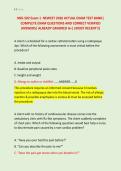
A client is scheduled for a cardiac catheterization using a radiopaque
dye. Which of the following assessments is most critical before the
procedure?
A. Intake and output
B. Baseline peripheral pulse rates
C. Height and weight
D. Allergy to iodine or shellfish ......ANSWER......D
This procedure requires an informed consent because it involves
injection of a radiopaque dye into the blood vessel. The risk of allergic
reaction & possible anaphylaxis is serious & must be assessed before
the procedure.
A client with no history of cardiovascular disease comes into the
ambulatory clinic with flu-like symptoms. The client suddenly complains
of chest pain. Which of the following questions would best help a nurse
to discriminate pain caused by a non-cardiac problem?
A. "Have you ever had this pain before?"
B. "Can you describe the pain to me?"
C. "Does the pain get worse when you breathe in?"
,2|Page
D. "Can you rate the pain on a scale of 1-10, with ten (10) being the
worst?" ......ANSWER......C
Chest pain is assessed by using the standard pain assessment
parameters. Pain of pleuropulmonary origin usually worsens on
inspiration.
A nurse notes 2+ bilateral edema in the lower extremities of a client
with myocardial infarction who was admitted two (2) days ago. The
nurse would plan to do which of the following next?
A. Review the intake and output records for the last two (2) days.
B. Change the time of diuretic administration from morning to evening.
C. Request a sodium restriction of one (1) g/day from the physician.
D. Order daily weight starting the following morning. ......ANSWER......A
Edema, the accumulation of excess fluid in the interstitial spaces can be
measured by intake greater than output & a sudden increase in weight.
Diuretics should not be given in the evening. Strict sodium restrictions
are reserved for clients with severe symptoms
A 60-year-old male client comes into the emergency department with
complaints of crushing chest pain that radiates to his shoulder and left
arm. The admitting diagnosis is acute myocardial infarction. Immediate
admission orders include oxygen by NC at 4L/minute, blood work, chest
X-ray, an ECG, and two (2) mg of morphine given intravenously. The
nurse should first:
,3|Page
A. Administer the morphine.
B. Obtain a 12-lead ECG.
C. Obtain the lab work.
D. Order the chest x-ray. ......ANSWER......A
Although obtaining the ECG, chest x-ray, & blood work are all important,
the nurse's priority action would be to relieve the crushing chest pain.
When teaching a client about propranolol hydrochloride, the nurse
should base the information on the knowledge that propranolol
hydrochloride:
A. Blocks beta-adrenergic stimulation and thus causes decreased heart
rate, myocardial contractility, and Conduction.
B. Increases norepinephrine secretion and thus decreases blood
pressure and heart rate.
C. Is a potent arterial and venous vasodilator that reduces peripheral
vascular resistance and lowers blood pressure.
D. Is an angiotensin-converting enzyme inhibitor that reduces blood
pressure by blocking the conversion of angiotensin I to angiotensin II.
......ANSWER......A
Propranolol hydrochloride is a beta-adrenergic blocking agent. Actions
of propranolol hydrochloride include reducing HR, decreasing
myocardial contractility, & slowing conduction
, 4|Page
Hypertension is known as the silent killer. This phrase is associated with
the fact that hypertension often goes undetected until symptoms of
other system failures occur. This may occur in the form of:
A. Cerebrovascular accident
B. Liver disease
C. Myocardial infarction
D. Pulmonary disease ......ANSWER......A
HTN is referred to as the silent killer for adults, because until the adult
has significant damage to other systems, the HTN may go undetected.
CVA's can be related to long-term HTN. Myocardial infarction is
generally related to coronary artery disease
As an initial step in treating a client with angina, the physician
prescribes nitroglycerin tablets, 0.3mggiven sublingually. This drug's
principal effects are produced by:
A. Antispasmodic effect on the pericardium.
B. Causing an increased myocardial oxygen demand.
C. Vasodilation of peripheral vasculature.
D. Improved conductivity in the myocardium. ......ANSWER......C
Nitroglycerin produces peripheral vasodilation, which reduces
myocardial oxygen consumption & demand. Vasodilation in coronary
arteries & collateral vessels may also increase blood flow to the
NSG 502 Exam 1 NEWEST 2026 ACTUAL EXAM TEST BANK|
COMPLETE EXAM QUESTIONS AND CORRECT VERIFIED
ANSWERS/ ALREADY GRADRED A+| (MOST RECENT!!)
A client is scheduled for a cardiac catheterization using a radiopaque
dye. Which of the following assessments is most critical before the
procedure?
A. Intake and output
B. Baseline peripheral pulse rates
C. Height and weight
D. Allergy to iodine or shellfish ......ANSWER......D
This procedure requires an informed consent because it involves
injection of a radiopaque dye into the blood vessel. The risk of allergic
reaction & possible anaphylaxis is serious & must be assessed before
the procedure.
A client with no history of cardiovascular disease comes into the
ambulatory clinic with flu-like symptoms. The client suddenly complains
of chest pain. Which of the following questions would best help a nurse
to discriminate pain caused by a non-cardiac problem?
A. "Have you ever had this pain before?"
B. "Can you describe the pain to me?"
C. "Does the pain get worse when you breathe in?"
,2|Page
D. "Can you rate the pain on a scale of 1-10, with ten (10) being the
worst?" ......ANSWER......C
Chest pain is assessed by using the standard pain assessment
parameters. Pain of pleuropulmonary origin usually worsens on
inspiration.
A nurse notes 2+ bilateral edema in the lower extremities of a client
with myocardial infarction who was admitted two (2) days ago. The
nurse would plan to do which of the following next?
A. Review the intake and output records for the last two (2) days.
B. Change the time of diuretic administration from morning to evening.
C. Request a sodium restriction of one (1) g/day from the physician.
D. Order daily weight starting the following morning. ......ANSWER......A
Edema, the accumulation of excess fluid in the interstitial spaces can be
measured by intake greater than output & a sudden increase in weight.
Diuretics should not be given in the evening. Strict sodium restrictions
are reserved for clients with severe symptoms
A 60-year-old male client comes into the emergency department with
complaints of crushing chest pain that radiates to his shoulder and left
arm. The admitting diagnosis is acute myocardial infarction. Immediate
admission orders include oxygen by NC at 4L/minute, blood work, chest
X-ray, an ECG, and two (2) mg of morphine given intravenously. The
nurse should first:
,3|Page
A. Administer the morphine.
B. Obtain a 12-lead ECG.
C. Obtain the lab work.
D. Order the chest x-ray. ......ANSWER......A
Although obtaining the ECG, chest x-ray, & blood work are all important,
the nurse's priority action would be to relieve the crushing chest pain.
When teaching a client about propranolol hydrochloride, the nurse
should base the information on the knowledge that propranolol
hydrochloride:
A. Blocks beta-adrenergic stimulation and thus causes decreased heart
rate, myocardial contractility, and Conduction.
B. Increases norepinephrine secretion and thus decreases blood
pressure and heart rate.
C. Is a potent arterial and venous vasodilator that reduces peripheral
vascular resistance and lowers blood pressure.
D. Is an angiotensin-converting enzyme inhibitor that reduces blood
pressure by blocking the conversion of angiotensin I to angiotensin II.
......ANSWER......A
Propranolol hydrochloride is a beta-adrenergic blocking agent. Actions
of propranolol hydrochloride include reducing HR, decreasing
myocardial contractility, & slowing conduction
, 4|Page
Hypertension is known as the silent killer. This phrase is associated with
the fact that hypertension often goes undetected until symptoms of
other system failures occur. This may occur in the form of:
A. Cerebrovascular accident
B. Liver disease
C. Myocardial infarction
D. Pulmonary disease ......ANSWER......A
HTN is referred to as the silent killer for adults, because until the adult
has significant damage to other systems, the HTN may go undetected.
CVA's can be related to long-term HTN. Myocardial infarction is
generally related to coronary artery disease
As an initial step in treating a client with angina, the physician
prescribes nitroglycerin tablets, 0.3mggiven sublingually. This drug's
principal effects are produced by:
A. Antispasmodic effect on the pericardium.
B. Causing an increased myocardial oxygen demand.
C. Vasodilation of peripheral vasculature.
D. Improved conductivity in the myocardium. ......ANSWER......C
Nitroglycerin produces peripheral vasodilation, which reduces
myocardial oxygen consumption & demand. Vasodilation in coronary
arteries & collateral vessels may also increase blood flow to the