

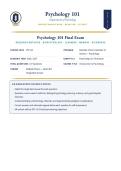
Psychology 101
LANIF · 101 YSP
Ψ Department of Psychology
PSYCHOLOGY
EST. 2026
UNDERSTANDING MIND · BEHAVIOR · SCIENCE
Psychology 101 Final Exam
R E S E A R C H M E T H O D S · B I O PSYC H O LO G Y · L E A R N I N G · M E M O RY · D I S O R D E RS
COURSE CODE PSY 101 PROGRAM Bachelor of Arts / Bachelor of
Science — Psychology
ACADEMIC YEAR EXAM TITLE Psychology 101 Final Exam
TOTAL QUESTIONS 107 Questions COURSE TITLE Introduction to Psychology
FORMAT Multiple Choice — Select the
Single Best Answer
EXAMINATION INSTRUCTIONS
▸ Select the single best answer for each question.
▸ Questions cover research methods, biological psychology, learning, memory, and psychological
disorders.
▸ Understanding key terminology, theorists, and experimental paradigms is emphasized.
▸ Correct answers and rationales appear below each question for self-assessment.
▸ All content reflects PSY 101 Final Exam learning objectives.
, SECTION I — RESEARCH METHODS, BIOPSYCHOLOGY,
Questions 1 – 107
LEARNING, MEMORY & DISORDERS
1. Sensory memory stores incoming sensory information in detail but only for an instant. Its
capacity is very ________, but the information in it is ________.
A. small; processed
B. large; unprocessed
C. limited; organized
D. moderate; filtered
CORRECT ANSWER B
RATIONALE Sensory memory has a very large capacity — it briefly holds all incoming sensory
information — but the information is unprocessed. If a flashlight moves quickly in
a circle, people see a circle of light, not individual points.
2. Observational learning is the process of learning to respond in a particular way by
watching others, who are called:
A. reinforcers
B. models
C. subjects
D. participants
CORRECT ANSWER B
RATIONALE Bandura's observational learning occurs through watching models — individuals
whose behavior is observed and imitated. This is a cornerstone of social learning
theory.
,3. Rods are photoreceptors that are highly sensitive to light and allow vision even in:
A. bright conditions
B. dim conditions
C. color-rich environments
D. only daytime
CORRECT ANSWER B
RATIONALE Rods are highly sensitive to light and enable vision in low-light (dim) conditions —
they do not detect color. Cones (C) function in bright light and enable color vision.
4. Semantic memory refers to the recall of:
A. personal experiences
B. general facts
C. how to do things
D. unconscious information
CORRECT ANSWER B
RATIONALE Semantic memory stores general knowledge and facts (e.g., knowing Paris is the
capital of France). Episodic memory (A) stores personal experiences. Procedural
memory (C) stores skills.
5. The spinal cord connects the brain to:
A. the heart only
B. the rest of the body
C. the endocrine system only
D. the sensory organs only
CORRECT ANSWER B
RATIONALE The spinal cord is the body's information highway — it connects the brain to the
peripheral nervous system and enables both voluntary movement and spinal
reflexes.
, 6. A person with PTSD persistently re-experiences a highly traumatic event and:
A. seeks out stimuli associated with the trauma
B. avoids stimuli associated with the trauma
C. has no memory of the trauma
D. only experiences symptoms during sleep
CORRECT ANSWER B
RATIONALE PTSD is characterized by intrusion symptoms (flashbacks, nightmares), avoidance
of trauma-related stimuli, negative alterations in cognition and mood, and
hyperarousal. Avoidance is a core diagnostic criterion.
7. The medulla lies next to the spinal cord and controls functions:
A. related to conscious thought
B. outside conscious control
C. involving language processing
D. related to visual perception
CORRECT ANSWER B
RATIONALE The medulla oblongata regulates vital autonomic functions — breathing, heart
rate, blood pressure, swallowing, and digestion — that operate without conscious
effort.
8. Hormones are chemicals that help to:
A. transmit neural impulses
B. regulate bodily functions
C. form myelin sheaths
D. create action potentials
CORRECT ANSWER B
RATIONALE Hormones are chemical messengers secreted by endocrine glands into the
bloodstream — they regulate growth, metabolism, reproduction, mood, and
many other bodily functions.
LANIF · 101 YSP
Ψ Department of Psychology
PSYCHOLOGY
EST. 2026
UNDERSTANDING MIND · BEHAVIOR · SCIENCE
Psychology 101 Final Exam
R E S E A R C H M E T H O D S · B I O PSYC H O LO G Y · L E A R N I N G · M E M O RY · D I S O R D E RS
COURSE CODE PSY 101 PROGRAM Bachelor of Arts / Bachelor of
Science — Psychology
ACADEMIC YEAR EXAM TITLE Psychology 101 Final Exam
TOTAL QUESTIONS 107 Questions COURSE TITLE Introduction to Psychology
FORMAT Multiple Choice — Select the
Single Best Answer
EXAMINATION INSTRUCTIONS
▸ Select the single best answer for each question.
▸ Questions cover research methods, biological psychology, learning, memory, and psychological
disorders.
▸ Understanding key terminology, theorists, and experimental paradigms is emphasized.
▸ Correct answers and rationales appear below each question for self-assessment.
▸ All content reflects PSY 101 Final Exam learning objectives.
, SECTION I — RESEARCH METHODS, BIOPSYCHOLOGY,
Questions 1 – 107
LEARNING, MEMORY & DISORDERS
1. Sensory memory stores incoming sensory information in detail but only for an instant. Its
capacity is very ________, but the information in it is ________.
A. small; processed
B. large; unprocessed
C. limited; organized
D. moderate; filtered
CORRECT ANSWER B
RATIONALE Sensory memory has a very large capacity — it briefly holds all incoming sensory
information — but the information is unprocessed. If a flashlight moves quickly in
a circle, people see a circle of light, not individual points.
2. Observational learning is the process of learning to respond in a particular way by
watching others, who are called:
A. reinforcers
B. models
C. subjects
D. participants
CORRECT ANSWER B
RATIONALE Bandura's observational learning occurs through watching models — individuals
whose behavior is observed and imitated. This is a cornerstone of social learning
theory.
,3. Rods are photoreceptors that are highly sensitive to light and allow vision even in:
A. bright conditions
B. dim conditions
C. color-rich environments
D. only daytime
CORRECT ANSWER B
RATIONALE Rods are highly sensitive to light and enable vision in low-light (dim) conditions —
they do not detect color. Cones (C) function in bright light and enable color vision.
4. Semantic memory refers to the recall of:
A. personal experiences
B. general facts
C. how to do things
D. unconscious information
CORRECT ANSWER B
RATIONALE Semantic memory stores general knowledge and facts (e.g., knowing Paris is the
capital of France). Episodic memory (A) stores personal experiences. Procedural
memory (C) stores skills.
5. The spinal cord connects the brain to:
A. the heart only
B. the rest of the body
C. the endocrine system only
D. the sensory organs only
CORRECT ANSWER B
RATIONALE The spinal cord is the body's information highway — it connects the brain to the
peripheral nervous system and enables both voluntary movement and spinal
reflexes.
, 6. A person with PTSD persistently re-experiences a highly traumatic event and:
A. seeks out stimuli associated with the trauma
B. avoids stimuli associated with the trauma
C. has no memory of the trauma
D. only experiences symptoms during sleep
CORRECT ANSWER B
RATIONALE PTSD is characterized by intrusion symptoms (flashbacks, nightmares), avoidance
of trauma-related stimuli, negative alterations in cognition and mood, and
hyperarousal. Avoidance is a core diagnostic criterion.
7. The medulla lies next to the spinal cord and controls functions:
A. related to conscious thought
B. outside conscious control
C. involving language processing
D. related to visual perception
CORRECT ANSWER B
RATIONALE The medulla oblongata regulates vital autonomic functions — breathing, heart
rate, blood pressure, swallowing, and digestion — that operate without conscious
effort.
8. Hormones are chemicals that help to:
A. transmit neural impulses
B. regulate bodily functions
C. form myelin sheaths
D. create action potentials
CORRECT ANSWER B
RATIONALE Hormones are chemical messengers secreted by endocrine glands into the
bloodstream — they regulate growth, metabolism, reproduction, mood, and
many other bodily functions.


