

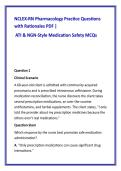
NCLEX-RN Pharmacology Practice Questions
with Rationales PDF |
ATI & NGN-Style Medication Safety MCQs
Question 1
Clinical Scenario
A 68-year-old client is admitted with community-acquired
pneumonia and is prescribed intravenous ceftriaxone. During
medication reconciliation, the nurse discovers the client takes
several prescription medications, an over-the-counter
antihistamine, and herbal supplements. The client states, "I only
told the provider about my prescription medicines because the
others aren't real medications."
Question Stem
Which response by the nurse best promotes safe medication
administration?
A. "Only prescription medications can cause significant drug
interactions."
,B. "Herbal supplements and over-the-counter medications
should also be reported because they may interact with
prescribed medications."
C. "You only need to report supplements if your provider
specifically asks."
D. "It is safe to continue all supplements while hospitalized."
Correct Answer
Correct Answer: B. Herbal supplements and over-the-counter
medications should also be reported because they may
interact with prescribed medications.
Detailed Rationale
Medication reconciliation is a critical patient safety process
performed whenever a patient is admitted, transferred, or
discharged. Prescription medications, over-the-counter (OTC)
drugs, vitamins, and herbal supplements all have the potential
to alter drug absorption, metabolism, distribution, or
elimination. For example, herbal products such as St. John's
wort may reduce the effectiveness of many medications by
inducing hepatic enzymes, while ginkgo biloba may increase
bleeding risk when combined with anticoagulants. Failure to
disclose these products can result in adverse drug events or
therapeutic failure.
, • Option B is correct because it emphasizes complete
medication reconciliation and patient education.
• Option A is incorrect because OTC and herbal products
may produce clinically significant interactions.
• Option C is incorrect because nurses should actively obtain
a complete medication history rather than waiting for
providers to ask.
• Option D is incorrect because many supplements should
be temporarily discontinued or evaluated during
hospitalization.
Nurses should encourage patients to maintain an updated
medication list and bring it to every healthcare visit.
Learning Objectives
After completing this question, the learner should be able to:
• Explain the purpose of medication reconciliation.
• Identify medications that should be included in a
medication history.
• Recognize the potential for OTC and herbal drug
interactions.
Medication Safety Focus
Medication Reconciliation
, Question 2
Clinical Scenario
A 74-year-old client with chronic kidney disease is prescribed a
medication that is primarily eliminated by the kidneys. The
nurse reviews laboratory results and notes a serum creatinine
level that is significantly elevated from baseline.
Question Stem
Which nursing action is the priority before administering the
medication?
A. Administer the medication with food.
B. Notify the provider because dosage adjustment may be
necessary.
C. Encourage increased oral fluid intake before administration.
D. Delay the medication until bedtime.
Correct Answer
Correct Answer: B. Notify the provider because dosage
adjustment may be necessary.
Detailed Rationale
Many medications are excreted through the kidneys. Reduced
renal function decreases drug clearance, allowing medications
with Rationales PDF |
ATI & NGN-Style Medication Safety MCQs
Question 1
Clinical Scenario
A 68-year-old client is admitted with community-acquired
pneumonia and is prescribed intravenous ceftriaxone. During
medication reconciliation, the nurse discovers the client takes
several prescription medications, an over-the-counter
antihistamine, and herbal supplements. The client states, "I only
told the provider about my prescription medicines because the
others aren't real medications."
Question Stem
Which response by the nurse best promotes safe medication
administration?
A. "Only prescription medications can cause significant drug
interactions."
,B. "Herbal supplements and over-the-counter medications
should also be reported because they may interact with
prescribed medications."
C. "You only need to report supplements if your provider
specifically asks."
D. "It is safe to continue all supplements while hospitalized."
Correct Answer
Correct Answer: B. Herbal supplements and over-the-counter
medications should also be reported because they may
interact with prescribed medications.
Detailed Rationale
Medication reconciliation is a critical patient safety process
performed whenever a patient is admitted, transferred, or
discharged. Prescription medications, over-the-counter (OTC)
drugs, vitamins, and herbal supplements all have the potential
to alter drug absorption, metabolism, distribution, or
elimination. For example, herbal products such as St. John's
wort may reduce the effectiveness of many medications by
inducing hepatic enzymes, while ginkgo biloba may increase
bleeding risk when combined with anticoagulants. Failure to
disclose these products can result in adverse drug events or
therapeutic failure.
, • Option B is correct because it emphasizes complete
medication reconciliation and patient education.
• Option A is incorrect because OTC and herbal products
may produce clinically significant interactions.
• Option C is incorrect because nurses should actively obtain
a complete medication history rather than waiting for
providers to ask.
• Option D is incorrect because many supplements should
be temporarily discontinued or evaluated during
hospitalization.
Nurses should encourage patients to maintain an updated
medication list and bring it to every healthcare visit.
Learning Objectives
After completing this question, the learner should be able to:
• Explain the purpose of medication reconciliation.
• Identify medications that should be included in a
medication history.
• Recognize the potential for OTC and herbal drug
interactions.
Medication Safety Focus
Medication Reconciliation
, Question 2
Clinical Scenario
A 74-year-old client with chronic kidney disease is prescribed a
medication that is primarily eliminated by the kidneys. The
nurse reviews laboratory results and notes a serum creatinine
level that is significantly elevated from baseline.
Question Stem
Which nursing action is the priority before administering the
medication?
A. Administer the medication with food.
B. Notify the provider because dosage adjustment may be
necessary.
C. Encourage increased oral fluid intake before administration.
D. Delay the medication until bedtime.
Correct Answer
Correct Answer: B. Notify the provider because dosage
adjustment may be necessary.
Detailed Rationale
Many medications are excreted through the kidneys. Reduced
renal function decreases drug clearance, allowing medications


