

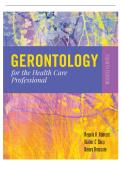
, TESTBANK FOR Gerontology for the Health Care Professional Fourth
Edition Robnett
Important Notes
The file includes the complete test bank, organized chapter by chapter.
A sample of selected pages has been provided for preview.
All available appendices and Excel files (if included in the original resources) are
provided.
Quizzes, Midterm and final exams are included (if available in the original resources).
We continuously update our files to ensure you receive the latest and most accurate
editions.
New editions are added regularly – stay connected for updates!
⚠️Note on Answer Keys: If the answer key is not included within the chapter
questions, you will find the complete answers and solutions at the end of each
chapter.
✅ Why Buy From Us?
📚 Complete & organized chapter-by-chapter – no missing content, no guessing.
⚡ Instant digital delivery – get your file the moment you pay, no waiting.
📅 Always up to date – we track new editions so you always get the latest version.
💬 Friendly support – real humans ready to help, anytime you need us.
🔒 Safe & secure – thousands of satisfied students trust us every semester.
🛡️Our Guarantees
💰 Money-Back Guarantee: Not satisfied? We offer a full refund – no questions asked.
🔄 Wrong File? No Problem: Contact us and we will replace it immediately with the
correct version, free of charge.
⏰ 24/7 Support: We are always here – reach out anytime and expect a fast response.
,Multiple Choice
1. The economic status of older people:
A. is extremely varied.
B. is dire across the board.
C. has declined significantly over the past 50 years.
D. has risen significantly over the past decade.
Answer: A
Complexity: Easy
Ahead: Economic Status
Subject: Chapter 01
Title: Age Matters: Profiles of an Aging Society
2. The most common chronic condition among non-institutionalized older people in the USA is:
A. diabetes.
B. cancer.
C. hypertension (uncontrolled).
D. arthritis.
Answer: C
Complexity: Easy
Ahead: Health Status
Subject: Chapter 01
Title: Age Matters: Profiles of an Aging Society
3. Older adults who become long-term residents of nursing homes will, on average, spend all of
their savings and assets within:
A. 1 month.
B. 1 year.
C. 3 years.
D. a decade.
Answer: B
Complexity: Easy
Ahead: Caregivers
Subject: Chapter 01
Title: Age Matters: Profiles of an Aging Society
,4. Which country had the oldest population in 2017?
A. United States
B. Japan
C. China
D. Germany
Answer: B
Complexity: Easy
Ahead: Global Aging
Subject: Chapter 01
Title: Age Matters: Profiles of an Aging Society
5. The major source of income for majority of older adults is:
A. private pensions.
B. Social Security.
C. earnings.
D. dividends from stocks and bonds.
Answer: B
Complexity: Easy
Ahead: Economic Status
Subject: Chapter 01
Title: Age Matters: Profiles of an Aging Society
6. The level at which a person can perform is considered his or her _____ age.
A. chronological
B. social
C. numerical
D. functional
Answer: D
Complexity: Easy
Ahead: Introduction
Subject: Chapter 01
Title: Age Matters: Profiles of an Aging Society
7. A person who is 68 years old would fall into which age grouping?
A. Old
B. Young-old
,C. Old-old
D. Centenarian
Answer: A
Complexity: Moderate
Ahead: Introduction
Subject: Chapter 01
Title: Age Matters: Profiles of an Aging Society
8. What is the median age of the entire world population?
A. 22 years
B. 30 years
C. 46 years
D. 51 years
Answer: B
Complexity: Easy
Ahead: Global Aging
Subject: Chapter 01
Title: Age Matters: Profiles of an Aging Society
9. Which of these people from the United States is considered to be a member of the baby boom
generation?
A. Charlie, who was born in 1932
B. April, who was born in 1941
C. Steven, who was born in 1952
D. Kelly, who was born in 1968
Answer: C
Complexity: Moderate
Ahead: Global Aging
Subject: Chapter 01
Title: Age Matters: Profiles of an Aging Society
10. About _____ of persons in the United States who are infected with HIV are older than age
50.
A. 20%
B. 35%
C. 40%
D. 50%
,Answer: D
Complexity: Easy
Ahead: Global Aging
Subject: Chapter 01
Title: Age Matters: Profiles of an Aging Society
11. Mass migration during times of war and political unrest can have a significant economic and
social impact on:
A. the departure country only.
B. the arrival country only.
C. both the departure and arrival countries.
D. neither the departure country nor the arrival country.
Answer: C
Complexity: Moderate
Ahead: Global Aging
Subject: Chapter 01
Title: Age Matters: Profiles of an Aging Society
12. According to the 2016 U.S. Census, which state had the oldest population?
A. Maine
B. Florida
C. Utah
D. Texas
Answer: A
Complexity: Easy
Ahead: Aging in the United States
Subject: Chapter 01
Title: Age Matters: Profiles of an Aging Society
13. One common reason that older adults migrate to new regions of the country is to:
A. pursue a new job opportunity.
B. live in a cooler, moister climate.
C. distance themselves from relatives.
D. live in a community with a lower cost of living.
Answer: D
Complexity: Easy
,Ahead: Aging in the United States
Subject: Chapter 01
Title: Age Matters: Profiles of an Aging Society
14. A snowbird is someone who:
A. migrates south only for the winter.
B. moves south permanently.
C. migrates north only for the winter.
D. moves north permanently.
Answer: A
Complexity: Easy
Ahead: Aging in the United States
Subject: Chapter 01
Title: Age Matters: Profiles of an Aging Society
15. Using the federal poverty level as an income baseline, middle income adults have an income
that is:
A. 50–75% below the poverty level.
B. 100–199% above the poverty level.
C. 200–399% above the poverty level.
D. at least 400% above the poverty level.
Answer: C
Complexity: Moderate
Ahead: Economic Status
Subject: Chapter 01
Title: Age Matters: Profiles of an Aging Society
16. The term _____ refers to the total number of cases of a chronic health condition or
communicable disease reported.
A. incidence
B. prevalence
C. longevity
D. lifespan
Answer: B
Complexity: Easy
Ahead: Health Status
Subject: Chapter 01
,Title: Age Matters: Profiles of an Aging Society
17. Which group of people experienced the highest percentage of cases of hypertension in 2014?
A. Blacks
B. Hispanics
C. Whites
D. Asians
Answer: A
Complexity: Moderate
Ahead: Health Status
Subject: Chapter 01
Title: Age Matters: Profiles of an Aging Society
18. Which type of functional limitation had the highest prevalence rate for both sexes and all
races in 2014?
A. Cognition
B. Vision
C. Mobility
D. Hearing
Answer: C
Complexity: Easy
Ahead: Health Status
Subject: Chapter 01
Title: Age Matters: Profiles of an Aging Society
19. Historically, _____ men and women have been least likely to receive an influenza
inoculation.
A. white
B. Asian
C. Hispanic
D. black
Answer: D
Complexity: Easy
Ahead: Health Status
Subject: Chapter 01
Title: Age Matters: Profiles of an Aging Society
,20. Why do older adults frequently rate their health as better than the people around them?
A. They feel that they do not have any significant health problems.
B. They are self-conscious and do not want to be viewed as weak.
C. They tend to compare their functional abilities with those of other people their age.
D. They feel healthier at their advanced age than they were when they were younger.
Answer: C
Complexity: Moderate
Ahead: Health Status
Subject: Chapter 01
Title: Age Matters: Profiles of an Aging Society
21. Which of the following is an example of an instrumental activity of daily living?
A. Housework
B. Eating
C. Bathing
D. Toileting
Answer: A
Complexity: Moderate
Ahead: Health Status
Subject: Chapter 01
Title: Age Matters: Profiles of an Aging Society
22. In the majority of cases, informal caregivers tend to be:
A. females caring for a female relative.
B. females caring for a male relative.
C. males caring for a female relative.
D. males caring for a male relative.
Answer: A
Complexity: Moderate
Ahead: Caregivers
Subject: Chapter 01
Title: Age Matters: Profiles of an Aging Society
23. Informal caregivers for persons with dementia provide, on average, _____ hours of service
per day of care.
, A. 4
B. 6
C. 9
D. 12
Answer: C
Complexity: Easy
Ahead: Caregivers
Subject: Chapter 01
Title: Age Matters: Profiles of an Aging Society
24. What was the leading cause of death among U.S. adults aged 65 years or older in 2014?
A. Cancer
B. Stroke
C. Unintentional injury
D. Heart disease
Answer: D
Complexity: Easy
Ahead: Death
Subject: Chapter 01
Title: Age Matters: Profiles of an Aging Society
25. Which is a component of hedonic well-being?
A. Life satisfaction
B. Sense of purpose
C. Stress level
D. Life meaning
Answer: C
Complexity: Moderate
Ahead: Aging Successfully
Subject: Chapter 01
Title: Age Matters: Profiles of an Aging Society
Edition Robnett
Important Notes
The file includes the complete test bank, organized chapter by chapter.
A sample of selected pages has been provided for preview.
All available appendices and Excel files (if included in the original resources) are
provided.
Quizzes, Midterm and final exams are included (if available in the original resources).
We continuously update our files to ensure you receive the latest and most accurate
editions.
New editions are added regularly – stay connected for updates!
⚠️Note on Answer Keys: If the answer key is not included within the chapter
questions, you will find the complete answers and solutions at the end of each
chapter.
✅ Why Buy From Us?
📚 Complete & organized chapter-by-chapter – no missing content, no guessing.
⚡ Instant digital delivery – get your file the moment you pay, no waiting.
📅 Always up to date – we track new editions so you always get the latest version.
💬 Friendly support – real humans ready to help, anytime you need us.
🔒 Safe & secure – thousands of satisfied students trust us every semester.
🛡️Our Guarantees
💰 Money-Back Guarantee: Not satisfied? We offer a full refund – no questions asked.
🔄 Wrong File? No Problem: Contact us and we will replace it immediately with the
correct version, free of charge.
⏰ 24/7 Support: We are always here – reach out anytime and expect a fast response.
,Multiple Choice
1. The economic status of older people:
A. is extremely varied.
B. is dire across the board.
C. has declined significantly over the past 50 years.
D. has risen significantly over the past decade.
Answer: A
Complexity: Easy
Ahead: Economic Status
Subject: Chapter 01
Title: Age Matters: Profiles of an Aging Society
2. The most common chronic condition among non-institutionalized older people in the USA is:
A. diabetes.
B. cancer.
C. hypertension (uncontrolled).
D. arthritis.
Answer: C
Complexity: Easy
Ahead: Health Status
Subject: Chapter 01
Title: Age Matters: Profiles of an Aging Society
3. Older adults who become long-term residents of nursing homes will, on average, spend all of
their savings and assets within:
A. 1 month.
B. 1 year.
C. 3 years.
D. a decade.
Answer: B
Complexity: Easy
Ahead: Caregivers
Subject: Chapter 01
Title: Age Matters: Profiles of an Aging Society
,4. Which country had the oldest population in 2017?
A. United States
B. Japan
C. China
D. Germany
Answer: B
Complexity: Easy
Ahead: Global Aging
Subject: Chapter 01
Title: Age Matters: Profiles of an Aging Society
5. The major source of income for majority of older adults is:
A. private pensions.
B. Social Security.
C. earnings.
D. dividends from stocks and bonds.
Answer: B
Complexity: Easy
Ahead: Economic Status
Subject: Chapter 01
Title: Age Matters: Profiles of an Aging Society
6. The level at which a person can perform is considered his or her _____ age.
A. chronological
B. social
C. numerical
D. functional
Answer: D
Complexity: Easy
Ahead: Introduction
Subject: Chapter 01
Title: Age Matters: Profiles of an Aging Society
7. A person who is 68 years old would fall into which age grouping?
A. Old
B. Young-old
,C. Old-old
D. Centenarian
Answer: A
Complexity: Moderate
Ahead: Introduction
Subject: Chapter 01
Title: Age Matters: Profiles of an Aging Society
8. What is the median age of the entire world population?
A. 22 years
B. 30 years
C. 46 years
D. 51 years
Answer: B
Complexity: Easy
Ahead: Global Aging
Subject: Chapter 01
Title: Age Matters: Profiles of an Aging Society
9. Which of these people from the United States is considered to be a member of the baby boom
generation?
A. Charlie, who was born in 1932
B. April, who was born in 1941
C. Steven, who was born in 1952
D. Kelly, who was born in 1968
Answer: C
Complexity: Moderate
Ahead: Global Aging
Subject: Chapter 01
Title: Age Matters: Profiles of an Aging Society
10. About _____ of persons in the United States who are infected with HIV are older than age
50.
A. 20%
B. 35%
C. 40%
D. 50%
,Answer: D
Complexity: Easy
Ahead: Global Aging
Subject: Chapter 01
Title: Age Matters: Profiles of an Aging Society
11. Mass migration during times of war and political unrest can have a significant economic and
social impact on:
A. the departure country only.
B. the arrival country only.
C. both the departure and arrival countries.
D. neither the departure country nor the arrival country.
Answer: C
Complexity: Moderate
Ahead: Global Aging
Subject: Chapter 01
Title: Age Matters: Profiles of an Aging Society
12. According to the 2016 U.S. Census, which state had the oldest population?
A. Maine
B. Florida
C. Utah
D. Texas
Answer: A
Complexity: Easy
Ahead: Aging in the United States
Subject: Chapter 01
Title: Age Matters: Profiles of an Aging Society
13. One common reason that older adults migrate to new regions of the country is to:
A. pursue a new job opportunity.
B. live in a cooler, moister climate.
C. distance themselves from relatives.
D. live in a community with a lower cost of living.
Answer: D
Complexity: Easy
,Ahead: Aging in the United States
Subject: Chapter 01
Title: Age Matters: Profiles of an Aging Society
14. A snowbird is someone who:
A. migrates south only for the winter.
B. moves south permanently.
C. migrates north only for the winter.
D. moves north permanently.
Answer: A
Complexity: Easy
Ahead: Aging in the United States
Subject: Chapter 01
Title: Age Matters: Profiles of an Aging Society
15. Using the federal poverty level as an income baseline, middle income adults have an income
that is:
A. 50–75% below the poverty level.
B. 100–199% above the poverty level.
C. 200–399% above the poverty level.
D. at least 400% above the poverty level.
Answer: C
Complexity: Moderate
Ahead: Economic Status
Subject: Chapter 01
Title: Age Matters: Profiles of an Aging Society
16. The term _____ refers to the total number of cases of a chronic health condition or
communicable disease reported.
A. incidence
B. prevalence
C. longevity
D. lifespan
Answer: B
Complexity: Easy
Ahead: Health Status
Subject: Chapter 01
,Title: Age Matters: Profiles of an Aging Society
17. Which group of people experienced the highest percentage of cases of hypertension in 2014?
A. Blacks
B. Hispanics
C. Whites
D. Asians
Answer: A
Complexity: Moderate
Ahead: Health Status
Subject: Chapter 01
Title: Age Matters: Profiles of an Aging Society
18. Which type of functional limitation had the highest prevalence rate for both sexes and all
races in 2014?
A. Cognition
B. Vision
C. Mobility
D. Hearing
Answer: C
Complexity: Easy
Ahead: Health Status
Subject: Chapter 01
Title: Age Matters: Profiles of an Aging Society
19. Historically, _____ men and women have been least likely to receive an influenza
inoculation.
A. white
B. Asian
C. Hispanic
D. black
Answer: D
Complexity: Easy
Ahead: Health Status
Subject: Chapter 01
Title: Age Matters: Profiles of an Aging Society
,20. Why do older adults frequently rate their health as better than the people around them?
A. They feel that they do not have any significant health problems.
B. They are self-conscious and do not want to be viewed as weak.
C. They tend to compare their functional abilities with those of other people their age.
D. They feel healthier at their advanced age than they were when they were younger.
Answer: C
Complexity: Moderate
Ahead: Health Status
Subject: Chapter 01
Title: Age Matters: Profiles of an Aging Society
21. Which of the following is an example of an instrumental activity of daily living?
A. Housework
B. Eating
C. Bathing
D. Toileting
Answer: A
Complexity: Moderate
Ahead: Health Status
Subject: Chapter 01
Title: Age Matters: Profiles of an Aging Society
22. In the majority of cases, informal caregivers tend to be:
A. females caring for a female relative.
B. females caring for a male relative.
C. males caring for a female relative.
D. males caring for a male relative.
Answer: A
Complexity: Moderate
Ahead: Caregivers
Subject: Chapter 01
Title: Age Matters: Profiles of an Aging Society
23. Informal caregivers for persons with dementia provide, on average, _____ hours of service
per day of care.
, A. 4
B. 6
C. 9
D. 12
Answer: C
Complexity: Easy
Ahead: Caregivers
Subject: Chapter 01
Title: Age Matters: Profiles of an Aging Society
24. What was the leading cause of death among U.S. adults aged 65 years or older in 2014?
A. Cancer
B. Stroke
C. Unintentional injury
D. Heart disease
Answer: D
Complexity: Easy
Ahead: Death
Subject: Chapter 01
Title: Age Matters: Profiles of an Aging Society
25. Which is a component of hedonic well-being?
A. Life satisfaction
B. Sense of purpose
C. Stress level
D. Life meaning
Answer: C
Complexity: Moderate
Ahead: Aging Successfully
Subject: Chapter 01
Title: Age Matters: Profiles of an Aging Society


