

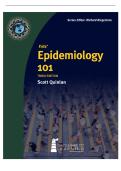
, TESTBANK FOR Friis' Epidemiology 101, Third Edition Third Edition
Quinlan
Important Notes
The file includes the complete test bank, organized chapter by chapter.
A sample of selected pages has been provided for preview.
All available appendices and Excel files (if included in the original resources) are
provided.
Quizzes, Midterm and final exams are included (if available in the original resources).
We continuously update our files to ensure you receive the latest and most accurate
editions.
New editions are added regularly – stay connected for updates!
⚠️Note on Answer Keys: If the answer key is not included within the chapter
questions, you will find the complete answers and solutions at the end of each
chapter.
✅ Why Buy From Us?
📚 Complete & organized chapter-by-chapter – no missing content, no guessing.
⚡ Instant digital delivery – get your file the moment you pay, no waiting.
📅 Always up to date – we track new editions so you always get the latest version.
💬 Friendly support – real humans ready to help, anytime you need us.
🔒 Safe & secure – thousands of satisfied students trust us every semester.
🛡️Our Guarantees
💰 Money-Back Guarantee: Not satisfied? We offer a full refund – no questions asked.
🔄 Wrong File? No Problem: Contact us and we will replace it immediately with the
correct version, free of charge.
⏰ 24/7 Support: We are always here – reach out anytime and expect a fast response.
,Import Settings:
Base Settings: Brownstone Default
Information Field: Complexity
Information Field: Ahead
Information Field: Subject
Highest Answer Letter: D
Multiple Keywords in Same Paragraph: No
NAS ISBN13: 9781284296310, add to Ahead, Title tags
Chapter: Chapter 01 – Quiz
Multiple Choice
1. Epidemiologic methods can be applied to which of the following public health–related fields?
A) Health education
B) Healthcare administration
C) Environmental health
D) All of these are correct.
Ans: D
Complexity: Easy
Ahead: The Concept of an Epidemic
Subject: Chapter 1
Title: History, Philosophy, and Uses of Epidemiology
2. Which of the following is not considered a use of epidemiology?
A) To study the workings of health services in the community
B) To diagnose the dimensions and distributions of disease within a community
C) To provide healthcare services to specific individuals
D) To search for causes of disease and other health outcomes
Ans: C
Complexity: Moderate
Ahead: Brief Overview of Current Uses of Epidemiology
Subject: Chapter 1
Title: History, Philosophy, and Uses of Epidemiology
3. Whether a contaminated food such as tomatoes caused an outbreak of gastrointestinal disease is a
simple example of:
A) a causal association.
B) the 1918 influenza pandemic.
C) a population.
D) All of these are correct.
Ans: A
Complexity: Moderate
Ahead: The Concept of an Epidemic
Subject: Chapter 1
Title: History, Philosophy, and Uses of Epidemiology
,4. Which of the following is considered a key characteristic of epidemiology?
A) Distribution
B) Population focus
C) Quantification
D) All of these are correct.
Ans: D
Complexity: Moderate
Ahead: Definition of Epidemiology
Subject: Chapter 1
Title: History, Philosophy, and Uses of Epidemiology
5. Variation in the occurrence of diseases and other health outcomes in populations relates most closely
to:
A) population focus.
B) distribution.
C) quantification.
D) None of these is correct.
Ans: B
Complexity: Easy
Ahead: Definition of Epidemiology
Subject: Chapter 1
Title: History, Philosophy, and Uses of Epidemiology
6. The key difference between descriptive and analytic epidemiology is:
A) descriptive epidemiology is observational while analytic is experimental.
B) descriptive epidemiology develops hypotheses while analytic epidemiology examines them.
C) descriptive epidemiology focuses on populations while analytic epidemiology focuses on individuals.
D) None of these is correct.
Ans: B
Complexity: Moderate
Ahead: Application of Descriptive and Analytic Methods to an Observational Science
Subject: Chapter 1
Title: History, Philosophy, and Uses of Epidemiology
True/False
1. True or False? Alexander Fleming discovered the antimicrobial properties of Penicillium notatum.
Ans: True
Complexity: Easy
Ahead: History of Epidemiology and Development of Epidemiologic Principles
Subject: Chapter 1
Title: History, Philosophy, and Uses of Epidemiology
,2. True or False? Epidemiology is an observational science that capitalizes on naturally occurring
situations.
Ans: True
Complexity: Easy
Ahead: Application of Descriptive and Analytic Methods to an Observational Science
Subject: Chapter 1
Title: History, Philosophy, and Uses of Epidemiology
3. True or False? John Graunt is said to be the first to employ quantitative methods to describe population
vital statistics.
Ans: True
Complexity: Moderate
Ahead: History of Epidemiology and Development of Epidemiologic Principles
Subject: Chapter 1
Title: History, Philosophy, and Uses of Epidemiology
4. True or False? The history of epidemiology begins with John Snow in the 1800s.
Ans: False
Complexity: Easy
Ahead: History of Epidemiology and Development of Epidemiologic Principles
Subject: Chapter 1
Title: History, Philosophy, and Uses of Epidemiology
5. True or False? Determinants are factors that are related to a health condition or outcome.
Ans: True
Complexity: Moderate
Ahead: Definition of Epidemiology
Subject: Chapter 1
Title: History, Philosophy, and Uses of Epidemiology
6. True or False? Alice Hamilton was the first woman hired to the faculty of the Harvard Medical School.
Ans: True
Complexity: Moderate
Ahead: History of Epidemiology and Development of Epidemiologic Principles
Subject: Chapter 1
Title: History, Philosophy, and Uses of Epidemiology
,Import Settings:
Base Settings: Brownstone Default
Information Field: Complexity
Information Field: Ahead
Information Field: Subject
Highest Answer Letter: D
Multiple Keywords in Same Paragraph: No
NAS ISBN13: 9781284296310, add to Ahead, Title tags
Chapter: Chapter 2 – Quiz
Multiple Choice
1. Highest education level completed is an example of:
A) quantitative data.
B) qualitative data.
C) continuous data.
D) dichotomous data.
Ans: B
Complexity: Difficult
Ahead: Variables, Data, and Measurement Scales
Subject: Chapter 2
Title: Epidemiology and Data Presentation
2. Systolic blood pressure is an example of:
A) quantitative data.
B) qualitative data.
C) nominal data.
D) dichotomous data.
Ans: A
Complexity: Difficult
Ahead: Variables, Data, and Measurement Scales
Subject: Chapter 2
Title: Epidemiology and Data Presentation
3. Which of these is appropriate to display qualitative data?
A) Box chart
B) Line graph
C) Histogram
D) Bar chart
Ans: D
Complexity: Moderate
Ahead: Graphical Presentation
Subject: Chapter 2
Title: Epidemiology and Data Presentation
,4. The mode is defined as:
A) the difference between the highest and lowest value.
B) the middle value.
C) the most common value.
D) None of these is correct.
Ans: C
Complexity: Moderate
Ahead: Measures of Central Tendency
Subject: Chapter 2
Title: Epidemiology and Data Presentation
5. Identify the correct statement.
A) An r of −1 is weaker association than an r of +1.
B) An r of +1 is a perfect direct linear association.
C) An association between X and Y is always causal.
D) A scatter plot cannot demonstrate an XY association.
Ans: B
Complexity: Difficult
Ahead: Analyses of Bivariate Association
Subject: Chapter 2
Title: Epidemiology and Data Presentation
6. According to the contingency table, what is the letter of the cell that shows that the exposure is absent
and disease is absent?
Contingency Table
Disease Status
Exposure Status Yes No Total
Yes A B A+B
No C D C+D
Total A+C B+D A+B+C+D
A) A
B) B
C) C
D) D
Ans: D
Complexity: Difficult
Ahead: Analyses of Bivariate Association
Subject: Chapter 2
Title: Epidemiology and Data Presentation
,7. According to the contingency table, what is the letter of the cell that shows that the exposure is present
and disease is absent?
Contingency Table
Disease Status
Exposure Status Yes No Total
Yes A B A+B
No C D C+D
Total A+C B+D A+B+C+D
A) A
B) B
C) C
D) D
Ans: B
Complexity: Difficult
Ahead: Analyses of Bivariate Association
Subject: Chapter 2
Title: Epidemiology and Data Presentation
True/False
1. True or False? Examples of continuous variables are height and weight.
Ans: True
Complexity: Easy
Ahead: Data and Measurement Scales
Subject: Chapter 2
Title: Epidemiology and Data Presentation
2. True or False? The closer the points lie on a scatter plot, with respect to the straight line of best fit
through them, the stronger the association between the variables.
Ans: True
Complexity: Moderate
Ahead: Analyses of Bivariate Association
Subject: Chapter 2
Title: Epidemiology and Data Presentation
3. True or False? Contingency tables tabulate data according to two dimensions.
Ans: True
Complexity: Moderate
Ahead: Analyses of Bivariate Association
Subject: Chapter 2
Title: Epidemiology and Data Presentation
,4. True or False? A multimodal curve is one that has several peaks in the frequency of a condition.
Ans: True
Complexity: Moderate
Ahead: Distribution Curves
Subject: Chapter 2
Title: Epidemiology and Data Presentation
5. True or False? A single value chosen to represent the population parameter is called a point estimate.
Ans: True
Complexity: Moderate
Ahead: Parameter Estimation
Subject: Chapter 2
Title: Epidemiology and Data Presentation
, Import Settings:
Base Settings: Brownstone Default
Information Field: Complexity
Information Field: Ahead
Information Field: Subject
Highest Answer Letter: D
Multiple Keywords in Same Paragraph: No
NAS ISBN13: 9781284296310, add to Ahead, Title tags
Chapter: Chapter 03 – Quiz
Multiple Choice
1. All of the following are considered ratios except:
A) proportion.
B) time.
C) rate.
D) percentage.
Ans: B
Complexity: Moderate
Ahead: Mathematical Terms Used in Epidemiology
Subject: Chapter 3
Title: Epidemiologic Measurements Used to Describe Disease Occurrence
2. Epidemiologic measures provide the following type of information:
A) frequency of disease or condition.
B) association between exposure and disease.
C) strength of relationship between exposure and disease.
D) All of these are correct.
Ans: D
Complexity: Moderate
Ahead: Types of Epidemiologic Measures
Subject: Chapter 3
Title: Epidemiologic Measurements Used to Describe Disease Occurrence
3. Those members of the population who are capable of developing a disease or condition are known as:
A) incident cases.
B) prevalent cases.
C) population at risk.
D) the immune fraction.
Ans: C
Complexity: Moderate
Ahead: General Information Regarding Epidemiologic Measures
Subject: Chapter 3
Title: Epidemiologic Measurements Used to Describe Disease Occurrence
Quinlan
Important Notes
The file includes the complete test bank, organized chapter by chapter.
A sample of selected pages has been provided for preview.
All available appendices and Excel files (if included in the original resources) are
provided.
Quizzes, Midterm and final exams are included (if available in the original resources).
We continuously update our files to ensure you receive the latest and most accurate
editions.
New editions are added regularly – stay connected for updates!
⚠️Note on Answer Keys: If the answer key is not included within the chapter
questions, you will find the complete answers and solutions at the end of each
chapter.
✅ Why Buy From Us?
📚 Complete & organized chapter-by-chapter – no missing content, no guessing.
⚡ Instant digital delivery – get your file the moment you pay, no waiting.
📅 Always up to date – we track new editions so you always get the latest version.
💬 Friendly support – real humans ready to help, anytime you need us.
🔒 Safe & secure – thousands of satisfied students trust us every semester.
🛡️Our Guarantees
💰 Money-Back Guarantee: Not satisfied? We offer a full refund – no questions asked.
🔄 Wrong File? No Problem: Contact us and we will replace it immediately with the
correct version, free of charge.
⏰ 24/7 Support: We are always here – reach out anytime and expect a fast response.
,Import Settings:
Base Settings: Brownstone Default
Information Field: Complexity
Information Field: Ahead
Information Field: Subject
Highest Answer Letter: D
Multiple Keywords in Same Paragraph: No
NAS ISBN13: 9781284296310, add to Ahead, Title tags
Chapter: Chapter 01 – Quiz
Multiple Choice
1. Epidemiologic methods can be applied to which of the following public health–related fields?
A) Health education
B) Healthcare administration
C) Environmental health
D) All of these are correct.
Ans: D
Complexity: Easy
Ahead: The Concept of an Epidemic
Subject: Chapter 1
Title: History, Philosophy, and Uses of Epidemiology
2. Which of the following is not considered a use of epidemiology?
A) To study the workings of health services in the community
B) To diagnose the dimensions and distributions of disease within a community
C) To provide healthcare services to specific individuals
D) To search for causes of disease and other health outcomes
Ans: C
Complexity: Moderate
Ahead: Brief Overview of Current Uses of Epidemiology
Subject: Chapter 1
Title: History, Philosophy, and Uses of Epidemiology
3. Whether a contaminated food such as tomatoes caused an outbreak of gastrointestinal disease is a
simple example of:
A) a causal association.
B) the 1918 influenza pandemic.
C) a population.
D) All of these are correct.
Ans: A
Complexity: Moderate
Ahead: The Concept of an Epidemic
Subject: Chapter 1
Title: History, Philosophy, and Uses of Epidemiology
,4. Which of the following is considered a key characteristic of epidemiology?
A) Distribution
B) Population focus
C) Quantification
D) All of these are correct.
Ans: D
Complexity: Moderate
Ahead: Definition of Epidemiology
Subject: Chapter 1
Title: History, Philosophy, and Uses of Epidemiology
5. Variation in the occurrence of diseases and other health outcomes in populations relates most closely
to:
A) population focus.
B) distribution.
C) quantification.
D) None of these is correct.
Ans: B
Complexity: Easy
Ahead: Definition of Epidemiology
Subject: Chapter 1
Title: History, Philosophy, and Uses of Epidemiology
6. The key difference between descriptive and analytic epidemiology is:
A) descriptive epidemiology is observational while analytic is experimental.
B) descriptive epidemiology develops hypotheses while analytic epidemiology examines them.
C) descriptive epidemiology focuses on populations while analytic epidemiology focuses on individuals.
D) None of these is correct.
Ans: B
Complexity: Moderate
Ahead: Application of Descriptive and Analytic Methods to an Observational Science
Subject: Chapter 1
Title: History, Philosophy, and Uses of Epidemiology
True/False
1. True or False? Alexander Fleming discovered the antimicrobial properties of Penicillium notatum.
Ans: True
Complexity: Easy
Ahead: History of Epidemiology and Development of Epidemiologic Principles
Subject: Chapter 1
Title: History, Philosophy, and Uses of Epidemiology
,2. True or False? Epidemiology is an observational science that capitalizes on naturally occurring
situations.
Ans: True
Complexity: Easy
Ahead: Application of Descriptive and Analytic Methods to an Observational Science
Subject: Chapter 1
Title: History, Philosophy, and Uses of Epidemiology
3. True or False? John Graunt is said to be the first to employ quantitative methods to describe population
vital statistics.
Ans: True
Complexity: Moderate
Ahead: History of Epidemiology and Development of Epidemiologic Principles
Subject: Chapter 1
Title: History, Philosophy, and Uses of Epidemiology
4. True or False? The history of epidemiology begins with John Snow in the 1800s.
Ans: False
Complexity: Easy
Ahead: History of Epidemiology and Development of Epidemiologic Principles
Subject: Chapter 1
Title: History, Philosophy, and Uses of Epidemiology
5. True or False? Determinants are factors that are related to a health condition or outcome.
Ans: True
Complexity: Moderate
Ahead: Definition of Epidemiology
Subject: Chapter 1
Title: History, Philosophy, and Uses of Epidemiology
6. True or False? Alice Hamilton was the first woman hired to the faculty of the Harvard Medical School.
Ans: True
Complexity: Moderate
Ahead: History of Epidemiology and Development of Epidemiologic Principles
Subject: Chapter 1
Title: History, Philosophy, and Uses of Epidemiology
,Import Settings:
Base Settings: Brownstone Default
Information Field: Complexity
Information Field: Ahead
Information Field: Subject
Highest Answer Letter: D
Multiple Keywords in Same Paragraph: No
NAS ISBN13: 9781284296310, add to Ahead, Title tags
Chapter: Chapter 2 – Quiz
Multiple Choice
1. Highest education level completed is an example of:
A) quantitative data.
B) qualitative data.
C) continuous data.
D) dichotomous data.
Ans: B
Complexity: Difficult
Ahead: Variables, Data, and Measurement Scales
Subject: Chapter 2
Title: Epidemiology and Data Presentation
2. Systolic blood pressure is an example of:
A) quantitative data.
B) qualitative data.
C) nominal data.
D) dichotomous data.
Ans: A
Complexity: Difficult
Ahead: Variables, Data, and Measurement Scales
Subject: Chapter 2
Title: Epidemiology and Data Presentation
3. Which of these is appropriate to display qualitative data?
A) Box chart
B) Line graph
C) Histogram
D) Bar chart
Ans: D
Complexity: Moderate
Ahead: Graphical Presentation
Subject: Chapter 2
Title: Epidemiology and Data Presentation
,4. The mode is defined as:
A) the difference between the highest and lowest value.
B) the middle value.
C) the most common value.
D) None of these is correct.
Ans: C
Complexity: Moderate
Ahead: Measures of Central Tendency
Subject: Chapter 2
Title: Epidemiology and Data Presentation
5. Identify the correct statement.
A) An r of −1 is weaker association than an r of +1.
B) An r of +1 is a perfect direct linear association.
C) An association between X and Y is always causal.
D) A scatter plot cannot demonstrate an XY association.
Ans: B
Complexity: Difficult
Ahead: Analyses of Bivariate Association
Subject: Chapter 2
Title: Epidemiology and Data Presentation
6. According to the contingency table, what is the letter of the cell that shows that the exposure is absent
and disease is absent?
Contingency Table
Disease Status
Exposure Status Yes No Total
Yes A B A+B
No C D C+D
Total A+C B+D A+B+C+D
A) A
B) B
C) C
D) D
Ans: D
Complexity: Difficult
Ahead: Analyses of Bivariate Association
Subject: Chapter 2
Title: Epidemiology and Data Presentation
,7. According to the contingency table, what is the letter of the cell that shows that the exposure is present
and disease is absent?
Contingency Table
Disease Status
Exposure Status Yes No Total
Yes A B A+B
No C D C+D
Total A+C B+D A+B+C+D
A) A
B) B
C) C
D) D
Ans: B
Complexity: Difficult
Ahead: Analyses of Bivariate Association
Subject: Chapter 2
Title: Epidemiology and Data Presentation
True/False
1. True or False? Examples of continuous variables are height and weight.
Ans: True
Complexity: Easy
Ahead: Data and Measurement Scales
Subject: Chapter 2
Title: Epidemiology and Data Presentation
2. True or False? The closer the points lie on a scatter plot, with respect to the straight line of best fit
through them, the stronger the association between the variables.
Ans: True
Complexity: Moderate
Ahead: Analyses of Bivariate Association
Subject: Chapter 2
Title: Epidemiology and Data Presentation
3. True or False? Contingency tables tabulate data according to two dimensions.
Ans: True
Complexity: Moderate
Ahead: Analyses of Bivariate Association
Subject: Chapter 2
Title: Epidemiology and Data Presentation
,4. True or False? A multimodal curve is one that has several peaks in the frequency of a condition.
Ans: True
Complexity: Moderate
Ahead: Distribution Curves
Subject: Chapter 2
Title: Epidemiology and Data Presentation
5. True or False? A single value chosen to represent the population parameter is called a point estimate.
Ans: True
Complexity: Moderate
Ahead: Parameter Estimation
Subject: Chapter 2
Title: Epidemiology and Data Presentation
, Import Settings:
Base Settings: Brownstone Default
Information Field: Complexity
Information Field: Ahead
Information Field: Subject
Highest Answer Letter: D
Multiple Keywords in Same Paragraph: No
NAS ISBN13: 9781284296310, add to Ahead, Title tags
Chapter: Chapter 03 – Quiz
Multiple Choice
1. All of the following are considered ratios except:
A) proportion.
B) time.
C) rate.
D) percentage.
Ans: B
Complexity: Moderate
Ahead: Mathematical Terms Used in Epidemiology
Subject: Chapter 3
Title: Epidemiologic Measurements Used to Describe Disease Occurrence
2. Epidemiologic measures provide the following type of information:
A) frequency of disease or condition.
B) association between exposure and disease.
C) strength of relationship between exposure and disease.
D) All of these are correct.
Ans: D
Complexity: Moderate
Ahead: Types of Epidemiologic Measures
Subject: Chapter 3
Title: Epidemiologic Measurements Used to Describe Disease Occurrence
3. Those members of the population who are capable of developing a disease or condition are known as:
A) incident cases.
B) prevalent cases.
C) population at risk.
D) the immune fraction.
Ans: C
Complexity: Moderate
Ahead: General Information Regarding Epidemiologic Measures
Subject: Chapter 3
Title: Epidemiologic Measurements Used to Describe Disease Occurrence


