

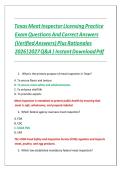
Texas Meat Inspector Licensing Practice
b b b b
Exam Questions And Correct Answers
b b b b b
(Verified Answers) Plus Rationales
b b b b
2026|2027 Q&A | Instant Download Pdf
b b b b b b
1. What is the primary purpose of meat inspection in Texas?
b b b b b b b b b b
A. To ensure flavor and texture
b b b b
B. To ensure meat safety and wholesomeness
b b b b b
C. To enhance shelf life
b b b
D. To promote exports
b b
Meat inspection is mandated to protect public health by ensuring that
b b b b b b b b b b
meat is safe, wholesome, and properly labeled.
b b b b b b b
2. Which federal agency oversees meat inspection?
b b b b b
A. FDA
B. CDC
C. USDA FSIS b
D. EPA
The USDA Food Safety and Inspection Service (FSIS) regulates and inspects
b b b b b b b b b b
meat, poultry, and egg products.
b b b b b
3. Which law established mandatory federal meat inspection?
b b b b b b
,A. Food Safety Act b b
B. Federal Meat Inspection Act (FMIA)
b b b b
C. Pure Food and Drug Act
b b b b
D. Consumer Protection Act b b
The FMIA of 1906 mandates inspection of all meat sold across state lines
b b b b b b b b b b b b
and in federally inspected plants.
b b b b b
4. What is the purpose of antemortem inspection?
b b b b b b
A. To check meat for pathogens
b b b b
B. To assess animal health before slaughter
b b b b b
C. To test meat packaging
b b b
D. To label carcasses
b b
Antemortem inspections help detect disease or abnormal conditions before
b b b b b b b b
the animal is slaughtered.
b b b b
5. Which of the following conditions would cause an animal to be
b b b b b b b b b b
condemned during antemortem inspection?
b b b b
A. Mild fever b
B. Downer (non-ambulatory) status b b
C. Pregnancy
D. Fractured limb b
Non-ambulatory animals cannot be used for meat due to the risk of BSE b b b b b b b b b b b b
and other diseases.
b b b
6. What is the role of a postmortem inspection?
b b b b b b b
A. To weigh carcasses
b b
B. To remove skin
b b
C. To identify diseased tissues or abnormalities after slaughter
b b b b b b b
D. To certify product grades
b b b
, Postmortem inspection is conducted after slaughter to ensure no signs of
b b b b b b b b b b
disease remain in meat.
b b b b
7. Which organ is commonly inspected postmortem to detect systemic
b b b b b b b b
illness?
b
A. Heart
B. Lungs
C. Intestines
D. Stomach
Lungs are often checked for pneumonia, abscesses, or lesions indicating
b b b b b b b b b
systemic illness.
b b
8. What does “USDA Inspected and Passed” mean?
b b b b b b
A. The meat was processed quickly
b b b b
B. The meat passed safety and quality standards
b b b b b b
C. The animal was grass-fed
b b b
D. The meat has no fat
b b b b
This label confirms that meat was inspected and found safe and
b b b b b b b b b b
wholesome for consumption.
b b b
9. Which pathogen is of particular concern in ground beef?
b b b b b b b b
A. Listeria
B. E. coli O157:H7
b b
C. Clostridium botulinum b
D. Norovirus
E. coli O157:H7 can cause serious illness and is a concern in ground beef
b b b b b b b b b b b b
due to internal contamination risks.
b b b b b
10. Who has the authority to retain or condemn a carcass?
b b b b b b b b b
b b b b
Exam Questions And Correct Answers
b b b b b
(Verified Answers) Plus Rationales
b b b b
2026|2027 Q&A | Instant Download Pdf
b b b b b b
1. What is the primary purpose of meat inspection in Texas?
b b b b b b b b b b
A. To ensure flavor and texture
b b b b
B. To ensure meat safety and wholesomeness
b b b b b
C. To enhance shelf life
b b b
D. To promote exports
b b
Meat inspection is mandated to protect public health by ensuring that
b b b b b b b b b b
meat is safe, wholesome, and properly labeled.
b b b b b b b
2. Which federal agency oversees meat inspection?
b b b b b
A. FDA
B. CDC
C. USDA FSIS b
D. EPA
The USDA Food Safety and Inspection Service (FSIS) regulates and inspects
b b b b b b b b b b
meat, poultry, and egg products.
b b b b b
3. Which law established mandatory federal meat inspection?
b b b b b b
,A. Food Safety Act b b
B. Federal Meat Inspection Act (FMIA)
b b b b
C. Pure Food and Drug Act
b b b b
D. Consumer Protection Act b b
The FMIA of 1906 mandates inspection of all meat sold across state lines
b b b b b b b b b b b b
and in federally inspected plants.
b b b b b
4. What is the purpose of antemortem inspection?
b b b b b b
A. To check meat for pathogens
b b b b
B. To assess animal health before slaughter
b b b b b
C. To test meat packaging
b b b
D. To label carcasses
b b
Antemortem inspections help detect disease or abnormal conditions before
b b b b b b b b
the animal is slaughtered.
b b b b
5. Which of the following conditions would cause an animal to be
b b b b b b b b b b
condemned during antemortem inspection?
b b b b
A. Mild fever b
B. Downer (non-ambulatory) status b b
C. Pregnancy
D. Fractured limb b
Non-ambulatory animals cannot be used for meat due to the risk of BSE b b b b b b b b b b b b
and other diseases.
b b b
6. What is the role of a postmortem inspection?
b b b b b b b
A. To weigh carcasses
b b
B. To remove skin
b b
C. To identify diseased tissues or abnormalities after slaughter
b b b b b b b
D. To certify product grades
b b b
, Postmortem inspection is conducted after slaughter to ensure no signs of
b b b b b b b b b b
disease remain in meat.
b b b b
7. Which organ is commonly inspected postmortem to detect systemic
b b b b b b b b
illness?
b
A. Heart
B. Lungs
C. Intestines
D. Stomach
Lungs are often checked for pneumonia, abscesses, or lesions indicating
b b b b b b b b b
systemic illness.
b b
8. What does “USDA Inspected and Passed” mean?
b b b b b b
A. The meat was processed quickly
b b b b
B. The meat passed safety and quality standards
b b b b b b
C. The animal was grass-fed
b b b
D. The meat has no fat
b b b b
This label confirms that meat was inspected and found safe and
b b b b b b b b b b
wholesome for consumption.
b b b
9. Which pathogen is of particular concern in ground beef?
b b b b b b b b
A. Listeria
B. E. coli O157:H7
b b
C. Clostridium botulinum b
D. Norovirus
E. coli O157:H7 can cause serious illness and is a concern in ground beef
b b b b b b b b b b b b
due to internal contamination risks.
b b b b b
10. Who has the authority to retain or condemn a carcass?
b b b b b b b b b


