
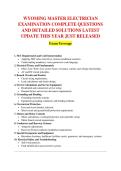
WYOMING MASTER ELECTRICIAN
EXAMINATION COMPLETE QUESTIONS
AND DETAILED SOLUTIONS LATEST
UPDATE THIS YEAR JUST RELEASED
Exam Coverage
1. NEC Requirements and Code Interpretation
Applying NEC rules correctly in various installation scenarios.
Understanding mandatory versus permissive code language.
2. Electrical Theory and Fundamentals
Ohm's Law, Watt's Law, power factor, resistance, current, and voltage relationships.
AC and DC circuit principles.
3. Branch Circuits and Feeders
Circuit sizing requirements.
Load calculations and feeder design.
4. Service Calculations and Service Equipment
Residential and commercial service sizing.
Demand factors and service disconnect requirements.
5. Grounding and Bonding
Grounding electrode systems.
Equipment grounding conductors and bonding methods.
6. Overcurrent Protection
Fuse and circuit breaker selection.
Short-circuit and ground-fault protection requirements.
7. Motors and Motor Controls
Motor calculations, overload protection, and controller sizing.
Motor branch-circuit requirements.
8. Conductors and Raceway Systems
Ampacity adjustments.
Raceway fill and conductor installation requirements.
9. Special Occupancies and Equipment
Hazardous locations, healthcare facilities, pools, generators, and emergency systems.
10. Electrical Safety and Troubleshooting
Safe work practices.
Fault identification and corrective actions.
,Wyoming Master Electrician Examination
1. When calculating the load for a commercial feeder supplying
continuous lighting loads, what minimum percentage must
generally be applied to the continuous load value?
A. 100%
B. 110%
C. 125%
D. 150%
Answer: C
Rationale: Continuous loads are generally calculated at 125%
to prevent overheating and ensure adequate conductor
capacity.
2. A technician measures 240 volts across a resistive heating
element drawing 20 amperes continuously. What is the
approximate power consumption?
A. 2,400 watts
B. 3,600 watts
C. 4,800 watts
D. 5,600 watts
Answer: C
Rationale: Power equals voltage multiplied by current. 240 ×
20 = 4,800 watts.
,3. Which primary purpose is served by bonding non-current-
carrying metal parts of electrical equipment together?
A. Increase efficiency
B. Reduce voltage drop
C. Establish effective fault-current path
D. Increase conductor ampacity
Answer: C
Rationale: Bonding creates a low-impedance path allowing
overcurrent devices to clear faults rapidly.
4. During a service calculation for a dwelling, demand factors
are primarily used for which purpose?
A. Increase connected load values
B. Reduce conductor insulation requirements
C. Account for diversity of electrical usage
D. Eliminate grounding requirements
Answer: C
Rationale: Demand factors recognize that all loads typically
do not operate simultaneously.
5. What condition most commonly causes an overcurrent
protective device to trip immediately after energizing
equipment?
, A. Slight voltage fluctuation
B. Ground fault or short circuit
C. Balanced load operation
D. Proper conductor sizing
Answer: B
Rationale: Short circuits and ground faults create excessive
current that trips protective devices quickly.
6. In a three-phase system, what is the primary advantage over
a comparable single-phase system serving large motors?
A. Higher conductor resistance
B. Reduced motor efficiency
C. Smoother motor operation and efficiency
D. Elimination of overload protection
Answer: C
Rationale: Three-phase motors operate more efficiently and
provide smoother torque.
7. Which conductor characteristic directly affects the voltage
drop experienced over a long circuit run?
A. Raceway color
B. Conductor resistance
C. Connector brand
D. Mounting height
EXAMINATION COMPLETE QUESTIONS
AND DETAILED SOLUTIONS LATEST
UPDATE THIS YEAR JUST RELEASED
Exam Coverage
1. NEC Requirements and Code Interpretation
Applying NEC rules correctly in various installation scenarios.
Understanding mandatory versus permissive code language.
2. Electrical Theory and Fundamentals
Ohm's Law, Watt's Law, power factor, resistance, current, and voltage relationships.
AC and DC circuit principles.
3. Branch Circuits and Feeders
Circuit sizing requirements.
Load calculations and feeder design.
4. Service Calculations and Service Equipment
Residential and commercial service sizing.
Demand factors and service disconnect requirements.
5. Grounding and Bonding
Grounding electrode systems.
Equipment grounding conductors and bonding methods.
6. Overcurrent Protection
Fuse and circuit breaker selection.
Short-circuit and ground-fault protection requirements.
7. Motors and Motor Controls
Motor calculations, overload protection, and controller sizing.
Motor branch-circuit requirements.
8. Conductors and Raceway Systems
Ampacity adjustments.
Raceway fill and conductor installation requirements.
9. Special Occupancies and Equipment
Hazardous locations, healthcare facilities, pools, generators, and emergency systems.
10. Electrical Safety and Troubleshooting
Safe work practices.
Fault identification and corrective actions.
,Wyoming Master Electrician Examination
1. When calculating the load for a commercial feeder supplying
continuous lighting loads, what minimum percentage must
generally be applied to the continuous load value?
A. 100%
B. 110%
C. 125%
D. 150%
Answer: C
Rationale: Continuous loads are generally calculated at 125%
to prevent overheating and ensure adequate conductor
capacity.
2. A technician measures 240 volts across a resistive heating
element drawing 20 amperes continuously. What is the
approximate power consumption?
A. 2,400 watts
B. 3,600 watts
C. 4,800 watts
D. 5,600 watts
Answer: C
Rationale: Power equals voltage multiplied by current. 240 ×
20 = 4,800 watts.
,3. Which primary purpose is served by bonding non-current-
carrying metal parts of electrical equipment together?
A. Increase efficiency
B. Reduce voltage drop
C. Establish effective fault-current path
D. Increase conductor ampacity
Answer: C
Rationale: Bonding creates a low-impedance path allowing
overcurrent devices to clear faults rapidly.
4. During a service calculation for a dwelling, demand factors
are primarily used for which purpose?
A. Increase connected load values
B. Reduce conductor insulation requirements
C. Account for diversity of electrical usage
D. Eliminate grounding requirements
Answer: C
Rationale: Demand factors recognize that all loads typically
do not operate simultaneously.
5. What condition most commonly causes an overcurrent
protective device to trip immediately after energizing
equipment?
, A. Slight voltage fluctuation
B. Ground fault or short circuit
C. Balanced load operation
D. Proper conductor sizing
Answer: B
Rationale: Short circuits and ground faults create excessive
current that trips protective devices quickly.
6. In a three-phase system, what is the primary advantage over
a comparable single-phase system serving large motors?
A. Higher conductor resistance
B. Reduced motor efficiency
C. Smoother motor operation and efficiency
D. Elimination of overload protection
Answer: C
Rationale: Three-phase motors operate more efficiently and
provide smoother torque.
7. Which conductor characteristic directly affects the voltage
drop experienced over a long circuit run?
A. Raceway color
B. Conductor resistance
C. Connector brand
D. Mounting height


