

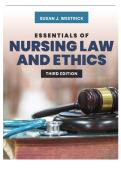
,TESTBANK FOR Essentials of Nursing Law and Ethics Third Edition Westrick
Important Notes
The file includes the complete test bank, organized chapter by chapter.
A sample of selected pages has been provided for preview.
All available appendices and Excel files (if included in the original resources) are
provided.
Quizzes, Midterm and final exams are included (if available in the original resources).
We continuously update our files to ensure you receive the latest and most accurate
editions.
New editions are added regularly – stay connected for updates!
⚠️Note on Answer Keys: If the answer key is not included within the chapter
questions, you will find the complete answers and solutions at the end of each
chapter.
✅ Why Buy From Us?
📚 Complete & organized chapter-by-chapter – no missing content, no guessing.
⚡ Instant digital delivery – get your file the moment you pay, no waiting.
📅 Always up to date – we track new editions so you always get the latest version.
💬 Friendly support – real humans ready to help, anytime you need us.
🔒 Safe & secure – thousands of satisfied students trust us every semester.
🛡️Our Guarantees
💰 Money-Back Guarantee: Not satisfied? We offer a full refund – no questions asked.
🔄 Wrong File? No Problem: Contact us and we will replace it immediately with the
correct version, free of charge.
⏰ 24/7 Support: We are always here – reach out anytime and expect a fast response.
,Essentials of Nursing Law and Ethics, Third Edition
Susan Westrick
Test Bank Questions for Instructors
1
,Part I: The Law and Nursing Practice
Chapter 1: The Legal Environment:
1. For which reason are nurses sometimes named as defendants in malpractice claims?
A) Naming more individuals increases the likelihood of full recovery.
B) Nurses have better malpractice insurance than other professions.
C) The scope of practice for nurses has expanded recently.
D) Nurses are suing their employers more often.
Answer: A. Hospitals or healthcare organizations that employ nurses and other
professionals, such as physicians, are often named as defendants alongside their
employees in lawsuits. It has become more common for plaintiffs to include multiple
defendants, including nurses, to increase their chances of winning the case and receiving
more damages. While nurses may carry malpractice insurance (B), this isn’t the reason
for the rise in legal claims. The scope of practice for nurses hasn't changed significantly
(C). If a nurse were to sue their employer, the nurse would be the plaintiff, and the
employer would be the defendant (D).
2. Legal processes follow a particular order after a claim of professional malpractice is
made by a plaintiff against a defendant nurse. Place the following steps in order of
occurrence:
A) The defendant files an answer to the allegations.
B) The defendant is served by summons with notice of the lawsuit.
C) Discovery takes place, including depositions of the parties of the lawsuit or
witnesses.
D) Evidence in the case is presented to the judge or jury if the case goes to trial.
E) An appeal can be filed by the losing party.
F) A verdict or judgment is rendered.
G) The lawsuit, including allegations against the defendant, is filed in court.
Answer: Order – G, B, A, C, D, F, E (Question uses alternate format of NCLEX style
question)
Chapter 2: Regulation of Nursing Practice
1. Nurse Practice Acts (NPAs) are specific to each state and require:
A) all professional nurses to have a baccalaureate degree.
B) mandatory licensure for anyone practicing as an RN.
2
, C) RNs to validate continuing education credits as a requirement for re-licensure
each year.
D) the state to develop a list of tasks that nurses can and cannot perform.
Answer: B. Mandatory licensure for RNs is required by each state to avoid having
unlicensed and unqualified individuals performing nursing tasks for compensation. This
protects both the safety of the public and the integrity of the profession. Answers B and C
are incorrect since baccalaureate degrees and continuing education credits are not
required by all NPAs, although some states’ NPAs do. Answer D is incorrect since a
specific list of tasks for nurses is not developed, as it would quickly be outdated. Rather,
a broad category of functions and areas of practice is defined.
2. Licensure of registered nurses (RNs) is a means to:
A) ensure that RNs meet standards for education in the scope of practice for RNs.
B) restrict the practice of other healthcare practitioners, such as social workers.
C) require states to join in multistate licensure pacts with other neighboring states.
D) allow nurses to practice only in an area for which they are credentialed.
Answer: A. Licensure protects the public by ensuring that those with the RN designation
have met certain educational standards reflective of the scope of practice for RNs.
Answer B is incorrect since Nurse Practice Acts are not designed to restrict other
practitioners, such as social workers. Answer C is incorrect since the licensure system for
RNs does not require participation in multistate licensure pacts, although it may be
voluntary. Answer D is incorrect because credentialing is a voluntary process not
required as a part of licensure, but it usually designates that a nurse is qualified in a
specialty area through advanced training and/or experience. Nursing organizations
typically offer and monitor credentialing processes.
Chapter 3: Nurses in Legal Actions
1. A nursing supervisor witnesses a nurse intentionally kick a bedside table toward a
verbally abusive patient, knocking the patient to the floor. The patient had bruising
but no major injuries. The nursing supervisor should:
A) verbally reprimand the nurse for mishandling the situation.
B) report the incident to the state board of nursing or to risk management for external
state or federal agency reporting if required.
C) enroll the nurse in a remediation program.
D) refer the nurse and patient to social work.
Answer: B. Nursing supervisors will be responsible under any state licensing or federal
reporting laws for their own inaction if they do not make a mandatory report of patient
3
,harm (regardless of seriousness) caused by an intentional act by licensed staff. Answer A
is not correct since the supervisor should follow the Human Resources policy on
employee reprimand. A referral to social work (D) may be indicated for the patient but is
not the appropriate response for an employee. A remediation program is meant for nurses
who have acted incompetently and have an opportunity to improve. This incident is not
an example of incompetence that would be corrected by remediation (C).
2. Which of the following is not a right to due process under administrative licensing
board procedures?
A) Right to be informed
B) Right to be heard
C) Right to state your side of the facts without repercussion
D) Right to be treated fairly in the process
Answer: C. The right to state your side of the facts without repercussion is not part of the
process. In fact, anything said by the nurse will be used by the board to support the
allegations. The nurse should always seek advice from an attorney before speaking to an
investigator.
Chapter 4: Standards of Care
1. A nurse–midwife is sued for failure to timely resuscitate a neonate in the neonatal
intensive care unit. Regarding the applicable standards of care, which of the following
is true?
A) The scope of practice for nurse–midwives is the same in every state.
B) The hospital's resuscitation policy may expand the scope of practice for the
midwife.
C) A pediatric nurse practitioner may be consulted to explain the neonatal
resuscitation standards to the jury.
D) The nurse–midwife’s response should be compared to similar responses by
emergency room physicians.
Answer: C. A pediatric nurse practitioner shares responsibility of neonatal resuscitation,
and most states allow each specialty to act as expert on the shared procedure. Answer A
is incorrect because scope of practice varies according to each state statute. Answer B is
incorrect because policies may not expand the scope of practice set by a Nurse Practice
Act, and answer D is incorrect because standards of care should be compared within the
same specialty only. The response of a nurse–midwife is not comparable to the response
by an emergency room physician because they have different practice settings and
licenses.
4
,2. When determining whether an activity falls within the scope of nursing practice, the
nurse should consider which of the following? (Check all that apply.)
A) ___ Is the activity consistent with sound nursing practice?
B) ___ Is there a standard for this activity from professional organizations?
C) ___ Does the activity provide a good patient outcome?
D) ___ Is the nurse prepared to accept accountability?
E) ___ Does the nurse have the competency for this activity?
Answer: A, B, D, and E. All are correct except "Does the activity provide a good patient
outcome?" This is not part of determining the scope of nursing practice criteria.
Chapter 5: Defenses to Negligence or Malpractice
1. Which among the following is a reasonable defense to a malpractice action by a
plaintiff-patient against a nurse?
A) The patient was not aware of the risks listed in the signed consent form.
B) Too much time has passed; the statute of limitations now bars the claim.
C) The nurse was not familiar with the procedure that was implemented for the
patient.
D) Complications are an inherent part of medical care.
Answer: B. Claims can be time barred by being claimed after the period of time that is
required by the statute of limitations, generally two to three years in malpractice actions,
with certain exceptions. The fact that the nurse is not familiar with a procedure or
intervention is not a defense to the alleged negligence or malpractice claim (C). The
nurse must refuse to implement the intervention if not competent to perform the action.
Patients can assume the risk of certain interventions by being informed but then cannot
claim that they did not know of the risk (A). While there are risks with medical care, the
patient does not assume the risk if the damage was negligent (D).
2. Immunity from liability for claims of negligence would not be applied for a nurse
who:
A) performs acts that are outside of the nurse’s scope of practice if working under
short-staffing conditions.
B) works as a governmental employee and the Federal Tort Claims Act (FTCA) is
used to substitute the government as the defendant.
C) renders services as a volunteer under the state’s “Good Samaritan Act.”
D) renders freely offered reasonable care to victims at the site of an emergency.
5
,Answer: A. When a nurse undertakes acts that are not within the scope of practice, there
is no defense to a negligence or malpractice claim that there is a short-staffing situation.
Immunities can be provided as a federal employee (B), or while acting within the
boundaries of the state “Good Samaritan Act” (C) as long as the assistance is not grossly
negligent or reckless.
Chapter 6: Prevention of Malpractice
1. The nurse assists a transport company with positioning a patient with a hip fracture
connected to traction on a stretcher prior to discharge. The nurse receives a lawsuit
notice 6 months later claiming permanent injury to the fractured hip due to negligent
transport methods at discharge. Which of the following is true regarding the legal
issues based on this scenario?
A) The nurse’s defense will be that the orders for traction and transport were placed
by the provider.
B) The nurse’s defense will be that they were not aware of how to set up traction for
an ambulance ride.
C) The claim of negligence against the nurse is based on the duty to act to prevent
foreseeable harm to the patient by the transport method.
D) The claim of negligence against the nurse is based on inappropriate delegation of
patient positioning to an outside transport company.
Answer: C. The nurse has an independent duty to act on the known standard of care
(knowledge as to the correct positioning of the fractured hip) if an act known to the nurse
can cause harm to the patient. Therefore, the nurse should have recognized that the
traction was not applied correctly and could cause harm prior to leaving the hospital.
2. A surgical nurse performed a postoperative sponge count and notified the circulating
nurse that it was correct. The surgical nurse received a lawsuit notice months later
that a sponge was retained after surgery. Which healthcare provider would be held
responsible for this error?
A) The surgical nurse
B) The surgeon
C) Surgical technicians
D) The circulating nurse
Answer: A. While surgeons were once considered to be responsible for all negligent acts
that occur during surgery, surgical nurses now have their own independent liability for
incorrect sponge and needle counts.
6
,Chapter 7: Nurses as Witnesses
1. A nurse who is testifying as an expert witness during a deposition involving
allegations of negligence by another nurse typically can testify about:
A) the standard of care of other nursing specialties.
B) hypothetical questions involving facts similar to issues in the lawsuit.
C) the standard of care required by physicians in the situation in question.
D) the defendant’s credentials.
Answer: B. Hypothetical questions are often asked to clarify the testimony. The nurse
expert is only qualified to testify about the standard of care for those whom they are
familiar with through training, education, or experience, and this would not include
physicians (C) or other specialties (A). Expert witness nurses typically testify about their
own credentials to establish credibility and to qualify as an expert who can give an
opinion in the case, but they do not testify about the defendant’s credentials.
2. If a family member requests that the primary nurse sign an important document as a
witness to their patient’s signature, the nurse should:
A) sign the document.
B) ask another appropriate person to sign as a witness.
C) sign it only if no one else is available.
D) consult with a lawyer.
Answer: B. Nurses should not sign these documents as a witness since doing so attests to
the fact that the patient had the capacity to sign and understand the document. The nurse
may be called to testify at a later proceeding if these issues are raised, so it is best to
avoid this possible conflict. Additionally, many employers have policies against signing
such documents, so these should be checked. The family is asking the nurse to be a
witness and not agree to anything on the document, so consulting a lawyer should not be
necessary.
Chapter 8: Professional Liability Insurance
1. Reasons that it is prudent for a nurse to have an individual professional liability
insurance policy include: (Check all that apply to receive credit for this question.)
7
, A) ___ Coverage is typically provided for defense of actions by the state board of
nursing.
B) ___ The nurse’s individual policy will not be considered as a primary policy if
other policies cover any judgment or settlement.
C) ___ The nurse’s interest in any litigation may be adverse to the employer’s
interest.
D) ___ The insurance company will provide an attorney who will defend the nurse.
E) ___ Volunteer activities while functioning as an RN are usually covered.
F) ___ Protection for excess judgments beyond your individual policy limits.
Answer: A, C, D, and E. Answer B is not true because the policy may be considered
primary or secondary, depending on the facts of the case and how the court interprets
each contract of insurance that is involved. Answer F is not true because the policy is a
contract and will only cover to the extent of any limits of the policy; excess judgments
may be recovered from the policies of other parties or from the nurse’s individual assets.
(alternate format NCLEX style question)
2. Exclusions that are typically part of an individual professional liability insurance
policy for an RN include:
A) punitive damages awarded to the plaintiff.
B) actions that are within the scope of practice for the RN.
C) claims that arise based on an unintentional mistake by the nurse.
D) any action by the nurse that could have been prevented.
Answer: A. Punitive damages are usually not covered by malpractice policies since they
are usually awarded to punish the wrongdoer and serve as an example for deterrence for
these actions by others. Thus, they are awarded on the basis of particularly egregious
behavior. Actions that are within the scope of the RN’s practice and are unintended
mistakes (negligence) that are often preventable are what the liability policy covers
against.
Chapter 9: Accepting or Refusing an Assignment/Patient Abandonment
1. A new graduate nurse has been informed by the nursing supervisor that he will need
to work on another patient care unit where he has not worked before for this shift.
The new graduate nurse should first:
A) inform the supervisor that he is not prepared to accept an assignment off his
regular unit.
B) ask his coworkers if someone else will float to the other unit.
C) accept the assignment.
8
Important Notes
The file includes the complete test bank, organized chapter by chapter.
A sample of selected pages has been provided for preview.
All available appendices and Excel files (if included in the original resources) are
provided.
Quizzes, Midterm and final exams are included (if available in the original resources).
We continuously update our files to ensure you receive the latest and most accurate
editions.
New editions are added regularly – stay connected for updates!
⚠️Note on Answer Keys: If the answer key is not included within the chapter
questions, you will find the complete answers and solutions at the end of each
chapter.
✅ Why Buy From Us?
📚 Complete & organized chapter-by-chapter – no missing content, no guessing.
⚡ Instant digital delivery – get your file the moment you pay, no waiting.
📅 Always up to date – we track new editions so you always get the latest version.
💬 Friendly support – real humans ready to help, anytime you need us.
🔒 Safe & secure – thousands of satisfied students trust us every semester.
🛡️Our Guarantees
💰 Money-Back Guarantee: Not satisfied? We offer a full refund – no questions asked.
🔄 Wrong File? No Problem: Contact us and we will replace it immediately with the
correct version, free of charge.
⏰ 24/7 Support: We are always here – reach out anytime and expect a fast response.
,Essentials of Nursing Law and Ethics, Third Edition
Susan Westrick
Test Bank Questions for Instructors
1
,Part I: The Law and Nursing Practice
Chapter 1: The Legal Environment:
1. For which reason are nurses sometimes named as defendants in malpractice claims?
A) Naming more individuals increases the likelihood of full recovery.
B) Nurses have better malpractice insurance than other professions.
C) The scope of practice for nurses has expanded recently.
D) Nurses are suing their employers more often.
Answer: A. Hospitals or healthcare organizations that employ nurses and other
professionals, such as physicians, are often named as defendants alongside their
employees in lawsuits. It has become more common for plaintiffs to include multiple
defendants, including nurses, to increase their chances of winning the case and receiving
more damages. While nurses may carry malpractice insurance (B), this isn’t the reason
for the rise in legal claims. The scope of practice for nurses hasn't changed significantly
(C). If a nurse were to sue their employer, the nurse would be the plaintiff, and the
employer would be the defendant (D).
2. Legal processes follow a particular order after a claim of professional malpractice is
made by a plaintiff against a defendant nurse. Place the following steps in order of
occurrence:
A) The defendant files an answer to the allegations.
B) The defendant is served by summons with notice of the lawsuit.
C) Discovery takes place, including depositions of the parties of the lawsuit or
witnesses.
D) Evidence in the case is presented to the judge or jury if the case goes to trial.
E) An appeal can be filed by the losing party.
F) A verdict or judgment is rendered.
G) The lawsuit, including allegations against the defendant, is filed in court.
Answer: Order – G, B, A, C, D, F, E (Question uses alternate format of NCLEX style
question)
Chapter 2: Regulation of Nursing Practice
1. Nurse Practice Acts (NPAs) are specific to each state and require:
A) all professional nurses to have a baccalaureate degree.
B) mandatory licensure for anyone practicing as an RN.
2
, C) RNs to validate continuing education credits as a requirement for re-licensure
each year.
D) the state to develop a list of tasks that nurses can and cannot perform.
Answer: B. Mandatory licensure for RNs is required by each state to avoid having
unlicensed and unqualified individuals performing nursing tasks for compensation. This
protects both the safety of the public and the integrity of the profession. Answers B and C
are incorrect since baccalaureate degrees and continuing education credits are not
required by all NPAs, although some states’ NPAs do. Answer D is incorrect since a
specific list of tasks for nurses is not developed, as it would quickly be outdated. Rather,
a broad category of functions and areas of practice is defined.
2. Licensure of registered nurses (RNs) is a means to:
A) ensure that RNs meet standards for education in the scope of practice for RNs.
B) restrict the practice of other healthcare practitioners, such as social workers.
C) require states to join in multistate licensure pacts with other neighboring states.
D) allow nurses to practice only in an area for which they are credentialed.
Answer: A. Licensure protects the public by ensuring that those with the RN designation
have met certain educational standards reflective of the scope of practice for RNs.
Answer B is incorrect since Nurse Practice Acts are not designed to restrict other
practitioners, such as social workers. Answer C is incorrect since the licensure system for
RNs does not require participation in multistate licensure pacts, although it may be
voluntary. Answer D is incorrect because credentialing is a voluntary process not
required as a part of licensure, but it usually designates that a nurse is qualified in a
specialty area through advanced training and/or experience. Nursing organizations
typically offer and monitor credentialing processes.
Chapter 3: Nurses in Legal Actions
1. A nursing supervisor witnesses a nurse intentionally kick a bedside table toward a
verbally abusive patient, knocking the patient to the floor. The patient had bruising
but no major injuries. The nursing supervisor should:
A) verbally reprimand the nurse for mishandling the situation.
B) report the incident to the state board of nursing or to risk management for external
state or federal agency reporting if required.
C) enroll the nurse in a remediation program.
D) refer the nurse and patient to social work.
Answer: B. Nursing supervisors will be responsible under any state licensing or federal
reporting laws for their own inaction if they do not make a mandatory report of patient
3
,harm (regardless of seriousness) caused by an intentional act by licensed staff. Answer A
is not correct since the supervisor should follow the Human Resources policy on
employee reprimand. A referral to social work (D) may be indicated for the patient but is
not the appropriate response for an employee. A remediation program is meant for nurses
who have acted incompetently and have an opportunity to improve. This incident is not
an example of incompetence that would be corrected by remediation (C).
2. Which of the following is not a right to due process under administrative licensing
board procedures?
A) Right to be informed
B) Right to be heard
C) Right to state your side of the facts without repercussion
D) Right to be treated fairly in the process
Answer: C. The right to state your side of the facts without repercussion is not part of the
process. In fact, anything said by the nurse will be used by the board to support the
allegations. The nurse should always seek advice from an attorney before speaking to an
investigator.
Chapter 4: Standards of Care
1. A nurse–midwife is sued for failure to timely resuscitate a neonate in the neonatal
intensive care unit. Regarding the applicable standards of care, which of the following
is true?
A) The scope of practice for nurse–midwives is the same in every state.
B) The hospital's resuscitation policy may expand the scope of practice for the
midwife.
C) A pediatric nurse practitioner may be consulted to explain the neonatal
resuscitation standards to the jury.
D) The nurse–midwife’s response should be compared to similar responses by
emergency room physicians.
Answer: C. A pediatric nurse practitioner shares responsibility of neonatal resuscitation,
and most states allow each specialty to act as expert on the shared procedure. Answer A
is incorrect because scope of practice varies according to each state statute. Answer B is
incorrect because policies may not expand the scope of practice set by a Nurse Practice
Act, and answer D is incorrect because standards of care should be compared within the
same specialty only. The response of a nurse–midwife is not comparable to the response
by an emergency room physician because they have different practice settings and
licenses.
4
,2. When determining whether an activity falls within the scope of nursing practice, the
nurse should consider which of the following? (Check all that apply.)
A) ___ Is the activity consistent with sound nursing practice?
B) ___ Is there a standard for this activity from professional organizations?
C) ___ Does the activity provide a good patient outcome?
D) ___ Is the nurse prepared to accept accountability?
E) ___ Does the nurse have the competency for this activity?
Answer: A, B, D, and E. All are correct except "Does the activity provide a good patient
outcome?" This is not part of determining the scope of nursing practice criteria.
Chapter 5: Defenses to Negligence or Malpractice
1. Which among the following is a reasonable defense to a malpractice action by a
plaintiff-patient against a nurse?
A) The patient was not aware of the risks listed in the signed consent form.
B) Too much time has passed; the statute of limitations now bars the claim.
C) The nurse was not familiar with the procedure that was implemented for the
patient.
D) Complications are an inherent part of medical care.
Answer: B. Claims can be time barred by being claimed after the period of time that is
required by the statute of limitations, generally two to three years in malpractice actions,
with certain exceptions. The fact that the nurse is not familiar with a procedure or
intervention is not a defense to the alleged negligence or malpractice claim (C). The
nurse must refuse to implement the intervention if not competent to perform the action.
Patients can assume the risk of certain interventions by being informed but then cannot
claim that they did not know of the risk (A). While there are risks with medical care, the
patient does not assume the risk if the damage was negligent (D).
2. Immunity from liability for claims of negligence would not be applied for a nurse
who:
A) performs acts that are outside of the nurse’s scope of practice if working under
short-staffing conditions.
B) works as a governmental employee and the Federal Tort Claims Act (FTCA) is
used to substitute the government as the defendant.
C) renders services as a volunteer under the state’s “Good Samaritan Act.”
D) renders freely offered reasonable care to victims at the site of an emergency.
5
,Answer: A. When a nurse undertakes acts that are not within the scope of practice, there
is no defense to a negligence or malpractice claim that there is a short-staffing situation.
Immunities can be provided as a federal employee (B), or while acting within the
boundaries of the state “Good Samaritan Act” (C) as long as the assistance is not grossly
negligent or reckless.
Chapter 6: Prevention of Malpractice
1. The nurse assists a transport company with positioning a patient with a hip fracture
connected to traction on a stretcher prior to discharge. The nurse receives a lawsuit
notice 6 months later claiming permanent injury to the fractured hip due to negligent
transport methods at discharge. Which of the following is true regarding the legal
issues based on this scenario?
A) The nurse’s defense will be that the orders for traction and transport were placed
by the provider.
B) The nurse’s defense will be that they were not aware of how to set up traction for
an ambulance ride.
C) The claim of negligence against the nurse is based on the duty to act to prevent
foreseeable harm to the patient by the transport method.
D) The claim of negligence against the nurse is based on inappropriate delegation of
patient positioning to an outside transport company.
Answer: C. The nurse has an independent duty to act on the known standard of care
(knowledge as to the correct positioning of the fractured hip) if an act known to the nurse
can cause harm to the patient. Therefore, the nurse should have recognized that the
traction was not applied correctly and could cause harm prior to leaving the hospital.
2. A surgical nurse performed a postoperative sponge count and notified the circulating
nurse that it was correct. The surgical nurse received a lawsuit notice months later
that a sponge was retained after surgery. Which healthcare provider would be held
responsible for this error?
A) The surgical nurse
B) The surgeon
C) Surgical technicians
D) The circulating nurse
Answer: A. While surgeons were once considered to be responsible for all negligent acts
that occur during surgery, surgical nurses now have their own independent liability for
incorrect sponge and needle counts.
6
,Chapter 7: Nurses as Witnesses
1. A nurse who is testifying as an expert witness during a deposition involving
allegations of negligence by another nurse typically can testify about:
A) the standard of care of other nursing specialties.
B) hypothetical questions involving facts similar to issues in the lawsuit.
C) the standard of care required by physicians in the situation in question.
D) the defendant’s credentials.
Answer: B. Hypothetical questions are often asked to clarify the testimony. The nurse
expert is only qualified to testify about the standard of care for those whom they are
familiar with through training, education, or experience, and this would not include
physicians (C) or other specialties (A). Expert witness nurses typically testify about their
own credentials to establish credibility and to qualify as an expert who can give an
opinion in the case, but they do not testify about the defendant’s credentials.
2. If a family member requests that the primary nurse sign an important document as a
witness to their patient’s signature, the nurse should:
A) sign the document.
B) ask another appropriate person to sign as a witness.
C) sign it only if no one else is available.
D) consult with a lawyer.
Answer: B. Nurses should not sign these documents as a witness since doing so attests to
the fact that the patient had the capacity to sign and understand the document. The nurse
may be called to testify at a later proceeding if these issues are raised, so it is best to
avoid this possible conflict. Additionally, many employers have policies against signing
such documents, so these should be checked. The family is asking the nurse to be a
witness and not agree to anything on the document, so consulting a lawyer should not be
necessary.
Chapter 8: Professional Liability Insurance
1. Reasons that it is prudent for a nurse to have an individual professional liability
insurance policy include: (Check all that apply to receive credit for this question.)
7
, A) ___ Coverage is typically provided for defense of actions by the state board of
nursing.
B) ___ The nurse’s individual policy will not be considered as a primary policy if
other policies cover any judgment or settlement.
C) ___ The nurse’s interest in any litigation may be adverse to the employer’s
interest.
D) ___ The insurance company will provide an attorney who will defend the nurse.
E) ___ Volunteer activities while functioning as an RN are usually covered.
F) ___ Protection for excess judgments beyond your individual policy limits.
Answer: A, C, D, and E. Answer B is not true because the policy may be considered
primary or secondary, depending on the facts of the case and how the court interprets
each contract of insurance that is involved. Answer F is not true because the policy is a
contract and will only cover to the extent of any limits of the policy; excess judgments
may be recovered from the policies of other parties or from the nurse’s individual assets.
(alternate format NCLEX style question)
2. Exclusions that are typically part of an individual professional liability insurance
policy for an RN include:
A) punitive damages awarded to the plaintiff.
B) actions that are within the scope of practice for the RN.
C) claims that arise based on an unintentional mistake by the nurse.
D) any action by the nurse that could have been prevented.
Answer: A. Punitive damages are usually not covered by malpractice policies since they
are usually awarded to punish the wrongdoer and serve as an example for deterrence for
these actions by others. Thus, they are awarded on the basis of particularly egregious
behavior. Actions that are within the scope of the RN’s practice and are unintended
mistakes (negligence) that are often preventable are what the liability policy covers
against.
Chapter 9: Accepting or Refusing an Assignment/Patient Abandonment
1. A new graduate nurse has been informed by the nursing supervisor that he will need
to work on another patient care unit where he has not worked before for this shift.
The new graduate nurse should first:
A) inform the supervisor that he is not prepared to accept an assignment off his
regular unit.
B) ask his coworkers if someone else will float to the other unit.
C) accept the assignment.
8


