

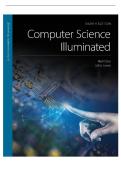
, TESTBANK FOR Computer Science Illuminated Eighth Edition Dale
Important Notes
The file includes the complete test bank, organized chapter by chapter.
A sample of selected pages has been provided for preview.
All available appendices and Excel files (if included in the original resources) are
provided.
Quizzes, Midterm and final exams are included (if available in the original resources).
We continuously update our files to ensure you receive the latest and most accurate
editions.
New editions are added regularly – stay connected for updates!
⚠️Note on Answer Keys: If the answer key is not included within the chapter
questions, you will find the complete answers and solutions at the end of each
chapter.
✅ Why Buy From Us?
📚 Complete & organized chapter-by-chapter – no missing content, no guessing.
⚡ Instant digital delivery – get your file the moment you pay, no waiting.
📅 Always up to date – we track new editions so you always get the latest version.
💬 Friendly support – real humans ready to help, anytime you need us.
🔒 Safe & secure – thousands of satisfied students trust us every semester.
🛡️Our Guarantees
💰 Money-Back Guarantee: Not satisfied? We offer a full refund – no questions asked.
🔄 Wrong File? No Problem: Contact us and we will replace it immediately with the
correct version, free of charge.
⏰ 24/7 Support: We are always here – reach out anytime and expect a fast response.
,Computer Science Illuminated, Eighth Edition
Nell Dale and John Lewis
Chapter Quiz: Chapter 1
Import Settings:
Base Settings: Brownstone Default
Information Field: Complexity
Information Field: Ahead
Information Field: Subject
Information Field: Title
Highest Answer Letter: E
Multiple Keywords in Same Paragraph: No
NAS ISBN13: 9781284275124, add to Ahead, Title tags
Chapter: Chapter 01 - Quiz
Multiple Choice
1. Which of the following is not one of the big ideas in computing discussed in Chapter 1?
A) Abstraction
B) The Internet
C) Visualization
D) Global impact
E) Creativity
Ans: C
Complexity: Moderate
Ahead: Computing as a Tool and a Discipline
Subject: Chapter 1
Title: Laying the Groundwork
2. Charles Babbage invented which of the following early computing devices?
A) Analytical engine
B) Memory drum
C) Transistor
D) Vacuum tube
E) Abacus
Ans: A
Complexity: Easy
Ahead: The History of Computing
Subject: Chapter 1
Title: Laying the Groundwork
3. What was one of the beneficial effects of the introduction of high-level languages like FORTRAN and
COBOL?
A) It was easier to work with numerical applications.
B) Computers could be used for business.
C) They enabled artificial intelligence.
D) They enabled the same program to run on more than one computer.
Copyright © 2025 by Jones & Bartlett Learning, LLC, an Ascend Learning Company
,Computer Science Illuminated, Eighth Edition
Nell Dale and John Lewis
Chapter Quiz: Chapter 1
Ans: D
Complexity: Easy
Ahead: The History of Computing
Subject: Chapter 1
Title: Laying the Groundwork
True/False
1. True or False? The abacus was the world's first electronic digital computer.
Ans: False
Complexity: Moderate
Ahead: The History of Computing
Subject: Chapter 1
Title: Laying the Groundwork
2. True or False? The transistor ushered in the second generation of commercial computers.
Ans: True
Complexity: Easy
Ahead: The History of Computing
Subject: Chapter 1
Title: Laying the Groundwork
3. True or False? A computer that has a parallel architecture uses multiple central processing units.
Ans: True
Complexity: Moderate
Ahead: The History of Computing
Subject: Chapter 1
Title: Laying the Groundwork
4. True or False? A database management system is one of the types of software that helped fuel early
adoption of personal computers.
Ans: True
Complexity: Easy
Ahead: The History of Computing
Subject: Chapter 1
Title: Laying the Groundwork
5. True or False? An embedded system describes computing technology that has been enclosed in
protective shielding for security reasons.
Ans: False
Complexity: Moderate
Ahead: The History of Computing
Copyright © 2025 by Jones & Bartlett Learning, LLC, an Ascend Learning Company
,Computer Science Illuminated, Eighth Edition
Nell Dale and John Lewis
Chapter Quiz: Chapter 1
Subject: Chapter 1
Title: Laying the Groundwork
Short Answer
1. _______________ has been considered an astronomical calendar, a temple, and a predictor of lunar
eclipses.
Ans: Stonehenge
Complexity: Easy
Ahead: The History of Computing
Subject: Chapter 1
Title: Laying the Groundwork
2. FORTRAN and COBOL are two of the earliest _______________ programming languages.
Ans: high-level
Complexity: Easy
Ahead: The History of Computing
Subject: Chapter 1
Title: Laying the Groundwork
3. In the earliest electronic computers, programmers had to write machine language code expressed as
_______________ digits.
Ans: binary
Complexity: Easy
Ahead: The History of Computing
Subject: Chapter 1
Title: Laying the Groundwork
4. The computer's operating system and language translators are generally known as _______________.
Ans: systems software
Complexity: Easy
Ahead: The History of Computing
Subject: Chapter 1
Title: Laying the Groundwork
Essay
1. What is timesharing?
Ans: The process of many users, each at a terminal, using a single computer at the same time.
Complexity: Easy
Copyright © 2025 by Jones & Bartlett Learning, LLC, an Ascend Learning Company
,Computer Science Illuminated, Eighth Edition
Nell Dale and John Lewis
Chapter Quiz: Chapter 1
Ahead: The History of Computing
Subject: Chapter 1
Title: Laying the Groundwork
2. Describe the innermost layer of a computing system.
Ans: The innermost layer of a computing system deals with the way we represent information, including
numbers, text, images, audio, and video on a computer.
Complexity: Difficult
Ahead: Computing Systems
Subject: Chapter 1
Title: Laying the Groundwork
3. What is a Turing machine?
Ans: A Turing machine is an abstract mathematical model developed by Alan Turing that laid the
foundation for theoretical computing.
Complexity: Easy
Ahead: The History of Computing
Subject: Chapter 1
Title: Laying the Groundwork
4. What is a computer terminal?
Ans: A terminal is an input/output device with a keyboard and screen that allows the user to interact with
a computer.
Complexity: Easy
Ahead: The History of Computing
Subject: Chapter 1
Title: Laying the Groundwork
5. What is computer software?
Ans: A collection of programs that provide instructions that a computer executes.
Complexity: Easy
Ahead: Computing Systems
Subject: Chapter 1
Title: Laying the Groundwork
6. What is the focus of the application layer of a computer system?
Ans: The application layer focuses on the programs that allow users to solve real-world problems.
Complexity: Easy
Ahead: Computing Systems
Subject: Chapter 1
Title: Laying the Groundwork
Copyright © 2025 by Jones & Bartlett Learning, LLC, an Ascend Learning Company
,Computer Science Illuminated, Eighth Edition
Nell Dale and John Lewis
Chapter Quiz: Chapter 1
7. What does Miller's law say?
Ans: Miller's law states that a human being can actively manage about seven, plus or minus two, pieces
of information in short-term memory at one time.
Complexity: Moderate
Ahead: Computing Systems
Subject: Chapter 1
Title: Laying the Groundwork
8. Name two major events that mark the beginning of the fifth software generation.
Ans: Growing popularity of object-oriented design and programming and the development of the World
Wide Web (also the rise of Microsoft).
Complexity: Easy
Ahead: The History of Computing
Subject: Chapter 1
Title: Laying the Groundwork
Multiple Response
1. Why were integrated circuits an improvement over circuit boards? Choose all that apply.
A) They were smaller.
B) They were faster.
C) They were more user-friendly.
D) They were cheaper.
E) They were more reliable.
Ans: A, B, D, E
Complexity: Easy
Ahead: The History of Computing
Subject: Chapter 1
Title: Laying the Groundwork
Copyright © 2025 by Jones & Bartlett Learning, LLC, an Ascend Learning Company
,Computer Science Illuminated, Eighth Edition
Nell Dale and John Lewis
Chapter Quiz: Chapter 2
Import Settings:
Base Settings: Brownstone Default
Information Field: Complexity
Information Field: Ahead
Information Field: Subject
Information Field: Title
Highest Answer Letter: E
Multiple Keywords in Same Paragraph: No
NAS ISBN13: 9781284275124, add to Ahead, Title tags
Chapter: Chapter 02 - Quiz
Multiple Choice
1. How many digits are there in the binary number system?
A) 1
B) 2
C) 7
D) 8
E) 9
Ans: B
Complexity: Easy
Ahead: Positional Notation
Subject: Chapter 2
Title: Binary Values and Number Systems
2. How many digits are there in the hexadecimal number system?
A) 0
B) 9
C) 10
D) 15
E) 16
Ans: E
Complexity: Moderate
Ahead: Positional Notation
Subject: Chapter 2
Title: Binary Values and Number Systems
3. What is the decimal value of the largest digit in the hexadecimal number system?
A) 0
B) 9
C) 10
D) 15
E) 16
Copyright © 2025 by Jones & Bartlett Learning, LLC, an Ascend Learning Company
,Computer Science Illuminated, Eighth Edition
Nell Dale and John Lewis
Chapter Quiz: Chapter 2
Ans: D
Complexity: Difficult
Ahead: Positional Notation
Subject: Chapter 2
Title: Binary Values and Number Systems
True/False
1. True or False? There is one set of underlying principles governing all number systems.
Ans: True
Complexity: Easy
Ahead: Positional Notation
Subject: Chapter 2
Title: Binary Values and Number Systems
2. True or False? To convert a base-10 number to another base, start by dividing it by 10.
Ans: False
Complexity: Moderate
Ahead: Positional Notation
Subject: Chapter 2
Title: Binary Values and Number Systems
3. True or False? The base of the hexadecimal number system is 15.
Ans: False
Complexity: Easy
Ahead: Positional Notation
Subject: Chapter 2
Title: Binary Values and Number Systems
4. True or False? A value of a number in any base can be expressed as a polynomial expression.
Ans: True
Complexity: Moderate
Ahead; Positional Notation
Subject: Chapter 2
Title: Binary Values and Number Systems
5. True or False? Grace Murray Hopper is credited with being the first programmer.
Ans: False
Complexity: Moderate
Ahead: Positional Notation
Subject: Chapter 2
Title: Binary Values and Number Systems
Copyright © 2025 by Jones & Bartlett Learning, LLC, an Ascend Learning Company
, Computer Science Illuminated, Eighth Edition
Nell Dale and John Lewis
Chapter Quiz: Chapter 2
6. True or False? Three octal digits can be stored in one byte.
Ans: False
Complexity: Difficult
Ahead: Positional Notation
Subject: Chapter 2
Title: Binary Values and Number Systems
Short Answer
1. A(n) _______________ is a unit of an abstract mathematical system subject to the laws of arithmetic.
Ans: number
Complexity: Easy
Ahead: Numbers and Computing
Subject: Chapter 2
Title: Binary Values and Number Systems
2. The value of a number in any base can be expressed as a(n) _______________ in which each term is
made up of a digit multiplied by the base raised to a power.
Ans: polynomial
Complexity: Easy
Ahead: Positional Notation
Subject: Chapter 2
Title: Binary Values and Number Systems
3. The highest digit in base 16 is _______________.
Ans: F
Complexity: Easy
Ahead: Positional Notation
Subject: Chapter 2
Title: Binary Values and Number Systems
4. In base 16, the digit D is used to represent the decimal value _______________.
Ans: 13
Complexity: Difficult
Ahead: Positional Notation
Subject: Chapter 2
Title: Binary Values and Number Systems
5. A group of eight bits is called a(n) _______________.
Copyright © 2025 by Jones & Bartlett Learning, LLC, an Ascend Learning Company
Important Notes
The file includes the complete test bank, organized chapter by chapter.
A sample of selected pages has been provided for preview.
All available appendices and Excel files (if included in the original resources) are
provided.
Quizzes, Midterm and final exams are included (if available in the original resources).
We continuously update our files to ensure you receive the latest and most accurate
editions.
New editions are added regularly – stay connected for updates!
⚠️Note on Answer Keys: If the answer key is not included within the chapter
questions, you will find the complete answers and solutions at the end of each
chapter.
✅ Why Buy From Us?
📚 Complete & organized chapter-by-chapter – no missing content, no guessing.
⚡ Instant digital delivery – get your file the moment you pay, no waiting.
📅 Always up to date – we track new editions so you always get the latest version.
💬 Friendly support – real humans ready to help, anytime you need us.
🔒 Safe & secure – thousands of satisfied students trust us every semester.
🛡️Our Guarantees
💰 Money-Back Guarantee: Not satisfied? We offer a full refund – no questions asked.
🔄 Wrong File? No Problem: Contact us and we will replace it immediately with the
correct version, free of charge.
⏰ 24/7 Support: We are always here – reach out anytime and expect a fast response.
,Computer Science Illuminated, Eighth Edition
Nell Dale and John Lewis
Chapter Quiz: Chapter 1
Import Settings:
Base Settings: Brownstone Default
Information Field: Complexity
Information Field: Ahead
Information Field: Subject
Information Field: Title
Highest Answer Letter: E
Multiple Keywords in Same Paragraph: No
NAS ISBN13: 9781284275124, add to Ahead, Title tags
Chapter: Chapter 01 - Quiz
Multiple Choice
1. Which of the following is not one of the big ideas in computing discussed in Chapter 1?
A) Abstraction
B) The Internet
C) Visualization
D) Global impact
E) Creativity
Ans: C
Complexity: Moderate
Ahead: Computing as a Tool and a Discipline
Subject: Chapter 1
Title: Laying the Groundwork
2. Charles Babbage invented which of the following early computing devices?
A) Analytical engine
B) Memory drum
C) Transistor
D) Vacuum tube
E) Abacus
Ans: A
Complexity: Easy
Ahead: The History of Computing
Subject: Chapter 1
Title: Laying the Groundwork
3. What was one of the beneficial effects of the introduction of high-level languages like FORTRAN and
COBOL?
A) It was easier to work with numerical applications.
B) Computers could be used for business.
C) They enabled artificial intelligence.
D) They enabled the same program to run on more than one computer.
Copyright © 2025 by Jones & Bartlett Learning, LLC, an Ascend Learning Company
,Computer Science Illuminated, Eighth Edition
Nell Dale and John Lewis
Chapter Quiz: Chapter 1
Ans: D
Complexity: Easy
Ahead: The History of Computing
Subject: Chapter 1
Title: Laying the Groundwork
True/False
1. True or False? The abacus was the world's first electronic digital computer.
Ans: False
Complexity: Moderate
Ahead: The History of Computing
Subject: Chapter 1
Title: Laying the Groundwork
2. True or False? The transistor ushered in the second generation of commercial computers.
Ans: True
Complexity: Easy
Ahead: The History of Computing
Subject: Chapter 1
Title: Laying the Groundwork
3. True or False? A computer that has a parallel architecture uses multiple central processing units.
Ans: True
Complexity: Moderate
Ahead: The History of Computing
Subject: Chapter 1
Title: Laying the Groundwork
4. True or False? A database management system is one of the types of software that helped fuel early
adoption of personal computers.
Ans: True
Complexity: Easy
Ahead: The History of Computing
Subject: Chapter 1
Title: Laying the Groundwork
5. True or False? An embedded system describes computing technology that has been enclosed in
protective shielding for security reasons.
Ans: False
Complexity: Moderate
Ahead: The History of Computing
Copyright © 2025 by Jones & Bartlett Learning, LLC, an Ascend Learning Company
,Computer Science Illuminated, Eighth Edition
Nell Dale and John Lewis
Chapter Quiz: Chapter 1
Subject: Chapter 1
Title: Laying the Groundwork
Short Answer
1. _______________ has been considered an astronomical calendar, a temple, and a predictor of lunar
eclipses.
Ans: Stonehenge
Complexity: Easy
Ahead: The History of Computing
Subject: Chapter 1
Title: Laying the Groundwork
2. FORTRAN and COBOL are two of the earliest _______________ programming languages.
Ans: high-level
Complexity: Easy
Ahead: The History of Computing
Subject: Chapter 1
Title: Laying the Groundwork
3. In the earliest electronic computers, programmers had to write machine language code expressed as
_______________ digits.
Ans: binary
Complexity: Easy
Ahead: The History of Computing
Subject: Chapter 1
Title: Laying the Groundwork
4. The computer's operating system and language translators are generally known as _______________.
Ans: systems software
Complexity: Easy
Ahead: The History of Computing
Subject: Chapter 1
Title: Laying the Groundwork
Essay
1. What is timesharing?
Ans: The process of many users, each at a terminal, using a single computer at the same time.
Complexity: Easy
Copyright © 2025 by Jones & Bartlett Learning, LLC, an Ascend Learning Company
,Computer Science Illuminated, Eighth Edition
Nell Dale and John Lewis
Chapter Quiz: Chapter 1
Ahead: The History of Computing
Subject: Chapter 1
Title: Laying the Groundwork
2. Describe the innermost layer of a computing system.
Ans: The innermost layer of a computing system deals with the way we represent information, including
numbers, text, images, audio, and video on a computer.
Complexity: Difficult
Ahead: Computing Systems
Subject: Chapter 1
Title: Laying the Groundwork
3. What is a Turing machine?
Ans: A Turing machine is an abstract mathematical model developed by Alan Turing that laid the
foundation for theoretical computing.
Complexity: Easy
Ahead: The History of Computing
Subject: Chapter 1
Title: Laying the Groundwork
4. What is a computer terminal?
Ans: A terminal is an input/output device with a keyboard and screen that allows the user to interact with
a computer.
Complexity: Easy
Ahead: The History of Computing
Subject: Chapter 1
Title: Laying the Groundwork
5. What is computer software?
Ans: A collection of programs that provide instructions that a computer executes.
Complexity: Easy
Ahead: Computing Systems
Subject: Chapter 1
Title: Laying the Groundwork
6. What is the focus of the application layer of a computer system?
Ans: The application layer focuses on the programs that allow users to solve real-world problems.
Complexity: Easy
Ahead: Computing Systems
Subject: Chapter 1
Title: Laying the Groundwork
Copyright © 2025 by Jones & Bartlett Learning, LLC, an Ascend Learning Company
,Computer Science Illuminated, Eighth Edition
Nell Dale and John Lewis
Chapter Quiz: Chapter 1
7. What does Miller's law say?
Ans: Miller's law states that a human being can actively manage about seven, plus or minus two, pieces
of information in short-term memory at one time.
Complexity: Moderate
Ahead: Computing Systems
Subject: Chapter 1
Title: Laying the Groundwork
8. Name two major events that mark the beginning of the fifth software generation.
Ans: Growing popularity of object-oriented design and programming and the development of the World
Wide Web (also the rise of Microsoft).
Complexity: Easy
Ahead: The History of Computing
Subject: Chapter 1
Title: Laying the Groundwork
Multiple Response
1. Why were integrated circuits an improvement over circuit boards? Choose all that apply.
A) They were smaller.
B) They were faster.
C) They were more user-friendly.
D) They were cheaper.
E) They were more reliable.
Ans: A, B, D, E
Complexity: Easy
Ahead: The History of Computing
Subject: Chapter 1
Title: Laying the Groundwork
Copyright © 2025 by Jones & Bartlett Learning, LLC, an Ascend Learning Company
,Computer Science Illuminated, Eighth Edition
Nell Dale and John Lewis
Chapter Quiz: Chapter 2
Import Settings:
Base Settings: Brownstone Default
Information Field: Complexity
Information Field: Ahead
Information Field: Subject
Information Field: Title
Highest Answer Letter: E
Multiple Keywords in Same Paragraph: No
NAS ISBN13: 9781284275124, add to Ahead, Title tags
Chapter: Chapter 02 - Quiz
Multiple Choice
1. How many digits are there in the binary number system?
A) 1
B) 2
C) 7
D) 8
E) 9
Ans: B
Complexity: Easy
Ahead: Positional Notation
Subject: Chapter 2
Title: Binary Values and Number Systems
2. How many digits are there in the hexadecimal number system?
A) 0
B) 9
C) 10
D) 15
E) 16
Ans: E
Complexity: Moderate
Ahead: Positional Notation
Subject: Chapter 2
Title: Binary Values and Number Systems
3. What is the decimal value of the largest digit in the hexadecimal number system?
A) 0
B) 9
C) 10
D) 15
E) 16
Copyright © 2025 by Jones & Bartlett Learning, LLC, an Ascend Learning Company
,Computer Science Illuminated, Eighth Edition
Nell Dale and John Lewis
Chapter Quiz: Chapter 2
Ans: D
Complexity: Difficult
Ahead: Positional Notation
Subject: Chapter 2
Title: Binary Values and Number Systems
True/False
1. True or False? There is one set of underlying principles governing all number systems.
Ans: True
Complexity: Easy
Ahead: Positional Notation
Subject: Chapter 2
Title: Binary Values and Number Systems
2. True or False? To convert a base-10 number to another base, start by dividing it by 10.
Ans: False
Complexity: Moderate
Ahead: Positional Notation
Subject: Chapter 2
Title: Binary Values and Number Systems
3. True or False? The base of the hexadecimal number system is 15.
Ans: False
Complexity: Easy
Ahead: Positional Notation
Subject: Chapter 2
Title: Binary Values and Number Systems
4. True or False? A value of a number in any base can be expressed as a polynomial expression.
Ans: True
Complexity: Moderate
Ahead; Positional Notation
Subject: Chapter 2
Title: Binary Values and Number Systems
5. True or False? Grace Murray Hopper is credited with being the first programmer.
Ans: False
Complexity: Moderate
Ahead: Positional Notation
Subject: Chapter 2
Title: Binary Values and Number Systems
Copyright © 2025 by Jones & Bartlett Learning, LLC, an Ascend Learning Company
, Computer Science Illuminated, Eighth Edition
Nell Dale and John Lewis
Chapter Quiz: Chapter 2
6. True or False? Three octal digits can be stored in one byte.
Ans: False
Complexity: Difficult
Ahead: Positional Notation
Subject: Chapter 2
Title: Binary Values and Number Systems
Short Answer
1. A(n) _______________ is a unit of an abstract mathematical system subject to the laws of arithmetic.
Ans: number
Complexity: Easy
Ahead: Numbers and Computing
Subject: Chapter 2
Title: Binary Values and Number Systems
2. The value of a number in any base can be expressed as a(n) _______________ in which each term is
made up of a digit multiplied by the base raised to a power.
Ans: polynomial
Complexity: Easy
Ahead: Positional Notation
Subject: Chapter 2
Title: Binary Values and Number Systems
3. The highest digit in base 16 is _______________.
Ans: F
Complexity: Easy
Ahead: Positional Notation
Subject: Chapter 2
Title: Binary Values and Number Systems
4. In base 16, the digit D is used to represent the decimal value _______________.
Ans: 13
Complexity: Difficult
Ahead: Positional Notation
Subject: Chapter 2
Title: Binary Values and Number Systems
5. A group of eight bits is called a(n) _______________.
Copyright © 2025 by Jones & Bartlett Learning, LLC, an Ascend Learning Company


