

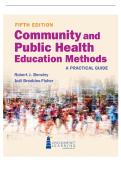
, TESTBANK FOR Community and Public Health Education Methods A
Practical Guide Fifth Edition Bensley
Important Notes
The file includes the complete test bank, organized chapter by chapter.
A sample of selected pages has been provided for preview.
All available appendices and Excel files (if included in the original resources) are
provided.
Quizzes, Midterm and final exams are included (if available in the original resources).
We continuously update our files to ensure you receive the latest and most accurate
editions.
New editions are added regularly – stay connected for updates!
⚠️Note on Answer Keys: If the answer key is not included within the chapter
questions, you will find the complete answers and solutions at the end of each
chapter.
✅ Why Buy From Us?
📚 Complete & organized chapter-by-chapter – no missing content, no guessing.
⚡ Instant digital delivery – get your file the moment you pay, no waiting.
📅 Always up to date – we track new editions so you always get the latest version.
💬 Friendly support – real humans ready to help, anytime you need us.
🔒 Safe & secure – thousands of satisfied students trust us every semester.
🛡️Our Guarantees
💰 Money-Back Guarantee: Not satisfied? We offer a full refund – no questions asked.
🔄 Wrong File? No Problem: Contact us and we will replace it immediately with the
correct version, free of charge.
⏰ 24/7 Support: We are always here – reach out anytime and expect a fast response.
,Community and Public Health Education Methods, Fifth Edition
Robert Bensley and Jodi Brookins Fisher
Test Bank Chapter 1
Chapter: Chapter 01 - Quiz
Multiple Choice
1. The Transtheoretical Model identifies stages or levels of readiness that can be applied to any type of
behavior change. These stages include:
A) precontemplation and contemplation.
B) preparation and action.
C) maintenance.
D) A and B
E) A, B, and C
Ans: E
Subject: Chapter 1
2. In the Theory of Planned Behavior, a person’s intention regarding performing a prescribed behavior
cannot be identified by which of the following?
A) Attitudes toward the behavior
B) What significant others will think about the behavior
C) If the person thinks it can be attained in a short amount of time—6 weeks or less
D) How difficult it will be for the individual to perform and maintain the behavior
Ans: C
Subject: Chapter 1
3. Positive health behaviors can by supported or encouraged through which of the following?
A) Interpersonal relationships
B) Social groups
C) Other social networks
D) None of the above
E) All of the above
Ans: E
Subject: Chapter 1
4. Which of the following concepts are essential to Social Cognitive Theory?
A) Behavioral capacity
B) Expectations
C) Self-efficacy
D) Observational learning
E) All of the above
Ans: E
Subject: Chapter 1
5. Diffusion of Innovation identifies people’s readiness to accept an innovation. An early adopter:
Copyright © 2025 by Jones & Bartlett Learning, LLC, an Ascend Learning Company
,Community and Public Health Education Methods, Fifth Edition
Robert Bensley and Jodi Brookins Fisher
Test Bank Chapter 1
A) is the first to adopt an innovation.
B) is interested, but does not want to be the first to adopt an innovation.
C) accepts innovations once others they respect have done so.
D) is skeptical of the innovation and late to adopt it.
Ans: B
Subject: Chapter 1
6. A theory is a general explanation of:
A) innovations that can be experimented with before a commitment is made.
B) the extent to which a program can succeed.
C) a system of moral principles.
D) why people act or do not act to maintain or promote the health of themselves, their families,
organizations, and communities.
Ans: D
Subject: Chapter 1
7. The Transtheoretical Model of Behavior Change is based on the assumption that:
A) health educators can identify a person’s intention.
B) behavior change is a concept of reasoned action.
C) behavior change is a process, and individuals are at varying levels of motivation or readiness to
change.
D) the emphasis of perceptions is vulnerability to illness and treatment.
Ans: C
Subject: Chapter 1
8. _______ refers to how consistent an innovation is with the values, habits, experiences, and needs of
potential adopters.
A) Compatibility
B) Relative advantage
C) Complexity
D) Treatability
E) None of the above
Ans: A
Subject: Chapter 1
9. The Health Belief Model is based on the belief that individuals:
A) perceive themselves to be susceptible to a health problem.
B) see the health problem as serious.
C) are convinced they will benefit from treatment or prevention activities.
D) All of the above
Ans: D
Subject: Chapter 1
10. Reciprocal determinism is:
Copyright © 2025 by Jones & Bartlett Learning, LLC, an Ascend Learning Company
,Community and Public Health Education Methods, Fifth Edition
Robert Bensley and Jodi Brookins Fisher
Test Bank Chapter 1
A) a theory that behavior changes are determined by interactions between a person and their
environment.
B) the degree to which an innovation is seen as being better than the program it replaces.
C) believing that one has the ability to take action.
D) the extent to which an innovation can be experimented with.
Ans: A
Subject: Chapter 1
Copyright © 2025 by Jones & Bartlett Learning, LLC, an Ascend Learning Company
,Community and Public Health Education Methods, Fifth Edition
Robert Bensley and Jodi Brookins Fisher
Test Bank: Chapter 2
Chapter: Chapter 02 - Quiz
Multiple Choice
1. Which of the following is not a principle in the core body of ethics?
A) Justice
B) Integrity
C) Doing good or beneficence
D) Avoiding harm or nonmaleficence
Ans: B
Subject: Chapter 2
2. _______ is a set of congruent behaviors, attitudes, and policies that come together in a system,
agency, or among professionals and enable that system, agency, or those professions to work effectively
in cross-cultural situations.”
A) Cultural humility
B) Cultural awareness
C) Cultural competence
D) Culture
Ans: C
Subject: Chapter 2
3. ___________ is “a lifelong commitment to self-evaluation and critique, to redressing power
imbalances … and to developing mutually beneficial and non-paternalistic partnerships with communities
on behalf of individuals and defined populations.”
A) Cultural humility
B) Cultural awareness
C) Cultural competence
D) Culture
Ans: A
Subject: Chapter 2
4. The best mentor–protégé relationships involve:
A) mutual respect.
B) trust.
C) two-way listening and reflection.
D) All of the above
Ans: D
Subject: Chapter 2
5. Health education specialists currently have _______ areas of responsibility.
A) two
Copyright © 2025 by Jones & Bartlett Learning, LLC, an Ascend Learning Company
,Community and Public Health Education Methods, Fifth Edition
Robert Bensley and Jodi Brookins Fisher
Test Bank: Chapter 2
B) four
C) six
D) eight
Ans: D
Subject: Chapter 2
6. Which of the following is not true about maintaining the CHES® or MCHES® credential?
A) You must accumulate at least 75 hours of continuing education every five years.
B) You must pay an annual recertification fee.
C) Both A and B
D) None of the above
Ans: C
Subject: Chapter 2
7. Which of the following is a way to share knowledge in the field of health education?
A) Poster presentation
B) Workshop
C) Oral presentation
D) Roundtable
E) All of the above
Ans: E
Subject: Chapter 2
True or False
1. Morals refer to freely chosen principles by individuals to guide their behaviors and decisions regarding
right and wrong.
Ans: False
Subject: Chapter 2
2. To be eligible for the MCHES® credential, one must have at least five years of work experience as a
health education specialist.
Ans: True
Subject: Chapter 2
3. Service learning can be thought as a collaborative partnership between an institution and the
community it serves.
Ans: True
Subject: Chapter 2
Copyright © 2025 by Jones & Bartlett Learning, LLC, an Ascend Learning Company
,Community and Public Health Education Methods, Fifth Edition
Robert Bensley and Jodi Brookins Fisher
Test Bank: Chapter 3
Chapter: Chapter 03 - Quiz
Multiple Choice
1. Equity is the absence of avoidable or remediable differences among groups of people as defined in
which of the following dimensions?
A) Social
B) Economic
C) Demographic
D) Geographic
E) All of the above
Ans: E
Subject: Chapter 3
2. _______ is defined as a process of openness, self-awareness, being egoless, and incorporating self-
reflection and critique after willingly interacting with diverse individuals.
A) Cultural humility
B) Cultural intelligence
C) Cultural awareness
D) Cultural competence
Ans: A
Subject: Chapter 3
3. _______ is a characteristic of those individuals who hold academic and interpersonal skills that allow
for increased understanding and appreciation of another group's differences and similarities.
A) Cultural humility
B) Cultural intelligence
C) Cultural awareness
D) Cultural competence
Ans: D
Subject: Chapter 3
4. _______ refers to one’s ability to function effectively across various cultural contexts, including the
ability to communicate, network, and lead in culturally diverse workplaces and a globalized world.
A) Cultural humility
B) Cultural intelligence
C) Cultural awareness
D) Cultural competence
Ans: B
Subject: Chapter 3
5. _______ refers to the consciousness one has about cultural similarities and differences.
Copyright © 2025 by Jones & Bartlett Learning, LLC, an Ascend Learning Company
,Community and Public Health Education Methods, Fifth Edition
Robert Bensley and Jodi Brookins Fisher
Test Bank: Chapter 3
A) Cultural humility
B) Cultural intelligence
C) Cultural awareness
D) Cultural competence
Ans: C
Subject: Chapter 3
6. In order to create an inclusive environment, the health education specialist should address which of the
following areas of concern? (Select all that apply.)
A) Language and verbiage
B) The focus population culture
C) Discussion guidelines and facilitation skills
D) Materials
E) Teaching techniques and learning styles
Ans: A, B, C, D, E
Subject: Chapter 3
True or False
1. The U.S. population will continue to become more racially and ethnically diverse.
Ans: True
Subject: Chapter 3
2. Social determinants of health include the conditions in which people are born, grow, live, and age; but
excludes their work environment.
Ans: False
Subject: Chapter 3
3. Internalized racism results when members of the stigmatized races accept negative messages about
their abilities and intrinsic worth.
Ans: True
Subject: Chapter 3
4. The first step in increasing personal awareness involves becoming familiar with personal biases.
Ans: True
Subject: Chapter 3
Copyright © 2025 by Jones & Bartlett Learning, LLC, an Ascend Learning Company
, Community and Public Health Education Methods, Fourth Edition
Robert Bensley and Jodi Brookins Fisher
Test Bank: Chapter 4
Chapter: Chapter 04 - Quiz
Multiple Choice
1. According to Healthy People 2030, individual health literacy is the ability to:
A) read and understand information to maintain good health.
B) understand and use information and services to maintain good health.
C) find, understand, and use information and services to maintain good health.
D) access, comprehend, evaluate, communicate, and use information to maintain good health.
Ans: C
Subject: Chapter 4
2. According to Healthy People 2030, organizational health literacy is the ability to:
A) address personal contexts.
B) advocate for statewide changes that equitably allow health education specialists to provide health
information and services.
C) equitably address empowerment with the target audience.
D) equitably enable individuals to find, understand, and use information and services to maintain good
health.
Ans: D
Subject: Chapter 4
3. Which of the following is an example of an individual barrier influencing health literacy? (Select all that
apply.)
A) Age 16 years or older
B) English as a second language
C) High school education
D) Disability
Ans: B, D
Subject: Chapter 4
4. You are tasked to address a rise of COVID-19 cases at a school district. During your public health
presentation at a high school, you overhead a group of students share a view about the “China virus.”
This is an example of what type of system barrier?
A) Community
B) Health information and communication
C) Health professionals
D) Workplace
Ans: B
Subject: Chapter 4
5. The building-blocks approach (ABCs) to health literacy are the:
Copyright © 2025 by Jones & Bartlett Learning, LLC, an Ascend Learning Company
Practical Guide Fifth Edition Bensley
Important Notes
The file includes the complete test bank, organized chapter by chapter.
A sample of selected pages has been provided for preview.
All available appendices and Excel files (if included in the original resources) are
provided.
Quizzes, Midterm and final exams are included (if available in the original resources).
We continuously update our files to ensure you receive the latest and most accurate
editions.
New editions are added regularly – stay connected for updates!
⚠️Note on Answer Keys: If the answer key is not included within the chapter
questions, you will find the complete answers and solutions at the end of each
chapter.
✅ Why Buy From Us?
📚 Complete & organized chapter-by-chapter – no missing content, no guessing.
⚡ Instant digital delivery – get your file the moment you pay, no waiting.
📅 Always up to date – we track new editions so you always get the latest version.
💬 Friendly support – real humans ready to help, anytime you need us.
🔒 Safe & secure – thousands of satisfied students trust us every semester.
🛡️Our Guarantees
💰 Money-Back Guarantee: Not satisfied? We offer a full refund – no questions asked.
🔄 Wrong File? No Problem: Contact us and we will replace it immediately with the
correct version, free of charge.
⏰ 24/7 Support: We are always here – reach out anytime and expect a fast response.
,Community and Public Health Education Methods, Fifth Edition
Robert Bensley and Jodi Brookins Fisher
Test Bank Chapter 1
Chapter: Chapter 01 - Quiz
Multiple Choice
1. The Transtheoretical Model identifies stages or levels of readiness that can be applied to any type of
behavior change. These stages include:
A) precontemplation and contemplation.
B) preparation and action.
C) maintenance.
D) A and B
E) A, B, and C
Ans: E
Subject: Chapter 1
2. In the Theory of Planned Behavior, a person’s intention regarding performing a prescribed behavior
cannot be identified by which of the following?
A) Attitudes toward the behavior
B) What significant others will think about the behavior
C) If the person thinks it can be attained in a short amount of time—6 weeks or less
D) How difficult it will be for the individual to perform and maintain the behavior
Ans: C
Subject: Chapter 1
3. Positive health behaviors can by supported or encouraged through which of the following?
A) Interpersonal relationships
B) Social groups
C) Other social networks
D) None of the above
E) All of the above
Ans: E
Subject: Chapter 1
4. Which of the following concepts are essential to Social Cognitive Theory?
A) Behavioral capacity
B) Expectations
C) Self-efficacy
D) Observational learning
E) All of the above
Ans: E
Subject: Chapter 1
5. Diffusion of Innovation identifies people’s readiness to accept an innovation. An early adopter:
Copyright © 2025 by Jones & Bartlett Learning, LLC, an Ascend Learning Company
,Community and Public Health Education Methods, Fifth Edition
Robert Bensley and Jodi Brookins Fisher
Test Bank Chapter 1
A) is the first to adopt an innovation.
B) is interested, but does not want to be the first to adopt an innovation.
C) accepts innovations once others they respect have done so.
D) is skeptical of the innovation and late to adopt it.
Ans: B
Subject: Chapter 1
6. A theory is a general explanation of:
A) innovations that can be experimented with before a commitment is made.
B) the extent to which a program can succeed.
C) a system of moral principles.
D) why people act or do not act to maintain or promote the health of themselves, their families,
organizations, and communities.
Ans: D
Subject: Chapter 1
7. The Transtheoretical Model of Behavior Change is based on the assumption that:
A) health educators can identify a person’s intention.
B) behavior change is a concept of reasoned action.
C) behavior change is a process, and individuals are at varying levels of motivation or readiness to
change.
D) the emphasis of perceptions is vulnerability to illness and treatment.
Ans: C
Subject: Chapter 1
8. _______ refers to how consistent an innovation is with the values, habits, experiences, and needs of
potential adopters.
A) Compatibility
B) Relative advantage
C) Complexity
D) Treatability
E) None of the above
Ans: A
Subject: Chapter 1
9. The Health Belief Model is based on the belief that individuals:
A) perceive themselves to be susceptible to a health problem.
B) see the health problem as serious.
C) are convinced they will benefit from treatment or prevention activities.
D) All of the above
Ans: D
Subject: Chapter 1
10. Reciprocal determinism is:
Copyright © 2025 by Jones & Bartlett Learning, LLC, an Ascend Learning Company
,Community and Public Health Education Methods, Fifth Edition
Robert Bensley and Jodi Brookins Fisher
Test Bank Chapter 1
A) a theory that behavior changes are determined by interactions between a person and their
environment.
B) the degree to which an innovation is seen as being better than the program it replaces.
C) believing that one has the ability to take action.
D) the extent to which an innovation can be experimented with.
Ans: A
Subject: Chapter 1
Copyright © 2025 by Jones & Bartlett Learning, LLC, an Ascend Learning Company
,Community and Public Health Education Methods, Fifth Edition
Robert Bensley and Jodi Brookins Fisher
Test Bank: Chapter 2
Chapter: Chapter 02 - Quiz
Multiple Choice
1. Which of the following is not a principle in the core body of ethics?
A) Justice
B) Integrity
C) Doing good or beneficence
D) Avoiding harm or nonmaleficence
Ans: B
Subject: Chapter 2
2. _______ is a set of congruent behaviors, attitudes, and policies that come together in a system,
agency, or among professionals and enable that system, agency, or those professions to work effectively
in cross-cultural situations.”
A) Cultural humility
B) Cultural awareness
C) Cultural competence
D) Culture
Ans: C
Subject: Chapter 2
3. ___________ is “a lifelong commitment to self-evaluation and critique, to redressing power
imbalances … and to developing mutually beneficial and non-paternalistic partnerships with communities
on behalf of individuals and defined populations.”
A) Cultural humility
B) Cultural awareness
C) Cultural competence
D) Culture
Ans: A
Subject: Chapter 2
4. The best mentor–protégé relationships involve:
A) mutual respect.
B) trust.
C) two-way listening and reflection.
D) All of the above
Ans: D
Subject: Chapter 2
5. Health education specialists currently have _______ areas of responsibility.
A) two
Copyright © 2025 by Jones & Bartlett Learning, LLC, an Ascend Learning Company
,Community and Public Health Education Methods, Fifth Edition
Robert Bensley and Jodi Brookins Fisher
Test Bank: Chapter 2
B) four
C) six
D) eight
Ans: D
Subject: Chapter 2
6. Which of the following is not true about maintaining the CHES® or MCHES® credential?
A) You must accumulate at least 75 hours of continuing education every five years.
B) You must pay an annual recertification fee.
C) Both A and B
D) None of the above
Ans: C
Subject: Chapter 2
7. Which of the following is a way to share knowledge in the field of health education?
A) Poster presentation
B) Workshop
C) Oral presentation
D) Roundtable
E) All of the above
Ans: E
Subject: Chapter 2
True or False
1. Morals refer to freely chosen principles by individuals to guide their behaviors and decisions regarding
right and wrong.
Ans: False
Subject: Chapter 2
2. To be eligible for the MCHES® credential, one must have at least five years of work experience as a
health education specialist.
Ans: True
Subject: Chapter 2
3. Service learning can be thought as a collaborative partnership between an institution and the
community it serves.
Ans: True
Subject: Chapter 2
Copyright © 2025 by Jones & Bartlett Learning, LLC, an Ascend Learning Company
,Community and Public Health Education Methods, Fifth Edition
Robert Bensley and Jodi Brookins Fisher
Test Bank: Chapter 3
Chapter: Chapter 03 - Quiz
Multiple Choice
1. Equity is the absence of avoidable or remediable differences among groups of people as defined in
which of the following dimensions?
A) Social
B) Economic
C) Demographic
D) Geographic
E) All of the above
Ans: E
Subject: Chapter 3
2. _______ is defined as a process of openness, self-awareness, being egoless, and incorporating self-
reflection and critique after willingly interacting with diverse individuals.
A) Cultural humility
B) Cultural intelligence
C) Cultural awareness
D) Cultural competence
Ans: A
Subject: Chapter 3
3. _______ is a characteristic of those individuals who hold academic and interpersonal skills that allow
for increased understanding and appreciation of another group's differences and similarities.
A) Cultural humility
B) Cultural intelligence
C) Cultural awareness
D) Cultural competence
Ans: D
Subject: Chapter 3
4. _______ refers to one’s ability to function effectively across various cultural contexts, including the
ability to communicate, network, and lead in culturally diverse workplaces and a globalized world.
A) Cultural humility
B) Cultural intelligence
C) Cultural awareness
D) Cultural competence
Ans: B
Subject: Chapter 3
5. _______ refers to the consciousness one has about cultural similarities and differences.
Copyright © 2025 by Jones & Bartlett Learning, LLC, an Ascend Learning Company
,Community and Public Health Education Methods, Fifth Edition
Robert Bensley and Jodi Brookins Fisher
Test Bank: Chapter 3
A) Cultural humility
B) Cultural intelligence
C) Cultural awareness
D) Cultural competence
Ans: C
Subject: Chapter 3
6. In order to create an inclusive environment, the health education specialist should address which of the
following areas of concern? (Select all that apply.)
A) Language and verbiage
B) The focus population culture
C) Discussion guidelines and facilitation skills
D) Materials
E) Teaching techniques and learning styles
Ans: A, B, C, D, E
Subject: Chapter 3
True or False
1. The U.S. population will continue to become more racially and ethnically diverse.
Ans: True
Subject: Chapter 3
2. Social determinants of health include the conditions in which people are born, grow, live, and age; but
excludes their work environment.
Ans: False
Subject: Chapter 3
3. Internalized racism results when members of the stigmatized races accept negative messages about
their abilities and intrinsic worth.
Ans: True
Subject: Chapter 3
4. The first step in increasing personal awareness involves becoming familiar with personal biases.
Ans: True
Subject: Chapter 3
Copyright © 2025 by Jones & Bartlett Learning, LLC, an Ascend Learning Company
, Community and Public Health Education Methods, Fourth Edition
Robert Bensley and Jodi Brookins Fisher
Test Bank: Chapter 4
Chapter: Chapter 04 - Quiz
Multiple Choice
1. According to Healthy People 2030, individual health literacy is the ability to:
A) read and understand information to maintain good health.
B) understand and use information and services to maintain good health.
C) find, understand, and use information and services to maintain good health.
D) access, comprehend, evaluate, communicate, and use information to maintain good health.
Ans: C
Subject: Chapter 4
2. According to Healthy People 2030, organizational health literacy is the ability to:
A) address personal contexts.
B) advocate for statewide changes that equitably allow health education specialists to provide health
information and services.
C) equitably address empowerment with the target audience.
D) equitably enable individuals to find, understand, and use information and services to maintain good
health.
Ans: D
Subject: Chapter 4
3. Which of the following is an example of an individual barrier influencing health literacy? (Select all that
apply.)
A) Age 16 years or older
B) English as a second language
C) High school education
D) Disability
Ans: B, D
Subject: Chapter 4
4. You are tasked to address a rise of COVID-19 cases at a school district. During your public health
presentation at a high school, you overhead a group of students share a view about the “China virus.”
This is an example of what type of system barrier?
A) Community
B) Health information and communication
C) Health professionals
D) Workplace
Ans: B
Subject: Chapter 4
5. The building-blocks approach (ABCs) to health literacy are the:
Copyright © 2025 by Jones & Bartlett Learning, LLC, an Ascend Learning Company


