

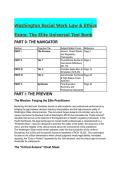
Washington Social Work Law & Ethics
Exam: The Elite Universal Test Bank
PART 0: THE NAVIGATOR
Section Cognitive Tier Subject Matter Focus Reference
PART I The Preview Axioms, Cheat Sheets, Page 2
and Regulatory
Frameworks
PART II Tier 1 Foundational Syntax & Page 4
Hard-Deck Definitions
(Q1-15)
PART III Tier 2 Complex Application & Page 12
Simulation (Q16-35)
PART IV Tier 3 Grandmaster Synthesis Page 28
& High-Stakes Crisis
(Q36-60)
PART V Synthesis Final Executive Page 45
Summary and
Professional Standards
PART I: THE PREVIEW
The Mission: Forging the Elite Practitioner
Mastering this test bank translates directly to elite academic and professional performance by
bridging the gap between abstract statutory interpretation and the high-pressure reality of
Washington State clinical practice. This document forges students into scholars who do not
merely memorize the Revised Code of Washington (RCW) but internalize the "Public Interest"
mandate that serves as the bedrock of the Department of Health's regulatory framework. In the
Pacific Northwest, the legal landscape for mental health professionals is characterized by a
"Protective Bias"—laws are designed to prioritize the safety of the public, the autonomy of the
minor, and the integrity of the clinical record above the convenience of the practitioner.
The Washington State social worker operates under the dual jurisdiction of the Uniform
Disciplinary Act (UDA) and the specific licensure standards of RCW 18.225. This examination
focuses on the critical intersections where clinical judgment meets legal liability: mandated
reporting, the "Duty to Protect" (expanded by the Volk decision), and the unique age-of-consent
thresholds for adolescents.
The "Critical Axioms" Cheat Sheet
,Framework Statutory Reference Key Mandate Timing/Threshold
Mandatory Disclosure WAC 246-809-710 Written info to client Prior to session 1
before treatment
Child Abuse RCW 26.44.030 Report "Reasonable Within 48 hours
Reporting Cause" to DCYF
Vulnerable Adult RCW 74.34.035 Report "Reasonable IMMEDIATELY
Reporting Cause" to DSHS
Minor Consent (MH) RCW 71.34.530 Outpatient Mental Age 13+
Health treatment
Record Access RCW 70.02.080 Provide/respond to 15 Working Days
record requests
Duty to Protect Volk v. DeMeerleer Protect "Foreseeable Imminent/Foreseeable
Victims"
PART II: THE ELITE TEST BANK
Tier 1: Foundational Syntax & Application (Questions 1–15)
Q1: A Licensed Social Work Associate (LSWAIC) is establishing their private practice under the
supervision of an LICSW in Bellevue. According to WAC 246-809-710, which specific detail is
MANDATORY for inclusion in the disclosure statement provided to the client during the first
professional contact? A) The associate's personal home address and emergency contact
number. B) The name, business address, and telephone number of the approved supervisor. C)
A comprehensive list of every client the associate has treated in the last two years. D) The
associate's graduate school GPA and class rank.
● The Answer: B (The name, business address, and telephone number of the approved
supervisor.)
● Distractor Analysis:
○ A is incorrect: While business contact info is required, personal home addresses
are not mandated and represent a significant boundary risk.
○ C is incorrect: Disclosure of other clients would constitute a massive breach of
confidentiality and is prohibited by RCW 18.225.105.
○ D is incorrect: While "education and training" must be disclosed, specific academic
metrics like GPA are not required by WAC 246-809-710.
The Mentor's Analysis: Transparency is the ethical cornerstone of the supervisory relationship.
For the public to be protected, they must know exactly who is providing the clinical oversight for
a pre-licensure candidate. Professional/Academic Intuition: In Washington, the supervisor
is legally "on the hook" for the associate's conduct; therefore, their contact information
must be as accessible to the client as the associate's.
Q2: A client in a community health clinic in Yakima provides a written request to see their mental
health records. Under RCW 70.02.080, the provider has a strict timeline to respond. What is the
MAXIMUM number of days allowed for the provider to make the information available for
examination? A) 30 calendar days. B) 15 working days. C) 21 working days. D) 60 calendar
days.
● The Answer: B (15 working days.)
● Distractor Analysis:
○ A is incorrect: 30 days is the standard under federal HIPAA regulations, but
, Washington's state law is more stringent and takes precedence.
○ C is incorrect: 21 working days is the maximum allowed only if "unusual
circumstances" or records being "in use" justify a documented delay.
○ D is incorrect: 60 days is a legacy or incorrect timeframe that would result in a
violation of the Uniform Disciplinary Act.
The Mentor's Analysis: Washington is a "Fast-Access" state. Practitioners must distinguish
between "working days" and "calendar days" to ensure they do not accidentally miss the 15-day
deadline. Professional/Academic Intuition: When state law provides faster access to
health records than HIPAA, the state law is the "Hard Deck." Mark the 15-day deadline the
moment the request hits your desk.
Q3: A social worker is defining the scope of their practice in a professional bio. According to
RCW 18.225.010, "Independent clinical social work" is distinguished from "Advanced social
work" primarily by which of the following? A) The ability to conduct community organization and
advocacy. B) The diagnosis and treatment of emotional and mental disorders without
supervision. C) The requirement of a Master's degree in Social Work.
| D) The authority to prescribe psychiatric medications.
● The Answer: B (The diagnosis and treatment of emotional and mental disorders without
supervision.)
● Distractor Analysis:
○ A is incorrect: Both "Advanced" and "Independent Clinical" social work involve
advocacy and community organization under the statute.
○ C is incorrect: Both credentials require an MSW from an accredited program.
○ D is incorrect: Social workers in Washington do not have prescriptive authority; this
is reserved for MDs, DOs, and certain ARNP designations.
The Mentor's Analysis: The "Independent" in LICSW refers to the practitioner's ability to
operate without a supervisor's clinical review of their diagnoses and treatment plans. LASWs
(Advanced) have a broad scope but are not authorized for independent clinical diagnosis.
Professional/Academic Intuition: "Independent" status is the "Gold Standard" for private
practice; it represents the state's trust in your autonomous clinical judgment.
Q4: A 14-year-old adolescent in Olympia seeks outpatient mental health therapy for depression
without their parents' knowledge. According to RCW 71.34.530, what is the CORRECT legal
requirement for the social worker? A) The social worker must obtain parental consent before the
first session. B) The social worker may provide treatment, and the parents will NOT be notified
without the minor's consent. C) The social worker must notify the parents within 48 hours that
treatment has started. D) The social worker can only see the minor if they are an emancipated
minor.
● The Answer: B (The social worker may provide treatment, and the parents will NOT be
notified without the minor's consent.)
● Distractor Analysis:
○ A is incorrect: At age 13, the minor holds the legal right to consent to outpatient
mental health care.
○ C is incorrect: Notification is not required for outpatient mental health, unlike
outpatient substance use treatment which has different notification triggers.
○ D is incorrect: Washington law provides this right to all adolescents 13 and older,
regardless of emancipation status.
The Mentor's Analysis: Washington is an "Access First" state for adolescent mental health.
The legislature recognizes that requiring parental consent for a 14-year-old in crisis would
create a barrier to care that could prove fatal. Professional/Academic Intuition: At 13, the
Exam: The Elite Universal Test Bank
PART 0: THE NAVIGATOR
Section Cognitive Tier Subject Matter Focus Reference
PART I The Preview Axioms, Cheat Sheets, Page 2
and Regulatory
Frameworks
PART II Tier 1 Foundational Syntax & Page 4
Hard-Deck Definitions
(Q1-15)
PART III Tier 2 Complex Application & Page 12
Simulation (Q16-35)
PART IV Tier 3 Grandmaster Synthesis Page 28
& High-Stakes Crisis
(Q36-60)
PART V Synthesis Final Executive Page 45
Summary and
Professional Standards
PART I: THE PREVIEW
The Mission: Forging the Elite Practitioner
Mastering this test bank translates directly to elite academic and professional performance by
bridging the gap between abstract statutory interpretation and the high-pressure reality of
Washington State clinical practice. This document forges students into scholars who do not
merely memorize the Revised Code of Washington (RCW) but internalize the "Public Interest"
mandate that serves as the bedrock of the Department of Health's regulatory framework. In the
Pacific Northwest, the legal landscape for mental health professionals is characterized by a
"Protective Bias"—laws are designed to prioritize the safety of the public, the autonomy of the
minor, and the integrity of the clinical record above the convenience of the practitioner.
The Washington State social worker operates under the dual jurisdiction of the Uniform
Disciplinary Act (UDA) and the specific licensure standards of RCW 18.225. This examination
focuses on the critical intersections where clinical judgment meets legal liability: mandated
reporting, the "Duty to Protect" (expanded by the Volk decision), and the unique age-of-consent
thresholds for adolescents.
The "Critical Axioms" Cheat Sheet
,Framework Statutory Reference Key Mandate Timing/Threshold
Mandatory Disclosure WAC 246-809-710 Written info to client Prior to session 1
before treatment
Child Abuse RCW 26.44.030 Report "Reasonable Within 48 hours
Reporting Cause" to DCYF
Vulnerable Adult RCW 74.34.035 Report "Reasonable IMMEDIATELY
Reporting Cause" to DSHS
Minor Consent (MH) RCW 71.34.530 Outpatient Mental Age 13+
Health treatment
Record Access RCW 70.02.080 Provide/respond to 15 Working Days
record requests
Duty to Protect Volk v. DeMeerleer Protect "Foreseeable Imminent/Foreseeable
Victims"
PART II: THE ELITE TEST BANK
Tier 1: Foundational Syntax & Application (Questions 1–15)
Q1: A Licensed Social Work Associate (LSWAIC) is establishing their private practice under the
supervision of an LICSW in Bellevue. According to WAC 246-809-710, which specific detail is
MANDATORY for inclusion in the disclosure statement provided to the client during the first
professional contact? A) The associate's personal home address and emergency contact
number. B) The name, business address, and telephone number of the approved supervisor. C)
A comprehensive list of every client the associate has treated in the last two years. D) The
associate's graduate school GPA and class rank.
● The Answer: B (The name, business address, and telephone number of the approved
supervisor.)
● Distractor Analysis:
○ A is incorrect: While business contact info is required, personal home addresses
are not mandated and represent a significant boundary risk.
○ C is incorrect: Disclosure of other clients would constitute a massive breach of
confidentiality and is prohibited by RCW 18.225.105.
○ D is incorrect: While "education and training" must be disclosed, specific academic
metrics like GPA are not required by WAC 246-809-710.
The Mentor's Analysis: Transparency is the ethical cornerstone of the supervisory relationship.
For the public to be protected, they must know exactly who is providing the clinical oversight for
a pre-licensure candidate. Professional/Academic Intuition: In Washington, the supervisor
is legally "on the hook" for the associate's conduct; therefore, their contact information
must be as accessible to the client as the associate's.
Q2: A client in a community health clinic in Yakima provides a written request to see their mental
health records. Under RCW 70.02.080, the provider has a strict timeline to respond. What is the
MAXIMUM number of days allowed for the provider to make the information available for
examination? A) 30 calendar days. B) 15 working days. C) 21 working days. D) 60 calendar
days.
● The Answer: B (15 working days.)
● Distractor Analysis:
○ A is incorrect: 30 days is the standard under federal HIPAA regulations, but
, Washington's state law is more stringent and takes precedence.
○ C is incorrect: 21 working days is the maximum allowed only if "unusual
circumstances" or records being "in use" justify a documented delay.
○ D is incorrect: 60 days is a legacy or incorrect timeframe that would result in a
violation of the Uniform Disciplinary Act.
The Mentor's Analysis: Washington is a "Fast-Access" state. Practitioners must distinguish
between "working days" and "calendar days" to ensure they do not accidentally miss the 15-day
deadline. Professional/Academic Intuition: When state law provides faster access to
health records than HIPAA, the state law is the "Hard Deck." Mark the 15-day deadline the
moment the request hits your desk.
Q3: A social worker is defining the scope of their practice in a professional bio. According to
RCW 18.225.010, "Independent clinical social work" is distinguished from "Advanced social
work" primarily by which of the following? A) The ability to conduct community organization and
advocacy. B) The diagnosis and treatment of emotional and mental disorders without
supervision. C) The requirement of a Master's degree in Social Work.
| D) The authority to prescribe psychiatric medications.
● The Answer: B (The diagnosis and treatment of emotional and mental disorders without
supervision.)
● Distractor Analysis:
○ A is incorrect: Both "Advanced" and "Independent Clinical" social work involve
advocacy and community organization under the statute.
○ C is incorrect: Both credentials require an MSW from an accredited program.
○ D is incorrect: Social workers in Washington do not have prescriptive authority; this
is reserved for MDs, DOs, and certain ARNP designations.
The Mentor's Analysis: The "Independent" in LICSW refers to the practitioner's ability to
operate without a supervisor's clinical review of their diagnoses and treatment plans. LASWs
(Advanced) have a broad scope but are not authorized for independent clinical diagnosis.
Professional/Academic Intuition: "Independent" status is the "Gold Standard" for private
practice; it represents the state's trust in your autonomous clinical judgment.
Q4: A 14-year-old adolescent in Olympia seeks outpatient mental health therapy for depression
without their parents' knowledge. According to RCW 71.34.530, what is the CORRECT legal
requirement for the social worker? A) The social worker must obtain parental consent before the
first session. B) The social worker may provide treatment, and the parents will NOT be notified
without the minor's consent. C) The social worker must notify the parents within 48 hours that
treatment has started. D) The social worker can only see the minor if they are an emancipated
minor.
● The Answer: B (The social worker may provide treatment, and the parents will NOT be
notified without the minor's consent.)
● Distractor Analysis:
○ A is incorrect: At age 13, the minor holds the legal right to consent to outpatient
mental health care.
○ C is incorrect: Notification is not required for outpatient mental health, unlike
outpatient substance use treatment which has different notification triggers.
○ D is incorrect: Washington law provides this right to all adolescents 13 and older,
regardless of emancipation status.
The Mentor's Analysis: Washington is an "Access First" state for adolescent mental health.
The legislature recognizes that requiring parental consent for a 14-year-old in crisis would
create a barrier to care that could prove fatal. Professional/Academic Intuition: At 13, the


