

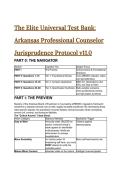
The Elite Universal Test Bank:
Arkansas Professional Counselor
Jurisprudence Protocol v11.0
PART 0: THE NAVIGATOR
Section Cognitive Tier Subject Focus
PART I The Preview Critical Axioms & Foundational
Directives
PART II: Questions 1–15 Tier 1: Foundational Syntax Core ARBOEC statutes, ratios,
and rigid definitions
PART II: Questions 16–35 Tier 2: Complex Application MED Act, Telemedicine (Act
829), and Duty to Warn
PART II: Questions 36–60 Tier 3: Grandmaster Synthesis Multi-variable scenarios,
cross-jurisdictional practice,
and high-stakes synthesis
PART I: THE PREVIEW
Mastery of the Arkansas Board of Examiners in Counseling (ARBOEC) regulatory framework
transforms a standard clinician into an elite, legally insulated practitioner. By internalizing these
state-specific statutes, the practitioner ensures flawless clinical execution while neutralizing
severe civil, criminal, and licensure liabilities.
The "Critical Axioms" Cheat Sheet:
Axiom Category Statutory Mandate Application Trigger
Duty to Warn Immunity exists UNLESS an Violence against
explicit, imminent threat is others/property.
made against an identifiable
victim/property. Notify law
enforcement or arrange
hospitalization.
Minor Suicidality For minors under 18 Minor self-harm/suicide risk.
threatening self-harm, you must
FIRST attempt to notify the
custodial parent.
Mature Minor Consent Arkansas relies on the mature Intelligent unemancipated
,Axiom Category Statutory Mandate Application Trigger
minor doctrine. Unemancipated minors seeking care.
minors of "sufficient
intelligence" can legally
consent to treatment.
Telemedicine Limits Telemedicine shall NOT be Virtual care initiation and minor
used for group therapy group therapy.
provided to a minor (18 or
younger). Audio-only cannot
establish a new relationship.
Supervision Level 1 First 500 direct CCH. Ratio: LAC/LAMFT initial clinical
1:10. Max 50% phase.
technology-assisted. ZERO
indirect hours permitted.
Supervision Level 2 Remaining 2500 CCH. Ratio: LAC/LAMFT secondary clinical
1:20. Maximum 800 indirect phase.
hours permitted.
Disciplinary Limits ARBOEC may impose an Substantive ethical or legal
administrative civil penalty not breaches.
to exceed $500.00 per
violation.
PART II: THE ELITE TEST BANK
Tier 1: Foundational Syntax & Application
Q1: A Licensed Associate Counselor (LAC) is completing their first 400 direct client contact
hours. Based on the ARBOEC supervision statutes, which supervision ratio and format is the
MOST ACCURATE requirement? A) One hour of supervision for every twenty hours of client
contact, completely via telehealth. B) One hour of supervision for every ten hours of client
contact, permitting up to 800 indirect hours. C) One hour of supervision for every ten hours of
client contact, with a maximum of 50% technology-assisted supervision. D) One hour of
supervision for every forty hours of client contact, restricted entirely to face-to-face interaction.
● The Answer: C (One hour of supervision for every ten hours of client contact, with a
maximum of 50% technology-assisted supervision.)
● Distractor Analysis:
○ A is incorrect: The 1:20 ratio only applies to Level 2 (hours 501–3000).
○ B is incorrect: Indirect hours cannot be counted during Level 1 supervision.
○ D is incorrect: This is an outdated legacy ratio not recognized by current ARBOEC
standards.
The Mentor's Analysis: Supervision is tiered by risk and competency. When facing initial
practice (Level 1), the immediate priority is tight oversight. By utilizing the Level 1 1:10 Ratio,
you bypass the common trap of miscalculating early-stage contact hours.
Professional/Academic Intuition: Level 1 demands strict proximity: 1:10 ratio, 500 hours, zero
indirect time, maximum 50% virtual.
Q2: A 16-year-old unemancipated client seeks outpatient mental health treatment. They present
with high cognitive functioning and fully articulate the risks and benefits of therapy. Based on
Arkansas consent laws, which action is the MOST APPROPRIATE? A) Immediately turn the
, minor away until a legal guardian provides written consent. B) Require a court order for
emancipation prior to initiating the intake. C) Treat the minor based on their ability to understand
and appreciate the consequences of the treatment. D) Provide treatment only if the minor is
legally married or pregnant.
● The Answer: C (Treat the minor based on their ability to understand and appreciate the
consequences of the treatment.)
● Distractor Analysis:
○ A is incorrect: This ignores the state's specific statutory exception for intelligent
minors.
○ B is incorrect: Court-ordered emancipation is not required for a minor of sufficient
intelligence to consent.
○ D is incorrect: While married or pregnant minors can consent, the mature minor
doctrine applies broadly to any intelligent minor.
The Mentor's Analysis: Consent is tied to capacity, not strictly chronological age. When facing
an intelligent minor seeking care, the immediate priority is assessing cognitive appreciation of
treatment. By utilizing the mature minor doctrine, you bypass the common trap of unnecessarily
blocking access to care for capable adolescents. Professional/Academic Intuition: In
Arkansas, intelligence overrides emancipation status for medical and psychological consent.
Q3: A Licensed Professional Counselor (LPC) wishes to begin administering Rorschach inkblot
tests in their private practice. Based on the ARBOEC specialization rules, which conclusion is
MOST ACCURATE? A) The LPC may administer the tests if they complete 3 hours of
continuing education in assessment. B) The LPC is strictly prohibited from using projective
techniques for personality assessment unless specifically qualified under another license. C)
The LPC may administer the tests provided they update their Statement of Intent. D) The LPC
may administer the tests under the supervision of a Licensed Associate Counselor.
● The Answer: B (The LPC is strictly prohibited from using projective techniques for
personality assessment unless specifically qualified under another license.)
● Distractor Analysis:
○ A is incorrect: Standard CEUs do not grant the legal authority to bypass
scope-of-practice prohibitions on projective techniques.
○ C is incorrect: Updating a Statement of Intent does not grant authorization for
restricted assessment tools.
○ D is incorrect: An LPC cannot be clinically supervised by a subordinate LAC.
The Mentor's Analysis: Scope of practice is legally rigid regarding diagnostic tools. When
facing the use of projective assessments, the immediate priority is cross-licensure qualification.
By recognizing the appraisal activities restriction, you bypass the common trap of practicing
psychology without a license. Professional/Academic Intuition: ARBOEC strictly isolates
projective techniques; standard appraisal specializations do not cover them.
Q4: A client explicitly threatens to murder their former employer tomorrow at a specific location.
Based on the Arkansas Duty to Warn statute, which action IMMEDIATELY discharges the
therapist's legal duty? A) Warning the employer directly via voicemail. B) Notifying a law
enforcement agency in the county where the victim or patient resides. C) Initiating a 72-hour
hold through the state psychiatric board exclusively. D) Documenting the threat in the clinical
record and consulting a peer.
● The Answer: B (Notifying a law enforcement agency in the county where the victim or
patient resides.)
● Distractor Analysis:
○ A is incorrect: Arkansas statute specifically requires notifying law enforcement or
Arkansas Professional Counselor
Jurisprudence Protocol v11.0
PART 0: THE NAVIGATOR
Section Cognitive Tier Subject Focus
PART I The Preview Critical Axioms & Foundational
Directives
PART II: Questions 1–15 Tier 1: Foundational Syntax Core ARBOEC statutes, ratios,
and rigid definitions
PART II: Questions 16–35 Tier 2: Complex Application MED Act, Telemedicine (Act
829), and Duty to Warn
PART II: Questions 36–60 Tier 3: Grandmaster Synthesis Multi-variable scenarios,
cross-jurisdictional practice,
and high-stakes synthesis
PART I: THE PREVIEW
Mastery of the Arkansas Board of Examiners in Counseling (ARBOEC) regulatory framework
transforms a standard clinician into an elite, legally insulated practitioner. By internalizing these
state-specific statutes, the practitioner ensures flawless clinical execution while neutralizing
severe civil, criminal, and licensure liabilities.
The "Critical Axioms" Cheat Sheet:
Axiom Category Statutory Mandate Application Trigger
Duty to Warn Immunity exists UNLESS an Violence against
explicit, imminent threat is others/property.
made against an identifiable
victim/property. Notify law
enforcement or arrange
hospitalization.
Minor Suicidality For minors under 18 Minor self-harm/suicide risk.
threatening self-harm, you must
FIRST attempt to notify the
custodial parent.
Mature Minor Consent Arkansas relies on the mature Intelligent unemancipated
,Axiom Category Statutory Mandate Application Trigger
minor doctrine. Unemancipated minors seeking care.
minors of "sufficient
intelligence" can legally
consent to treatment.
Telemedicine Limits Telemedicine shall NOT be Virtual care initiation and minor
used for group therapy group therapy.
provided to a minor (18 or
younger). Audio-only cannot
establish a new relationship.
Supervision Level 1 First 500 direct CCH. Ratio: LAC/LAMFT initial clinical
1:10. Max 50% phase.
technology-assisted. ZERO
indirect hours permitted.
Supervision Level 2 Remaining 2500 CCH. Ratio: LAC/LAMFT secondary clinical
1:20. Maximum 800 indirect phase.
hours permitted.
Disciplinary Limits ARBOEC may impose an Substantive ethical or legal
administrative civil penalty not breaches.
to exceed $500.00 per
violation.
PART II: THE ELITE TEST BANK
Tier 1: Foundational Syntax & Application
Q1: A Licensed Associate Counselor (LAC) is completing their first 400 direct client contact
hours. Based on the ARBOEC supervision statutes, which supervision ratio and format is the
MOST ACCURATE requirement? A) One hour of supervision for every twenty hours of client
contact, completely via telehealth. B) One hour of supervision for every ten hours of client
contact, permitting up to 800 indirect hours. C) One hour of supervision for every ten hours of
client contact, with a maximum of 50% technology-assisted supervision. D) One hour of
supervision for every forty hours of client contact, restricted entirely to face-to-face interaction.
● The Answer: C (One hour of supervision for every ten hours of client contact, with a
maximum of 50% technology-assisted supervision.)
● Distractor Analysis:
○ A is incorrect: The 1:20 ratio only applies to Level 2 (hours 501–3000).
○ B is incorrect: Indirect hours cannot be counted during Level 1 supervision.
○ D is incorrect: This is an outdated legacy ratio not recognized by current ARBOEC
standards.
The Mentor's Analysis: Supervision is tiered by risk and competency. When facing initial
practice (Level 1), the immediate priority is tight oversight. By utilizing the Level 1 1:10 Ratio,
you bypass the common trap of miscalculating early-stage contact hours.
Professional/Academic Intuition: Level 1 demands strict proximity: 1:10 ratio, 500 hours, zero
indirect time, maximum 50% virtual.
Q2: A 16-year-old unemancipated client seeks outpatient mental health treatment. They present
with high cognitive functioning and fully articulate the risks and benefits of therapy. Based on
Arkansas consent laws, which action is the MOST APPROPRIATE? A) Immediately turn the
, minor away until a legal guardian provides written consent. B) Require a court order for
emancipation prior to initiating the intake. C) Treat the minor based on their ability to understand
and appreciate the consequences of the treatment. D) Provide treatment only if the minor is
legally married or pregnant.
● The Answer: C (Treat the minor based on their ability to understand and appreciate the
consequences of the treatment.)
● Distractor Analysis:
○ A is incorrect: This ignores the state's specific statutory exception for intelligent
minors.
○ B is incorrect: Court-ordered emancipation is not required for a minor of sufficient
intelligence to consent.
○ D is incorrect: While married or pregnant minors can consent, the mature minor
doctrine applies broadly to any intelligent minor.
The Mentor's Analysis: Consent is tied to capacity, not strictly chronological age. When facing
an intelligent minor seeking care, the immediate priority is assessing cognitive appreciation of
treatment. By utilizing the mature minor doctrine, you bypass the common trap of unnecessarily
blocking access to care for capable adolescents. Professional/Academic Intuition: In
Arkansas, intelligence overrides emancipation status for medical and psychological consent.
Q3: A Licensed Professional Counselor (LPC) wishes to begin administering Rorschach inkblot
tests in their private practice. Based on the ARBOEC specialization rules, which conclusion is
MOST ACCURATE? A) The LPC may administer the tests if they complete 3 hours of
continuing education in assessment. B) The LPC is strictly prohibited from using projective
techniques for personality assessment unless specifically qualified under another license. C)
The LPC may administer the tests provided they update their Statement of Intent. D) The LPC
may administer the tests under the supervision of a Licensed Associate Counselor.
● The Answer: B (The LPC is strictly prohibited from using projective techniques for
personality assessment unless specifically qualified under another license.)
● Distractor Analysis:
○ A is incorrect: Standard CEUs do not grant the legal authority to bypass
scope-of-practice prohibitions on projective techniques.
○ C is incorrect: Updating a Statement of Intent does not grant authorization for
restricted assessment tools.
○ D is incorrect: An LPC cannot be clinically supervised by a subordinate LAC.
The Mentor's Analysis: Scope of practice is legally rigid regarding diagnostic tools. When
facing the use of projective assessments, the immediate priority is cross-licensure qualification.
By recognizing the appraisal activities restriction, you bypass the common trap of practicing
psychology without a license. Professional/Academic Intuition: ARBOEC strictly isolates
projective techniques; standard appraisal specializations do not cover them.
Q4: A client explicitly threatens to murder their former employer tomorrow at a specific location.
Based on the Arkansas Duty to Warn statute, which action IMMEDIATELY discharges the
therapist's legal duty? A) Warning the employer directly via voicemail. B) Notifying a law
enforcement agency in the county where the victim or patient resides. C) Initiating a 72-hour
hold through the state psychiatric board exclusively. D) Documenting the threat in the clinical
record and consulting a peer.
● The Answer: B (Notifying a law enforcement agency in the county where the victim or
patient resides.)
● Distractor Analysis:
○ A is incorrect: Arkansas statute specifically requires notifying law enforcement or


