

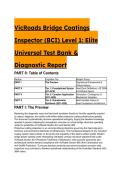
VicRoads Bridge Coatings
Inspector (BCI) Level 1: Elite
Universal Test Bank &
Diagnostic Report
PART 0: Table of Contents
Section Cognitive Tier Subject Focus
PART I The Preview Operational Frameworks &
Critical Axioms
PART II Tier 1: Foundational Syntax Hard Deck Definitions, AS 3894
(Q1–Q10) & VicRoads Specs
PART II Tier 2: Complex Application Simulation, Contingency &
(Q11–Q20) Mechanical Variables
PART II Tier 3: Grandmaster Multi-Variable Failure &
Synthesis (Q21–Q30) Dual-Compliance Architecture
PART I: The Preview
Mastering this diagnostic report and test bank translates directly to the elite capability required
to inspect, diagnose, and certify multi-million-dollar protective coating infrastructure globally.
This document systematically removes operational ambiguity, forging the baseline knowledge
required to prevent catastrophic atmospheric corrosion on critical bridge structures operating
under the jurisdiction of VicRoads Section 631 and Section 685.
Protective coating inspection is an uncompromising discipline governing the thermodynamic,
chemical, and mechanical interfaces of infrastructure. The foundational integrity of any industrial
coating system relies entirely on the purity and angularity of the steel's surface profile. Modern
bridge assets operate under intersecting mandates; primary structural steelwork falls under
VicRoads Section 631 (Protective Treatment of Steelwork), while concrete abutments and
architectural barriers demand compliance with VicRoads Section 685 (Anti-Carbonation and
Anti-Graffiti Protection). To ensure absolute continuity and prevent localized corrosion cells,
inspectors must command a flawless operational understanding of the Australian Standard (AS)
3894 series.
,Table 1.0: Core AS 3894 Diagnostic Testing Protocols
Standard Inspection Parameter Critical Function
AS 3894.1 High-Voltage Continuity Detects holidays/pinholes in
thick-film non-conductive
systems.
AS 3894.2 Wet Sponge Continuity Detects holidays in thin-film
systems using a low-voltage
wetted sponge.
AS 3894.3 Dry Film Thickness (DFT) Quantifies cured polymer
thickness via
magnetic/electromagnetic
induction.
AS 3894.4 Degree of Cure Evaluates the chemical
cross-linking and solvent
resistance of the matrix.
AS 3894.5 Surface Profile Measures the microscopic
anchor amplitude created by
abrasive blasting.
AS 3894.7 Surface Temperature Verifies substrate
thermodynamics against dew
point constraints.
AS 3894.10 Daily Inspection Report The legal daily log of
environmental variables and
hold-point releases.
The "Critical Axioms" Cheat Sheet:
● The Anchor Profile Imperative: Coatings require absolute mechanical adhesion.
VicRoads Section 631 strictly demands a minimum Class 3 finish utilizing crushed, sharp
angular grit. Spherical shot is universally forbidden as it peens rather than cuts the steel
substrate.
● The Thermodynamic Threshold: Coating application is strictly prohibited unless the
steel surface temperature is an absolute minimum of 3°C above the ambient dew point to
avert micro-condensation and subsequent intercoat adhesion failure.
● The Contaminant Hard Deck: Abrasive media must never contain more than 1.0% free
crystalline silica or 0.01% lead. Water-soluble salts in the abrasive must remain below 50
ppm, yielding a strict upper conductivity limit of 30 mS/m.
● The Dual-Compliance Mandate: Steel rusts; concrete carbonates. Projects frequently
utilize Section 631 zinc/epoxy architectures for steel alongside Section 685 single-coat
silane/siloxane systems (e.g., Nanokote ProGuard) that require a >3.5 MPa pull-off
adhesion on concrete substrates.
PART II: THE ELITE TEST BANK
Tier 1: Foundational Syntax & Application
Q1: The VicRoads Section 631 specification establishes strict parameters for the protective
treatment of newly fabricated structural steelwork. When evaluating the abrasive blast cleaning
process prior to primer application, which constraint regarding the abrasive media is the MOST
, ACCURATE? A) Abrasives must consist exclusively of spherical steel shot to ensure a uniform
surface profile without inducing micro-fractures in the substrate. B) Recycled abrasives may be
utilized without laboratory testing provided they are mechanically separated on-site using a
centrifugal reclamation system. C) Abrasives must contain no more than 1.0% free crystalline
silica, no more than 0.01% lead, and water-soluble salts must not exceed 50 ppm. D) The
abrasive blasting process must achieve a minimum of a Class 2.5 surface finish in accordance
with the AS 1627 Part 4 standard.
● The Answer: C (Abrasives must contain no more than 1.0% free crystalline silica, no
more than 0.01% lead, and water-soluble salts must not exceed 50 ppm.)
● Distractor Analysis:
○ A is incorrect: Section 631 explicitly forbids spherical shot and cut wire abrasives;
inspectors must verify the use of crushed, sharp angular grit to achieve the required
mechanical anchor profile.
○ B is incorrect: Recycled materials require strict testing to minimize respirable dust
and confirm chloride/salt limits before authorization is granted.
○ D is incorrect: VicRoads Section 631 mandates a minimum of a Class 3 (White
Metal) surface finish for new steel, representing a higher standard of cleanliness
than Class 2.5.
The Mentor's Analysis: The foundational integrity of any industrial coating system relies
entirely on the purity and angularity of the steel's surface profile. When facing abrasive media
selection, the immediate priority is eliminating substrate contamination prior to primer
application. By utilizing sharp angular grit within strict chemical thresholds, you bypass the
common trap of embedding corrosive or toxic elements into the steel matrix.
Professional/Academic Intuition: A surface profile is a mechanical anchor; if the anchor is dull
(spherical) or poisoned (chlorides/lead), the entire protective envelope is structurally
compromised before the first drop of paint is applied.
Q2: A Quality Assurance (QA) inspector on a VicRoads bridge project utilizes a standardized
metallic gauge with physical notches of known dimensions during the primer application phase.
Based on the fundamental principles of coating inspection, what specific metric is the inspector
measuring, and by what mechanism? A) Dry Film Thickness (DFT) via magnetic induction
according to AS 3894.3. B) Wet Film Thickness (WFT) via capillary action and angular
displacement. C) Surface Profile Amplitude via a spring-loaded micrometre according to AS
3894.5. D) Wet Film Thickness (WFT) via physical notches or gaps pressed directly into the
un-cured film.
● The Answer: D (Wet Film Thickness (WFT) via physical notches or gaps pressed directly
into the un-cured film.)
● Distractor Analysis:
○ A is incorrect: Dry Film Thickness (DFT) testing occurs after the solvent has
evaporated and the coating has cured, typically utilizing magnetic or
electromagnetic induction gauges as specified in AS 3894.3.
○ B is incorrect: Capillary action is a fluid dynamics principle unrelated to the physical
displacement measurement used by standard metallic WFT gauges.
○ C is incorrect: Surface profile is measured on the bare, blasted substrate using a
dial micrometer and replica tape or a needle gauge (AS 3894.5), not a notched tool
during paint application.
The Mentor's Analysis: In-process application control is the primary defense against systemic
coating failure. When facing dynamic paint application, the immediate priority is ensuring the
applicator applies the correct volume of wet product to achieve the targeted dry film. By utilizing
Inspector (BCI) Level 1: Elite
Universal Test Bank &
Diagnostic Report
PART 0: Table of Contents
Section Cognitive Tier Subject Focus
PART I The Preview Operational Frameworks &
Critical Axioms
PART II Tier 1: Foundational Syntax Hard Deck Definitions, AS 3894
(Q1–Q10) & VicRoads Specs
PART II Tier 2: Complex Application Simulation, Contingency &
(Q11–Q20) Mechanical Variables
PART II Tier 3: Grandmaster Multi-Variable Failure &
Synthesis (Q21–Q30) Dual-Compliance Architecture
PART I: The Preview
Mastering this diagnostic report and test bank translates directly to the elite capability required
to inspect, diagnose, and certify multi-million-dollar protective coating infrastructure globally.
This document systematically removes operational ambiguity, forging the baseline knowledge
required to prevent catastrophic atmospheric corrosion on critical bridge structures operating
under the jurisdiction of VicRoads Section 631 and Section 685.
Protective coating inspection is an uncompromising discipline governing the thermodynamic,
chemical, and mechanical interfaces of infrastructure. The foundational integrity of any industrial
coating system relies entirely on the purity and angularity of the steel's surface profile. Modern
bridge assets operate under intersecting mandates; primary structural steelwork falls under
VicRoads Section 631 (Protective Treatment of Steelwork), while concrete abutments and
architectural barriers demand compliance with VicRoads Section 685 (Anti-Carbonation and
Anti-Graffiti Protection). To ensure absolute continuity and prevent localized corrosion cells,
inspectors must command a flawless operational understanding of the Australian Standard (AS)
3894 series.
,Table 1.0: Core AS 3894 Diagnostic Testing Protocols
Standard Inspection Parameter Critical Function
AS 3894.1 High-Voltage Continuity Detects holidays/pinholes in
thick-film non-conductive
systems.
AS 3894.2 Wet Sponge Continuity Detects holidays in thin-film
systems using a low-voltage
wetted sponge.
AS 3894.3 Dry Film Thickness (DFT) Quantifies cured polymer
thickness via
magnetic/electromagnetic
induction.
AS 3894.4 Degree of Cure Evaluates the chemical
cross-linking and solvent
resistance of the matrix.
AS 3894.5 Surface Profile Measures the microscopic
anchor amplitude created by
abrasive blasting.
AS 3894.7 Surface Temperature Verifies substrate
thermodynamics against dew
point constraints.
AS 3894.10 Daily Inspection Report The legal daily log of
environmental variables and
hold-point releases.
The "Critical Axioms" Cheat Sheet:
● The Anchor Profile Imperative: Coatings require absolute mechanical adhesion.
VicRoads Section 631 strictly demands a minimum Class 3 finish utilizing crushed, sharp
angular grit. Spherical shot is universally forbidden as it peens rather than cuts the steel
substrate.
● The Thermodynamic Threshold: Coating application is strictly prohibited unless the
steel surface temperature is an absolute minimum of 3°C above the ambient dew point to
avert micro-condensation and subsequent intercoat adhesion failure.
● The Contaminant Hard Deck: Abrasive media must never contain more than 1.0% free
crystalline silica or 0.01% lead. Water-soluble salts in the abrasive must remain below 50
ppm, yielding a strict upper conductivity limit of 30 mS/m.
● The Dual-Compliance Mandate: Steel rusts; concrete carbonates. Projects frequently
utilize Section 631 zinc/epoxy architectures for steel alongside Section 685 single-coat
silane/siloxane systems (e.g., Nanokote ProGuard) that require a >3.5 MPa pull-off
adhesion on concrete substrates.
PART II: THE ELITE TEST BANK
Tier 1: Foundational Syntax & Application
Q1: The VicRoads Section 631 specification establishes strict parameters for the protective
treatment of newly fabricated structural steelwork. When evaluating the abrasive blast cleaning
process prior to primer application, which constraint regarding the abrasive media is the MOST
, ACCURATE? A) Abrasives must consist exclusively of spherical steel shot to ensure a uniform
surface profile without inducing micro-fractures in the substrate. B) Recycled abrasives may be
utilized without laboratory testing provided they are mechanically separated on-site using a
centrifugal reclamation system. C) Abrasives must contain no more than 1.0% free crystalline
silica, no more than 0.01% lead, and water-soluble salts must not exceed 50 ppm. D) The
abrasive blasting process must achieve a minimum of a Class 2.5 surface finish in accordance
with the AS 1627 Part 4 standard.
● The Answer: C (Abrasives must contain no more than 1.0% free crystalline silica, no
more than 0.01% lead, and water-soluble salts must not exceed 50 ppm.)
● Distractor Analysis:
○ A is incorrect: Section 631 explicitly forbids spherical shot and cut wire abrasives;
inspectors must verify the use of crushed, sharp angular grit to achieve the required
mechanical anchor profile.
○ B is incorrect: Recycled materials require strict testing to minimize respirable dust
and confirm chloride/salt limits before authorization is granted.
○ D is incorrect: VicRoads Section 631 mandates a minimum of a Class 3 (White
Metal) surface finish for new steel, representing a higher standard of cleanliness
than Class 2.5.
The Mentor's Analysis: The foundational integrity of any industrial coating system relies
entirely on the purity and angularity of the steel's surface profile. When facing abrasive media
selection, the immediate priority is eliminating substrate contamination prior to primer
application. By utilizing sharp angular grit within strict chemical thresholds, you bypass the
common trap of embedding corrosive or toxic elements into the steel matrix.
Professional/Academic Intuition: A surface profile is a mechanical anchor; if the anchor is dull
(spherical) or poisoned (chlorides/lead), the entire protective envelope is structurally
compromised before the first drop of paint is applied.
Q2: A Quality Assurance (QA) inspector on a VicRoads bridge project utilizes a standardized
metallic gauge with physical notches of known dimensions during the primer application phase.
Based on the fundamental principles of coating inspection, what specific metric is the inspector
measuring, and by what mechanism? A) Dry Film Thickness (DFT) via magnetic induction
according to AS 3894.3. B) Wet Film Thickness (WFT) via capillary action and angular
displacement. C) Surface Profile Amplitude via a spring-loaded micrometre according to AS
3894.5. D) Wet Film Thickness (WFT) via physical notches or gaps pressed directly into the
un-cured film.
● The Answer: D (Wet Film Thickness (WFT) via physical notches or gaps pressed directly
into the un-cured film.)
● Distractor Analysis:
○ A is incorrect: Dry Film Thickness (DFT) testing occurs after the solvent has
evaporated and the coating has cured, typically utilizing magnetic or
electromagnetic induction gauges as specified in AS 3894.3.
○ B is incorrect: Capillary action is a fluid dynamics principle unrelated to the physical
displacement measurement used by standard metallic WFT gauges.
○ C is incorrect: Surface profile is measured on the bare, blasted substrate using a
dial micrometer and replica tape or a needle gauge (AS 3894.5), not a notched tool
during paint application.
The Mentor's Analysis: In-process application control is the primary defense against systemic
coating failure. When facing dynamic paint application, the immediate priority is ensuring the
applicator applies the correct volume of wet product to achieve the targeted dry film. By utilizing


