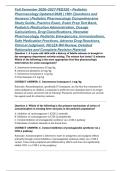
Fall Semester 2026–2027 ATI450 – ATI Comprehensive
Predictor Updated 2026 | 190+ Questions and Answers
| ATI450 Comprehensive Predictor Comprehensive
Study Guide, Practice Exam, Exam Prep Test Bank,
Medical-Surgical Nursing, Pharmacology,
Fundamentals of Nursing, Maternal-Newborn Nursing,
Pediatric Nursing, Mental Health Nursing, Leadership
& Management, Community Health Nursing, Clinical
Judgment, Prioritization, Delegation, Next Generation
NCLEX (NGN), Detailed Rationales and Complete
Revision Material
Question 1: A client who is 24 hours post-operative following an open
cholecystectomy reports sudden onset of severe chest pain and shortness of
breath. The nurse notes a heart rate of 118 bpm, respiratory rate of 28/min,
and an oxygen saturation of 88% on room air. Which action should the nurse
take first?
A. Administer the prescribed PRN morphine sulfate for pain.
B. Apply supplemental oxygen via a non-rebreather mask.
C. Position the client in the left lateral Trendelenburg position.
D. Prepare for an immediate electrocardiogram (ECG).
CORRECT ANSWER: B. Apply supplemental oxygen via a non-rebreather mask.
Rationale: The client's symptoms (sudden chest pain, dyspnea, tachycardia, and
hypoxia) are classic signs of a pulmonary embolism, a life-threatening post-operative
complication. The priority intervention is to correct the life-threatening hypoxia.
Applying a non-rebreather mask at 100% oxygen is the first step to maximize
oxygenation. While the other options may be part of the subsequent treatment plan,
they are not the immediate priority.
Question 2: A nurse is providing discharge teaching to a client with a new
diagnosis of heart failure. Which statement by the client indicates a need for
further teaching?
A. "I will weigh myself every morning before breakfast and after I empty my bladder."
B. "I will limit my daily sodium intake to less than 2,000 mg per day."
C. "I can stop taking my furosemide if I feel dizzy."
D. "I will rest between activities and pace myself throughout the day."
CORRECT ANSWER: C. "I can stop taking my furosemide if I feel dizzy."
Rationale: Dizziness can be a side effect of furosemide due to hypotension or electrolyte
imbalance. The client should notify the healthcare provider of this symptom rather than
stopping the medication, as this can lead to fluid overload and worsening heart failure.
,The other statements indicate correct understanding of self-management strategies for
heart failure.
Question 3: A nurse is caring for a client receiving a continuous tube feeding
via a nasogastric tube. What is the most important action for the nurse to take
to prevent aspiration?
A. Flush the tube with 50 mL of air every 4 hours.
B. Elevate the head of the bed to at least 30 degrees continuously.
C. Change the feeding bag and tubing every 72 hours.
D. Verify tube placement by auscultation of injected air every shift.
CORRECT ANSWER: B. Elevate the head of the bed to at least 30 degrees
continuously.
Rationale: Maintaining the head of the bed at 30 to 45 degrees is the most critical
intervention to prevent aspiration during enteral feedings. This position uses gravity to
help keep gastric contents in the stomach. While verifying placement and changing
tubing are important, they do not directly prevent aspiration as effectively as proper
positioning.
Question 4: A client with schizophrenia is prescribed haloperidol. The nurse
should monitor the client for which of the following adverse effects?
A. Weight gain and hyperglycemia.
B. Tardive dyskinesia and dystonia.
C. Blurred vision and urinary retention.
D. Dry mouth and tachycardia.
CORRECT ANSWER: B. Tardive dyskinesia and dystonia.
Rationale: Haloperidol is a typical (first-generation) antipsychotic. It is known for a high
risk of extrapyramidal side effects (EPS), including acute dystonia, parkinsonism,
akathisia, and tardive dyskinesia (a late-onset, potentially irreversible movement
disorder). The other options are more commonly associated with atypical antipsychotics
or anticholinergic side effects.
Question 5: A nurse is preparing to administer an intradermal injection. Which
angle of insertion is correct for this route?
A. 5 to 15 degrees
B. 45 degrees
C. 90 degrees
D. 25 to 30 degrees
,CORRECT ANSWER: A. 5 to 15 degrees.
Rationale: Intradermal injections, such as a tuberculin skin test, are administered into
the dermis layer of the skin. The needle is inserted at a very shallow angle,
approximately 5 to 15 degrees, with the bevel facing up to ensure the medication is
deposited just below the epidermis. A 90-degree angle is used for intramuscular
injections, and a 45-degree angle is used for subcutaneous injections in some cases.
Question 6: A nurse is assessing a client in the immediate post-operative
period after a thyroidectomy. Which of the following findings requires the
nurse's priority action?
A. Pain rated 4 out of 10 on a numeric scale.
B. Serosanguineous drainage on the dressing.
C. Stridor upon inspiration.
D. Hoarse voice.
CORRECT ANSWER: C. Stridor upon inspiration.
Rationale: Stridor is a high-pitched, harsh sound on inspiration that indicates airway
obstruction. After a thyroidectomy, this is a sign of laryngeal edema or a hematoma
compressing the trachea, which can be life-threatening. This finding represents a critical
airway issue and requires immediate intervention. Pain, drainage, and hoarseness are
expected findings but are not as urgent.
Question 7: A nurse is providing education to a client prescribed an MAOI for
depression. Which dietary restriction should the nurse include in the teaching?
A. Foods high in tyramine, such as aged cheese and cured meats.
B. Foods high in potassium, such as bananas and oranges.
C. Foods high in fiber, such as whole grains and beans.
D. Foods high in calcium, such as milk and yogurt.
CORRECT ANSWER: A. Foods high in tyramine, such as aged cheese and cured
meats.
Rationale: Monoamine oxidase inhibitors (MAOIs) block the enzyme that breaks down
tyramine. Consuming high-tyramine foods can lead to a hypertensive crisis, a severe and
potentially fatal condition. Foods to avoid include aged cheeses, cured meats, avocados,
and fermented foods.
Question 8: A client is admitted with a diagnosis of hypovolemic shock
secondary to gastrointestinal bleeding. Which of the following laboratory
values is the nurse most likely to find?
, A. Decreased hemoglobin and hematocrit.
B. Decreased serum sodium.
C. Increased serum potassium.
D. Increased platelet count.
CORRECT ANSWER: A. Decreased hemoglobin and hematocrit.
Rationale: In hypovolemic shock due to bleeding, there is a loss of whole blood, which
contains both red blood cells and plasma. This loss directly leads to a decrease in
hemoglobin and hematocrit levels. While other electrolyte imbalances can occur, the
hallmark finding is acute anemia.
Question 9: A nurse is reinforcing teaching on fall prevention with the family
of an elderly client with dementia. Which suggestion is most appropriate?
A. Keep a nightlight on in the client's room and hallway.
B. Place a large, colorful rug on the floor to provide traction.
C. Encourage the client to wear non-skid socks with a loose fit.
D. Keep the client's bed in the high position to ease egress.
CORRECT ANSWER: A. Keep a nightlight on in the client's room and hallway.
Rationale: Ensuring adequate lighting, especially during nighttime, is a key fall
prevention strategy. It helps the client navigate safely to the bathroom. Rugs are a
tripping hazard, loose non-skid socks can cause falls, and a low bed position is safer to
minimize injury if the client falls during egress.
Question 10: The nurse is caring for a client receiving IV heparin therapy.
Which laboratory value is most important to monitor to determine the
therapeutic effect of this medication?
A. Prothrombin time (PT).
B. Activated partial thromboplastin time (aPTT).
C. International normalized ratio (INR).
D. Platelet count.
CORRECT ANSWER: B. Activated partial thromboplastin time (aPTT).
Rationale: Heparin affects the intrinsic pathway of the coagulation cascade, which is
monitored by the aPTT. The therapeutic goal for a client on a continuous IV heparin
infusion is usually an aPTT that is 1.5 to 2.5 times the normal control value. PT and INR
are used to monitor warfarin (Coumadin) therapy.
Question 11: A nurse is performing a Glasgow Coma Scale (GCS) assessment
on a client who experienced a head injury. The client opens eyes to pain,
Predictor Updated 2026 | 190+ Questions and Answers
| ATI450 Comprehensive Predictor Comprehensive
Study Guide, Practice Exam, Exam Prep Test Bank,
Medical-Surgical Nursing, Pharmacology,
Fundamentals of Nursing, Maternal-Newborn Nursing,
Pediatric Nursing, Mental Health Nursing, Leadership
& Management, Community Health Nursing, Clinical
Judgment, Prioritization, Delegation, Next Generation
NCLEX (NGN), Detailed Rationales and Complete
Revision Material
Question 1: A client who is 24 hours post-operative following an open
cholecystectomy reports sudden onset of severe chest pain and shortness of
breath. The nurse notes a heart rate of 118 bpm, respiratory rate of 28/min,
and an oxygen saturation of 88% on room air. Which action should the nurse
take first?
A. Administer the prescribed PRN morphine sulfate for pain.
B. Apply supplemental oxygen via a non-rebreather mask.
C. Position the client in the left lateral Trendelenburg position.
D. Prepare for an immediate electrocardiogram (ECG).
CORRECT ANSWER: B. Apply supplemental oxygen via a non-rebreather mask.
Rationale: The client's symptoms (sudden chest pain, dyspnea, tachycardia, and
hypoxia) are classic signs of a pulmonary embolism, a life-threatening post-operative
complication. The priority intervention is to correct the life-threatening hypoxia.
Applying a non-rebreather mask at 100% oxygen is the first step to maximize
oxygenation. While the other options may be part of the subsequent treatment plan,
they are not the immediate priority.
Question 2: A nurse is providing discharge teaching to a client with a new
diagnosis of heart failure. Which statement by the client indicates a need for
further teaching?
A. "I will weigh myself every morning before breakfast and after I empty my bladder."
B. "I will limit my daily sodium intake to less than 2,000 mg per day."
C. "I can stop taking my furosemide if I feel dizzy."
D. "I will rest between activities and pace myself throughout the day."
CORRECT ANSWER: C. "I can stop taking my furosemide if I feel dizzy."
Rationale: Dizziness can be a side effect of furosemide due to hypotension or electrolyte
imbalance. The client should notify the healthcare provider of this symptom rather than
stopping the medication, as this can lead to fluid overload and worsening heart failure.
,The other statements indicate correct understanding of self-management strategies for
heart failure.
Question 3: A nurse is caring for a client receiving a continuous tube feeding
via a nasogastric tube. What is the most important action for the nurse to take
to prevent aspiration?
A. Flush the tube with 50 mL of air every 4 hours.
B. Elevate the head of the bed to at least 30 degrees continuously.
C. Change the feeding bag and tubing every 72 hours.
D. Verify tube placement by auscultation of injected air every shift.
CORRECT ANSWER: B. Elevate the head of the bed to at least 30 degrees
continuously.
Rationale: Maintaining the head of the bed at 30 to 45 degrees is the most critical
intervention to prevent aspiration during enteral feedings. This position uses gravity to
help keep gastric contents in the stomach. While verifying placement and changing
tubing are important, they do not directly prevent aspiration as effectively as proper
positioning.
Question 4: A client with schizophrenia is prescribed haloperidol. The nurse
should monitor the client for which of the following adverse effects?
A. Weight gain and hyperglycemia.
B. Tardive dyskinesia and dystonia.
C. Blurred vision and urinary retention.
D. Dry mouth and tachycardia.
CORRECT ANSWER: B. Tardive dyskinesia and dystonia.
Rationale: Haloperidol is a typical (first-generation) antipsychotic. It is known for a high
risk of extrapyramidal side effects (EPS), including acute dystonia, parkinsonism,
akathisia, and tardive dyskinesia (a late-onset, potentially irreversible movement
disorder). The other options are more commonly associated with atypical antipsychotics
or anticholinergic side effects.
Question 5: A nurse is preparing to administer an intradermal injection. Which
angle of insertion is correct for this route?
A. 5 to 15 degrees
B. 45 degrees
C. 90 degrees
D. 25 to 30 degrees
,CORRECT ANSWER: A. 5 to 15 degrees.
Rationale: Intradermal injections, such as a tuberculin skin test, are administered into
the dermis layer of the skin. The needle is inserted at a very shallow angle,
approximately 5 to 15 degrees, with the bevel facing up to ensure the medication is
deposited just below the epidermis. A 90-degree angle is used for intramuscular
injections, and a 45-degree angle is used for subcutaneous injections in some cases.
Question 6: A nurse is assessing a client in the immediate post-operative
period after a thyroidectomy. Which of the following findings requires the
nurse's priority action?
A. Pain rated 4 out of 10 on a numeric scale.
B. Serosanguineous drainage on the dressing.
C. Stridor upon inspiration.
D. Hoarse voice.
CORRECT ANSWER: C. Stridor upon inspiration.
Rationale: Stridor is a high-pitched, harsh sound on inspiration that indicates airway
obstruction. After a thyroidectomy, this is a sign of laryngeal edema or a hematoma
compressing the trachea, which can be life-threatening. This finding represents a critical
airway issue and requires immediate intervention. Pain, drainage, and hoarseness are
expected findings but are not as urgent.
Question 7: A nurse is providing education to a client prescribed an MAOI for
depression. Which dietary restriction should the nurse include in the teaching?
A. Foods high in tyramine, such as aged cheese and cured meats.
B. Foods high in potassium, such as bananas and oranges.
C. Foods high in fiber, such as whole grains and beans.
D. Foods high in calcium, such as milk and yogurt.
CORRECT ANSWER: A. Foods high in tyramine, such as aged cheese and cured
meats.
Rationale: Monoamine oxidase inhibitors (MAOIs) block the enzyme that breaks down
tyramine. Consuming high-tyramine foods can lead to a hypertensive crisis, a severe and
potentially fatal condition. Foods to avoid include aged cheeses, cured meats, avocados,
and fermented foods.
Question 8: A client is admitted with a diagnosis of hypovolemic shock
secondary to gastrointestinal bleeding. Which of the following laboratory
values is the nurse most likely to find?
, A. Decreased hemoglobin and hematocrit.
B. Decreased serum sodium.
C. Increased serum potassium.
D. Increased platelet count.
CORRECT ANSWER: A. Decreased hemoglobin and hematocrit.
Rationale: In hypovolemic shock due to bleeding, there is a loss of whole blood, which
contains both red blood cells and plasma. This loss directly leads to a decrease in
hemoglobin and hematocrit levels. While other electrolyte imbalances can occur, the
hallmark finding is acute anemia.
Question 9: A nurse is reinforcing teaching on fall prevention with the family
of an elderly client with dementia. Which suggestion is most appropriate?
A. Keep a nightlight on in the client's room and hallway.
B. Place a large, colorful rug on the floor to provide traction.
C. Encourage the client to wear non-skid socks with a loose fit.
D. Keep the client's bed in the high position to ease egress.
CORRECT ANSWER: A. Keep a nightlight on in the client's room and hallway.
Rationale: Ensuring adequate lighting, especially during nighttime, is a key fall
prevention strategy. It helps the client navigate safely to the bathroom. Rugs are a
tripping hazard, loose non-skid socks can cause falls, and a low bed position is safer to
minimize injury if the client falls during egress.
Question 10: The nurse is caring for a client receiving IV heparin therapy.
Which laboratory value is most important to monitor to determine the
therapeutic effect of this medication?
A. Prothrombin time (PT).
B. Activated partial thromboplastin time (aPTT).
C. International normalized ratio (INR).
D. Platelet count.
CORRECT ANSWER: B. Activated partial thromboplastin time (aPTT).
Rationale: Heparin affects the intrinsic pathway of the coagulation cascade, which is
monitored by the aPTT. The therapeutic goal for a client on a continuous IV heparin
infusion is usually an aPTT that is 1.5 to 2.5 times the normal control value. PT and INR
are used to monitor warfarin (Coumadin) therapy.
Question 11: A nurse is performing a Glasgow Coma Scale (GCS) assessment
on a client who experienced a head injury. The client opens eyes to pain,