

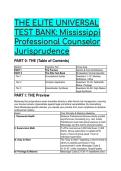
THE ELITE UNIVERSAL
TEST BANK: Mississippi
Professional Counselor
Jurisprudence
PART 0: THE (Table of Contents)
Section Cognitive Tier Focus Area
PART I The Preview Axioms & Core Architecture
PART II The Elite Test Bank 60-Question Clinical Gauntlet
- Tier 1 Foundational Syntax Questions 1–15: Statutes,
Definitions, CEUs
- Tier 2 Complex Application Questions 16–35: Telehealth,
Ratios, Privilege
- Tier 3 Grandmaster Synthesis Questions 36–60: High-Stakes
Legal Synthesis
PART I: THE Preview
Mastering this jurisprudence exam translates directly to elite clinical risk management, ensuring
your license remains impenetrable against legal and ethical vulnerabilities. By internalizing
these Mississippi-specific statutes, you elevate your practice from mere compliance to absolute
professional mastery.
Axiom Core Principle & Statutory Baseline
I. Telemental Health Distance Professional Services strictly prohibit
asynchronous counseling (e.g., text, email).
Practitioners must hold active licensure in both
Mississippi and the client's physical location.
II. Supervision Math P-LPCs must accrue 3,000 total hours (1,200
direct). Group supervision is capped at 50
hours; 2 hours of group equal 1 hour of
individual supervision.
III. Duty to Warn The "Duty to Warn" regarding a client's threat to
others is explicitly permissive ("may
communicate") under Mississippi Code §
41-21-97, unlike mandatory Tarasoff states.
IV. Privilege & Waivers Mississippi Code § 73-30-17 establishes strict
,Axiom Core Principle & Statutory Baseline
non-disclosure, waived only by written consent,
imminent harm/suicide, or if the client brings
formal charges against the LPC.
V. Abuse Reporting Child abuse (§ 43-21-353) and vulnerable adult
abuse (§ 43-47-7) reporting is absolute,
immediate, and mandatory, overriding all
clinical confidentiality.
PART II: THE ELITE TEST BANK
Tier 1: Foundational Syntax & Application
Q1: A fully licensed LPC is preparing for biennial license renewal. Which combination of
Continuing Education Hours (CEH) reflects the EXACT minimum Mississippi Board
requirement? A) 40 total hours, including 4 hours of ethics and 2 hours of cultural diversity. B)
24 total hours, including 6 hours of professional ethics/legal issues. C) 24 total hours, including
4 hours of ethics and 1 hour of mandated reporting. D) 20 total hours, including 6 hours of
ethics.
● The Answer: B (24 total hours, including 6 hours of professional ethics/legal issues.)
● Distractor Analysis:
○ A is incorrect: This is the continuing education standard for Mississippi Social
Workers , not LPCs.
○ C is incorrect: This blends social work and LPC requirements; LPCs specifically
require 6 ethics hours.
○ D is incorrect: 20 hours is an outdated or out-of-state standard.
The Mentor's Analysis: Licensees frequently confuse LPC requirements with those of Social
Workers. The LPC standard is distinct and rigid, originating from Rule 6.2.
Professional/Academic Intuition: LPCs live by the 24/6 rule: 24 total CEHs biennially, with
exactly 6 dedicated to ethics and legal issues.
Q2: A Provisional Licensed Professional Counselor (P-LPC) transitions to a new Board
Qualified Supervisor (LPC-S). Which action is MOST APPROPRIATE regarding
documentation? A) Submit a transfer letter signed by both supervisors within 30 days. B)
Continue using the original Declaration of Practice until renewal. C) Immediately submit an
updated Declaration of Practice to the Board. D) Retain the original Declaration but log the new
supervisor online.
● The Answer: C (Immediately submit an updated Declaration of Practice to the Board.)
● Distractor Analysis:
○ A is incorrect: A transfer letter does not satisfy the statutory Declaration of Practice
requirement.
○ B is incorrect: Waiting until renewal places the P-LPC out of compliance.
○ D is incorrect: Logging data online does not replace formal document submission.
The Mentor's Analysis: The Declaration of Practice serves as the ultimate informed consent
baseline. Whenever oversight variables change, the contract with the public changes.
Professional/Academic Intuition: Any change in a P-LPC's clinical site or supervisor
mandates an immediate update to the Declaration of Practice.
Q3: According to Mississippi Code § 41-21-97, an adult client reveals an actionable plan to
murder a neighbor. How does the statute classify the LPC's obligation to warn the victim? A)
, Strictly prohibited under HIPAA without a court order. B) A mandatory requirement triggering
immediate legal liability if ignored. C) Permissive, granting the LPC discretion to communicate
the threat. D) Mandatory only if the intended victim is a minor.
● The Answer: C (Permissive, granting the LPC discretion to communicate the threat.)
● Distractor Analysis:
○ A is incorrect: The statute provides an explicit carve-out allowing disclosure for
actual threats.
○ B is incorrect: Unlike mandatory Tarasoff states, Mississippi law states the therapist
"may" communicate the threat.
○ D is incorrect: The permissive nature applies universally.
The Mentor's Analysis: Mississippi utilizes "permissive" language, shielding clinicians from
mandatory civil liability while allowing them to act to save a life. Professional/Academic
Intuition: In Mississippi, Duty to Warn is a statutory "may," not a "must".
Q4: A Mississippi LPC holds the Distance Professional Services designation. Which modality is
STRICTLY PROHIBITED by the Board for delivering direct counseling? A) Synchronous video
conferencing utilizing a HIPAA-compliant platform. B) Verbal telephone communications during
a session. C) Asynchronous methods, including email, text messaging, and chat rooms. D)
Two-way audiovisual links with no perceivable delay.
● The Answer: C (Asynchronous methods, including email, text messaging, and chat
rooms.)
● Distractor Analysis:
○ A is incorrect: Synchronous video is the standard for distance services.
○ B is incorrect: Verbal telephone communication is explicitly permitted.
○ D is incorrect: This defines permitted synchronous communication.
The Mentor's Analysis: Therapy requires real-time clinical assessment. Time-delayed
communication destroys the clinician's ability to assess affect and immediate safety.
Professional/Academic Intuition: If it is not live and simultaneous, it is not legally
recognized counseling in Mississippi.
Q5: An LPC-S is auditing a P-LPC's final log of 3,000 total hours. According to Rule 4.3, what is
the MINIMUM number of hours that must consist of Direct Services? A) 1,000 hours B) 1,200
hours C) 1,500 hours D) 2,000 hours
● The Answer: B (1,200 hours)
● Distractor Analysis:
○ A is incorrect: 1,000 hours falls short of Mississippi's mandate.
○ C is incorrect: Overestimates the direct service requirement.
○ D is incorrect: An arbitrary inflation of the direct service mandate.
The Mentor's Analysis: The Board requires a precise balance between theoretical learning
and actual client contact. Exactly 1,200 hours must be face-to-face or synchronous direct care.
Professional/Academic Intuition: The mathematical backbone of Mississippi LPC
licensure is 3,000 total hours with 1,200 direct service hours.
Q6: Under Mississippi Code § 43-21-353, an LPC suspects a 10-year-old client is being
sexually abused. Which action is the FIRST legally mandated step? A) Contact the alleged
abuser to gather corroborating evidence. B) Cause an oral report to be made immediately by
telephone or otherwise to the Department of Child Protection Services. C) Submit a written
report to the LPC Board within 72 hours. D) Wait for the next supervision session to obtain the
LPC-S's consent.
● The Answer: B (Cause an oral report to be made immediately by telephone or otherwise
to the Department of Child Protection Services.)
TEST BANK: Mississippi
Professional Counselor
Jurisprudence
PART 0: THE (Table of Contents)
Section Cognitive Tier Focus Area
PART I The Preview Axioms & Core Architecture
PART II The Elite Test Bank 60-Question Clinical Gauntlet
- Tier 1 Foundational Syntax Questions 1–15: Statutes,
Definitions, CEUs
- Tier 2 Complex Application Questions 16–35: Telehealth,
Ratios, Privilege
- Tier 3 Grandmaster Synthesis Questions 36–60: High-Stakes
Legal Synthesis
PART I: THE Preview
Mastering this jurisprudence exam translates directly to elite clinical risk management, ensuring
your license remains impenetrable against legal and ethical vulnerabilities. By internalizing
these Mississippi-specific statutes, you elevate your practice from mere compliance to absolute
professional mastery.
Axiom Core Principle & Statutory Baseline
I. Telemental Health Distance Professional Services strictly prohibit
asynchronous counseling (e.g., text, email).
Practitioners must hold active licensure in both
Mississippi and the client's physical location.
II. Supervision Math P-LPCs must accrue 3,000 total hours (1,200
direct). Group supervision is capped at 50
hours; 2 hours of group equal 1 hour of
individual supervision.
III. Duty to Warn The "Duty to Warn" regarding a client's threat to
others is explicitly permissive ("may
communicate") under Mississippi Code §
41-21-97, unlike mandatory Tarasoff states.
IV. Privilege & Waivers Mississippi Code § 73-30-17 establishes strict
,Axiom Core Principle & Statutory Baseline
non-disclosure, waived only by written consent,
imminent harm/suicide, or if the client brings
formal charges against the LPC.
V. Abuse Reporting Child abuse (§ 43-21-353) and vulnerable adult
abuse (§ 43-47-7) reporting is absolute,
immediate, and mandatory, overriding all
clinical confidentiality.
PART II: THE ELITE TEST BANK
Tier 1: Foundational Syntax & Application
Q1: A fully licensed LPC is preparing for biennial license renewal. Which combination of
Continuing Education Hours (CEH) reflects the EXACT minimum Mississippi Board
requirement? A) 40 total hours, including 4 hours of ethics and 2 hours of cultural diversity. B)
24 total hours, including 6 hours of professional ethics/legal issues. C) 24 total hours, including
4 hours of ethics and 1 hour of mandated reporting. D) 20 total hours, including 6 hours of
ethics.
● The Answer: B (24 total hours, including 6 hours of professional ethics/legal issues.)
● Distractor Analysis:
○ A is incorrect: This is the continuing education standard for Mississippi Social
Workers , not LPCs.
○ C is incorrect: This blends social work and LPC requirements; LPCs specifically
require 6 ethics hours.
○ D is incorrect: 20 hours is an outdated or out-of-state standard.
The Mentor's Analysis: Licensees frequently confuse LPC requirements with those of Social
Workers. The LPC standard is distinct and rigid, originating from Rule 6.2.
Professional/Academic Intuition: LPCs live by the 24/6 rule: 24 total CEHs biennially, with
exactly 6 dedicated to ethics and legal issues.
Q2: A Provisional Licensed Professional Counselor (P-LPC) transitions to a new Board
Qualified Supervisor (LPC-S). Which action is MOST APPROPRIATE regarding
documentation? A) Submit a transfer letter signed by both supervisors within 30 days. B)
Continue using the original Declaration of Practice until renewal. C) Immediately submit an
updated Declaration of Practice to the Board. D) Retain the original Declaration but log the new
supervisor online.
● The Answer: C (Immediately submit an updated Declaration of Practice to the Board.)
● Distractor Analysis:
○ A is incorrect: A transfer letter does not satisfy the statutory Declaration of Practice
requirement.
○ B is incorrect: Waiting until renewal places the P-LPC out of compliance.
○ D is incorrect: Logging data online does not replace formal document submission.
The Mentor's Analysis: The Declaration of Practice serves as the ultimate informed consent
baseline. Whenever oversight variables change, the contract with the public changes.
Professional/Academic Intuition: Any change in a P-LPC's clinical site or supervisor
mandates an immediate update to the Declaration of Practice.
Q3: According to Mississippi Code § 41-21-97, an adult client reveals an actionable plan to
murder a neighbor. How does the statute classify the LPC's obligation to warn the victim? A)
, Strictly prohibited under HIPAA without a court order. B) A mandatory requirement triggering
immediate legal liability if ignored. C) Permissive, granting the LPC discretion to communicate
the threat. D) Mandatory only if the intended victim is a minor.
● The Answer: C (Permissive, granting the LPC discretion to communicate the threat.)
● Distractor Analysis:
○ A is incorrect: The statute provides an explicit carve-out allowing disclosure for
actual threats.
○ B is incorrect: Unlike mandatory Tarasoff states, Mississippi law states the therapist
"may" communicate the threat.
○ D is incorrect: The permissive nature applies universally.
The Mentor's Analysis: Mississippi utilizes "permissive" language, shielding clinicians from
mandatory civil liability while allowing them to act to save a life. Professional/Academic
Intuition: In Mississippi, Duty to Warn is a statutory "may," not a "must".
Q4: A Mississippi LPC holds the Distance Professional Services designation. Which modality is
STRICTLY PROHIBITED by the Board for delivering direct counseling? A) Synchronous video
conferencing utilizing a HIPAA-compliant platform. B) Verbal telephone communications during
a session. C) Asynchronous methods, including email, text messaging, and chat rooms. D)
Two-way audiovisual links with no perceivable delay.
● The Answer: C (Asynchronous methods, including email, text messaging, and chat
rooms.)
● Distractor Analysis:
○ A is incorrect: Synchronous video is the standard for distance services.
○ B is incorrect: Verbal telephone communication is explicitly permitted.
○ D is incorrect: This defines permitted synchronous communication.
The Mentor's Analysis: Therapy requires real-time clinical assessment. Time-delayed
communication destroys the clinician's ability to assess affect and immediate safety.
Professional/Academic Intuition: If it is not live and simultaneous, it is not legally
recognized counseling in Mississippi.
Q5: An LPC-S is auditing a P-LPC's final log of 3,000 total hours. According to Rule 4.3, what is
the MINIMUM number of hours that must consist of Direct Services? A) 1,000 hours B) 1,200
hours C) 1,500 hours D) 2,000 hours
● The Answer: B (1,200 hours)
● Distractor Analysis:
○ A is incorrect: 1,000 hours falls short of Mississippi's mandate.
○ C is incorrect: Overestimates the direct service requirement.
○ D is incorrect: An arbitrary inflation of the direct service mandate.
The Mentor's Analysis: The Board requires a precise balance between theoretical learning
and actual client contact. Exactly 1,200 hours must be face-to-face or synchronous direct care.
Professional/Academic Intuition: The mathematical backbone of Mississippi LPC
licensure is 3,000 total hours with 1,200 direct service hours.
Q6: Under Mississippi Code § 43-21-353, an LPC suspects a 10-year-old client is being
sexually abused. Which action is the FIRST legally mandated step? A) Contact the alleged
abuser to gather corroborating evidence. B) Cause an oral report to be made immediately by
telephone or otherwise to the Department of Child Protection Services. C) Submit a written
report to the LPC Board within 72 hours. D) Wait for the next supervision session to obtain the
LPC-S's consent.
● The Answer: B (Cause an oral report to be made immediately by telephone or otherwise
to the Department of Child Protection Services.)


