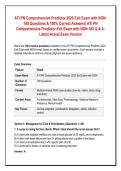
ATI PN Comprehensive Predictor 2026 Exit Exam with NGN:
180 Questions & 100% Correct Answers| ATI PN
Comprehensive Predictor Exit Exam with NGN 180 Q & A:
Latest Actual Exam Version
Below are 180 practice questions modeled on the ATI PN Comprehensive Predictor 2023
Exit Exam with NGN format, based on verified exam documents . Each answer includes a
detailed rationale to reinforce clinical judgment and exam readiness .
Exam Overview
Feature Detail
Exam Name ATI PN Comprehensive Predictor 2023 Exit Exam with NGN
Number of 180 Questions
Questions
Format Multiple-choice, NGN case studies (bow-tie, matrix, cloze, drag-
and-drop)
Content Areas Fundamentals, Med-Surg, Pharmacology, Maternal-Newborn,
Pediatrics, Mental Health
Key Focus Clinical judgment, prioritization, delegation, safety, infection
control
Section 1: Management of Care & Prioritization (Questions 1–20)
1. A nurse is caring for four clients. Which client should the nurse assess first?
A) A client with diabetes mellitus who has a blood glucose of 55 mg/dL and is diaphoretic.
B) A client with heart failure who has 2+ pitting edema and crackles in the bases.
C) A client post-operative day 1 who reports pain of 6/10.
D) A client with a history of seizures who is watching television.
Answer: A
,Rationale: Hypoglycemia (55 mg/dL) with diaphoresis indicates an acute, life-threatening
condition that requires immediate intervention. Safety and ABCs (Airway, Breathing,
Circulation) take priority; hypoglycemia affects cerebral function .
2. A charge nurse is assigning staff for a shift. Which task should be delegated to a
Licensed Practical Nurse (LPN)?
A) Performing the initial admission assessment on a client with pneumonia.
B) Creating the plan of care for a client with a fractured hip.
C) Administering an IV push antibiotic to a client with a central line.
D) Administering a tube feeding to a client with a gastrostomy tube.
Answer: D
Rationale: LPNs can administer enteral feedings and monitor stable clients. Initial
assessments, care planning, and IV push medications are typically reserved for RNs .
3. A nurse is providing discharge teaching to a client who speaks a different
language. An interpreter is present. Where should the nurse sit?
A) Next to the interpreter, facing the client.
B) Behind the client to avoid distractions.
C) Facing the client, with the interpreter beside the nurse.
D) Next to the client, with the interpreter behind the nurse.
Answer: C
Rationale: The nurse should maintain eye contact with the client to show respect and
engagement, while the interpreter sits slightly behind or beside the nurse to facilitate
communication .
4. A nurse is preparing to transfer a client from the bed to a stretcher. Which action
demonstrates proper body mechanics?
A) Twisting at the waist to reach for the client.
B) Bending at the knees and keeping the back straight.
C) Keeping feet together to create a stable base.
D) Lifting with the back muscles.
,Answer: B
Rationale: Proper body mechanics require using the strong leg muscles, maintaining a
wide base of support, and keeping the back straight to prevent injury .
5. A client refuses to take their prescribed medication. What is the appropriate
nursing action?
A) Hide the medication in the client's food.
B) Document the refusal and notify the provider.
C) Tell the client they will not be allowed visitors if they refuse.
D) Ask a family member to persuade the client.
Answer: B
Rationale: Clients have the right to refuse treatment. The nurse must document the refusal,
attempt to understand the reason, and notify the provider for alternative options .
6. A nurse is reviewing advance directives with a client. Which statement by the client
indicates understanding?
A) "Once I sign this, my family cannot change anything."
B) "The living will names the person who will make decisions for me."
C) "A durable power of attorney for health care lets me choose someone to make decisions
if I am unable."
D) "I need a lawyer to create this document."
Answer: C
Rationale: A durable power of attorney for health care designates a proxy. A living will
specifies treatment preferences. Clients can change directives at any time .
7. A nurse is reinforcing teaching about living wills with a client. Which statement by
the client indicates understanding?
A) "A living will designates a person to make healthcare decisions for me."
B) "A living will outlines my wishes for medical treatment if I become incapacitated."
, C) "A living will is the same as a durable power of attorney for healthcare."
D) "A living will must be reviewed by an attorney every year."
Answer: B
Rationale: A living will is a legal document that specifies a client's preferences for medical
interventions if they become unable to communicate. A durable power of attorney
designates a proxy .
8. A nurse is reinforcing teaching about the client's right to privacy. Which action
violates HIPAA regulations?
A) Discussing client care with the oncoming shift in the break room.
B) Faxing laboratory results to the receiving facility with a cover sheet.
C) Placing a client's name on the door of a semi-private room.
D) Allowing a nursing student to review a chart for educational purposes.
Answer: A
Rationale: Client information should be discussed in a private area away from visitors,
other clients, and unauthorized personnel. The break room is not a secure location .
9. A client is being placed in restraints. Which documentation is the priority?
A) The type of restraint used.
B) The client's vital signs before application.
C) The family's consent for restraint use.
D) The provider's prescription for restraints.
Answer: D
Rationale: Restraints require a provider's prescription based on a face-to-face assessment
of the client. The order must specify the type, duration, and reason. This is a legal
requirement .
10. A client with active tuberculosis is admitted. Which precautions should the nurse
implement?
180 Questions & 100% Correct Answers| ATI PN
Comprehensive Predictor Exit Exam with NGN 180 Q & A:
Latest Actual Exam Version
Below are 180 practice questions modeled on the ATI PN Comprehensive Predictor 2023
Exit Exam with NGN format, based on verified exam documents . Each answer includes a
detailed rationale to reinforce clinical judgment and exam readiness .
Exam Overview
Feature Detail
Exam Name ATI PN Comprehensive Predictor 2023 Exit Exam with NGN
Number of 180 Questions
Questions
Format Multiple-choice, NGN case studies (bow-tie, matrix, cloze, drag-
and-drop)
Content Areas Fundamentals, Med-Surg, Pharmacology, Maternal-Newborn,
Pediatrics, Mental Health
Key Focus Clinical judgment, prioritization, delegation, safety, infection
control
Section 1: Management of Care & Prioritization (Questions 1–20)
1. A nurse is caring for four clients. Which client should the nurse assess first?
A) A client with diabetes mellitus who has a blood glucose of 55 mg/dL and is diaphoretic.
B) A client with heart failure who has 2+ pitting edema and crackles in the bases.
C) A client post-operative day 1 who reports pain of 6/10.
D) A client with a history of seizures who is watching television.
Answer: A
,Rationale: Hypoglycemia (55 mg/dL) with diaphoresis indicates an acute, life-threatening
condition that requires immediate intervention. Safety and ABCs (Airway, Breathing,
Circulation) take priority; hypoglycemia affects cerebral function .
2. A charge nurse is assigning staff for a shift. Which task should be delegated to a
Licensed Practical Nurse (LPN)?
A) Performing the initial admission assessment on a client with pneumonia.
B) Creating the plan of care for a client with a fractured hip.
C) Administering an IV push antibiotic to a client with a central line.
D) Administering a tube feeding to a client with a gastrostomy tube.
Answer: D
Rationale: LPNs can administer enteral feedings and monitor stable clients. Initial
assessments, care planning, and IV push medications are typically reserved for RNs .
3. A nurse is providing discharge teaching to a client who speaks a different
language. An interpreter is present. Where should the nurse sit?
A) Next to the interpreter, facing the client.
B) Behind the client to avoid distractions.
C) Facing the client, with the interpreter beside the nurse.
D) Next to the client, with the interpreter behind the nurse.
Answer: C
Rationale: The nurse should maintain eye contact with the client to show respect and
engagement, while the interpreter sits slightly behind or beside the nurse to facilitate
communication .
4. A nurse is preparing to transfer a client from the bed to a stretcher. Which action
demonstrates proper body mechanics?
A) Twisting at the waist to reach for the client.
B) Bending at the knees and keeping the back straight.
C) Keeping feet together to create a stable base.
D) Lifting with the back muscles.
,Answer: B
Rationale: Proper body mechanics require using the strong leg muscles, maintaining a
wide base of support, and keeping the back straight to prevent injury .
5. A client refuses to take their prescribed medication. What is the appropriate
nursing action?
A) Hide the medication in the client's food.
B) Document the refusal and notify the provider.
C) Tell the client they will not be allowed visitors if they refuse.
D) Ask a family member to persuade the client.
Answer: B
Rationale: Clients have the right to refuse treatment. The nurse must document the refusal,
attempt to understand the reason, and notify the provider for alternative options .
6. A nurse is reviewing advance directives with a client. Which statement by the client
indicates understanding?
A) "Once I sign this, my family cannot change anything."
B) "The living will names the person who will make decisions for me."
C) "A durable power of attorney for health care lets me choose someone to make decisions
if I am unable."
D) "I need a lawyer to create this document."
Answer: C
Rationale: A durable power of attorney for health care designates a proxy. A living will
specifies treatment preferences. Clients can change directives at any time .
7. A nurse is reinforcing teaching about living wills with a client. Which statement by
the client indicates understanding?
A) "A living will designates a person to make healthcare decisions for me."
B) "A living will outlines my wishes for medical treatment if I become incapacitated."
, C) "A living will is the same as a durable power of attorney for healthcare."
D) "A living will must be reviewed by an attorney every year."
Answer: B
Rationale: A living will is a legal document that specifies a client's preferences for medical
interventions if they become unable to communicate. A durable power of attorney
designates a proxy .
8. A nurse is reinforcing teaching about the client's right to privacy. Which action
violates HIPAA regulations?
A) Discussing client care with the oncoming shift in the break room.
B) Faxing laboratory results to the receiving facility with a cover sheet.
C) Placing a client's name on the door of a semi-private room.
D) Allowing a nursing student to review a chart for educational purposes.
Answer: A
Rationale: Client information should be discussed in a private area away from visitors,
other clients, and unauthorized personnel. The break room is not a secure location .
9. A client is being placed in restraints. Which documentation is the priority?
A) The type of restraint used.
B) The client's vital signs before application.
C) The family's consent for restraint use.
D) The provider's prescription for restraints.
Answer: D
Rationale: Restraints require a provider's prescription based on a face-to-face assessment
of the client. The order must specify the type, duration, and reason. This is a legal
requirement .
10. A client with active tuberculosis is admitted. Which precautions should the nurse
implement?