

Biology 1010 Exam 1 Questions and Correct
Answers
Question 1
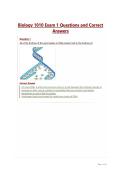
All of the findings of the early leaders in DNA research led to the findings of:
Correct Answer
•To copy DNA, it splits and enzymes come in to eat between the hydrogen bonds to
separate so they can be copied by nucleotides that are carried in and attach
themselves to one of the four bases.
•Hydrogen bonds are formed to create two copies of DNA.
Page 1 of 61
,Question 2
tertiary structure
Correct Answer
The third level of protein structure; the overall, three-dimensional shape of a
polypeptide due to interactions of the R groups of the amino acids making up the
chain.
Question 3
Process of True Breeding
Correct Answer
P1 X P1 = True breeding => F1(hybrids) => F2 . Pollen from male white flower to
female purple flower resulted in all purple flowers. (This meant that white flowers
carry a recessive trait & purple is dominant?). Then, used hybrids to create F2
generation= white flowers showed up again. Every trait he looked at (whether it was
flower color, pea color, etc had a 3:1 ratio in the F2 generation).
Page 2 of 61
,Question 4
a cell
Correct Answer
smallest unit of living matter. seperated from external environment by membrane(s).
all living things are composed of these.
Question 5
Hierarchy of Levels
Correct Answer
a) Atom b) molecule (atoms merged together) c) cell (molecules merged together)
smallest living unit d) tissue (two or more cells form together) e) organ (two or more
tissues working together) f) organ system (two or more organs [ex] digestive
systems) g) organism [ex] blue whales/humans h) population (interbreeding group
of same organism) i) community (all populations in a particular area). j) ecosystem
(all communities-living & non-living)
Question 6
evolution
Correct Answer
Species change over time by a means of natural selection. species have to change in
order to survive in their environment.
Question 7
steroids
Correct Answer
lipids composed of four linked rings of carbon atoms. Many of this type of lipid
serve as chemical messengers or as parts of the cell membrane; examples include
cholesterol, testosterone, and estrogen.
Page 3 of 61
, Question 8
atoms are made up of:
Correct Answer
three types of subatomic particles: protons and neutrons. Both of these make up
the nucleaus. the third type of subatomic particle is a electron which orbits the
nucleus.
Question 9
Polysaccharide
Correct Answer
More than two molecules. [ex] glycogen (a way we store our excess glucose) &
starch. [ex] chitin- makes up the outside of some bugs. Their "skeleton"
=Exoskeleton.
Question 10
Three types of chemical bonds:
Correct Answer
1. Ionic Bond 2. Covalent Bond 3. Hydrogen Bond
Question 11
Organic Compounds
Correct Answer
formed by carbon and hydrogen atoms; carbohydrates (CHO)- sugars and starches.
Seperated into four catagories: 1. Monosaccharide 2. Disaccharide 3. Polysaccharide
4. Lipids
Question 12
proteins
Correct Answer
important biological, complex macromolecules w/n the bodies of all organisms. a
long chain of amino acids linked end to end by peptide bonds.
Page 4 of 61
Answers
Question 1
All of the findings of the early leaders in DNA research led to the findings of:
Correct Answer
•To copy DNA, it splits and enzymes come in to eat between the hydrogen bonds to
separate so they can be copied by nucleotides that are carried in and attach
themselves to one of the four bases.
•Hydrogen bonds are formed to create two copies of DNA.
Page 1 of 61
,Question 2
tertiary structure
Correct Answer
The third level of protein structure; the overall, three-dimensional shape of a
polypeptide due to interactions of the R groups of the amino acids making up the
chain.
Question 3
Process of True Breeding
Correct Answer
P1 X P1 = True breeding => F1(hybrids) => F2 . Pollen from male white flower to
female purple flower resulted in all purple flowers. (This meant that white flowers
carry a recessive trait & purple is dominant?). Then, used hybrids to create F2
generation= white flowers showed up again. Every trait he looked at (whether it was
flower color, pea color, etc had a 3:1 ratio in the F2 generation).
Page 2 of 61
,Question 4
a cell
Correct Answer
smallest unit of living matter. seperated from external environment by membrane(s).
all living things are composed of these.
Question 5
Hierarchy of Levels
Correct Answer
a) Atom b) molecule (atoms merged together) c) cell (molecules merged together)
smallest living unit d) tissue (two or more cells form together) e) organ (two or more
tissues working together) f) organ system (two or more organs [ex] digestive
systems) g) organism [ex] blue whales/humans h) population (interbreeding group
of same organism) i) community (all populations in a particular area). j) ecosystem
(all communities-living & non-living)
Question 6
evolution
Correct Answer
Species change over time by a means of natural selection. species have to change in
order to survive in their environment.
Question 7
steroids
Correct Answer
lipids composed of four linked rings of carbon atoms. Many of this type of lipid
serve as chemical messengers or as parts of the cell membrane; examples include
cholesterol, testosterone, and estrogen.
Page 3 of 61
, Question 8
atoms are made up of:
Correct Answer
three types of subatomic particles: protons and neutrons. Both of these make up
the nucleaus. the third type of subatomic particle is a electron which orbits the
nucleus.
Question 9
Polysaccharide
Correct Answer
More than two molecules. [ex] glycogen (a way we store our excess glucose) &
starch. [ex] chitin- makes up the outside of some bugs. Their "skeleton"
=Exoskeleton.
Question 10
Three types of chemical bonds:
Correct Answer
1. Ionic Bond 2. Covalent Bond 3. Hydrogen Bond
Question 11
Organic Compounds
Correct Answer
formed by carbon and hydrogen atoms; carbohydrates (CHO)- sugars and starches.
Seperated into four catagories: 1. Monosaccharide 2. Disaccharide 3. Polysaccharide
4. Lipids
Question 12
proteins
Correct Answer
important biological, complex macromolecules w/n the bodies of all organisms. a
long chain of amino acids linked end to end by peptide bonds.
Page 4 of 61


