

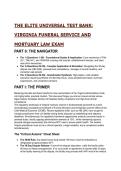
THE ELITE UNIVERSAL TEST BANK:
VIRGINIA FUNERAL SERVICE AND
MORTUARY LAW EXAM
PART 0: THE NAVIGATOR
● Tier 1 (Questions 1–28) - Foundational Syntax & Application: Core mechanics of Title
32.1, Title 54.1, and 18VAC65 covering vital records, establishment licenses, and basic
next-of-kin hierarchies.
● Tier 2 (Questions 29–58) - Complex Application & Simulation: Navigating the 30-day
dispute rule (HB 2246), preneed trust cancellations, manager of record transfers, and
cremation wait periods.
● Tier 3 (Questions 59–88) - Grandmaster Synthesis: High-stakes, multi-variable
scenarios requiring synthesis of internship hours, cross-jurisdictional transit, summary
suspensions, and unclaimed cremains.
PART I: THE PRIMER
Mastering this elite test bank transforms rote memorization of the Virginia Administrative Code
into highly lethal, practical intuition. This document forges you into an A-level scholar whose
legal mastery translates directly into flawless facility compliance and high-level clinical
competence.
The regulatory landscape of Virginia mortuary science is fundamentally governed by a strict
chronobiology mandated by the Board of Funeral Directors and Embalmers and the Office of the
Chief Medical Examiner (OCME). Recent legislative shifts, such as HB 2246, have sought to
insulate practitioners from civil liability during family disputes by establishing hard statutory
deadlines. Simultaneously, the regulatory framework aggressively protects consumer equity in
preneed trusts, strictly capping administrative retention at 10% , while maintaining rigorous
physical storage requirements (the 48-hour/40°F rule) to ensure public health. The modern
Virginia practitioner must act as a clinical operator, a legal mediator, and a compliance auditor
simultaneously.
The "Critical Axioms" Cheat Sheet
● The 48/40 Rule: Any dead human body stored >48 hours must be embalmed or
refrigerated at approximately 40°F.
● The 30-Day Dispute Release: If next-of-kin dispute disposition, notify the facility within
48 hours to freeze arrangements. If no court order or agreement is reached after 30 days
of the facility learning of the dispute, the facility may proceed with ANY next-of-kin without
, liability.
● The 10% Preneed Trust Cap: Providers may retain up to 10% of preneed funds
(principal and interest) for administrative costs when funded through a trust.
● Vital Records Chronobiology: Medical certification is due within 24 hours via EDRS; the
demographic death certificate must be filed within 3 days and prior to final disposition.
● The Internship Matrix: 2000 hours over 12-48 months. Directors need 25 funerals/25
arrangements; Embalmers need 25 embalmings. Training sites must average 50+ volume
per intern.
Virginia Statutory Timeline Matrix
Action / Requirement Statutory Deadline / Limit Governing Statute/Regulation
Medical Certification of Death 24 hours via EDRS § 32.1-263
Filing Death Certificate 3 days and prior to disposition
Unembalmed Body Storage 48 hours (then refrigerate
~40°F)
Next-of-Kin Dispute Wait 30 days post-notification § 54.1-2807.01
Unclaimed Cremains Hold 120 days post-cremation § 54.1-2808.1
Manager of Record Change Notify Board within 14 days 18VAC65-20-60
Preneed Trust Cancellation 100% refund within 30 days 18VAC65-30-80
PART II: THE ELITE TEST BANK
Tier 1: Foundational Syntax & Application
Q1: A decedent passes away in a Virginia hospital. Based on the principles of Virginia Vital
Records Law, which action regarding the death certificate is the MOST ACCURATE? A) The
medical certification must be filed within 72 hours via EDRS. B) The certificate must be filed
within 3 days of death and prior to final disposition. C) The funeral director must sign the
medical certification if the physician is delayed. D) The next-of-kin must physically file the
certificate with the local registrar.
● The Answer: B (The certificate must be filed within 3 days of death and prior to final
disposition.)
● Distractor Analysis:
○ A is incorrect: Medical certification is legally mandated within 24 hours, not 72.
○ C is incorrect: Funeral licensees are strictly prohibited from certifying the medical
cause of death.
○ D is incorrect: The licensee assuming custody files the demographic data, not the
next-of-kin.
The Mentor's Analysis: Chronobiology governs vital records compliance. When facing death
certificate filings, the immediate priority is the 3-day window. By utilizing EDRS within 72 hours,
you bypass the common trap of delaying final disposition. Professional Intuition: File the
demographic certificate within 3 days, but secure the medical certification within 24
hours.
Q2: A funeral establishment receives unembalmed remains, but the family delays disposition
due to international travel. Based on the principles of Virginia § 54.1-2811.1, what is the FIRST
required action if disposition is delayed beyond 48 hours? A) The remains must be sealed in a
,metal casket. B) The remains must be cremated immediately to prevent public health hazards.
C) The remains must be embalmed or refrigerated at no more than approximately 40°F. D) The
facility must request a hardship waiver from the Board.
● The Answer: C (The remains must be embalmed or refrigerated at no more than
approximately 40°F.)
● Distractor Analysis:
○ A is incorrect: Metal caskets are required for specific out-of-state transit via
common carrier, not standard in-state delays.
○ B is incorrect: Forced cremation violates next-of-kin rights.
○ D is incorrect: Hardship waivers apply to Manager of Record requirements, not
clinical storage.
The Mentor's Analysis: Storage chronobiology dictates preservation. When facing delays
exceeding 48 hours, the immediate priority is biological stabilization. By utilizing refrigeration or
embalming, you bypass the common trap of pathogenic degradation. Professional Intuition: The
48-hour mark strictly triggers the 40°F refrigeration mandate.
Q3: An individual dies without leaving a designated agent. Based on the principles of the
Virginia Next-of-Kin Hierarchy (§ 54.1-2800), who holds the HIGHEST priority to make
disposition arrangements? A) The decedent's adult sibling. B) The decedent's adult child. C)
The decedent's legal spouse. D) The decedent's parent.
● The Answer: C (The decedent's legal spouse.)
● Distractor Analysis:
○ A is incorrect: Siblings fall below spouses, children, and parents.
○ B is incorrect: Adult children are secondary to the surviving spouse.
○ D is incorrect: Parents are tertiary in the absence of a spouse or adult child.
The Mentor's Analysis: Statutory hierarchy overrides family dynamics. When facing
arrangement authorization, the immediate priority is identifying the apex legal decision-maker.
By utilizing the Spouse-Child-Parent-Sibling cascade, you bypass the common trap of taking
orders from vocal but legally subordinate relatives. Professional Intuition: Unless a § 54.1-2825
designee exists, the legal spouse always holds absolute primary authority.
Q4: A consumer defaults on an irrevocable preneed trust. Based on the principles of
18VAC65-30, what MAXIMUM percentage of the trusted funds (principal and interest) may the
funeral provider retain? A) 0% B) 5% C) 10% D) 15%
● The Answer: C (10%)
● Distractor Analysis:
○ A is incorrect: Providers are explicitly allowed an administrative retention.
○ B is incorrect: 5% is a common novice guess confused with other state contract
laws.
○ D is incorrect: 15% exceeds the statutory cap and constitutes a violation.
The Mentor's Analysis: Preneed funds represent consumer protection. When facing a trusted
contract, the immediate priority is capping administrative fees. By utilizing the 10% retention
cap, you bypass the common trap of over-drafting trust accounts. Professional Intuition: You
may retain up to 10% of a preneed trust for administrative costs; the rest is protected.
Q5: An applicant wishes to become a Virginia Funeral Service Intern. Based on the principles of
18VAC65-40, what are the TOTAL required hours and the maximum timeframe allowed to
complete them without a board extension? A) 1,000 hours in 24 months. B) 2,000 hours in 48
months. C) 3,000 hours in 36 months. D) 2,000 hours in 60 months.
● The Answer: B (2,000 hours in 48 months.)
● Distractor Analysis:
, ○ A is incorrect: 1,000 hours is merely the midpoint reporting requirement.
○ C is incorrect: 3,000 hours is an inflated novice metric.
○ D is incorrect: 60 months exceeds the strict 48-month statutory maximum limit.
The Mentor's Analysis: Licensure requires disciplined pacing. When facing the internship
gauntlet, the immediate priority is finishing within the statutory window. By utilizing the
2,000-hour/48-month threshold, you bypass the common trap of expired intern registrations.
Professional Intuition: An intern has exactly 4 years to complete 2,000 hours.
Q6: A licensed Manager of Record (MOR) abruptly resigns from a Virginia funeral
establishment. Based on the principles of 18VAC65-20-60, within how many days MUST the
board be notified of this change? A) 7 days. B) 14 days. C) 30 days. D) 60 days.
● The Answer: B (14 days.)
● Distractor Analysis:
○ A is incorrect: 7 days is too aggressive and not supported by VA Code.
○ C is incorrect: 30 days applies to personal address changes, not MOR facility
changes.
○ D is incorrect: 60 days guarantees an establishment license suspension.
The Mentor's Analysis: Operational accountability cannot lapse. When facing a sudden
leadership vacuum, the immediate priority is notifying the Board. By utilizing the 14-day
reporting window, you bypass the common trap of operating an unmanaged facility. Professional
Intuition: Any change in ownership or Manager of Record demands board notification
within 14 days.
Q7: An out-of-state funeral director holds a Virginia Courtesy Card. Based on the principles of
18VAC65-20-440, which action is this cardholder legally PERMITTED to perform? A) Open a
new branch chapel in Virginia. B) Act as the Manager of Record for a Virginia crematory. C)
Engage only in the practice for which they are licensed in their home state on a restricted basis.
D) Sell preneed contracts to Virginia residents.
● The Answer: C (Engage only in the practice for which they are licensed in their home
state on a restricted basis.)
● Distractor Analysis:
○ A is incorrect: Courtesy cards expressly forbid establishing a business in VA.
○ B is incorrect: MOR status requires a full, unrestricted VA license.
○ D is incorrect: Selling preneed requires a VA license and establishment affiliation.
The Mentor's Analysis: Interstate privileges are highly restricted. When facing courtesy card
limits, the immediate priority is understanding scope boundaries. By utilizing restricted
cross-border privileges, you bypass the common trap of unlicensed corporate expansion.
Professional Intuition: A courtesy card is a pass for limited transit and handling, not a
license to set up shop.
Q8: A crematory processes human remains. Based on the principles of Virginia Cremation
Regulations (18VAC65-20-436), which requirement MUST be met before the retort is ignited? A)
The remains must be placed in a metal casket. B) The OCME must grant permission and visual
ID must be verified by the next-of-kin. C) The remains must be embalmed. D) The family must
wait 48 hours post-death regardless of ID.
● The Answer: B (The OCME must grant permission and visual ID must be verified by the
next-of-kin.)
● Distractor Analysis:
○ A is incorrect: Virginia explicitly states a casket cannot be required for cremation.
○ C is incorrect: Embalming is never mandated for standard cremation.
○ D is incorrect: The 24-hour wait is only triggered if a visual ID is not feasible; there
VIRGINIA FUNERAL SERVICE AND
MORTUARY LAW EXAM
PART 0: THE NAVIGATOR
● Tier 1 (Questions 1–28) - Foundational Syntax & Application: Core mechanics of Title
32.1, Title 54.1, and 18VAC65 covering vital records, establishment licenses, and basic
next-of-kin hierarchies.
● Tier 2 (Questions 29–58) - Complex Application & Simulation: Navigating the 30-day
dispute rule (HB 2246), preneed trust cancellations, manager of record transfers, and
cremation wait periods.
● Tier 3 (Questions 59–88) - Grandmaster Synthesis: High-stakes, multi-variable
scenarios requiring synthesis of internship hours, cross-jurisdictional transit, summary
suspensions, and unclaimed cremains.
PART I: THE PRIMER
Mastering this elite test bank transforms rote memorization of the Virginia Administrative Code
into highly lethal, practical intuition. This document forges you into an A-level scholar whose
legal mastery translates directly into flawless facility compliance and high-level clinical
competence.
The regulatory landscape of Virginia mortuary science is fundamentally governed by a strict
chronobiology mandated by the Board of Funeral Directors and Embalmers and the Office of the
Chief Medical Examiner (OCME). Recent legislative shifts, such as HB 2246, have sought to
insulate practitioners from civil liability during family disputes by establishing hard statutory
deadlines. Simultaneously, the regulatory framework aggressively protects consumer equity in
preneed trusts, strictly capping administrative retention at 10% , while maintaining rigorous
physical storage requirements (the 48-hour/40°F rule) to ensure public health. The modern
Virginia practitioner must act as a clinical operator, a legal mediator, and a compliance auditor
simultaneously.
The "Critical Axioms" Cheat Sheet
● The 48/40 Rule: Any dead human body stored >48 hours must be embalmed or
refrigerated at approximately 40°F.
● The 30-Day Dispute Release: If next-of-kin dispute disposition, notify the facility within
48 hours to freeze arrangements. If no court order or agreement is reached after 30 days
of the facility learning of the dispute, the facility may proceed with ANY next-of-kin without
, liability.
● The 10% Preneed Trust Cap: Providers may retain up to 10% of preneed funds
(principal and interest) for administrative costs when funded through a trust.
● Vital Records Chronobiology: Medical certification is due within 24 hours via EDRS; the
demographic death certificate must be filed within 3 days and prior to final disposition.
● The Internship Matrix: 2000 hours over 12-48 months. Directors need 25 funerals/25
arrangements; Embalmers need 25 embalmings. Training sites must average 50+ volume
per intern.
Virginia Statutory Timeline Matrix
Action / Requirement Statutory Deadline / Limit Governing Statute/Regulation
Medical Certification of Death 24 hours via EDRS § 32.1-263
Filing Death Certificate 3 days and prior to disposition
Unembalmed Body Storage 48 hours (then refrigerate
~40°F)
Next-of-Kin Dispute Wait 30 days post-notification § 54.1-2807.01
Unclaimed Cremains Hold 120 days post-cremation § 54.1-2808.1
Manager of Record Change Notify Board within 14 days 18VAC65-20-60
Preneed Trust Cancellation 100% refund within 30 days 18VAC65-30-80
PART II: THE ELITE TEST BANK
Tier 1: Foundational Syntax & Application
Q1: A decedent passes away in a Virginia hospital. Based on the principles of Virginia Vital
Records Law, which action regarding the death certificate is the MOST ACCURATE? A) The
medical certification must be filed within 72 hours via EDRS. B) The certificate must be filed
within 3 days of death and prior to final disposition. C) The funeral director must sign the
medical certification if the physician is delayed. D) The next-of-kin must physically file the
certificate with the local registrar.
● The Answer: B (The certificate must be filed within 3 days of death and prior to final
disposition.)
● Distractor Analysis:
○ A is incorrect: Medical certification is legally mandated within 24 hours, not 72.
○ C is incorrect: Funeral licensees are strictly prohibited from certifying the medical
cause of death.
○ D is incorrect: The licensee assuming custody files the demographic data, not the
next-of-kin.
The Mentor's Analysis: Chronobiology governs vital records compliance. When facing death
certificate filings, the immediate priority is the 3-day window. By utilizing EDRS within 72 hours,
you bypass the common trap of delaying final disposition. Professional Intuition: File the
demographic certificate within 3 days, but secure the medical certification within 24
hours.
Q2: A funeral establishment receives unembalmed remains, but the family delays disposition
due to international travel. Based on the principles of Virginia § 54.1-2811.1, what is the FIRST
required action if disposition is delayed beyond 48 hours? A) The remains must be sealed in a
,metal casket. B) The remains must be cremated immediately to prevent public health hazards.
C) The remains must be embalmed or refrigerated at no more than approximately 40°F. D) The
facility must request a hardship waiver from the Board.
● The Answer: C (The remains must be embalmed or refrigerated at no more than
approximately 40°F.)
● Distractor Analysis:
○ A is incorrect: Metal caskets are required for specific out-of-state transit via
common carrier, not standard in-state delays.
○ B is incorrect: Forced cremation violates next-of-kin rights.
○ D is incorrect: Hardship waivers apply to Manager of Record requirements, not
clinical storage.
The Mentor's Analysis: Storage chronobiology dictates preservation. When facing delays
exceeding 48 hours, the immediate priority is biological stabilization. By utilizing refrigeration or
embalming, you bypass the common trap of pathogenic degradation. Professional Intuition: The
48-hour mark strictly triggers the 40°F refrigeration mandate.
Q3: An individual dies without leaving a designated agent. Based on the principles of the
Virginia Next-of-Kin Hierarchy (§ 54.1-2800), who holds the HIGHEST priority to make
disposition arrangements? A) The decedent's adult sibling. B) The decedent's adult child. C)
The decedent's legal spouse. D) The decedent's parent.
● The Answer: C (The decedent's legal spouse.)
● Distractor Analysis:
○ A is incorrect: Siblings fall below spouses, children, and parents.
○ B is incorrect: Adult children are secondary to the surviving spouse.
○ D is incorrect: Parents are tertiary in the absence of a spouse or adult child.
The Mentor's Analysis: Statutory hierarchy overrides family dynamics. When facing
arrangement authorization, the immediate priority is identifying the apex legal decision-maker.
By utilizing the Spouse-Child-Parent-Sibling cascade, you bypass the common trap of taking
orders from vocal but legally subordinate relatives. Professional Intuition: Unless a § 54.1-2825
designee exists, the legal spouse always holds absolute primary authority.
Q4: A consumer defaults on an irrevocable preneed trust. Based on the principles of
18VAC65-30, what MAXIMUM percentage of the trusted funds (principal and interest) may the
funeral provider retain? A) 0% B) 5% C) 10% D) 15%
● The Answer: C (10%)
● Distractor Analysis:
○ A is incorrect: Providers are explicitly allowed an administrative retention.
○ B is incorrect: 5% is a common novice guess confused with other state contract
laws.
○ D is incorrect: 15% exceeds the statutory cap and constitutes a violation.
The Mentor's Analysis: Preneed funds represent consumer protection. When facing a trusted
contract, the immediate priority is capping administrative fees. By utilizing the 10% retention
cap, you bypass the common trap of over-drafting trust accounts. Professional Intuition: You
may retain up to 10% of a preneed trust for administrative costs; the rest is protected.
Q5: An applicant wishes to become a Virginia Funeral Service Intern. Based on the principles of
18VAC65-40, what are the TOTAL required hours and the maximum timeframe allowed to
complete them without a board extension? A) 1,000 hours in 24 months. B) 2,000 hours in 48
months. C) 3,000 hours in 36 months. D) 2,000 hours in 60 months.
● The Answer: B (2,000 hours in 48 months.)
● Distractor Analysis:
, ○ A is incorrect: 1,000 hours is merely the midpoint reporting requirement.
○ C is incorrect: 3,000 hours is an inflated novice metric.
○ D is incorrect: 60 months exceeds the strict 48-month statutory maximum limit.
The Mentor's Analysis: Licensure requires disciplined pacing. When facing the internship
gauntlet, the immediate priority is finishing within the statutory window. By utilizing the
2,000-hour/48-month threshold, you bypass the common trap of expired intern registrations.
Professional Intuition: An intern has exactly 4 years to complete 2,000 hours.
Q6: A licensed Manager of Record (MOR) abruptly resigns from a Virginia funeral
establishment. Based on the principles of 18VAC65-20-60, within how many days MUST the
board be notified of this change? A) 7 days. B) 14 days. C) 30 days. D) 60 days.
● The Answer: B (14 days.)
● Distractor Analysis:
○ A is incorrect: 7 days is too aggressive and not supported by VA Code.
○ C is incorrect: 30 days applies to personal address changes, not MOR facility
changes.
○ D is incorrect: 60 days guarantees an establishment license suspension.
The Mentor's Analysis: Operational accountability cannot lapse. When facing a sudden
leadership vacuum, the immediate priority is notifying the Board. By utilizing the 14-day
reporting window, you bypass the common trap of operating an unmanaged facility. Professional
Intuition: Any change in ownership or Manager of Record demands board notification
within 14 days.
Q7: An out-of-state funeral director holds a Virginia Courtesy Card. Based on the principles of
18VAC65-20-440, which action is this cardholder legally PERMITTED to perform? A) Open a
new branch chapel in Virginia. B) Act as the Manager of Record for a Virginia crematory. C)
Engage only in the practice for which they are licensed in their home state on a restricted basis.
D) Sell preneed contracts to Virginia residents.
● The Answer: C (Engage only in the practice for which they are licensed in their home
state on a restricted basis.)
● Distractor Analysis:
○ A is incorrect: Courtesy cards expressly forbid establishing a business in VA.
○ B is incorrect: MOR status requires a full, unrestricted VA license.
○ D is incorrect: Selling preneed requires a VA license and establishment affiliation.
The Mentor's Analysis: Interstate privileges are highly restricted. When facing courtesy card
limits, the immediate priority is understanding scope boundaries. By utilizing restricted
cross-border privileges, you bypass the common trap of unlicensed corporate expansion.
Professional Intuition: A courtesy card is a pass for limited transit and handling, not a
license to set up shop.
Q8: A crematory processes human remains. Based on the principles of Virginia Cremation
Regulations (18VAC65-20-436), which requirement MUST be met before the retort is ignited? A)
The remains must be placed in a metal casket. B) The OCME must grant permission and visual
ID must be verified by the next-of-kin. C) The remains must be embalmed. D) The family must
wait 48 hours post-death regardless of ID.
● The Answer: B (The OCME must grant permission and visual ID must be verified by the
next-of-kin.)
● Distractor Analysis:
○ A is incorrect: Virginia explicitly states a casket cannot be required for cremation.
○ C is incorrect: Embalming is never mandated for standard cremation.
○ D is incorrect: The 24-hour wait is only triggered if a visual ID is not feasible; there


