

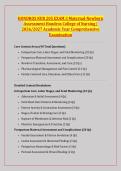
HONDROS NUR 205 EXAM 3 Maternal-Newborn
Assessment Hondros College of Nursing |
2026/2027 Academic Year Comprehensive
Examination
Core Content Areas (90 Total Questions)
• Intrapartum Care, Labor Stages, and Fetal Monitoring (22 Qs)
• Postpartum Maternal Assessment and Complications (20 Qs)
• Newborn Transition, Assessment, and Care (22 Qs)
• Pharmacological Management and Pain Control (14 Qs)
• Family-Centered Care, Education, and Ethical Care (12 Qs)
Detailed Content Breakdown
Intrapartum Care, Labor Stages, and Fetal Monitoring (22 Qs)
• Admission & Initial Assessment (4 Qs)
• Fetal Heart Rate Patterns & Monitoring (6 Qs)
• Uterine Activity & Contraction Assessment (3 Qs)
• Stages of Labor & Nursing Care (5 Qs)
• Rupture of Membranes & Infection Risk (2 Qs)
• Obstetric Emergencies & Priorities (2 Qs)
Postpartum Maternal Assessment and Complications (20 Qs)
• Fundal Assessment & Uterine Involution (4 Qs)
• Lochia Assessment & Abnormal Findings (3 Qs)
• Postpartum Hemorrhage & Risk Factors (3 Qs)
• Perineal Assessment & Wound Healing (2 Qs)
, • Urinary Retention & Bladder Assessment (2 Qs)
• Thromboembolism & Prevention (2 Qs)
• Infection & Fever Assessment (2 Qs)
• Postpartum Hypertension (2 Qs)
Newborn Transition, Assessment, and Care (22 Qs)
• Thermoregulation & Temperature Management (4 Qs)
• Apgar Scoring & Immediate Assessment (4 Qs)
• Respiratory Transition & Normal Findings (3 Qs)
• Glucose Stability & Hypoglycemia Prevention (3 Qs)
• Newborn Physical Assessment (3 Qs)
• Feeding & Nutrition (2 Qs)
• Jaundice Assessment & Management (2 Qs)
• Cord & Circumcision Care (1 Q)
Pharmacological Management and Pain Control (14 Qs)
• Epidural & Regional Anesthesia (3 Qs)
• Opioid Safety & Pain Management (2 Qs)
• Oxytocin & Uterotonic Medications (3 Qs)
• Magnesium Sulfate (2 Qs)
• Corticosteroids (1 Q)
• Medication Administration & Safety (3 Qs)
Family-Centered Care, Education, and Ethical Care (12 Qs)
• Informed Consent & Patient Rights (3 Qs)
• Culturally Responsive Care (2 Qs)
• Teaching & Teach-Back Method (3 Qs)
• Newborn Safety & Security (2 Qs)
, • Discharge Planning & Family Support (2 Qs)
1. A patient at 39 weeks gestation is admitted to the labor and delivery
unit. The initial nursing assessment should prioritize which of the
following first?
A. Fetal heart rate monitoring
B. Assessment of cervical dilation and effacement
C. Maternal vital signs including temperature
D. Review of the patient's birth plan
Correct Answer: A
Rationale: The initial assessment in labor should prioritize fetal heart rate
monitoring to establish a baseline and ensure fetal well-being. While all
assessments are important, fetal status is the priority upon admission.
Cervical assessment, vital signs, and birth plan review follow after fetal status
is established. This follows the principle of assessing the fetus first in labor
and delivery.
2. A patient is in active labor with contractions every 3 minutes, lasting
60 seconds. The fetal heart rate (FHR) baseline is 140 bpm with
moderate variability. During a contraction, the FHR decreases to 120
bpm and returns to 140 bpm after the contraction ends. What is the
correct interpretation of this finding?
A. Early decelerations
B. Variable decelerations
C. Late decelerations
D. Prolonged decelerations
Correct Answer: A
Rationale: This pattern describes early decelerations, which are
characterized by a gradual decrease in FHR that mirrors the contraction, with
the nadir occurring at the peak of the contraction. Early decelerations are
caused by fetal head compression and are considered benign. They are not
associated with fetal compromise and do not require intervention.
, 3. A patient at 40 weeks gestation is in active labor. The nurse notes
variable decelerations on the fetal monitor. What is the priority nursing
action?
A. Position the patient on her left side
B. Administer oxygen via face mask at 8-10 L/min
C. Increase the rate of IV fluids
D. Prepare for immediate cesarean section
Correct Answer: A
Rationale: Variable decelerations are often caused by umbilical cord
compression. The priority nursing intervention is to reposition the patient,
typically to the left lateral position, to improve placental perfusion and relieve
cord compression. If variable decelerations persist, additional interventions
such as oxygen administration and IV fluids may be needed. Immediate
cesarean section is not the first-line response.
4. A patient at 38 weeks gestation is experiencing contractions and
reports sudden gush of fluid from the vagina. Which finding would
indicate that the fluid is amniotic fluid?
A. The fluid has a clear, pale yellow appearance
B. The fluid has a foul odor
C. The fluid is greenish in color
D. The fluid is bright red in color
Correct Answer: A
Rationale: Normal amniotic fluid is clear and pale yellow in appearance. It
may contain small white flecks of vernix caseosa. Greenish fluid indicates
meconium staining, which may indicate fetal distress. Foul odor suggests
infection. Bright red fluid suggests bleeding, which requires immediate
evaluation.
Assessment Hondros College of Nursing |
2026/2027 Academic Year Comprehensive
Examination
Core Content Areas (90 Total Questions)
• Intrapartum Care, Labor Stages, and Fetal Monitoring (22 Qs)
• Postpartum Maternal Assessment and Complications (20 Qs)
• Newborn Transition, Assessment, and Care (22 Qs)
• Pharmacological Management and Pain Control (14 Qs)
• Family-Centered Care, Education, and Ethical Care (12 Qs)
Detailed Content Breakdown
Intrapartum Care, Labor Stages, and Fetal Monitoring (22 Qs)
• Admission & Initial Assessment (4 Qs)
• Fetal Heart Rate Patterns & Monitoring (6 Qs)
• Uterine Activity & Contraction Assessment (3 Qs)
• Stages of Labor & Nursing Care (5 Qs)
• Rupture of Membranes & Infection Risk (2 Qs)
• Obstetric Emergencies & Priorities (2 Qs)
Postpartum Maternal Assessment and Complications (20 Qs)
• Fundal Assessment & Uterine Involution (4 Qs)
• Lochia Assessment & Abnormal Findings (3 Qs)
• Postpartum Hemorrhage & Risk Factors (3 Qs)
• Perineal Assessment & Wound Healing (2 Qs)
, • Urinary Retention & Bladder Assessment (2 Qs)
• Thromboembolism & Prevention (2 Qs)
• Infection & Fever Assessment (2 Qs)
• Postpartum Hypertension (2 Qs)
Newborn Transition, Assessment, and Care (22 Qs)
• Thermoregulation & Temperature Management (4 Qs)
• Apgar Scoring & Immediate Assessment (4 Qs)
• Respiratory Transition & Normal Findings (3 Qs)
• Glucose Stability & Hypoglycemia Prevention (3 Qs)
• Newborn Physical Assessment (3 Qs)
• Feeding & Nutrition (2 Qs)
• Jaundice Assessment & Management (2 Qs)
• Cord & Circumcision Care (1 Q)
Pharmacological Management and Pain Control (14 Qs)
• Epidural & Regional Anesthesia (3 Qs)
• Opioid Safety & Pain Management (2 Qs)
• Oxytocin & Uterotonic Medications (3 Qs)
• Magnesium Sulfate (2 Qs)
• Corticosteroids (1 Q)
• Medication Administration & Safety (3 Qs)
Family-Centered Care, Education, and Ethical Care (12 Qs)
• Informed Consent & Patient Rights (3 Qs)
• Culturally Responsive Care (2 Qs)
• Teaching & Teach-Back Method (3 Qs)
• Newborn Safety & Security (2 Qs)
, • Discharge Planning & Family Support (2 Qs)
1. A patient at 39 weeks gestation is admitted to the labor and delivery
unit. The initial nursing assessment should prioritize which of the
following first?
A. Fetal heart rate monitoring
B. Assessment of cervical dilation and effacement
C. Maternal vital signs including temperature
D. Review of the patient's birth plan
Correct Answer: A
Rationale: The initial assessment in labor should prioritize fetal heart rate
monitoring to establish a baseline and ensure fetal well-being. While all
assessments are important, fetal status is the priority upon admission.
Cervical assessment, vital signs, and birth plan review follow after fetal status
is established. This follows the principle of assessing the fetus first in labor
and delivery.
2. A patient is in active labor with contractions every 3 minutes, lasting
60 seconds. The fetal heart rate (FHR) baseline is 140 bpm with
moderate variability. During a contraction, the FHR decreases to 120
bpm and returns to 140 bpm after the contraction ends. What is the
correct interpretation of this finding?
A. Early decelerations
B. Variable decelerations
C. Late decelerations
D. Prolonged decelerations
Correct Answer: A
Rationale: This pattern describes early decelerations, which are
characterized by a gradual decrease in FHR that mirrors the contraction, with
the nadir occurring at the peak of the contraction. Early decelerations are
caused by fetal head compression and are considered benign. They are not
associated with fetal compromise and do not require intervention.
, 3. A patient at 40 weeks gestation is in active labor. The nurse notes
variable decelerations on the fetal monitor. What is the priority nursing
action?
A. Position the patient on her left side
B. Administer oxygen via face mask at 8-10 L/min
C. Increase the rate of IV fluids
D. Prepare for immediate cesarean section
Correct Answer: A
Rationale: Variable decelerations are often caused by umbilical cord
compression. The priority nursing intervention is to reposition the patient,
typically to the left lateral position, to improve placental perfusion and relieve
cord compression. If variable decelerations persist, additional interventions
such as oxygen administration and IV fluids may be needed. Immediate
cesarean section is not the first-line response.
4. A patient at 38 weeks gestation is experiencing contractions and
reports sudden gush of fluid from the vagina. Which finding would
indicate that the fluid is amniotic fluid?
A. The fluid has a clear, pale yellow appearance
B. The fluid has a foul odor
C. The fluid is greenish in color
D. The fluid is bright red in color
Correct Answer: A
Rationale: Normal amniotic fluid is clear and pale yellow in appearance. It
may contain small white flecks of vernix caseosa. Greenish fluid indicates
meconium staining, which may indicate fetal distress. Foul odor suggests
infection. Bright red fluid suggests bleeding, which requires immediate
evaluation.


