

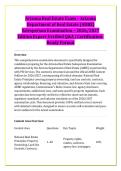
Arizona Real Estate Exam – Arizona
Department of Real Estate (ADRE)
Salesperson Examination – 2026/2027
Edition Expert-Verified Q&A | Certification-
Ready Format
Overview
This comprehensive examination document is specifically designed for
candidates preparing for the Arizona Real Estate Salesperson Examination
administered by the Arizona Department of Real Estate (ADRE) in partnership
with PSI Services. The content is structured around the official ADRE Content
Outline for 2026/2027, encompassing all critical domains: National Real
Estate Principles covering property ownership, land use controls, contracts,
agency relationships, financing, and valuation; and Arizona State Law covering
ADRE regulations, Commissioner's Rules, license law, agency disclosure
requirements, subdivision laws, and state-specific property regulations. Each
question has been expertly verified to reflect the most current statutes,
regulatory standards, and industry standards as of the 2026/2027
examination cycle. This document provides 100% verified correct answers
with detailed rationales, designed to ensure accurate self-evaluation and pass-
level readiness for the actual examination.
Content Area Overview
Content Area Questions Key Topics Weight
National Real Estate
Property rights,
Principles: Property 1–40 44%
estates, contracts,
Ownership, Land Use
agency law, mortgages,
Controls, Contracts,
,Content Area Questions Key Topics Weight
Agency, Financing & appraisal, taxation, fair
Valuation housing
Arizona State Law: ADRE structure, license
ADRE Regulations, types, agency
Commissioner's Rules, disclosure, fair
41–90 56%
Agency, Disclosures, housing, subdivision
Subdivisions & License law, escrow, CE
Law requirements
Comprehensive
TOTAL 90 100%
Coverage
Q1. Which of the following best describes the bundle of rights in real
property ownership?
A. The right to use land only for agricultural purposes
B. The right to possess, control, enjoy, exclude, and dispose of property
C. The right to transfer property only through inheritance
D. The right to use property subject to unlimited government regulation
Answer: B. The right to possess, control, enjoy, exclude, and dispose of
property
RATIONALE: The bundle of rights includes the rights of possession, control,
enjoyment (use), exclusion, and disposition. These are the fundamental legal
rights that accompany real property ownership. Property owners have the
right to possess the property, control its use, enjoy its benefits, exclude others
from entering, and dispose of it through sale, gift, or inheritance.
Q2. A property owner grants a neighbor the right to use a pathway
across their land. This is an example of:
,A. A license
B. An easement appurtenant
C. A lien
D. A leasehold interest
Answer: B. An easement appurtenant
RATIONALE: An easement appurtenant benefits a dominant tenement (the
benefited parcel) and runs with the land. The servient tenement (the
burdened parcel) must allow the specified use by the dominant tenement
owner. The easement attaches to the land and transfers automatically with the
property, unlike a license which is personal and revocable.
Q3. Which type of zoning regulates the height, bulk, and placement of
buildings on a lot?
A. Use zoning
B. Density zoning
C. Bulk zoning
D. Aesthetic zoning
Answer: C. Bulk zoning
RATIONALE: Bulk zoning (also called area zoning) regulates the physical
dimensions of buildings, including height limitations, setback requirements,
floor area ratios, and lot coverage percentages. It controls the density and
mass of development. Use zoning regulates the types of activities permitted on
a property. Density zoning regulates the number of dwelling units per acre.
Q4. What is a non-conforming use?
A. A use permitted only by variance
B. A use that was legal when established but does not comply with current
zoning regulations
C. A use that violates all zoning regulations
D. A use that requires a special use permit
, Answer: B. A use that was legal when established but does not comply
with current zoning regulations
RATIONALE: A non-conforming use is a use of property that was lawful when
established but does not conform to current zoning regulations. These uses
are typically "grandfathered" and may continue, but often have restrictions on
expansion, reconstruction after damage, or transfer to new owners.
Q5. Which of the following best defines 'police power' as it relates to real
estate?
A. The power of the federal government to impose taxes
B. The power of the state to regulate land use for the health, safety, and
welfare of the public
C. The power of law enforcement to seize property
D. The power of local governments to purchase property through eminent
domain
Answer: B. The power of the state to regulate land use for the health,
safety, and welfare of the public
RATIONALE: Police power is the inherent authority of state and local
governments to regulate private property to protect public health, safety,
morals, and general welfare. Zoning ordinances, building codes, and
subdivision regulations are examples of police power in action. This is distinct
from eminent domain (the power to take property for public use with
compensation) and taxation.
Q6. Littoral rights refer to:
A. Rights to use water from underground aquifers
B. Rights of landowners whose property abuts navigable lakes and seas
C. Rights to appropriate water for agricultural use
D. Rights to mineral deposits beneath the surface
Answer: B. Rights of landowners whose property abuts navigable lakes
and seas
Department of Real Estate (ADRE)
Salesperson Examination – 2026/2027
Edition Expert-Verified Q&A | Certification-
Ready Format
Overview
This comprehensive examination document is specifically designed for
candidates preparing for the Arizona Real Estate Salesperson Examination
administered by the Arizona Department of Real Estate (ADRE) in partnership
with PSI Services. The content is structured around the official ADRE Content
Outline for 2026/2027, encompassing all critical domains: National Real
Estate Principles covering property ownership, land use controls, contracts,
agency relationships, financing, and valuation; and Arizona State Law covering
ADRE regulations, Commissioner's Rules, license law, agency disclosure
requirements, subdivision laws, and state-specific property regulations. Each
question has been expertly verified to reflect the most current statutes,
regulatory standards, and industry standards as of the 2026/2027
examination cycle. This document provides 100% verified correct answers
with detailed rationales, designed to ensure accurate self-evaluation and pass-
level readiness for the actual examination.
Content Area Overview
Content Area Questions Key Topics Weight
National Real Estate
Property rights,
Principles: Property 1–40 44%
estates, contracts,
Ownership, Land Use
agency law, mortgages,
Controls, Contracts,
,Content Area Questions Key Topics Weight
Agency, Financing & appraisal, taxation, fair
Valuation housing
Arizona State Law: ADRE structure, license
ADRE Regulations, types, agency
Commissioner's Rules, disclosure, fair
41–90 56%
Agency, Disclosures, housing, subdivision
Subdivisions & License law, escrow, CE
Law requirements
Comprehensive
TOTAL 90 100%
Coverage
Q1. Which of the following best describes the bundle of rights in real
property ownership?
A. The right to use land only for agricultural purposes
B. The right to possess, control, enjoy, exclude, and dispose of property
C. The right to transfer property only through inheritance
D. The right to use property subject to unlimited government regulation
Answer: B. The right to possess, control, enjoy, exclude, and dispose of
property
RATIONALE: The bundle of rights includes the rights of possession, control,
enjoyment (use), exclusion, and disposition. These are the fundamental legal
rights that accompany real property ownership. Property owners have the
right to possess the property, control its use, enjoy its benefits, exclude others
from entering, and dispose of it through sale, gift, or inheritance.
Q2. A property owner grants a neighbor the right to use a pathway
across their land. This is an example of:
,A. A license
B. An easement appurtenant
C. A lien
D. A leasehold interest
Answer: B. An easement appurtenant
RATIONALE: An easement appurtenant benefits a dominant tenement (the
benefited parcel) and runs with the land. The servient tenement (the
burdened parcel) must allow the specified use by the dominant tenement
owner. The easement attaches to the land and transfers automatically with the
property, unlike a license which is personal and revocable.
Q3. Which type of zoning regulates the height, bulk, and placement of
buildings on a lot?
A. Use zoning
B. Density zoning
C. Bulk zoning
D. Aesthetic zoning
Answer: C. Bulk zoning
RATIONALE: Bulk zoning (also called area zoning) regulates the physical
dimensions of buildings, including height limitations, setback requirements,
floor area ratios, and lot coverage percentages. It controls the density and
mass of development. Use zoning regulates the types of activities permitted on
a property. Density zoning regulates the number of dwelling units per acre.
Q4. What is a non-conforming use?
A. A use permitted only by variance
B. A use that was legal when established but does not comply with current
zoning regulations
C. A use that violates all zoning regulations
D. A use that requires a special use permit
, Answer: B. A use that was legal when established but does not comply
with current zoning regulations
RATIONALE: A non-conforming use is a use of property that was lawful when
established but does not conform to current zoning regulations. These uses
are typically "grandfathered" and may continue, but often have restrictions on
expansion, reconstruction after damage, or transfer to new owners.
Q5. Which of the following best defines 'police power' as it relates to real
estate?
A. The power of the federal government to impose taxes
B. The power of the state to regulate land use for the health, safety, and
welfare of the public
C. The power of law enforcement to seize property
D. The power of local governments to purchase property through eminent
domain
Answer: B. The power of the state to regulate land use for the health,
safety, and welfare of the public
RATIONALE: Police power is the inherent authority of state and local
governments to regulate private property to protect public health, safety,
morals, and general welfare. Zoning ordinances, building codes, and
subdivision regulations are examples of police power in action. This is distinct
from eminent domain (the power to take property for public use with
compensation) and taxation.
Q6. Littoral rights refer to:
A. Rights to use water from underground aquifers
B. Rights of landowners whose property abuts navigable lakes and seas
C. Rights to appropriate water for agricultural use
D. Rights to mineral deposits beneath the surface
Answer: B. Rights of landowners whose property abuts navigable lakes
and seas


