

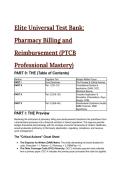
Elite Universal Test Bank:
Pharmacy Billing and
Reimbursement (PTCB
Professional Mastery)
PART 0: THE (Table of Contents)
Section Cognitive Tier Subject Matter Focus
PART I Core Directives The Preview & Critical Axioms
PART II Tier 1 (Q1–15) Foundational Syntax &
Application (DAW, OCC,
Medicare Basics)
PART II Tier 2 (Q16–35) Complex Application &
Simulation (Calculations, Days
Supply, COB)
PART II Tier 3 (Q36–60) Grandmaster Synthesis (Audits,
QMB Protocols, PBM
Algorithms)
PART I: THE Preview
Mastering the intricacies of pharmacy billing and reimbursement transforms the practitioner from
a transactional processor into a financial architect of clinical operations. This rigorous gauntlet
bridges theoretical pharmacology with the complex economic frameworks of modern healthcare,
ensuring absolute proficiency in third-party adjudication, regulatory compliance, and revenue
cycle management.
The "Critical Axioms" Cheat Sheet
● The Dispense As Written (DAW) Matrix: The entity demanding the brand dictates the
code. Prescriber = 1, Patient = 2, Pharmacy = 3, PBM/Plan = 9.
● The Other Coverage Code (OCC) Hierarchy: OCC 2 indicates payment was collected
from a primary payer; OCC 4 indicates the primary payer processed the claim but applied
, it entirely to the patient's deductible (no payment collected).
● The Days Supply Formula (Insulin): ÷ [Maximum daily units including priming].
● The Qualified Medicare Beneficiary (QMB) Absolute: Medicare providers are strictly
prohibited under federal law from balance billing QMBs for Medicare Part A or B
cost-sharing, regardless of Medicaid reimbursement levels.
● The Financial Profit Equations: Gross Profit = Selling Price – Cost of Goods Sold; Net
Profit = Selling Price – (Cost of Goods Sold + Overhead).
PART II: THE ELITE TEST BANK
Q1: A prescriber writes a prescription for a brand-name statin, signing the "Substitution
Permitted" line. The patient's formulary prefers generics, and the pharmacy stocks the generic
equivalent. The patient insists on receiving the brand-name product and agrees to pay the cost
difference. Based on the principles of NCPDP coding, which Dispense As Written (DAW) code is
the MOST ACCURATE? A) DAW 0 B) DAW 1 C) DAW 2 D) DAW 9
● The Answer: C (DAW 2)
● Distractor Analysis:
○ A is incorrect: DAW 0 applies only when no specific product selection is indicated
by any party, which would result in the generic being dispensed.
○ B is incorrect: DAW 1 requires the prescriber to legally mandate the brand name,
not the patient.
○ D is incorrect: DAW 9 indicates the insurance plan requests the brand, which
contradicts the formulary's generic preference.
The Mentor's Analysis: Patient autonomy dictates product selection when clinical substitution
is legally permitted but personally refused. When facing patient-driven brand requests, the
immediate priority is documenting the financial consent to bypass formulary rejections. By
utilizing DAW 2, the practitioner bypasses the common trap of billing the plan for a patient's
preference. Professional/Academic Intuition: The entity demanding the brand dictates the
code; if the patient demands it, it is unequivocally DAW 2.
Q2: A pharmacy receives a rejection for a dual-eligible patient indicating that the primary
insurance (Medicare Part D) has approved the claim but left a copay. The pharmacy must now
bill Medicaid as the secondary payer. Which Other Coverage Code (OCC) is the MOST
APPROPRIATE to submit to Medicaid? A) OCC 1 B) OCC 2 C) OCC 3 D) OCC 4
● The Answer: B (OCC 2)
● Distractor Analysis:
○ A is incorrect: OCC 1 indicates no other coverage is identified.
○ C is incorrect: OCC 3 indicates the primary insurance denied the claim entirely,
leaving no copay.
○ D is incorrect: OCC 4 is utilized when the primary payer approves the claim but
zero payment is collected because the entire amount was applied to the deductible.
The Mentor's Analysis: Coordination of Benefits (COB) requires transparent communication of
financial data between payers. When facing a dual-eligible claim where primary payment was
issued, the immediate priority is transmitting the exact paid amount downstream. By utilizing
OCC 2, the practitioner bypasses the common trap of double-billing or triggering secondary
payer audits. Professional/Academic Intuition: OCC 2 means "Payment Collected"; the
downstream payer must see the primary payer's exact reimbursement amount.
Q3: A patient requires an annual influenza vaccination. The patient has both Medicare Part B
, and a Medicare Part D standalone prescription drug plan. Which billing action is the MOST
ACCURATE? A) Bill Medicare Part D exclusively. B) Bill Medicare Part B exclusively. C) Bill the
patient directly, as vaccines are non-covered exclusions. D) Bill Medicare Part B as primary and
Part D for the administration fee.
● The Answer: B (Bill Medicare Part B exclusively.)
● Distractor Analysis:
○ A is incorrect: Part D covers prophylactic vaccines like Shingles, but influenza is a
statutory Part B benefit.
○ C is incorrect: Influenza is a fully covered preventive service under Medicare.
○ D is incorrect: Part B covers both the vaccine product and the administration fee.
The Mentor's Analysis: Statutory boundaries govern Medicare reimbursements for
immunizations. When facing respiratory prophylactic vaccines, the immediate priority is routing
the claim to the medical benefit. By utilizing Medicare Part B, the practitioner bypasses the
common trap of routing standard vaccines through prescription drug plans.
Professional/Academic Intuition: Part B is for the arm (flu/pneumonia vaccines); Part D is for
the vial (shingles vaccines).
Q4: A pharmacy's total sales for a quarter are $250,000. The cost of goods sold (COGS) is
$180,000, and the pharmacy's overhead is $40,000. What is the pharmacy's exact Net Profit?
A) $30,000 B) $70,000 C) $210,000 D) $250,000
● The Answer: A ($30,000)
● Distractor Analysis:
○ B is incorrect: $70,000 is the Gross Profit (Sales minus COGS), which ignores
overhead entirely.
○ C is incorrect: This calculation incorrectly subtracts only overhead from sales,
ignoring the cost of the inventory itself.
○ D is incorrect: $250,000 represents total gross revenue, not profit.
The Mentor's Analysis: Financial viability requires distinguishing between raw margin and
actual operational income. When facing profitability calculations, the immediate priority is
deducting all operational costs from the gross margin. By utilizing the Net Profit Formula, the
practitioner bypasses the common trap of conflating gross margin with true profitability.
Professional/Academic Intuition: Gross Profit keeps the inventory flowing; Net Profit keeps
the lights on.
Q5: An NCPDP rejection code of "88" appears during the adjudication of a prescription for
tramadol. The patient is already taking oxycodone. What is the FIRST logical action? A) Tell the
patient the drug is not on the formulary. B) Override the rejection using a DAW 1 code. C)
Review the Drug Utilization Review (DUR) message for therapeutic duplication. D) Submit the
claim with an OCC 3 code.
● The Answer: C (Review the Drug Utilization Review (DUR) message for therapeutic
duplication.)
● Distractor Analysis:
○ A is incorrect: Code 88 does not indicate formulary exclusion; it indicates a clinical
warning.
○ B is incorrect: DAW codes relate to brand/generic product selection, not clinical
interactions.
○ D is incorrect: OCC codes relate to downstream billing, not clinical safety alerts.
The Mentor's Analysis: Automated adjudication systems act as the first line of defense against
adverse events. When facing an NCPDP Reject Code 88, the immediate priority is clinical
evaluation of the conflict. By utilizing DUR analysis, the practitioner bypasses the common trap
Pharmacy Billing and
Reimbursement (PTCB
Professional Mastery)
PART 0: THE (Table of Contents)
Section Cognitive Tier Subject Matter Focus
PART I Core Directives The Preview & Critical Axioms
PART II Tier 1 (Q1–15) Foundational Syntax &
Application (DAW, OCC,
Medicare Basics)
PART II Tier 2 (Q16–35) Complex Application &
Simulation (Calculations, Days
Supply, COB)
PART II Tier 3 (Q36–60) Grandmaster Synthesis (Audits,
QMB Protocols, PBM
Algorithms)
PART I: THE Preview
Mastering the intricacies of pharmacy billing and reimbursement transforms the practitioner from
a transactional processor into a financial architect of clinical operations. This rigorous gauntlet
bridges theoretical pharmacology with the complex economic frameworks of modern healthcare,
ensuring absolute proficiency in third-party adjudication, regulatory compliance, and revenue
cycle management.
The "Critical Axioms" Cheat Sheet
● The Dispense As Written (DAW) Matrix: The entity demanding the brand dictates the
code. Prescriber = 1, Patient = 2, Pharmacy = 3, PBM/Plan = 9.
● The Other Coverage Code (OCC) Hierarchy: OCC 2 indicates payment was collected
from a primary payer; OCC 4 indicates the primary payer processed the claim but applied
, it entirely to the patient's deductible (no payment collected).
● The Days Supply Formula (Insulin): ÷ [Maximum daily units including priming].
● The Qualified Medicare Beneficiary (QMB) Absolute: Medicare providers are strictly
prohibited under federal law from balance billing QMBs for Medicare Part A or B
cost-sharing, regardless of Medicaid reimbursement levels.
● The Financial Profit Equations: Gross Profit = Selling Price – Cost of Goods Sold; Net
Profit = Selling Price – (Cost of Goods Sold + Overhead).
PART II: THE ELITE TEST BANK
Q1: A prescriber writes a prescription for a brand-name statin, signing the "Substitution
Permitted" line. The patient's formulary prefers generics, and the pharmacy stocks the generic
equivalent. The patient insists on receiving the brand-name product and agrees to pay the cost
difference. Based on the principles of NCPDP coding, which Dispense As Written (DAW) code is
the MOST ACCURATE? A) DAW 0 B) DAW 1 C) DAW 2 D) DAW 9
● The Answer: C (DAW 2)
● Distractor Analysis:
○ A is incorrect: DAW 0 applies only when no specific product selection is indicated
by any party, which would result in the generic being dispensed.
○ B is incorrect: DAW 1 requires the prescriber to legally mandate the brand name,
not the patient.
○ D is incorrect: DAW 9 indicates the insurance plan requests the brand, which
contradicts the formulary's generic preference.
The Mentor's Analysis: Patient autonomy dictates product selection when clinical substitution
is legally permitted but personally refused. When facing patient-driven brand requests, the
immediate priority is documenting the financial consent to bypass formulary rejections. By
utilizing DAW 2, the practitioner bypasses the common trap of billing the plan for a patient's
preference. Professional/Academic Intuition: The entity demanding the brand dictates the
code; if the patient demands it, it is unequivocally DAW 2.
Q2: A pharmacy receives a rejection for a dual-eligible patient indicating that the primary
insurance (Medicare Part D) has approved the claim but left a copay. The pharmacy must now
bill Medicaid as the secondary payer. Which Other Coverage Code (OCC) is the MOST
APPROPRIATE to submit to Medicaid? A) OCC 1 B) OCC 2 C) OCC 3 D) OCC 4
● The Answer: B (OCC 2)
● Distractor Analysis:
○ A is incorrect: OCC 1 indicates no other coverage is identified.
○ C is incorrect: OCC 3 indicates the primary insurance denied the claim entirely,
leaving no copay.
○ D is incorrect: OCC 4 is utilized when the primary payer approves the claim but
zero payment is collected because the entire amount was applied to the deductible.
The Mentor's Analysis: Coordination of Benefits (COB) requires transparent communication of
financial data between payers. When facing a dual-eligible claim where primary payment was
issued, the immediate priority is transmitting the exact paid amount downstream. By utilizing
OCC 2, the practitioner bypasses the common trap of double-billing or triggering secondary
payer audits. Professional/Academic Intuition: OCC 2 means "Payment Collected"; the
downstream payer must see the primary payer's exact reimbursement amount.
Q3: A patient requires an annual influenza vaccination. The patient has both Medicare Part B
, and a Medicare Part D standalone prescription drug plan. Which billing action is the MOST
ACCURATE? A) Bill Medicare Part D exclusively. B) Bill Medicare Part B exclusively. C) Bill the
patient directly, as vaccines are non-covered exclusions. D) Bill Medicare Part B as primary and
Part D for the administration fee.
● The Answer: B (Bill Medicare Part B exclusively.)
● Distractor Analysis:
○ A is incorrect: Part D covers prophylactic vaccines like Shingles, but influenza is a
statutory Part B benefit.
○ C is incorrect: Influenza is a fully covered preventive service under Medicare.
○ D is incorrect: Part B covers both the vaccine product and the administration fee.
The Mentor's Analysis: Statutory boundaries govern Medicare reimbursements for
immunizations. When facing respiratory prophylactic vaccines, the immediate priority is routing
the claim to the medical benefit. By utilizing Medicare Part B, the practitioner bypasses the
common trap of routing standard vaccines through prescription drug plans.
Professional/Academic Intuition: Part B is for the arm (flu/pneumonia vaccines); Part D is for
the vial (shingles vaccines).
Q4: A pharmacy's total sales for a quarter are $250,000. The cost of goods sold (COGS) is
$180,000, and the pharmacy's overhead is $40,000. What is the pharmacy's exact Net Profit?
A) $30,000 B) $70,000 C) $210,000 D) $250,000
● The Answer: A ($30,000)
● Distractor Analysis:
○ B is incorrect: $70,000 is the Gross Profit (Sales minus COGS), which ignores
overhead entirely.
○ C is incorrect: This calculation incorrectly subtracts only overhead from sales,
ignoring the cost of the inventory itself.
○ D is incorrect: $250,000 represents total gross revenue, not profit.
The Mentor's Analysis: Financial viability requires distinguishing between raw margin and
actual operational income. When facing profitability calculations, the immediate priority is
deducting all operational costs from the gross margin. By utilizing the Net Profit Formula, the
practitioner bypasses the common trap of conflating gross margin with true profitability.
Professional/Academic Intuition: Gross Profit keeps the inventory flowing; Net Profit keeps
the lights on.
Q5: An NCPDP rejection code of "88" appears during the adjudication of a prescription for
tramadol. The patient is already taking oxycodone. What is the FIRST logical action? A) Tell the
patient the drug is not on the formulary. B) Override the rejection using a DAW 1 code. C)
Review the Drug Utilization Review (DUR) message for therapeutic duplication. D) Submit the
claim with an OCC 3 code.
● The Answer: C (Review the Drug Utilization Review (DUR) message for therapeutic
duplication.)
● Distractor Analysis:
○ A is incorrect: Code 88 does not indicate formulary exclusion; it indicates a clinical
warning.
○ B is incorrect: DAW codes relate to brand/generic product selection, not clinical
interactions.
○ D is incorrect: OCC codes relate to downstream billing, not clinical safety alerts.
The Mentor's Analysis: Automated adjudication systems act as the first line of defense against
adverse events. When facing an NCPDP Reject Code 88, the immediate priority is clinical
evaluation of the conflict. By utilizing DUR analysis, the practitioner bypasses the common trap


