
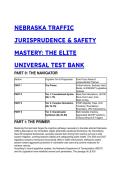
NEBRASKA TRAFFIC
JURISPRUDENCE & SAFETY
MASTERY: THE ELITE
UNIVERSAL TEST BANK
PART 0: THE NAVIGATOR
Section Cognitive Tier & Progression Core Focus Areas &
Jurisprudential Themes
PART I The Primer Critical Axioms, Statutory Hard
Decks, & 2026/2027 Legislative
Updates
PART II Tier 1: Foundational Syntax Base Point Allocations, LB 530
(Qs 1–15) Move-Over Laws, Core
Right-of-Way
PART II Tier 2: Complex Simulation STOP Eligibility Traps, ALR
(Qs 16–35) Timelines, Roundabout
Kinematics, VRU Intersections
PART II Tier 3: Grandmaster Multi-Variable Crashes,
Synthesis (Qs 36–60) Aggravated DUI/IIP Violations,
Compounding ALR Triggers
PART I: THE PRIMER
Mastering this test bank forges the cognitive pathways necessary to translate abstract Nebraska
traffic jurisprudence into immediate, legally defensible situational dominance. By internalizing
these 60 analytical frameworks, operators elevate their driving from reactive survival to elite
hazard mitigation, averting statutory liability and safeguarding public health. The 2026 and 2027
legislative sessions introduced monumental shifts in traffic enforcement, shifting the state's
posture toward aggressive protection of vulnerable road users and punitive measures for
extreme velocity.
According to recent legislative updates, the Nebraska Department of Transportation (NDOT)
and the Legislature have redefined several core parameters. The passage of LB 530
,significantly expanded the "Move-Over Law," requiring drivers to afford lateral space to all
stopped vehicles on the shoulder, not merely emergency apparatus. Furthermore, LB 977
expanded protections for Vulnerable Road Users (VRUs), while LB 1202 tightened the noose on
Ignition Interlock Permit (IIP) circumvention. To synthesize these updates into professional
intuition, operators must memorize the following statutory matrices.
The LB 530 Velocity & Penalty Matrix
Under LB 530, fines for speeding have increased across all tiers for the first time since 1996.
Furthermore, speeding in a marked work zone where workers are present automatically doubles
these base fines.
Speed Over Limit Base Statutory Fine Work Zone Fine Point Assessment
(Workers Present)
1–5 mph $50 $100 1 Point (0 if on certain
highways)
6–10 mph $75 $150 1 to 2 Points
11–15 mph $125 $250 2 Points
16–20 mph $200 $400 3 Points
21–35 mph $300 $600 3 Points
36+ mph $400 $800 4 Points
Crucial Axiom: Driving in excess of twice the posted speed limit constitutes statutory evidence of
Reckless Driving, triggering a 5-point assessment and severe criminal liability.
The Point System & Administrative License Revocation (ALR)
Nebraska operates on a strict 12-point threshold within any consecutive two-year period.
Reaching this threshold guarantees automatic Administrative License Revocation (ALR).
Operators may preemptively deduct 2 points by taking a state-approved 4-hour Driver
Improvement Course, provided the course is completed before the violation that pushes the
balance to 12 points.
Violation Category Point Strike ALR Threshold Consequence
DUI / Willful Reckless / 6 Points First 12-Point Breach: 6-Month
Hit-and-Run Revocation
Reckless Driving 5 Points Second 12-Point Breach (within
5 yrs): 3-Year Revocation
Careless Driving / Yield Failure 4 Points Driver retains points for 5 years
(Injury) on their record
Texting & Driving (Handheld 3 Points Handheld device usage is
Device) statutorily isolated from STOP
The STOP Program Exclusions (Ticket Dismissal)
The Safety Training Option Program (STOP) allows drivers to dismiss minor citations via a
4-hour course (fee: $125). However, elite operators must recognize the absolute statutory
exclusions. You are universally disqualified if you possess a CDL (regardless of the vehicle
driven), exceed the speed limit by 20+ mph, commit a DUI, cause an injury-producing crash, or
are cited for texting while driving.
, PART II: THE ELITE TEST BANK
Q1: A driver on Interstate 80 observes a civilian passenger sedan stopped on the right shoulder
with its hazard lights activated. The driver is traveling 75 mph in the right lane. Based on the
2026 implementation of LB 530, which action is the MOST ACCURATE legal requirement? A)
Maintain speed and position, as the vehicle is not an emergency response unit or tow truck. B)
Come to a complete stop behind the sedan to render roadside assistance. C) Move into the left
lane if safe to do so; if not possible, reduce speed and proceed with due caution. D) Honk the
horn continuously to alert the civilian to remain inside their vehicle.
● The Answer: C (Move into the left lane if safe to do so; if not possible, reduce speed and
proceed with due caution.)
● Distractor Analysis:
○ A is incorrect: LB 530 explicitly expanded the Move-Over Law to include all stopped
vehicles, eliminating the emergency-only legacy rule.
○ B is incorrect: Stopping on a high-speed interstate creates a fatal kinetic hazard and
violates minimum speed statutes.
○ D is incorrect: Honking does not satisfy the statutory mandate to yield lateral space
or kinetic energy.
The Mentor's Analysis: The expansion of the Move-Over Law removes subjective judgment
regarding vehicle classification. When facing any stopped vehicle, the immediate priority is
lateral displacement or velocity reduction. By utilizing statutory lane divergence, you bypass the
common trap of selective compliance. Professional/Academic Intuition: Treat every stopped
vehicle on a highway shoulder as an active hazard zone requiring immediate spatial or velocity
adjustments.
Q2: A motorist is cited for traveling 52 mph in a marked 25 mph residential zone. Based on the
velocity multipliers established in LB 530, what is the MOST LIKELY statutory escalation of this
offense? A) The driver faces a standard $300 fine and is eligible for the STOP program. B) The
speed constitutes statutory evidence of Reckless Driving because it exceeds twice the posted
limit. C) The driver's vehicle will be immediately impounded under zero-tolerance urban
speeding laws. D) The citation is classified as Careless Driving and carries a mandatory 4-point
penalty.
● The Answer: B (The speed constitutes statutory evidence of Reckless Driving because it
exceeds twice the posted limit.)
● Distractor Analysis:
○ A is incorrect: The driver exceeds the limit by 27 mph (violating the 20 mph STOP
disqualification threshold) and has crossed into reckless territory.
○ C is incorrect: Impoundment is an unconstitutional overreach for standard speeding
absent other felony factors.
○ D is incorrect: Careless driving implies inattention; speeds exceeding 2x the limit
generate statutory evidence of Reckless driving (5 points).
The Mentor's Analysis: Velocity multipliers fundamentally alter the legal classification of an
offense. When facing speeds greater than twice the limit, the immediate priority is understanding
the escalation from an infraction to a criminal traffic misdemeanor. By utilizing proportional
speed analysis, you bypass the common trap of viewing all speeding as standard infractions.
Professional/Academic Intuition: Exceeding twice the posted speed limit legally signals a
reckless disregard for public safety and upgrades the charge.
Q3: A driver approaches an intersection with a completely malfunctioning traffic signal that is
JURISPRUDENCE & SAFETY
MASTERY: THE ELITE
UNIVERSAL TEST BANK
PART 0: THE NAVIGATOR
Section Cognitive Tier & Progression Core Focus Areas &
Jurisprudential Themes
PART I The Primer Critical Axioms, Statutory Hard
Decks, & 2026/2027 Legislative
Updates
PART II Tier 1: Foundational Syntax Base Point Allocations, LB 530
(Qs 1–15) Move-Over Laws, Core
Right-of-Way
PART II Tier 2: Complex Simulation STOP Eligibility Traps, ALR
(Qs 16–35) Timelines, Roundabout
Kinematics, VRU Intersections
PART II Tier 3: Grandmaster Multi-Variable Crashes,
Synthesis (Qs 36–60) Aggravated DUI/IIP Violations,
Compounding ALR Triggers
PART I: THE PRIMER
Mastering this test bank forges the cognitive pathways necessary to translate abstract Nebraska
traffic jurisprudence into immediate, legally defensible situational dominance. By internalizing
these 60 analytical frameworks, operators elevate their driving from reactive survival to elite
hazard mitigation, averting statutory liability and safeguarding public health. The 2026 and 2027
legislative sessions introduced monumental shifts in traffic enforcement, shifting the state's
posture toward aggressive protection of vulnerable road users and punitive measures for
extreme velocity.
According to recent legislative updates, the Nebraska Department of Transportation (NDOT)
and the Legislature have redefined several core parameters. The passage of LB 530
,significantly expanded the "Move-Over Law," requiring drivers to afford lateral space to all
stopped vehicles on the shoulder, not merely emergency apparatus. Furthermore, LB 977
expanded protections for Vulnerable Road Users (VRUs), while LB 1202 tightened the noose on
Ignition Interlock Permit (IIP) circumvention. To synthesize these updates into professional
intuition, operators must memorize the following statutory matrices.
The LB 530 Velocity & Penalty Matrix
Under LB 530, fines for speeding have increased across all tiers for the first time since 1996.
Furthermore, speeding in a marked work zone where workers are present automatically doubles
these base fines.
Speed Over Limit Base Statutory Fine Work Zone Fine Point Assessment
(Workers Present)
1–5 mph $50 $100 1 Point (0 if on certain
highways)
6–10 mph $75 $150 1 to 2 Points
11–15 mph $125 $250 2 Points
16–20 mph $200 $400 3 Points
21–35 mph $300 $600 3 Points
36+ mph $400 $800 4 Points
Crucial Axiom: Driving in excess of twice the posted speed limit constitutes statutory evidence of
Reckless Driving, triggering a 5-point assessment and severe criminal liability.
The Point System & Administrative License Revocation (ALR)
Nebraska operates on a strict 12-point threshold within any consecutive two-year period.
Reaching this threshold guarantees automatic Administrative License Revocation (ALR).
Operators may preemptively deduct 2 points by taking a state-approved 4-hour Driver
Improvement Course, provided the course is completed before the violation that pushes the
balance to 12 points.
Violation Category Point Strike ALR Threshold Consequence
DUI / Willful Reckless / 6 Points First 12-Point Breach: 6-Month
Hit-and-Run Revocation
Reckless Driving 5 Points Second 12-Point Breach (within
5 yrs): 3-Year Revocation
Careless Driving / Yield Failure 4 Points Driver retains points for 5 years
(Injury) on their record
Texting & Driving (Handheld 3 Points Handheld device usage is
Device) statutorily isolated from STOP
The STOP Program Exclusions (Ticket Dismissal)
The Safety Training Option Program (STOP) allows drivers to dismiss minor citations via a
4-hour course (fee: $125). However, elite operators must recognize the absolute statutory
exclusions. You are universally disqualified if you possess a CDL (regardless of the vehicle
driven), exceed the speed limit by 20+ mph, commit a DUI, cause an injury-producing crash, or
are cited for texting while driving.
, PART II: THE ELITE TEST BANK
Q1: A driver on Interstate 80 observes a civilian passenger sedan stopped on the right shoulder
with its hazard lights activated. The driver is traveling 75 mph in the right lane. Based on the
2026 implementation of LB 530, which action is the MOST ACCURATE legal requirement? A)
Maintain speed and position, as the vehicle is not an emergency response unit or tow truck. B)
Come to a complete stop behind the sedan to render roadside assistance. C) Move into the left
lane if safe to do so; if not possible, reduce speed and proceed with due caution. D) Honk the
horn continuously to alert the civilian to remain inside their vehicle.
● The Answer: C (Move into the left lane if safe to do so; if not possible, reduce speed and
proceed with due caution.)
● Distractor Analysis:
○ A is incorrect: LB 530 explicitly expanded the Move-Over Law to include all stopped
vehicles, eliminating the emergency-only legacy rule.
○ B is incorrect: Stopping on a high-speed interstate creates a fatal kinetic hazard and
violates minimum speed statutes.
○ D is incorrect: Honking does not satisfy the statutory mandate to yield lateral space
or kinetic energy.
The Mentor's Analysis: The expansion of the Move-Over Law removes subjective judgment
regarding vehicle classification. When facing any stopped vehicle, the immediate priority is
lateral displacement or velocity reduction. By utilizing statutory lane divergence, you bypass the
common trap of selective compliance. Professional/Academic Intuition: Treat every stopped
vehicle on a highway shoulder as an active hazard zone requiring immediate spatial or velocity
adjustments.
Q2: A motorist is cited for traveling 52 mph in a marked 25 mph residential zone. Based on the
velocity multipliers established in LB 530, what is the MOST LIKELY statutory escalation of this
offense? A) The driver faces a standard $300 fine and is eligible for the STOP program. B) The
speed constitutes statutory evidence of Reckless Driving because it exceeds twice the posted
limit. C) The driver's vehicle will be immediately impounded under zero-tolerance urban
speeding laws. D) The citation is classified as Careless Driving and carries a mandatory 4-point
penalty.
● The Answer: B (The speed constitutes statutory evidence of Reckless Driving because it
exceeds twice the posted limit.)
● Distractor Analysis:
○ A is incorrect: The driver exceeds the limit by 27 mph (violating the 20 mph STOP
disqualification threshold) and has crossed into reckless territory.
○ C is incorrect: Impoundment is an unconstitutional overreach for standard speeding
absent other felony factors.
○ D is incorrect: Careless driving implies inattention; speeds exceeding 2x the limit
generate statutory evidence of Reckless driving (5 points).
The Mentor's Analysis: Velocity multipliers fundamentally alter the legal classification of an
offense. When facing speeds greater than twice the limit, the immediate priority is understanding
the escalation from an infraction to a criminal traffic misdemeanor. By utilizing proportional
speed analysis, you bypass the common trap of viewing all speeding as standard infractions.
Professional/Academic Intuition: Exceeding twice the posted speed limit legally signals a
reckless disregard for public safety and upgrades the charge.
Q3: A driver approaches an intersection with a completely malfunctioning traffic signal that is


