

Elite Tennessee Plumbing
Mastery: The Universal Test Bank
Protocol v11.0
PART 0: THE NAVIGATOR
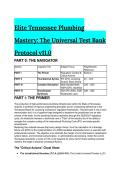
Section Cognitive Tier Subject Focus Page/Section
Reference
PART I The Primer Regulatory Context & Section I
Critical Axioms
PART II Foundational Syntax IPC 2018, Licensing Q1 – Q15
Scopes, Basic Sizing
PART III Complex Simulation Multi-Variable Math, Q16 – Q35
WSFU/DFU, Backflow
PART IV Grandmaster 2024 IPC Shifts, 2026 Q36 – Q60
Synthesis Wastewater Laws
PART I: THE PRIMER
The production of high-performance plumbing infrastructure within the State of Tennessee
requires a synthesis of rigorous engineering principles and an unwavering adherence to the
Tennessee Board for Licensing Contractors' regulatory frameworks. This test bank is not a mere
memorization tool; it is a cognitive forge designed to transform the practitioner into an elite
scholar of the trade. As the plumbing industry transitions through the 2026/2027 regulatory
cycle, the distinction between a technician and a "Titan" of the industry lies in the ability to
navigate the complex overlap of the International Plumbing Code (IPC) and state-specific
amendments.
Mastering this material ensures that every design choice, from the calculation of a drainage
fixture unit (DFU) to the implementation of a 2026-mandated wastewater bond, is executed with
professional precision. The objective is to eliminate the margin of error that leads to catastrophic
system failure, environmental contamination, or administrative de-licensing. Under the current
Tennessee standards, a score of 73% is the baseline for entry, but for those seeking universal
mastery, the target is absolute conceptual fluency.
The "Critical Axioms" Cheat Sheet
● The Jurisdictional Boundary (T.C.A. § 62-6-101): The Limited Licensed Plumber (LLP)
, is strictly capped at projects where the total contract value—including all labor, materials,
and equipment furnished by the owner or third parties—does not exceed $25,000.
● The Closed-System Mandate: Any installation of a check valve, backflow preventer, or
pressure-reducing valve (PRV) on a potable water service line creates a "closed system,"
which, under Tennessee code, necessitates the installation of a thermal expansion control
device to prevent fixture fatigue.
● The Scouring Velocity Constant: All horizontal drainage piping must be installed at a
slope that maintains a minimum scouring velocity. For pipes 3 inches or smaller, the
minimum slope is 1/4 inch per foot; for pipes 4 inches or larger, the minimum is 1/8 inch
per foot.
● The TDEC Backflow Buffer: All irrigation backflow assemblies must be installed a
minimum of 12 inches above finished grade, with 36 inches of clear, unobstructed access
on the testing side to facilitate annual certification by a TDEC-approved tester.
● The 2026 Wastewater Liability: Developers of decentralized wastewater systems in
residential subdivisions must now post a 100% replacement bond for the first two years
after 50% occupancy, shifting the financial risk of infrastructure failure from the county
back to the private sector.
PART II: THE ELITE TEST BANK
Q1: A plumbing contractor is engaged to provide all labor and materials for a commercial
kitchen upgrade in a Knox County restaurant. The firm's labor estimate is $18,000, and the
restaurant owner is providing the specialized fixtures, which have a retail value of $8,000.
Based on the licensing requirements of the Tennessee Board for Licensing Contractors, which
license classification is MOST APPROPRIATE for this project? A) Limited Licensed Plumber
(LLP) B) CMC-A (Plumbing and Gas Piping) C) CMC (Full Mechanical) D) Local Municipal
Master Plumber License
● The Answer: B (CMC-A (Plumbing and Gas Piping))
● Distractor Analysis:
○ A is incorrect: While the labor portion ($18k) is under the $25k threshold, the total
contract value—including owner-furnished materials ($8k)—reaches $26,000, which
exceeds the statutory limit for an LLP.
○ B is correct: The CMC-A is required for any project with a total cost of $25,000 or
more, and this project totals $26,000.
○ C is incorrect: CMC is a broader mechanical license that includes plumbing, but the
CMC-A is the specific "niche-pure" classification for plumbing and gas.
○ D is incorrect: While a local license may be required by the municipality, the
state-mandated monetary threshold for the CMC-A takes precedence for projects of
this value.
The Mentor's Analysis: The $25,000 "hard deck" is the most common legal trap in Tennessee
contracting. Novices often believe that if they only bill for labor under $25,000, they are safe, but
the Board calculates the total project cost, including all materials. By utilizing the Total Contract
Value metric, you bypass the trap of unlicensed contracting. Professional/Academic Intuition:
Always include owner-furnished materials in your licensing threshold calculation to
avoid civil penalties and the voiding of your contract rights.
Q2: During the design of a residential potable water system for a new home in Clarksville, the
static pressure at the city meter is measured at 95 PSI. To ensure the safety of the interior
, fixtures and to comply with the 2018 IPC (as adopted by TN), what is the FIRST corrective
action that must be implemented? A) Increase the pipe size of the main service line to reduce
velocity. B) Install an approved pressure-reducing valve (PRV) to limit pressure to 80 PSI or
less. C) Install a booster pump to maintain constant flow during peak demand. D) Switch the
piping material from PEX to Type L Copper to handle the extra pressure.
● The Answer: B (Install an approved pressure-reducing valve (PRV) to limit pressure to 80
PSI or less.)
● Distractor Analysis:
○ A is incorrect: Increasing pipe size reduces friction loss but does not lower the static
pressure of the system, which is what threatens fixture seals.
○ B is correct: The IPC and Tennessee standards mandate a PRV if the static
pressure exceeds 80 PSI at any time to prevent fixture damage.
○ C is incorrect: A booster pump is used for low-pressure environments, typically
where the static pressure is below 35-40 PSI.
○ D is incorrect: While Type L Copper is highly durable, the code mandate for
pressure limitation is based on protecting the wetted components of valves and
appliances, not just the pipe walls.
The Mentor's Analysis: High static pressure is the leading cause of "ghost-dripping" in faucets
and the catastrophic failure of water heater tanks. When facing Excessive Static Load, the
immediate priority is mechanical regulation at the source. By utilizing an Approved PRV, you
bypass the common trap of over-engineering the pipe diameter while leaving the fixtures
vulnerable. Professional/Academic Intuition: 80 PSI is the non-negotiable ceiling; any
reading above this requires a PRV and, consequently, a thermal expansion tank.
Q3: A plumber is calculating the drainage load for a commercial facility with the following
fixtures: (2) Flushometer-valve public water closets, (2) Public lavatories, and (1)
Commercial-grade automatic clothes washer. Using 2018 IPC Table 709.1, what is the TOTAL
Drainage Fixture Unit (DFU) load for these fixtures? A) 8.0 DFU B) 11.0 DFU C) 13.0 DFU D)
15.0 DFU
● The Answer: C (13.0 DFU)
● Distractor Analysis:
○ A is incorrect: This math assumes all fixtures are rated at 1.0 DFU, which is a
novice error.
○ B is incorrect: This error occurs if the plumber uses residential DFU values for the
public water closets.
○ C is correct: (2) Public Water Closets \times 4.0 = 8.0; (2) Public Lavatories \times
1.0 = 2.0; (1) Commercial Clothes Washer \times 3.0 = 3.0. Total = 13.0 DFU.
○ D is incorrect: This is a result of overestimating the lavatory or washer values.
The Mentor's Analysis: Precision in DFU calculation is the bedrock of sanitary drainage
design. When facing Mixed Occupancy Loads, the immediate priority is assigning the correct
"Public" vs "Private" values. By utilizing Table 709.1, you bypass the common trap of
undersizing the main building drain, which leads to chronic backups. Professional/Academic
Intuition: Commercial clothes washers are 3.0 DFU; Public flushometer toilets are 4.0
DFU. Master these core values to master commercial sizing.
Q4: In a renovation project for a historical building in downtown Nashville, a contractor must
replace a significant portion of the DWV system. Under the Tennessee code (T.comp.R.&Regs.
0680-02), what is the legal status of the EXISTING plumbing that is not being altered? A) It must
be upgraded to current code standards immediately. B) It may remain in place if it is in safe
operating condition and not detrimental to the system. C) It must be replaced if it consists of
Mastery: The Universal Test Bank
Protocol v11.0
PART 0: THE NAVIGATOR
Section Cognitive Tier Subject Focus Page/Section
Reference
PART I The Primer Regulatory Context & Section I
Critical Axioms
PART II Foundational Syntax IPC 2018, Licensing Q1 – Q15
Scopes, Basic Sizing
PART III Complex Simulation Multi-Variable Math, Q16 – Q35
WSFU/DFU, Backflow
PART IV Grandmaster 2024 IPC Shifts, 2026 Q36 – Q60
Synthesis Wastewater Laws
PART I: THE PRIMER
The production of high-performance plumbing infrastructure within the State of Tennessee
requires a synthesis of rigorous engineering principles and an unwavering adherence to the
Tennessee Board for Licensing Contractors' regulatory frameworks. This test bank is not a mere
memorization tool; it is a cognitive forge designed to transform the practitioner into an elite
scholar of the trade. As the plumbing industry transitions through the 2026/2027 regulatory
cycle, the distinction between a technician and a "Titan" of the industry lies in the ability to
navigate the complex overlap of the International Plumbing Code (IPC) and state-specific
amendments.
Mastering this material ensures that every design choice, from the calculation of a drainage
fixture unit (DFU) to the implementation of a 2026-mandated wastewater bond, is executed with
professional precision. The objective is to eliminate the margin of error that leads to catastrophic
system failure, environmental contamination, or administrative de-licensing. Under the current
Tennessee standards, a score of 73% is the baseline for entry, but for those seeking universal
mastery, the target is absolute conceptual fluency.
The "Critical Axioms" Cheat Sheet
● The Jurisdictional Boundary (T.C.A. § 62-6-101): The Limited Licensed Plumber (LLP)
, is strictly capped at projects where the total contract value—including all labor, materials,
and equipment furnished by the owner or third parties—does not exceed $25,000.
● The Closed-System Mandate: Any installation of a check valve, backflow preventer, or
pressure-reducing valve (PRV) on a potable water service line creates a "closed system,"
which, under Tennessee code, necessitates the installation of a thermal expansion control
device to prevent fixture fatigue.
● The Scouring Velocity Constant: All horizontal drainage piping must be installed at a
slope that maintains a minimum scouring velocity. For pipes 3 inches or smaller, the
minimum slope is 1/4 inch per foot; for pipes 4 inches or larger, the minimum is 1/8 inch
per foot.
● The TDEC Backflow Buffer: All irrigation backflow assemblies must be installed a
minimum of 12 inches above finished grade, with 36 inches of clear, unobstructed access
on the testing side to facilitate annual certification by a TDEC-approved tester.
● The 2026 Wastewater Liability: Developers of decentralized wastewater systems in
residential subdivisions must now post a 100% replacement bond for the first two years
after 50% occupancy, shifting the financial risk of infrastructure failure from the county
back to the private sector.
PART II: THE ELITE TEST BANK
Q1: A plumbing contractor is engaged to provide all labor and materials for a commercial
kitchen upgrade in a Knox County restaurant. The firm's labor estimate is $18,000, and the
restaurant owner is providing the specialized fixtures, which have a retail value of $8,000.
Based on the licensing requirements of the Tennessee Board for Licensing Contractors, which
license classification is MOST APPROPRIATE for this project? A) Limited Licensed Plumber
(LLP) B) CMC-A (Plumbing and Gas Piping) C) CMC (Full Mechanical) D) Local Municipal
Master Plumber License
● The Answer: B (CMC-A (Plumbing and Gas Piping))
● Distractor Analysis:
○ A is incorrect: While the labor portion ($18k) is under the $25k threshold, the total
contract value—including owner-furnished materials ($8k)—reaches $26,000, which
exceeds the statutory limit for an LLP.
○ B is correct: The CMC-A is required for any project with a total cost of $25,000 or
more, and this project totals $26,000.
○ C is incorrect: CMC is a broader mechanical license that includes plumbing, but the
CMC-A is the specific "niche-pure" classification for plumbing and gas.
○ D is incorrect: While a local license may be required by the municipality, the
state-mandated monetary threshold for the CMC-A takes precedence for projects of
this value.
The Mentor's Analysis: The $25,000 "hard deck" is the most common legal trap in Tennessee
contracting. Novices often believe that if they only bill for labor under $25,000, they are safe, but
the Board calculates the total project cost, including all materials. By utilizing the Total Contract
Value metric, you bypass the trap of unlicensed contracting. Professional/Academic Intuition:
Always include owner-furnished materials in your licensing threshold calculation to
avoid civil penalties and the voiding of your contract rights.
Q2: During the design of a residential potable water system for a new home in Clarksville, the
static pressure at the city meter is measured at 95 PSI. To ensure the safety of the interior
, fixtures and to comply with the 2018 IPC (as adopted by TN), what is the FIRST corrective
action that must be implemented? A) Increase the pipe size of the main service line to reduce
velocity. B) Install an approved pressure-reducing valve (PRV) to limit pressure to 80 PSI or
less. C) Install a booster pump to maintain constant flow during peak demand. D) Switch the
piping material from PEX to Type L Copper to handle the extra pressure.
● The Answer: B (Install an approved pressure-reducing valve (PRV) to limit pressure to 80
PSI or less.)
● Distractor Analysis:
○ A is incorrect: Increasing pipe size reduces friction loss but does not lower the static
pressure of the system, which is what threatens fixture seals.
○ B is correct: The IPC and Tennessee standards mandate a PRV if the static
pressure exceeds 80 PSI at any time to prevent fixture damage.
○ C is incorrect: A booster pump is used for low-pressure environments, typically
where the static pressure is below 35-40 PSI.
○ D is incorrect: While Type L Copper is highly durable, the code mandate for
pressure limitation is based on protecting the wetted components of valves and
appliances, not just the pipe walls.
The Mentor's Analysis: High static pressure is the leading cause of "ghost-dripping" in faucets
and the catastrophic failure of water heater tanks. When facing Excessive Static Load, the
immediate priority is mechanical regulation at the source. By utilizing an Approved PRV, you
bypass the common trap of over-engineering the pipe diameter while leaving the fixtures
vulnerable. Professional/Academic Intuition: 80 PSI is the non-negotiable ceiling; any
reading above this requires a PRV and, consequently, a thermal expansion tank.
Q3: A plumber is calculating the drainage load for a commercial facility with the following
fixtures: (2) Flushometer-valve public water closets, (2) Public lavatories, and (1)
Commercial-grade automatic clothes washer. Using 2018 IPC Table 709.1, what is the TOTAL
Drainage Fixture Unit (DFU) load for these fixtures? A) 8.0 DFU B) 11.0 DFU C) 13.0 DFU D)
15.0 DFU
● The Answer: C (13.0 DFU)
● Distractor Analysis:
○ A is incorrect: This math assumes all fixtures are rated at 1.0 DFU, which is a
novice error.
○ B is incorrect: This error occurs if the plumber uses residential DFU values for the
public water closets.
○ C is correct: (2) Public Water Closets \times 4.0 = 8.0; (2) Public Lavatories \times
1.0 = 2.0; (1) Commercial Clothes Washer \times 3.0 = 3.0. Total = 13.0 DFU.
○ D is incorrect: This is a result of overestimating the lavatory or washer values.
The Mentor's Analysis: Precision in DFU calculation is the bedrock of sanitary drainage
design. When facing Mixed Occupancy Loads, the immediate priority is assigning the correct
"Public" vs "Private" values. By utilizing Table 709.1, you bypass the common trap of
undersizing the main building drain, which leads to chronic backups. Professional/Academic
Intuition: Commercial clothes washers are 3.0 DFU; Public flushometer toilets are 4.0
DFU. Master these core values to master commercial sizing.
Q4: In a renovation project for a historical building in downtown Nashville, a contractor must
replace a significant portion of the DWV system. Under the Tennessee code (T.comp.R.&Regs.
0680-02), what is the legal status of the EXISTING plumbing that is not being altered? A) It must
be upgraded to current code standards immediately. B) It may remain in place if it is in safe
operating condition and not detrimental to the system. C) It must be replaced if it consists of


