

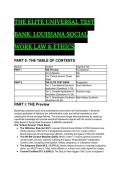
THE ELITE UNIVERSAL TEST
BANK: LOUISIANA SOCIAL
WORK LAW & ETHICS
PART 0: THE TABLE OF CONTENTS
Section Content Cognitive Tier
PART I THE Preview Foundational
Intro & Mission N/A
The "Critical Axioms" Cheat N/A
Sheet
PART II THE ELITE TEST BANK Progression
Tier 1: Foundational Syntax & Core Definitions
Application (Questions 1–15)
Tier 2: Complex Application & Scenario Logic
Simulation (Questions 16–35)
Tier 3: Grandmaster Synthesis High-Stakes Synthesis
(Questions 36–60)
PART I: THE Preview
Mastering Louisiana social work jurisprudence transcends rote memorization; it demands
surgical application of statutory law, administrative code, and ethical mandates to avert
catastrophic clinical and legal failures. This document forges elite practitioners by replacing
superficial knowledge with precise analytical frameworks aligned with the current Louisiana
State Board of Social Work Examiners (LABSWE) standards.
The "Critical Axioms" Cheat Sheet:
● The 3000-Hour Rule (Act 457): Licensed Clinical Social Worker (LCSW) licensure now
strictly requires 3,000 hours of postgraduate practice over 2 to 4 years under a
Board-Approved Clinical Supervisor (BACS), overriding the legacy 5,760-hour standard.
● The HB 400 Consent Mandate (2025): Minors under 17 require parental consent for
mental health services, explicitly nullifying the legacy "illness/disease" independent
consent rules, excepting emancipation, military, pregnancy, or substance misuse.
● The Subpoena Shield (R.S. 13:3715.1): Never release records on a standard subpoena
alone; you MUST have a 7-day notice affidavit or a direct court order signed by a judge.
● Tarasoff Codified (R.S. 9:2800.2): The Duty to Warn triggers ONLY upon an apparent
, intent and ability to carry out a threat of physical violence against a clearly identified
victim.
● The 5-Year Intimacy Ban (LAC 46:XXV.113): Sexual intimacy with a former client is
absolutely prohibited for 5 years post-termination, and strictly regulated thereafter.
Core Regulatory Data Structures
CE Requirement Parameter Standard Mandate Reference
Annual Total Hours 20 Clock Hours
Clinical Content (LCSW only) 10 Hours Annually
Ethics Content 3 Hours Every Two Years
Asynchronous Virtual Limit Maximum 10 Hours (Live video
is "in-person")
BACS Supervision CE 3 Hours Every Two Years
Telesupervision CE 1.5 Hours (One-Time
Requirement)
---
PART II: THE ELITE TEST BANK
Tier 1: Foundational Syntax & Application
Q1: A Licensed Master's Social Worker (LMSW) applies for LCSW licensure. Based on the
principles of the Louisiana Social Work Practice Act (R.S. 37:2708), which action/conclusion is
the MOST ACCURATE regarding postgraduate practice hours? A) The applicant must verify
5,760 total hours, including 3,840 BACS-supervised hours. B) The applicant must complete
3,840 hours of supervised clinical practice over three years. C) The applicant must complete at
least 3,000 hours of postgraduate practice over a minimum of two years and a maximum of four
years under a BACS. D) The applicant is exempt from BACS supervision if they operate in a
state-exempt agency.
● The Answer: C (The applicant must complete at least 3,000 hours of postgraduate
practice over a minimum of two years and a maximum of four years under a BACS.)
● Distractor Analysis:
○ A is incorrect: This reflects the outdated legacy standard prior to the enactment of
Act 457.
○ B is incorrect: This misapplies the legacy supervised hour requirement.
○ D is incorrect: All clinical social work practice aimed at LCSW licensure requires
BACS supervision, regardless of the agency setting.
The Mentor's Analysis: Act 457 modernized Louisiana's licensure pipeline. When calculating
experience, the immediate priority is utilizing the current statutory metric. By utilizing R.S.
37:2708, you bypass the common trap of delaying licensure based on repealed frameworks.
Professional/Academic Intuition: LCSW eligibility is secured at 3,000 hours over 2 to 4
years.
Q2: A social worker is auditing their annual Continuing Education (CE) completion. Based on
the principles of LABSWE CE Rules (LAC 46:XXV.317), which conclusion is the MOST
ACCURATE? A) The social worker may complete all 20 required hours via asynchronous virtual
, learning. B) The social worker may complete 10 hours via asynchronous distance learning, as
synchronous interactive online courses count as in-person. C) The social worker must complete
all 20 hours strictly in a physical classroom environment. D) The social worker must take 3
hours of clinical supervision training annually.
● The Answer: B (The social worker may complete 10 hours via asynchronous distance
learning, as synchronous interactive online courses count as in-person.)
● Distractor Analysis:
○ A is incorrect: LABSWE strictly caps asynchronous virtual learning at 10 hours. * C
is incorrect: Live, synchronous interactive webinars are classified as in-person
learning. * D is incorrect: Only LCSW-BACS require supervision CE, and it is 3
hours every two years, not annually.
The Mentor's Analysis: CE compliance demands format awareness. When auditing hours, the
priority is distinguishing between synchronous and asynchronous delivery. By utilizing the
synchronous exemption, you bypass the common trap of failing the asynchronous audit limit.
Professional/Academic Intuition: Live video is in-person; pre-recorded video is capped at
10 hours.
Q3: An LMSW wishes to incorporate telesupervision into their LCSW clinical tracking. Based on
the principles of LABSWE telesupervision mandates, which action is FIRST necessary? A) The
LMSW must physically meet the BACS for the initial 96 hours before transitioning online. B) The
LMSW must acquire written Board approval due to a physical travel hardship. C) Both the
LMSW and BACS must complete a one-time 1.5-hour continuing education course in
telesupervision. D) The LMSW must reside in a rural parish designated as a mental health
shortage area.
● The Answer: C (Both the LMSW and BACS must complete a one-time 1.5-hour
continuing education course in telesupervision.)
● Distractor Analysis:
○ A is incorrect: Face-to-face hours can be met synchronously online under modern
telesupervision rules without front-loading physical meetings.
○ B is incorrect: Act 865 codified telesupervision, removing the legacy mandate for
individual Board hardship approval.
○ D is incorrect: Telesupervision is geographically agnostic within state bounds.
The Mentor's Analysis: Act 865 standardized remote supervision. When initiating
telesupervision, the immediate priority is credentialing both parties in the modality. By utilizing
the 1.5-hour CE mandate, you bypass the common trap of invalidating supervised hours.
Professional/Academic Intuition: Telesupervision requires specialized CE, but no longer
requires Board hardship waivers.
Q4: A client abruptly terminates services and demands their complete clinical file be destroyed.
Based on the principles of LABSWE record retention rules (LAC 46:XXV.111), which action is
the MOST ACCURATE? A) The social worker must surrender the original records and delete all
backups immediately. B) The social worker must maintain the records for six years after the last
date of service. C) The social worker must maintain the records for ten years to satisfy federal
HIPAA regulations. D) The social worker must transfer the records to the Board's archival
database.
● The Answer: B (The social worker must maintain the records for six years after the last
date of service.)
● Distractor Analysis:
○ A is incorrect: The provider retains the original record; destroying it constitutes
spoliation.
BANK: LOUISIANA SOCIAL
WORK LAW & ETHICS
PART 0: THE TABLE OF CONTENTS
Section Content Cognitive Tier
PART I THE Preview Foundational
Intro & Mission N/A
The "Critical Axioms" Cheat N/A
Sheet
PART II THE ELITE TEST BANK Progression
Tier 1: Foundational Syntax & Core Definitions
Application (Questions 1–15)
Tier 2: Complex Application & Scenario Logic
Simulation (Questions 16–35)
Tier 3: Grandmaster Synthesis High-Stakes Synthesis
(Questions 36–60)
PART I: THE Preview
Mastering Louisiana social work jurisprudence transcends rote memorization; it demands
surgical application of statutory law, administrative code, and ethical mandates to avert
catastrophic clinical and legal failures. This document forges elite practitioners by replacing
superficial knowledge with precise analytical frameworks aligned with the current Louisiana
State Board of Social Work Examiners (LABSWE) standards.
The "Critical Axioms" Cheat Sheet:
● The 3000-Hour Rule (Act 457): Licensed Clinical Social Worker (LCSW) licensure now
strictly requires 3,000 hours of postgraduate practice over 2 to 4 years under a
Board-Approved Clinical Supervisor (BACS), overriding the legacy 5,760-hour standard.
● The HB 400 Consent Mandate (2025): Minors under 17 require parental consent for
mental health services, explicitly nullifying the legacy "illness/disease" independent
consent rules, excepting emancipation, military, pregnancy, or substance misuse.
● The Subpoena Shield (R.S. 13:3715.1): Never release records on a standard subpoena
alone; you MUST have a 7-day notice affidavit or a direct court order signed by a judge.
● Tarasoff Codified (R.S. 9:2800.2): The Duty to Warn triggers ONLY upon an apparent
, intent and ability to carry out a threat of physical violence against a clearly identified
victim.
● The 5-Year Intimacy Ban (LAC 46:XXV.113): Sexual intimacy with a former client is
absolutely prohibited for 5 years post-termination, and strictly regulated thereafter.
Core Regulatory Data Structures
CE Requirement Parameter Standard Mandate Reference
Annual Total Hours 20 Clock Hours
Clinical Content (LCSW only) 10 Hours Annually
Ethics Content 3 Hours Every Two Years
Asynchronous Virtual Limit Maximum 10 Hours (Live video
is "in-person")
BACS Supervision CE 3 Hours Every Two Years
Telesupervision CE 1.5 Hours (One-Time
Requirement)
---
PART II: THE ELITE TEST BANK
Tier 1: Foundational Syntax & Application
Q1: A Licensed Master's Social Worker (LMSW) applies for LCSW licensure. Based on the
principles of the Louisiana Social Work Practice Act (R.S. 37:2708), which action/conclusion is
the MOST ACCURATE regarding postgraduate practice hours? A) The applicant must verify
5,760 total hours, including 3,840 BACS-supervised hours. B) The applicant must complete
3,840 hours of supervised clinical practice over three years. C) The applicant must complete at
least 3,000 hours of postgraduate practice over a minimum of two years and a maximum of four
years under a BACS. D) The applicant is exempt from BACS supervision if they operate in a
state-exempt agency.
● The Answer: C (The applicant must complete at least 3,000 hours of postgraduate
practice over a minimum of two years and a maximum of four years under a BACS.)
● Distractor Analysis:
○ A is incorrect: This reflects the outdated legacy standard prior to the enactment of
Act 457.
○ B is incorrect: This misapplies the legacy supervised hour requirement.
○ D is incorrect: All clinical social work practice aimed at LCSW licensure requires
BACS supervision, regardless of the agency setting.
The Mentor's Analysis: Act 457 modernized Louisiana's licensure pipeline. When calculating
experience, the immediate priority is utilizing the current statutory metric. By utilizing R.S.
37:2708, you bypass the common trap of delaying licensure based on repealed frameworks.
Professional/Academic Intuition: LCSW eligibility is secured at 3,000 hours over 2 to 4
years.
Q2: A social worker is auditing their annual Continuing Education (CE) completion. Based on
the principles of LABSWE CE Rules (LAC 46:XXV.317), which conclusion is the MOST
ACCURATE? A) The social worker may complete all 20 required hours via asynchronous virtual
, learning. B) The social worker may complete 10 hours via asynchronous distance learning, as
synchronous interactive online courses count as in-person. C) The social worker must complete
all 20 hours strictly in a physical classroom environment. D) The social worker must take 3
hours of clinical supervision training annually.
● The Answer: B (The social worker may complete 10 hours via asynchronous distance
learning, as synchronous interactive online courses count as in-person.)
● Distractor Analysis:
○ A is incorrect: LABSWE strictly caps asynchronous virtual learning at 10 hours. * C
is incorrect: Live, synchronous interactive webinars are classified as in-person
learning. * D is incorrect: Only LCSW-BACS require supervision CE, and it is 3
hours every two years, not annually.
The Mentor's Analysis: CE compliance demands format awareness. When auditing hours, the
priority is distinguishing between synchronous and asynchronous delivery. By utilizing the
synchronous exemption, you bypass the common trap of failing the asynchronous audit limit.
Professional/Academic Intuition: Live video is in-person; pre-recorded video is capped at
10 hours.
Q3: An LMSW wishes to incorporate telesupervision into their LCSW clinical tracking. Based on
the principles of LABSWE telesupervision mandates, which action is FIRST necessary? A) The
LMSW must physically meet the BACS for the initial 96 hours before transitioning online. B) The
LMSW must acquire written Board approval due to a physical travel hardship. C) Both the
LMSW and BACS must complete a one-time 1.5-hour continuing education course in
telesupervision. D) The LMSW must reside in a rural parish designated as a mental health
shortage area.
● The Answer: C (Both the LMSW and BACS must complete a one-time 1.5-hour
continuing education course in telesupervision.)
● Distractor Analysis:
○ A is incorrect: Face-to-face hours can be met synchronously online under modern
telesupervision rules without front-loading physical meetings.
○ B is incorrect: Act 865 codified telesupervision, removing the legacy mandate for
individual Board hardship approval.
○ D is incorrect: Telesupervision is geographically agnostic within state bounds.
The Mentor's Analysis: Act 865 standardized remote supervision. When initiating
telesupervision, the immediate priority is credentialing both parties in the modality. By utilizing
the 1.5-hour CE mandate, you bypass the common trap of invalidating supervised hours.
Professional/Academic Intuition: Telesupervision requires specialized CE, but no longer
requires Board hardship waivers.
Q4: A client abruptly terminates services and demands their complete clinical file be destroyed.
Based on the principles of LABSWE record retention rules (LAC 46:XXV.111), which action is
the MOST ACCURATE? A) The social worker must surrender the original records and delete all
backups immediately. B) The social worker must maintain the records for six years after the last
date of service. C) The social worker must maintain the records for ten years to satisfy federal
HIPAA regulations. D) The social worker must transfer the records to the Board's archival
database.
● The Answer: B (The social worker must maintain the records for six years after the last
date of service.)
● Distractor Analysis:
○ A is incorrect: The provider retains the original record; destroying it constitutes
spoliation.


