

Written by students who passed Immediately available after payment Read online or as PDF Wrong document? Swap it for free 4.6 TrustPilot
logo-home
Document preview thumbnail
Preview 2 out of 12 pages
Other

MDC Exam #1 Concept Guide| Pain Assessment & Priority Needs in Nursing - Complete Guide - Rasmussen.

Document preview thumbnail
Preview 2 out of 12 pages

MDC Exam #1 Concept Guide Please review the following content areas to prepare for the first exam • Maslow’s hierarchy of needs: where things fall • Priority assessments/Prioritizing clients (address physiological needs first) • Focused pain assessment: Pain is subjective!! Pain is the 5th vital sign. • Types of pain (cutaneous, neuropathic, somatic, nociceptive, acute, chronic, etc.) - Acute pain causes increased respiratory rate w/ decrease in depth - Pain can cause BP increase, but prolonged pain can cause decrease in BP - Cutaneous: Arises from burning your skin such as like on a hot iron or from touching a hot pan on the stove - Visceral pain: Caused from deep internal disorders such as menstrual cramps, labor pains or GI infections - Deep Somatic: Originates from the ligaments, tendons, nerves, blood vessels and bones such as fractures or sprains - Radiating: Starts at an origin but extends to other locations such as a sore throat may extend to ears and head - Referred: occurs in an area distant from the site of origin such as pain from an MI might be felt in left arm or jaw - Phantom: Pain that is perceived from an area that has been surgically or traumatically removed - Neuropathic: Results from an injury of one or more nerves where messages regarding pain are transmitted w/o a pain stimulus occurs - Acute: short duration, rapid onset, and associated w/ some kind of injury - Chronic: Last 6 months or longer and interferes w/ ADLs - Order for priority of which patient needs to be seen first or which need must be met first - Physiological: ABCs - Safety & Security: Can include financial security - Love & Belonging: Emotional needs - Esteem: Feelings towards oneself - Self Actualization: Highest level of performance• Physiology of nociceptive pain (Ch. 41 ATI) • Subjective versus objective data • RICE acronym: Ice packs no longer than 20 minutes • Do not apply ice or heat directly on skin • Factors that affect sleep: Terms insomnia, narcolepsy, sleep apnea • Nutrition methods: oral/enteral/parenteral - Arises from tissues damaged by physical or chemical agents such as trauma, surgery, or chemical burns, while neuropathic pain arises from diseases or damage mediated directly to sensory nerves such as diabetic neuropathy, shingles or post therapeutic neuralgia - R: Rest - I: Ice - C: Compression - E: Elevation - Insomnia: inability to get an adequate amount of sheep or feel rested • Acute/chronic/intermittent • Women and older adults are more prone - Sleep apnea: more than 5 breathing cessations lasting longer than 10 seconds an hr during sleep, resulting in decreased arterial O2 saturation levels • can be central or obstructive - Narcolepsy: sudden attacks of sleep at inappropriate times - Oral: By Mouth - Enteral: All intake through an NG tube, G- tube, Peg Tube, or Jejunostomy tube (TPN) - Parenteral: Nutrition through a centrally inserted IV tone such as a PICC or central venous access device - Subjective: Based on perception; health history - Objective: Measurable or factual; use senses• Long-term consequence of malnutrition • Nutrition disorders: bulimia and anorexia • Type of diets for certain diseases or conditions. (Who should be on a high protein diet or a low sodium diet) • Fluid volume: deficits versus excess (S&S) & what to assess FIRST • How to determine fluid volume changes, why do I & O’s? - A higher risk of obesity, heart disease and diabetes - Reduced wound healing - Severe weight loss (aka cachexia) - Failure of organs - Bulimia: Eating disorder marked by binging, followed by methods to avoid weight gain - Anorexia: Restriction of food intake leading to low body weight w/ intense fear of gaining weight - Mechanical soft: Easy to chew and safer to swallow (stroke) - Low Fiber: GI illness or post op and limits to less than 10 grams or less of fiber daily - Carbohydrate controlled: promotes glucose control (diabetics) - Cardiac: Limits fats, cholesterol and sodium (HTN, MI) - Thickened Liquids: Safer for dysphagia - Clear liquids: Prior to GI procedures (leaves no residue) - Fluid Deficit: weak pulses, hypotension, tachycardia, poor perfusion, AMS, dry skin and membranes - Fluid overload: bonding pulses, hypertension, bradycardia, crackles in lungs, and edema - Assess mental status and VS first - Determine by measuring fluid intake by mouth and through IV and compare to urinary output to evaluate renal function, BP, edema and urinary retention etc - Check for weight gain or loss - Check vital signs• I & O’s balance & imbalance. What does an imbalance possibly represent? • Electrolyte imbalances • Constipation: enema position • Prevention of constipation • Metabolic acidosis: diabetic ketoacidosis (Ch. 57 ATI) uncontrolled diabetes: what does that look like? • Immobility: DVT assessment & DVT prevention • Effects of immobility/Mobility physiologic consequences (cardiovascular, respiratory, integumentary, metabolism, etc.) - Urinary retention -Dysrhythmia - Third spacing - AMS - CHF - Weakness - Edema - Dehydration - Abnormal VS - Adequate fluid, fiber intake and exercise - Left lateral position - Assessment: Temperature, color, swelling, or pain on posterior leg - Prevention: compression socks, mobility, anticoagulants - Extremely high blood sugar - Tachypnea (Kussmaul breathing in image) - AMS - Generalized weakness - pH is acidic and bicarbonate decrease - Assessments for immobility: skin, cardiovascular, respiratory, metabolic, musculoskeletal, psych, elimination and mobility - Higher risks for: pneumonia, blood clots, skin break down, slowed metabolism, depression, and decreased elimination• Physiological changes of elderly clients: reduced muscle strength, sensory deficits, balance issues, slower reflexes, less body water, thinner/drier skin, loss of subcutaneous fat, arterial blood flow is often decreased, more chronic diseases, decreased immunity, slower metabolism, etc. • Interventions to prevent skin breakdown (at risk for skin integrity) • Sensory perception issues (hearing loss, vision loss, neuropathy): communication & precautions/ interventions/education • Get up & go test • What factors can influence diffusion? (Gas exchange) • Hypoxia: What does pulse oximetry measure? - Turning patient at least every 2 hours - Reduce layers of fabric or bedding underneath patient - Barrier creams - Wound dressings - Risks Factors: medication, trauma and damage to nervous system - Physiological consequences: increased fall risk physical injuries, problems doing ADLs, ambulation and communication - Hearing loss: face patient and speak in normal tone w/short and direct sentences - Interventions: primary is prevention and secondary is screening - Use corrective devices - Requires patients to stand up from chair, walk a short distance, turn around, return and sit down again to test mobility and balance - Diffusion: the exchange of O2 and CO2 btwn the alveoli and RBCs - Reduced by: increased amounts of fluid secretions and thick sputum - Ventilation = inspiration - Diffusion = expiration - Oxygen saturation in the blood and peripheral pulses• Perfusion: central versus peripheral S&S • Late signs of hypoxemia • What raises BP? What can lower BP? • Normal temp/hypothermia/hyperthermia: what affects temperature? • Therapeutic communication responses • Communicating with clients of various cultures - Cyanosis - Central: blood pumped by the heart that is targeted to organ perfusion - Peripheral: blood that flows to arteries and capillaries to target tissues - S & S of Lack of Central: dyspnea, dizziness, syncope and chest pain - S & S of Lack of Peripheral: cold, decreased capillary refill, numbness, and discoloration - BP changes are caused by: cardiac output, vascular resistance, volume, elasticity of arterial walls, pain, emotional responses, and dehydration - High BP causes: high fluid volume, acute pain, blockages - Low BP causes: fluid loss, chronic pain, infection - Normal: 95.9 -99.5F - Affected by ability to thermoregulate, environment, and loss of subcutaneous fat - Thermoregulation controlled by hypothalamus - Be aware of own biases - Avoid Ethnocentrism (belief that one's own culture is better and others are wrong) - Learn about other cultures in your location - Convey empathy and respect - Be aware of cultural preferences related to eye contact, space and touch - Address client appropriately - Appropriate use of interpreters - Client-centered communication directed to achieve the patient's goal - 5 key Characteristics: Empathy, respect, genuiness, concreteness, and confrontation• Verbal vs. non-verbal communication • Therapeutic communication terms (restating, clarifying, sequencing, reassuring, silence, etc.) • Barriers to communication (be able to identify) • Phases of therapeutic relationships (pre-interaction, orientation, working, termination) • Culture terms (assimilation, shock, blindness, imposition) - Verbal: Speaking, tone, volume, and written - Nonverbal: Therapeutic touch, eye contact, posture, facial expressions, space, appearance - Restating: uses the client's exact words - Clarifying: Ensure you have decoded the message correctly - Validate: confirms you have made the correct interpretation - Asking too many questions - changing the subject - Expressing approval or disapproval - Pre interaction: begins w/ collection of data - Orientation: establish rapport and trust - Working: therapeutic communication - Termination: End of communication or relationship - Assimilation: A new member gradually learns and takes essential values, beliefs and behaviors of the dominant culture gradually - Shock: The feelings a person may experience when plated in a different culture perceived as strange - Blindness: The inability to understand how particular matters might be viewed by people of different cultures b/c of a rigid adherence to the views, attitudes and values of one's own culture or believe the perspective of one's own culture is sufficiently limiting to make it difficult to see alternatives - Imposition: Example: A nurse is telling a new mother fromAfrica that she shouldn't carry her baby in a sling created from a large rectangular cloth. The African woman tells the nurse that everyone in Africa carries babies this way. The nurse believes that bassinets are safer for infants• Complementary and alternative therapies to manage pain (ex. Acupuncture, breathing techniques, etc. • Review effects of: Gingko Biloba, Ginseng, Chamomile, Echinacea, Aloe (Ch. 42 ATI) • Basic patient safety (turning, transferring, ambulating) • Proper body mechanics • Sentinel events “never events” - Guided imagery/visualization - Healing intention - Breath work - Humor - Meditation - Simple touch - Music or art therapy - Relaxation techniques - Gingko Biloba: Improves memory - Ginseng: Increases physical endurance - Aloe: promotes wound healing - Chamomile: Anti-inflammatory and calming - Echinacea: Enhances Immunity - Garlin: Inhibits platelet aggregation - Ginger: Antiemetic - Valerian: Promotes sleep and reduces anxiety - Foreign objects left in patients after surgery - Air Embolism - Administering the wrong type of blood - severe pressure injuries - Falls and trauma - Infections associated w/ urinary catheters or IV catheters - Symptoms resulting from poorly controlled blood sugar - Surgical site infections following certain election procedures - DVT or PE following total knee and total hip replacement procedure• Common healthcare worker injuries & how to prevent • Purpose of incident reports • Side rail safety • OSHA mission • National Patient Safety Goals • Healthy People 2030 goals • WHO (World Health Organization) mission • Home safety (infants, toddlers, adolescents, adults) - To prevent work-related injuries, illnesses, and deaths - Goals included improving the accuracy of patient identification, improving the effectiveness of communication among caregivers, reducing the harm associated w/ clinical alarm systems, reducing the risk of healthcare-associated infections, and implementing evidence-based practices for preventing surgical Site infections - sets data-driven national objectives to improve health and well-being over the next decade - Education and home assessments - Poisoning, fires, firearms, fay hazards, drowning, suffocation - A tool used in identifying opportunities for improvement - Do not put up all side rails b/c this is considered a restraint - use them so patient does not fall at of bed - to reduce the risk for unnecessary harm associated w/ healthcare to a minimum - Focus or globally providing health• Poisoning (food, ingestion, safe handling of food) • Fall interventions for elderly clients (clinical setting & home—focus on safety) • Screening tools: Braden, Confusion Assessment Method (CAM), Morse Fall - keep houseplants and cleaning products out of reach - Inspect and remove sources of lead and provide parents w/ into about prevention of lead poisoning - Place medications including vitamins in a child proof container and lock up - Dispose of medications that are expired or no longer taken - For poisoning DO Not induce vomiting b/c trachea can-be further damaged - For most poisonings, the most effective intervention is Professional administration of activated charcoal orally or via gastric tube - Antidotes: Narcan for narcotics or Flumazenil for antidepressants - Provide adequate lighting - Remove trip hazards - Promote healthy sleep patterns - use shower chairs and raised toilet seats - Keep stairs free of clutter - use an ice melt product during winter - Encourage the client to have regular toileting schedules - Encourage the client not to drink 2-4 hours prior to bedtime• Using Morse Fall score can help identify higher risk fall patients & prevent falls • Fall occurs? Report & always reassess patient • Fire safety (RACE, PASS • Equipment malfunctions • Restraints: should have tried alternative methods first, quick release knot, bedframe, 2 fingers, only release one restraint at a time for ROM every 2 hours, make sure to offer elimination, hygiene, nutrition, hydration, check circulation q30 minutes • Nursing diagnosis (scenario & pick nursing diagnosis that applies or selecting highest priority) • Interventions for risk for scenarios • Delegation (Ch. 6 ATI) • Interprofessional team (Ch. 2 ATI) occupational therapist, social worker, speech, etc. • Chain of infection (Ch. 56 ATI) - 5 Rights: right task, right circumstance, right person, right communication, right supervision - Causative agent: Virus, bacteria, fungus, prion, parasite - Susceptible host: Immunocompromised, open wounds, etc - Portal of entry: Airways, mucus membranes, open wounds - Mode of transmission: Contact, droplet, airborne - Portal of exit: Respiratory, GI, GU, skin, mucus membranes, bodily fluids, blood, transplacental, reproductive tract - Reservoir: Human, animal, food, water, soil insects, fomites '• Weather related casualties: heat, floods, hurricanes, tornado • SOAP/ PIE/ DAR charting- subjective, objective, assessment, plan (Ch. 5 ATI) • Preventing edema- elevate - More than 1,000 deaths each year in U.s. due to weather hazards - Most common killer is heat - The # of deaths due to lightning tornadoes, and hurricanes has fallen steadily - Deaths related to floods have declined only more recently mostly b/c of advances in tech and warning systems

Content preview

MDC Exam #1 Concept Guide

Please review the following content areas to prepare for the rst exam
• Maslow’s hierarchy of needs: where things fall
• Priority assessments/Prioritizing clients (address
physiological needs rst)

- Order for priority of which patient needs to be seen first
or which need must be met first
- Physiological: ABCs
- Safety & Security: Can include financial security
- Love & Belonging: Emotional needs
- Esteem: Feelings towards oneself
- Self Actualization: Highest level of performance


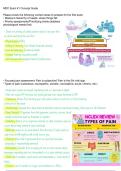
• Focused pain assessment: Pain is subjective!! Pain is the 5th vital sign.
• Types of pain (cutaneous, neuropathic, somatic, nociceptive, acute, chronic, etc.)

- Acute pain causes increased respiratory rate w/ decrease in depth
- Pain can cause BP increase, but prolonged pain can cause decrease in BP
- Cutaneous: Arises from burning your skin such as like on a hot iron or from touching
a hot pan on the stove
- Visceral pain: Caused from deep internal disorders such as menstrual cramps, labor pains or GI infections
- Deep Somatic: Originates from the ligaments, tendons, nerves, blood
vessels and bones such as fractures or sprains
- Radiating: Starts at an origin but extends to other locations such as
a sore throat may extend to ears and head
- Referred: occurs in an area distant from the site of origin such as
pain from an MI might be felt in left arm or jaw
- Phantom: Pain that is perceived from an area that has been
surgically or traumatically removed
- Neuropathic: Results from an injury of one or more nerves where
messages regarding pain are transmitted w/o a pain stimulus occurs
- Acute: short duration, rapid onset, and associated w/ some kind of
injury
- Chronic: Last 6 months or longer and interferes w/ ADLs

, • Physiology of nociceptive pain (Ch. 41 ATI)

- Arises from tissues damaged by physical or chemical agents such as trauma, surgery, or chemical burns, while
neuropathic pain arises from diseases or damage mediated directly to sensory nerves such as diabetic neuropathy,
shingles or post therapeutic neuralgia

• Subjective versus objective data

- Subjective: Based on perception; health history
- Objective: Measurable or factual; use senses

• RICE acronym: Ice packs no longer than 20
minutes

- R: Rest
- I: Ice
- C: Compression
- E: Elevation

• Do not apply ice or heat directly on skin
• Factors that a ect sleep: Terms insomnia, narcolepsy, sleep apnea

- Insomnia: inability to get an adequate amount of sheep or feel rested
• Acute/chronic/intermittent
• Women and older adults are more prone
- Sleep apnea: more than 5 breathing cessations lasting longer than 10 seconds
an hr during sleep, resulting in decreased arterial O2 saturation
levels
• can be central or obstructive
- Narcolepsy: sudden attacks of sleep at inappropriate times


• Nutrition methods: oral/enteral/parenteral

- Oral: By Mouth
- Enteral: All intake through an NG tube, G- tube, Peg Tube, or
Jejunostomy tube (TPN)
- Parenteral: Nutrition through a centrally inserted IV tone such as
a PICC or central venous access device


Document information

Uploaded on
July 4, 2026
Number of pages
12
Written in
2025/2026
Type
Other
Person
Unknown
$14.49

Wrong document? Swap it for free Within 14 days of purchase and before downloading, you can choose a different document. You can simply spend the amount again.
Written by students who passed
Immediately available after payment
Read online or as PDF

Seller avatar
Reputation scores are based on the amount of documents a seller has sold for a fee and the reviews they have received for those documents. There are three levels: Bronze, Silver and Gold. The better the reputation, the more your can rely on the quality of the sellers work.
MindCraft
3.8
(47)
Sold
368
Followers
7
Items
2789
Last sold
9 hours ago


Why students choose Stuvia

Created by fellow students, verified by reviews

Quality you can trust: written by students who passed their tests and reviewed by others who've used these notes.

Didn't get what you expected? Choose another document

No worries! You can instantly pick a different document that better fits what you're looking for.

Pay as you like, start learning right away

No subscription, no commitments. Pay the way you're used to via credit card and download your PDF document instantly.

Student with book image

“Bought, downloaded, and aced it. It really can be that simple.”

Alisha Student

Working on your references?

Create accurate citations in APA, MLA and Harvard with our free citation generator.

Working on your references?

Frequently asked questions
