

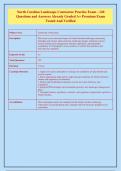
North Carolina Landscape Contractor Practice Exam - 120
Questions and Answers Already Graded A+ Premium Exam
Tested And Verified
Subject Area Landscape Contracting
Description This exam covers advanced topics in North Carolina landscape contracting,
including soil science, plant selection, hardscape design, irrigation systems,
erosion control, pest management, business operations, and regulatory
compliance. It is designed to assess mastery of current best practices and
state-specific standards.
Expected Grade A+
Total Questions 120
Duration 3 hours
Learning Outcomes 1. Apply soil science principles to manage site conditions for plant health and
erosion control.
2. Select appropriate plant species and hardscape materials for North Carolina's
climate and regulatory environment.
3. Design and troubleshoot irrigation systems for water efficiency and
compliance.
4. Integrate IPM strategies and sustainable practices into landscape management
plans.
5. Navigate business operations, contracts, and regulatory requirements specific to
North Carolina.
Accreditation This examination meets the standards of the North Carolina Landscape
Contractors' Licensing Board and is aligned with US university graduate-level
curriculum.
Page 1
,Question: 1 of 120
A landscape contractor in the Piedmont region of North Carolina is tasked with
designing a rain garden to manage stormwater runoff from a 2,000 sq ft impervious
surface. The site has clay-loam soil with a percolation rate of 0.2 inches per hour. The
design must capture the first 1 inch of runoff. What is the minimum surface area (in sq
333 sq ft
500 sq ft
667 sq ft
1,000 sq ft
PREVIOUS
Question: 2 of 120
A landscape contractor in Charlotte, NC, is specifying plants for a commercial site with
full sun, well-drained soil, and a requirement for drought tolerance. Which of the
following combinations of trees, shrubs, and perennials is most appropriate for this
site, considering North Carolina's climate and the need for year-round interest?
Quercus rubra, Rhododendron maximum, Hosta plantaginea
Pinus taeda, Ilex vomitoria, Echinacea purpurea
Acer rubrum, Kalmia latifolia, Heuchera americana
Cornus florida, Hydrangea quercifolia, Liriope muscari
Page 2
, PREVIOUS
Question: 3 of 120
A landscape contractor is installing a retaining wall using segmental concrete blocks
on a site with clay soil. The wall will be 4 feet high and must be designed to prevent
hydrostatic pressure buildup. Which of the following drainage strategies is most
critical for the long-term stability of this wall?
Placement of a clay cap on top of the wall to reduce infiltration
Installation of a perforated drainage pipe at the base of the wall, wrapped in geotextile fabric
and surrounded by gravel
Use of impermeable geotextile fabric behind the wall to direct water away
Battering the wall at a 10-degree angle to reduce lateral pressure
PREVIOUS
Question: 4 of 120
A landscape contractor in Raleigh, NC, is designing a drip irrigation system for a
vegetable garden. The garden is 50 ft by 30 ft, with rows spaced 2 ft apart. The drip
Page 3
, tubing has emitters
spaced 12 inches apart, each with a flow rate of 0.5 gallons per hour (gph). The system
will be operated at 20 psi. What is the total flow rate (in gallons
15.6 gpm
31.2 gpm
62.5 gpm
125 gpm
PREVIOUS
Question: 5 of 120
A landscape contractor is developing an erosion and sediment control plan for a
residential subdivision in the Piedmont region. The site has slopes up to 15% and
highly erodible soils. Which of the following combinations of Best Management
Practices (BMPs) is most effective for minimizing sediment export during the
Silt fencing at the perimeter, straw mulch on disturbed areas, and a sediment basin at the outlet
Check dams in all swales, hydroseeding of all disturbed areas, and a rock construction entrance
Temporary seeding of all disturbed areas, fiber check logs, and a sediment trap Perimeter
dikes and swales, gravel filter berms, and a sediment forebay
PREVIOUS
Page 4
Questions and Answers Already Graded A+ Premium Exam
Tested And Verified
Subject Area Landscape Contracting
Description This exam covers advanced topics in North Carolina landscape contracting,
including soil science, plant selection, hardscape design, irrigation systems,
erosion control, pest management, business operations, and regulatory
compliance. It is designed to assess mastery of current best practices and
state-specific standards.
Expected Grade A+
Total Questions 120
Duration 3 hours
Learning Outcomes 1. Apply soil science principles to manage site conditions for plant health and
erosion control.
2. Select appropriate plant species and hardscape materials for North Carolina's
climate and regulatory environment.
3. Design and troubleshoot irrigation systems for water efficiency and
compliance.
4. Integrate IPM strategies and sustainable practices into landscape management
plans.
5. Navigate business operations, contracts, and regulatory requirements specific to
North Carolina.
Accreditation This examination meets the standards of the North Carolina Landscape
Contractors' Licensing Board and is aligned with US university graduate-level
curriculum.
Page 1
,Question: 1 of 120
A landscape contractor in the Piedmont region of North Carolina is tasked with
designing a rain garden to manage stormwater runoff from a 2,000 sq ft impervious
surface. The site has clay-loam soil with a percolation rate of 0.2 inches per hour. The
design must capture the first 1 inch of runoff. What is the minimum surface area (in sq
333 sq ft
500 sq ft
667 sq ft
1,000 sq ft
PREVIOUS
Question: 2 of 120
A landscape contractor in Charlotte, NC, is specifying plants for a commercial site with
full sun, well-drained soil, and a requirement for drought tolerance. Which of the
following combinations of trees, shrubs, and perennials is most appropriate for this
site, considering North Carolina's climate and the need for year-round interest?
Quercus rubra, Rhododendron maximum, Hosta plantaginea
Pinus taeda, Ilex vomitoria, Echinacea purpurea
Acer rubrum, Kalmia latifolia, Heuchera americana
Cornus florida, Hydrangea quercifolia, Liriope muscari
Page 2
, PREVIOUS
Question: 3 of 120
A landscape contractor is installing a retaining wall using segmental concrete blocks
on a site with clay soil. The wall will be 4 feet high and must be designed to prevent
hydrostatic pressure buildup. Which of the following drainage strategies is most
critical for the long-term stability of this wall?
Placement of a clay cap on top of the wall to reduce infiltration
Installation of a perforated drainage pipe at the base of the wall, wrapped in geotextile fabric
and surrounded by gravel
Use of impermeable geotextile fabric behind the wall to direct water away
Battering the wall at a 10-degree angle to reduce lateral pressure
PREVIOUS
Question: 4 of 120
A landscape contractor in Raleigh, NC, is designing a drip irrigation system for a
vegetable garden. The garden is 50 ft by 30 ft, with rows spaced 2 ft apart. The drip
Page 3
, tubing has emitters
spaced 12 inches apart, each with a flow rate of 0.5 gallons per hour (gph). The system
will be operated at 20 psi. What is the total flow rate (in gallons
15.6 gpm
31.2 gpm
62.5 gpm
125 gpm
PREVIOUS
Question: 5 of 120
A landscape contractor is developing an erosion and sediment control plan for a
residential subdivision in the Piedmont region. The site has slopes up to 15% and
highly erodible soils. Which of the following combinations of Best Management
Practices (BMPs) is most effective for minimizing sediment export during the
Silt fencing at the perimeter, straw mulch on disturbed areas, and a sediment basin at the outlet
Check dams in all swales, hydroseeding of all disturbed areas, and a rock construction entrance
Temporary seeding of all disturbed areas, fiber check logs, and a sediment trap Perimeter
dikes and swales, gravel filter berms, and a sediment forebay
PREVIOUS
Page 4


