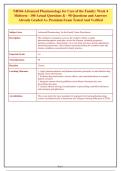
NR566 Advanced Pharmacology for Care of the Family: Week 4
Midterm - 100 Actual Questions & - 98 Questions and Answers
Already Graded A+ Premium Exam Tested And Verified
Subject Area Advanced Pharmacology for the Family Nurse Practitioner
Description This midterm examination assesses the student's ability to apply
pharmacotherapeutic principles across the lifespan, including pregnancy,
lactation, pediatrics, and geriatrics. It covers drug selection, dosing adjustments,
monitoring parameters, and evidence-based prescribing for common acute and
chronic conditions encountered in family practice.
Expected Grade A+
Total Questions 98
Duration 3 hours
Learning Outcomes 1. Apply pharmacokinetic and pharmacodynamic principles to individualize drug
therapy across the lifespan.
2. Evaluate drug interactions, adverse effects, and contraindications in complex
patient scenarios.
3. Integrate current clinical guidelines and evidence-based practice into
prescribing decisions.
4. Analyze ethical and legal considerations in prescribing controlled substances
and managing polypharmacy.
Accreditation This exam meets the rigor standards for graduate-level nursing pharmacology
courses accredited by the Commission on Collegiate Nursing Education (CCNE).
Page 1
,ati. NR566 Advanced Pharmacology for Care of the Family: Week 4 Midterm - 100
Actual Questions & - 98 Questions and Answers Already Graded A+ Premium Exam
Question: 1 of 98
A patient with type 2 diabetes and chronic kidney disease (stage 3b, eGFR 38 mL/min)
is currently on metformin 1000 mg twice daily and glipizide 10 mg daily. HbA1c is 7.8%.
Which of the following adjustments is most appropriate based on current evidence and
guideline recommendations?
Continue metformin at current dose; add dapagliflozin 10 mg daily.
Discontinue metformin; start insulin glargine 10 units daily.
Reduce metformin to 500 mg twice daily; add liraglutide 0.6 mg daily.
Discontinue metformin; start canagliflozin 100 mg daily.
PREVIOUS
Question: 2 of 98
A patient presents with acute-onset severe hypertension (BP 210/130 mm Hg) and is
found to have a left ventricular hypertrophy on echocardiogram. The patient has no
history of stroke or coronary artery disease. Which intravenous antihypertensive agent
is most appropriate for immediate blood pressure reduction while minimizing the risk
Sodium nitroprusside
Labetalol
Esmolol
Hydralazine
PREVIOUS
Page 2
,ati. NR566 Advanced Pharmacology for Care of the Family: Week 4 Midterm - 100
Actual Questions & - 98 Questions and Answers Already Graded A+ Premium Exam
Question: 3 of 98
A patient is initiated on warfarin for atrial fibrillation. The patient's CYP2C9 genotype is
*1/*3 and VKORC1 genotype is -1639G>A (AA). Which of the following best describes
the expected effect on warfarin dosing?
Requires higher than average dose due to increased metabolism.
Requires lower than average dose due to reduced metabolism and increased sensitivity.
Requires standard dosing with careful INR monitoring.
Warfarin is contraindicated due to high bleeding risk.
PREVIOUS
Question: 4 of 98
A patient with HIV (CD4 count 350 cells/mm³, viral load 50,000 copies/mL) is started on
dolutegravir/abacavir/lamivudine. Prior to initiation, which laboratory test is most
critical to obtain?
HLA-B*5701 screening
CYP2C19 genotype
HIV tropism assay
Quantitative hepatitis B surface antigen
PREVIOUS
Page 3
, ati. NR566 Advanced Pharmacology for Care of the Family: Week 4 Midterm - 100
Actual Questions & - 98 Questions and Answers Already Graded A+ Premium Exam
Question: 5 of 98
A patient with major depressive disorder has failed adequate trials of sertraline and
escitalopram. The patient is now started on venlafaxine XR 75 mg daily. After 2 weeks,
the patient reports no improvement. What is the most appropriate next step?
Increase venlafaxine to 150 mg daily and reassess in 4 weeks.
Switch to a monoamine oxidase inhibitor (MAOI) such as phenelzine.
Augment with aripiprazole 2 mg daily.
Discontinue venlafaxine and start tranylcypromine.
PREVIOUS
Question: 6 of 98
A patient with chronic heart failure (LVEF 35%) is on lisinopril 40 mg daily, carvedilol
25 mg twice daily, furosemide 40 mg daily, and spironolactone 25 mg daily. The patient
develops hyperkalemia (serum K+ 5.8 mEq/L). Which medication is most likely
contributing to this?
Lisinopril
Carvedilol
Furosemide
Spironolactone
PREVIOUS
Page 4
Midterm - 100 Actual Questions & - 98 Questions and Answers
Already Graded A+ Premium Exam Tested And Verified
Subject Area Advanced Pharmacology for the Family Nurse Practitioner
Description This midterm examination assesses the student's ability to apply
pharmacotherapeutic principles across the lifespan, including pregnancy,
lactation, pediatrics, and geriatrics. It covers drug selection, dosing adjustments,
monitoring parameters, and evidence-based prescribing for common acute and
chronic conditions encountered in family practice.
Expected Grade A+
Total Questions 98
Duration 3 hours
Learning Outcomes 1. Apply pharmacokinetic and pharmacodynamic principles to individualize drug
therapy across the lifespan.
2. Evaluate drug interactions, adverse effects, and contraindications in complex
patient scenarios.
3. Integrate current clinical guidelines and evidence-based practice into
prescribing decisions.
4. Analyze ethical and legal considerations in prescribing controlled substances
and managing polypharmacy.
Accreditation This exam meets the rigor standards for graduate-level nursing pharmacology
courses accredited by the Commission on Collegiate Nursing Education (CCNE).
Page 1
,ati. NR566 Advanced Pharmacology for Care of the Family: Week 4 Midterm - 100
Actual Questions & - 98 Questions and Answers Already Graded A+ Premium Exam
Question: 1 of 98
A patient with type 2 diabetes and chronic kidney disease (stage 3b, eGFR 38 mL/min)
is currently on metformin 1000 mg twice daily and glipizide 10 mg daily. HbA1c is 7.8%.
Which of the following adjustments is most appropriate based on current evidence and
guideline recommendations?
Continue metformin at current dose; add dapagliflozin 10 mg daily.
Discontinue metformin; start insulin glargine 10 units daily.
Reduce metformin to 500 mg twice daily; add liraglutide 0.6 mg daily.
Discontinue metformin; start canagliflozin 100 mg daily.
PREVIOUS
Question: 2 of 98
A patient presents with acute-onset severe hypertension (BP 210/130 mm Hg) and is
found to have a left ventricular hypertrophy on echocardiogram. The patient has no
history of stroke or coronary artery disease. Which intravenous antihypertensive agent
is most appropriate for immediate blood pressure reduction while minimizing the risk
Sodium nitroprusside
Labetalol
Esmolol
Hydralazine
PREVIOUS
Page 2
,ati. NR566 Advanced Pharmacology for Care of the Family: Week 4 Midterm - 100
Actual Questions & - 98 Questions and Answers Already Graded A+ Premium Exam
Question: 3 of 98
A patient is initiated on warfarin for atrial fibrillation. The patient's CYP2C9 genotype is
*1/*3 and VKORC1 genotype is -1639G>A (AA). Which of the following best describes
the expected effect on warfarin dosing?
Requires higher than average dose due to increased metabolism.
Requires lower than average dose due to reduced metabolism and increased sensitivity.
Requires standard dosing with careful INR monitoring.
Warfarin is contraindicated due to high bleeding risk.
PREVIOUS
Question: 4 of 98
A patient with HIV (CD4 count 350 cells/mm³, viral load 50,000 copies/mL) is started on
dolutegravir/abacavir/lamivudine. Prior to initiation, which laboratory test is most
critical to obtain?
HLA-B*5701 screening
CYP2C19 genotype
HIV tropism assay
Quantitative hepatitis B surface antigen
PREVIOUS
Page 3
, ati. NR566 Advanced Pharmacology for Care of the Family: Week 4 Midterm - 100
Actual Questions & - 98 Questions and Answers Already Graded A+ Premium Exam
Question: 5 of 98
A patient with major depressive disorder has failed adequate trials of sertraline and
escitalopram. The patient is now started on venlafaxine XR 75 mg daily. After 2 weeks,
the patient reports no improvement. What is the most appropriate next step?
Increase venlafaxine to 150 mg daily and reassess in 4 weeks.
Switch to a monoamine oxidase inhibitor (MAOI) such as phenelzine.
Augment with aripiprazole 2 mg daily.
Discontinue venlafaxine and start tranylcypromine.
PREVIOUS
Question: 6 of 98
A patient with chronic heart failure (LVEF 35%) is on lisinopril 40 mg daily, carvedilol
25 mg twice daily, furosemide 40 mg daily, and spironolactone 25 mg daily. The patient
develops hyperkalemia (serum K+ 5.8 mEq/L). Which medication is most likely
contributing to this?
Lisinopril
Carvedilol
Furosemide
Spironolactone
PREVIOUS
Page 4