

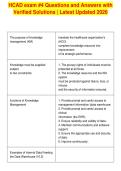
HCAD exam #4 Questions and Answers with
Verified Solutions | Latest Updated 2026
The purpose of knowledge translate the healthcare organization's
management (KM) (HCO)
complete knowledge resource into
improvement
of its strategic performance.
Knowledge must be supplied 1. The privacy rights of individuals must be
subject protected at all times.
to two constraints: 2. The knowledge resource and the KM
system
must be protected against failure, loss, or
misuse
and the security of information ensured.
functions of Knowledge 1. Provide prompt and useful access to
Management management information (data warehouse:
2. Provide prompt and useful access to
clinical
information (the EHR):
3. Ensure reliability and validity of data:
4. Maintain communications and software
support:
5. Ensure the appropriate use and security
of data:
6. Improve continuously:
Examples of Internal Data Feeding
the Data Warehouse (10.2)
,*Data Management System A system for aggregating and
disaggregating
electronic data designed to facilitate
recovery and
use.
Common uses of information in -managing individual patients
high -reporting performance
preforming healthcare -identifying OFIs
organizations -setting goals
-supporting PITs
-reviewing protocols
International Classification of authoritative index of mental and physical
Diseases (ICD) diseases,
including infectious diseases, and the
criteria for
their diagnosis; published by the World
Health
Organization (WHO)
Diagnosis-related groups (DRGs) System that categorizes into payment
groups
patients who are medically related with
respect to
diagnosis and treatment and statistically
similar with
regard to length of stay
,Ambulatory patient Classification Classification system of patients based on
(APCs) the
International Classification of Diseases,
clinical
modification codes for diagnoses, current
procedural terminology evaluation and
management codes, and procedure codes,
age,
sex, and visit disposition used for
reimbursement
for health care provided in the hospital
outpatient
setting
All care providers must known.. • What is wrong with this patient?
• What are we doing for this patient? What
has
been done in the past?
• What must we not do for this patient (in
terms of
allergies, advance directives, other
important
contraindications)?
, Office of the National Coordinator • sets the standards and certification
for Health Information Technology criteria that
(ONC) EHRs must meet to assure healthcare
professionals
and hospitals of what the systems they
adopt are
able to do;
• specifies minimum functions of EHRs;
• directs the State Health Information
Exchange
Cooperative Agreement Program, which
funds
states' efforts to rapidly build capacity for
exchanging health information across
systems
within and across states; and
• provides challenge grants to states to
encourage
innovations for health information
exchange.
*Meaningful Use Measurement thresholds that range from
recording
patient information as structured data in
the EHR to
integrating the information across care
providers
and demonstrating value in exchange for
incentive
payments from the Centers for Medicare
and
Medicaid (CMS).
Verified Solutions | Latest Updated 2026
The purpose of knowledge translate the healthcare organization's
management (KM) (HCO)
complete knowledge resource into
improvement
of its strategic performance.
Knowledge must be supplied 1. The privacy rights of individuals must be
subject protected at all times.
to two constraints: 2. The knowledge resource and the KM
system
must be protected against failure, loss, or
misuse
and the security of information ensured.
functions of Knowledge 1. Provide prompt and useful access to
Management management information (data warehouse:
2. Provide prompt and useful access to
clinical
information (the EHR):
3. Ensure reliability and validity of data:
4. Maintain communications and software
support:
5. Ensure the appropriate use and security
of data:
6. Improve continuously:
Examples of Internal Data Feeding
the Data Warehouse (10.2)
,*Data Management System A system for aggregating and
disaggregating
electronic data designed to facilitate
recovery and
use.
Common uses of information in -managing individual patients
high -reporting performance
preforming healthcare -identifying OFIs
organizations -setting goals
-supporting PITs
-reviewing protocols
International Classification of authoritative index of mental and physical
Diseases (ICD) diseases,
including infectious diseases, and the
criteria for
their diagnosis; published by the World
Health
Organization (WHO)
Diagnosis-related groups (DRGs) System that categorizes into payment
groups
patients who are medically related with
respect to
diagnosis and treatment and statistically
similar with
regard to length of stay
,Ambulatory patient Classification Classification system of patients based on
(APCs) the
International Classification of Diseases,
clinical
modification codes for diagnoses, current
procedural terminology evaluation and
management codes, and procedure codes,
age,
sex, and visit disposition used for
reimbursement
for health care provided in the hospital
outpatient
setting
All care providers must known.. • What is wrong with this patient?
• What are we doing for this patient? What
has
been done in the past?
• What must we not do for this patient (in
terms of
allergies, advance directives, other
important
contraindications)?
, Office of the National Coordinator • sets the standards and certification
for Health Information Technology criteria that
(ONC) EHRs must meet to assure healthcare
professionals
and hospitals of what the systems they
adopt are
able to do;
• specifies minimum functions of EHRs;
• directs the State Health Information
Exchange
Cooperative Agreement Program, which
funds
states' efforts to rapidly build capacity for
exchanging health information across
systems
within and across states; and
• provides challenge grants to states to
encourage
innovations for health information
exchange.
*Meaningful Use Measurement thresholds that range from
recording
patient information as structured data in
the EHR to
integrating the information across care
providers
and demonstrating value in exchange for
incentive
payments from the Centers for Medicare
and
Medicaid (CMS).


