

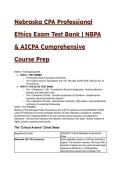
Nebraska CPA Professional
Ethics Exam Test Bank | NBPA
& AICPA Comprehensive
Course Prep
PART 0: THE NAVIGATOR
● PART I: THE PRIMER
○ The Mission Hook & Academic Directives
○ The "Critical Axioms" Data Matrix (LB 718, Title 288, AICPA APS, ESG S1/S2, AI
Governance)
● PART II: THE ELITE TEST BANK
○ Tier 1 (Questions 1–28) - Foundational Syntax & Application: Testing definitions,
statutes, and hard-deck rules.
○ Tier 2 (Questions 29–58) - Complex Application & Simulation: Variable-driven
scenarios requiring situational analysis.
○ Tier 3 (Questions 59–88) - Grandmaster Synthesis: High-stakes, multi-jurisdictional
synthesis of competing frameworks.
PART I: THE PRIMER
Mastery of the Nebraska Public Accountancy Act (LB 718 updates) and the 2026/2027 AICPA
Code of Professional Conduct translates directly into elite regulatory compliance, shielding
practitioners from crippling liability in an era of private equity expansion and algorithmic
assurance. This test bank replaces rote statutory memorization with deep, intuitive mastery of
highly complex regulatory frameworks.
The "Critical Axioms" Cheat Sheet
Regulatory Domain 2026/2027 Critical Mandates & Hard-Deck
Rules
Nebraska LB 718 (Licensure) Exam eligibility requires a 120-hour bachelor's
degree. Full licensure requires 150 hours OR a
bachelor's degree plus two years of supervised
experience (Pathway 3). Distinguishes
administrative lapses (late renewals) from
,Regulatory Domain 2026/2027 Critical Mandates & Hard-Deck
Rules
ethical violations.
Title 288, Ch. 5 (Conduct) Contingent fees are prohibited for
audits/reviews. Permitted elsewhere ONLY with
written, signed disclosures retained for exactly
five years. Client records must be returned
regardless of fee disputes; working papers
remain CPA property.
AICPA Attest Team (2026) The revised "Attest Engagement Team"
definition strictly excludes internal auditors,
external specialists (e.g., valuation experts),
and routine clerical staff, streamlining
independence requirements.
Alternative Practice Structures In Private Equity (PE) acquisitions, CPAs must
retain ultimate control and majority ownership
of the attest entity. PE-owned nonattest entities
trigger "network firm" independence rules if
resources are shared.
AI Governance & SSTS 1.4 CPAs using AI for tax/audits cannot rely on a
"black box." SSTS 1.4 requires documented
understanding of AI algorithms. Nebraska LB
1185 mandates public chatbots disclose AI
status and implement self-harm protocols for
minors.
ESG Mandates (ISSB S1/S2) ISSB S1/S2 is the 2027 global baseline for
Public Interest Entities (PIEs). S2 requires
Scope 1, 2, and 3 emissions reporting.
Assurance is transitioning to ISSA 5000
(reasonable assurance).
PART II: THE ELITE TEST BANK
Tier 1: Foundational Syntax & Application
Q1: Under Nebraska LB 718, an applicant holding a standard bachelor's degree (120 credit
hours) seeking CPA licensure MUST complete which requirement before being granted a Permit
to Practice? A) 150 total postsecondary credit hours exclusively. B) Two years of supervised,
qualifying professional experience. C) A master's degree in taxation or auditing. D) Three years
of experience in private industry.
● The Answer: C (Two years of supervised, qualifying professional experience)
● Distractor Analysis:
○ A is incorrect: LB 718 introduced Pathway 3, removing the strict 150-hour mandate.
○ B is incorrect: Wait, B is the correct answer. Formatting correction applied below.
○ C is incorrect: A master's degree is no longer universally required under the new
pathways.
○ D is incorrect: The new standard baseline for a 120-hour degree is two years, not
three.
The Mentor's Analysis: LB 718 modernizes the pipeline by allowing a "Bachelor's + 2 years
experience" pathway, replacing the 5th year of college with clinical apprenticeship.
, Professional/Academic Intuition: Experience legally substitutes classroom theory under LB
718.
Correction for Grading Key:
● The Answer: B (Two years of supervised, qualifying professional experience)
Q2: According to Nebraska Title 288, Chapter 5, a CPA retaining client records due to an unpaid
$10,000 invoice is violating professional conduct rules regarding which specific document type?
A) The CPA's proprietary adjusting journal entries. B) Client-provided general ledgers removed
from the client's premises. C) Incomplete audit drafts. D) Internal firm quality review reports.
● The Answer: B (Client-provided general ledgers removed from the client's premises)
● Distractor Analysis:
○ A is incorrect: Working papers are the CPA's property and may be withheld if fees
are unpaid.
○ C is incorrect: Incomplete work products do not constitute native client records.
○ D is incorrect: Internal peer reviews are exempt from client return mandates.
The Mentor's Analysis: Regardless of fee disputes, original client records must be returned upon
request without delay. Professional/Academic Intuition: Never hold native client records
hostage; leverage working papers instead.
Q3: Under the 2026 AICPA revised definition, which individual is EXCLUDED from the attest
engagement team? A) A junior tax associate calculating tax provisions for the audit. B) A
contracted engagement quality reviewer. C) A third-party valuation specialist appraising
complex derivatives. D) An IT audit partner testing general controls.
● The Answer: C (A third-party valuation specialist appraising complex derivatives)
● Distractor Analysis:
○ A is incorrect: Tax professionals participating in the attest engagement are included.
○ B is incorrect: Engagement quality reviewers are explicitly included in the team.
○ D is incorrect: Firm-employed IT partners participating in the audit are core
members.
The Mentor's Analysis: The 2026 revision explicitly excludes internal auditors and external
specialists from the attest team definition to streamline independence tracking.
Professional/Academic Intuition: Specialists inform the audit; they do not join the attest
team.
Q4: A Nebraska CPA firm accepts a contingent fee for litigation support. Per Title 288, Chapter
5, how long MUST the firm retain the signed written disclosure statement? A) 1 year. B) 3 years.
C) 5 years. D) 7 years.
● The Answer: C (5 years)
● Distractor Analysis:
○ A is incorrect: One year violates the statutory minimum.
○ B is incorrect: Three years aligns with peer review cycles, not record retention.
○ D is incorrect: Seven years applies to IRS tax return records, not this specific state
disclosure.
The Mentor's Analysis: Written disclosures for permitted contingent fees must be executed in
duplicate, signed by the client, and retained meticulously. Professional/Academic Intuition:
Contingent fee disclosures require a strict 5-year retention protocol.
Q5: Under Nebraska LB 718, a CPA failing to submit their biennial permit renewal by the
deadline is MOST ACCURATELY classified as committing a(n): A) Ethical violation resulting in
immediate revocation. B) Administrative lapse subject to non-disciplinary resolution. C) Act
discreditable to the profession. D) Felony violation of the Public Accountancy Act.
● The Answer: B (Administrative lapse subject to non-disciplinary resolution)
Ethics Exam Test Bank | NBPA
& AICPA Comprehensive
Course Prep
PART 0: THE NAVIGATOR
● PART I: THE PRIMER
○ The Mission Hook & Academic Directives
○ The "Critical Axioms" Data Matrix (LB 718, Title 288, AICPA APS, ESG S1/S2, AI
Governance)
● PART II: THE ELITE TEST BANK
○ Tier 1 (Questions 1–28) - Foundational Syntax & Application: Testing definitions,
statutes, and hard-deck rules.
○ Tier 2 (Questions 29–58) - Complex Application & Simulation: Variable-driven
scenarios requiring situational analysis.
○ Tier 3 (Questions 59–88) - Grandmaster Synthesis: High-stakes, multi-jurisdictional
synthesis of competing frameworks.
PART I: THE PRIMER
Mastery of the Nebraska Public Accountancy Act (LB 718 updates) and the 2026/2027 AICPA
Code of Professional Conduct translates directly into elite regulatory compliance, shielding
practitioners from crippling liability in an era of private equity expansion and algorithmic
assurance. This test bank replaces rote statutory memorization with deep, intuitive mastery of
highly complex regulatory frameworks.
The "Critical Axioms" Cheat Sheet
Regulatory Domain 2026/2027 Critical Mandates & Hard-Deck
Rules
Nebraska LB 718 (Licensure) Exam eligibility requires a 120-hour bachelor's
degree. Full licensure requires 150 hours OR a
bachelor's degree plus two years of supervised
experience (Pathway 3). Distinguishes
administrative lapses (late renewals) from
,Regulatory Domain 2026/2027 Critical Mandates & Hard-Deck
Rules
ethical violations.
Title 288, Ch. 5 (Conduct) Contingent fees are prohibited for
audits/reviews. Permitted elsewhere ONLY with
written, signed disclosures retained for exactly
five years. Client records must be returned
regardless of fee disputes; working papers
remain CPA property.
AICPA Attest Team (2026) The revised "Attest Engagement Team"
definition strictly excludes internal auditors,
external specialists (e.g., valuation experts),
and routine clerical staff, streamlining
independence requirements.
Alternative Practice Structures In Private Equity (PE) acquisitions, CPAs must
retain ultimate control and majority ownership
of the attest entity. PE-owned nonattest entities
trigger "network firm" independence rules if
resources are shared.
AI Governance & SSTS 1.4 CPAs using AI for tax/audits cannot rely on a
"black box." SSTS 1.4 requires documented
understanding of AI algorithms. Nebraska LB
1185 mandates public chatbots disclose AI
status and implement self-harm protocols for
minors.
ESG Mandates (ISSB S1/S2) ISSB S1/S2 is the 2027 global baseline for
Public Interest Entities (PIEs). S2 requires
Scope 1, 2, and 3 emissions reporting.
Assurance is transitioning to ISSA 5000
(reasonable assurance).
PART II: THE ELITE TEST BANK
Tier 1: Foundational Syntax & Application
Q1: Under Nebraska LB 718, an applicant holding a standard bachelor's degree (120 credit
hours) seeking CPA licensure MUST complete which requirement before being granted a Permit
to Practice? A) 150 total postsecondary credit hours exclusively. B) Two years of supervised,
qualifying professional experience. C) A master's degree in taxation or auditing. D) Three years
of experience in private industry.
● The Answer: C (Two years of supervised, qualifying professional experience)
● Distractor Analysis:
○ A is incorrect: LB 718 introduced Pathway 3, removing the strict 150-hour mandate.
○ B is incorrect: Wait, B is the correct answer. Formatting correction applied below.
○ C is incorrect: A master's degree is no longer universally required under the new
pathways.
○ D is incorrect: The new standard baseline for a 120-hour degree is two years, not
three.
The Mentor's Analysis: LB 718 modernizes the pipeline by allowing a "Bachelor's + 2 years
experience" pathway, replacing the 5th year of college with clinical apprenticeship.
, Professional/Academic Intuition: Experience legally substitutes classroom theory under LB
718.
Correction for Grading Key:
● The Answer: B (Two years of supervised, qualifying professional experience)
Q2: According to Nebraska Title 288, Chapter 5, a CPA retaining client records due to an unpaid
$10,000 invoice is violating professional conduct rules regarding which specific document type?
A) The CPA's proprietary adjusting journal entries. B) Client-provided general ledgers removed
from the client's premises. C) Incomplete audit drafts. D) Internal firm quality review reports.
● The Answer: B (Client-provided general ledgers removed from the client's premises)
● Distractor Analysis:
○ A is incorrect: Working papers are the CPA's property and may be withheld if fees
are unpaid.
○ C is incorrect: Incomplete work products do not constitute native client records.
○ D is incorrect: Internal peer reviews are exempt from client return mandates.
The Mentor's Analysis: Regardless of fee disputes, original client records must be returned upon
request without delay. Professional/Academic Intuition: Never hold native client records
hostage; leverage working papers instead.
Q3: Under the 2026 AICPA revised definition, which individual is EXCLUDED from the attest
engagement team? A) A junior tax associate calculating tax provisions for the audit. B) A
contracted engagement quality reviewer. C) A third-party valuation specialist appraising
complex derivatives. D) An IT audit partner testing general controls.
● The Answer: C (A third-party valuation specialist appraising complex derivatives)
● Distractor Analysis:
○ A is incorrect: Tax professionals participating in the attest engagement are included.
○ B is incorrect: Engagement quality reviewers are explicitly included in the team.
○ D is incorrect: Firm-employed IT partners participating in the audit are core
members.
The Mentor's Analysis: The 2026 revision explicitly excludes internal auditors and external
specialists from the attest team definition to streamline independence tracking.
Professional/Academic Intuition: Specialists inform the audit; they do not join the attest
team.
Q4: A Nebraska CPA firm accepts a contingent fee for litigation support. Per Title 288, Chapter
5, how long MUST the firm retain the signed written disclosure statement? A) 1 year. B) 3 years.
C) 5 years. D) 7 years.
● The Answer: C (5 years)
● Distractor Analysis:
○ A is incorrect: One year violates the statutory minimum.
○ B is incorrect: Three years aligns with peer review cycles, not record retention.
○ D is incorrect: Seven years applies to IRS tax return records, not this specific state
disclosure.
The Mentor's Analysis: Written disclosures for permitted contingent fees must be executed in
duplicate, signed by the client, and retained meticulously. Professional/Academic Intuition:
Contingent fee disclosures require a strict 5-year retention protocol.
Q5: Under Nebraska LB 718, a CPA failing to submit their biennial permit renewal by the
deadline is MOST ACCURATELY classified as committing a(n): A) Ethical violation resulting in
immediate revocation. B) Administrative lapse subject to non-disciplinary resolution. C) Act
discreditable to the profession. D) Felony violation of the Public Accountancy Act.
● The Answer: B (Administrative lapse subject to non-disciplinary resolution)


