

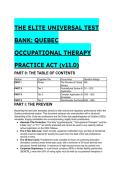
THE ELITE UNIVERSAL TEST
BANK: QUEBEC
OCCUPATIONAL THERAPY
PRACTICE ACT (v11.0)
PART 0: THE TABLE OF CONTENTS
Section Cognitive Tier Focus Area Question Range
PART I Primer The Preview & Critical N/A
Axioms
PART II Tier 1 Foundational Syntax & Q1 – Q15
Application
PART II Tier 2 Complex Application & Q16 – Q35
Simulation
PART II Tier 3 Grandmaster Synthesis Q36 – Q60
PART I: THE PREVIEW
Mastering this test bank translates directly to elite clinical and regulatory performance within the
Quebec professional system. This document replaces rote memorization with a structural
dismantling of the Code des professions and the Ordre des ergothérapeutes du Québec (OEQ)
mandates, forging candidates into uncompromising, legally fluent practitioners.
● Absolute Title Protection: The titles "ergothérapeute," "Occupational Therapist," and the
initials "erg." or "O.T." are strictly protected and cannot be used in any capacity without
active registration on the OEQ Tableau.
● The 5-Year Data Law: Client records, equipment calibration logs, and lists of transferred
records must be retained for exactly five years from the date of the last professional
service or entry.
● The 45-Hour Cycle: Practitioners must complete 45 hours of continuing education
(formation continue) every three-year cycle, with a minimum of 30 hours derived from
structured, formal activities. A maximum of eight excess hours may be carried over.
● Corporate Supremacy: In a joint-stock company (SPA) or limited liability partnership
(SENCRL), more than 50% of voting rights must be held by occupational therapists or
, recognized health and social service professionals.
● Reserved Acts: Assessing functional abilities for individuals with confirmed mental or
neuropsychological disorders is an exclusive reserved act due to the severe risk of harm,
while practicing psychotherapy requires a separate, dedicated permit from the Ordre des
psychologues du Québec.
Regulatory Milestones & Structural Data
Regulatory Component Statutory Deadline / Metric Governing Legal Framework
Record Retention 5 Years (Post-last service) Règlement sur la tenue des
dossiers
Continuing Education 45 Hours / 3 Years Règlement sur la formation
continue
Inspection Questionnaire 21 Days to submit Règlement sur l'inspection
professionnelle
Cessation of Practice Notice 30 Days before/after Règlement sur la tenue des
dossiers
Conciliation Hold 45 Days (No legal action) Règlement sur l'arbitrage des
comptes
PART II: THE ELITE TEST BANK
Tier 1 - Foundational Syntax & Application
Q1: An internationally trained practitioner relocates to Quebec and immediately prints business
cards using the title "Occupational Therapist" while awaiting their official OEQ permit. Based on
the Code des professions, which conclusion is MOST ACCURATE? A) The action is legal if the
practitioner appends "Candidate" to the title. B) The action is permissible for a 30-day grace
period during integration. C) The action is a strict violation constituting unauthorized use of a
title. D) The action is legal provided no reserved acts are performed.
● The Answer: C (The action is a strict violation constituting unauthorized use of a title.)
● Distractor Analysis:
○ A is incorrect: Quebec law does not recognize "Candidate" as an exception to title
protection under Article 32. * B is incorrect: There are no grace periods for
protected titles; the practitioner is either on the Roll or is not.
○ D is incorrect: Title protection and the restriction of reserved acts are separate,
equally enforced legal barriers.
The Mentor's Analysis: Regulatory bodies govern through absolute boundaries. Until a name
appears on the Tableau de l'Ordre, there is zero legal standing to associate with the profession
publicly. By enforcing strict title protection laws, the OEQ prevents public deception and
guarantees accountability. Professional/Academic Intuition: Registration on the Roll
precedes all professional identification.
Q2: An occupational therapist is reviewing their continuing education (formation continue)
portfolio at the end of the three-year cycle. The therapist has logged 50 hours of unstructured
self-study. According to OEQ regulations, what is the IMMEDIATE status of their compliance?
A) Compliant, as the therapist has exceeded the 45-hour minimum requirement. B) Compliant,
provided the therapist carries over the 5 excess hours to the next cycle. C) Non-compliant,
because at least 30 hours must come from structured activities. D) Non-compliant, because
, self-study is entirely inadmissible for OEQ credit.
● The Answer: C (Non-compliant, because at least 30 hours must come from structured
activities.)
● Distractor Analysis:
○ A is incorrect: Total hours do not negate the specific sub-category mandates of the
regulation.
○ B is incorrect: Excess unstructured hours cannot cure a deficit in the structured
activity requirement.
○ D is incorrect: Self-study is admissible, but it is capped and categorized as
unstructured activity.
The Mentor's Analysis: Professional growth cannot be entirely isolated. The OEQ mandates
structured activities to ensure peer interaction, standardized learning, and verifiable
competence. By mandating structured continuing education, the Order bypasses the trap of
unverified professional stagnation. Professional/Academic Intuition: Total hours are
irrelevant if the 30-hour structured ratio is ignored.
Q3: A client requests the termination of their occupational therapy file and asks the therapist to
destroy all clinical notes immediately to protect their privacy. Based on the Règlement sur la
tenue des dossiers, which action is MOST APPROPRIATE? A) Destroy the records immediately
to comply with patient privacy directives. B) Transfer the records to the client's family physician
for safekeeping. C) Retain the records for 5 years from the date of the last professional service
rendered. D) Send the records directly to the OEQ archives for immediate destruction.
● The Answer: C (Retain the records for 5 years from the date of the last professional
service rendered.)
● Distractor Analysis:
○ A is incorrect: Client requests do not override the therapist's legal obligation to
maintain medical records for liability purposes.
○ B is incorrect: Records cannot be arbitrarily transferred out of the occupational
therapist's custody without a legal mandate.
○ D is incorrect: The OEQ does not function as a document destruction service for
active practitioners.
The Mentor's Analysis: The clinical record is a legal document protecting both the public and
the practitioner. The statutory retention law supersedes patient preference to ensure
accountability in the event of future litigation or professional inspection.
Professional/Academic Intuition: Statutory retention laws always override client deletion
requests.
Q4: An occupational therapist wishes to incorporate a private clinic as a joint-stock company
(SPA). To comply with the Règlement sur l'exercice de la profession d'ergothérapeute en
société, who MUST hold the majority of the voting rights? A) Any combination of licensed
healthcare professionals and private investors. B) Exclusively members of the Ordre des
ergothérapeutes du Québec. C) Occupational therapists or other recognized health and social
service professionals. D) A designated respondent appointed by the provincial government.
● The Answer: C (Occupational therapists or other recognized health and social service
professionals.)
● Distractor Analysis:
○ A is incorrect: Private investors cannot hold the majority of voting rights; clinical
control must remain with regulated professionals.
○ B is incorrect: The regulation allows other health and social service professionals
governed by the Code des professions to share the majority.
BANK: QUEBEC
OCCUPATIONAL THERAPY
PRACTICE ACT (v11.0)
PART 0: THE TABLE OF CONTENTS
Section Cognitive Tier Focus Area Question Range
PART I Primer The Preview & Critical N/A
Axioms
PART II Tier 1 Foundational Syntax & Q1 – Q15
Application
PART II Tier 2 Complex Application & Q16 – Q35
Simulation
PART II Tier 3 Grandmaster Synthesis Q36 – Q60
PART I: THE PREVIEW
Mastering this test bank translates directly to elite clinical and regulatory performance within the
Quebec professional system. This document replaces rote memorization with a structural
dismantling of the Code des professions and the Ordre des ergothérapeutes du Québec (OEQ)
mandates, forging candidates into uncompromising, legally fluent practitioners.
● Absolute Title Protection: The titles "ergothérapeute," "Occupational Therapist," and the
initials "erg." or "O.T." are strictly protected and cannot be used in any capacity without
active registration on the OEQ Tableau.
● The 5-Year Data Law: Client records, equipment calibration logs, and lists of transferred
records must be retained for exactly five years from the date of the last professional
service or entry.
● The 45-Hour Cycle: Practitioners must complete 45 hours of continuing education
(formation continue) every three-year cycle, with a minimum of 30 hours derived from
structured, formal activities. A maximum of eight excess hours may be carried over.
● Corporate Supremacy: In a joint-stock company (SPA) or limited liability partnership
(SENCRL), more than 50% of voting rights must be held by occupational therapists or
, recognized health and social service professionals.
● Reserved Acts: Assessing functional abilities for individuals with confirmed mental or
neuropsychological disorders is an exclusive reserved act due to the severe risk of harm,
while practicing psychotherapy requires a separate, dedicated permit from the Ordre des
psychologues du Québec.
Regulatory Milestones & Structural Data
Regulatory Component Statutory Deadline / Metric Governing Legal Framework
Record Retention 5 Years (Post-last service) Règlement sur la tenue des
dossiers
Continuing Education 45 Hours / 3 Years Règlement sur la formation
continue
Inspection Questionnaire 21 Days to submit Règlement sur l'inspection
professionnelle
Cessation of Practice Notice 30 Days before/after Règlement sur la tenue des
dossiers
Conciliation Hold 45 Days (No legal action) Règlement sur l'arbitrage des
comptes
PART II: THE ELITE TEST BANK
Tier 1 - Foundational Syntax & Application
Q1: An internationally trained practitioner relocates to Quebec and immediately prints business
cards using the title "Occupational Therapist" while awaiting their official OEQ permit. Based on
the Code des professions, which conclusion is MOST ACCURATE? A) The action is legal if the
practitioner appends "Candidate" to the title. B) The action is permissible for a 30-day grace
period during integration. C) The action is a strict violation constituting unauthorized use of a
title. D) The action is legal provided no reserved acts are performed.
● The Answer: C (The action is a strict violation constituting unauthorized use of a title.)
● Distractor Analysis:
○ A is incorrect: Quebec law does not recognize "Candidate" as an exception to title
protection under Article 32. * B is incorrect: There are no grace periods for
protected titles; the practitioner is either on the Roll or is not.
○ D is incorrect: Title protection and the restriction of reserved acts are separate,
equally enforced legal barriers.
The Mentor's Analysis: Regulatory bodies govern through absolute boundaries. Until a name
appears on the Tableau de l'Ordre, there is zero legal standing to associate with the profession
publicly. By enforcing strict title protection laws, the OEQ prevents public deception and
guarantees accountability. Professional/Academic Intuition: Registration on the Roll
precedes all professional identification.
Q2: An occupational therapist is reviewing their continuing education (formation continue)
portfolio at the end of the three-year cycle. The therapist has logged 50 hours of unstructured
self-study. According to OEQ regulations, what is the IMMEDIATE status of their compliance?
A) Compliant, as the therapist has exceeded the 45-hour minimum requirement. B) Compliant,
provided the therapist carries over the 5 excess hours to the next cycle. C) Non-compliant,
because at least 30 hours must come from structured activities. D) Non-compliant, because
, self-study is entirely inadmissible for OEQ credit.
● The Answer: C (Non-compliant, because at least 30 hours must come from structured
activities.)
● Distractor Analysis:
○ A is incorrect: Total hours do not negate the specific sub-category mandates of the
regulation.
○ B is incorrect: Excess unstructured hours cannot cure a deficit in the structured
activity requirement.
○ D is incorrect: Self-study is admissible, but it is capped and categorized as
unstructured activity.
The Mentor's Analysis: Professional growth cannot be entirely isolated. The OEQ mandates
structured activities to ensure peer interaction, standardized learning, and verifiable
competence. By mandating structured continuing education, the Order bypasses the trap of
unverified professional stagnation. Professional/Academic Intuition: Total hours are
irrelevant if the 30-hour structured ratio is ignored.
Q3: A client requests the termination of their occupational therapy file and asks the therapist to
destroy all clinical notes immediately to protect their privacy. Based on the Règlement sur la
tenue des dossiers, which action is MOST APPROPRIATE? A) Destroy the records immediately
to comply with patient privacy directives. B) Transfer the records to the client's family physician
for safekeeping. C) Retain the records for 5 years from the date of the last professional service
rendered. D) Send the records directly to the OEQ archives for immediate destruction.
● The Answer: C (Retain the records for 5 years from the date of the last professional
service rendered.)
● Distractor Analysis:
○ A is incorrect: Client requests do not override the therapist's legal obligation to
maintain medical records for liability purposes.
○ B is incorrect: Records cannot be arbitrarily transferred out of the occupational
therapist's custody without a legal mandate.
○ D is incorrect: The OEQ does not function as a document destruction service for
active practitioners.
The Mentor's Analysis: The clinical record is a legal document protecting both the public and
the practitioner. The statutory retention law supersedes patient preference to ensure
accountability in the event of future litigation or professional inspection.
Professional/Academic Intuition: Statutory retention laws always override client deletion
requests.
Q4: An occupational therapist wishes to incorporate a private clinic as a joint-stock company
(SPA). To comply with the Règlement sur l'exercice de la profession d'ergothérapeute en
société, who MUST hold the majority of the voting rights? A) Any combination of licensed
healthcare professionals and private investors. B) Exclusively members of the Ordre des
ergothérapeutes du Québec. C) Occupational therapists or other recognized health and social
service professionals. D) A designated respondent appointed by the provincial government.
● The Answer: C (Occupational therapists or other recognized health and social service
professionals.)
● Distractor Analysis:
○ A is incorrect: Private investors cannot hold the majority of voting rights; clinical
control must remain with regulated professionals.
○ B is incorrect: The regulation allows other health and social service professionals
governed by the Code des professions to share the majority.


