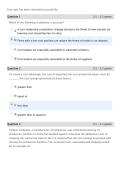
Your quiz has been submitted successfully.
Question 1 2..5 points
Which of the following statements is accurate?
a) A cost-leadership competitive strategy increases the threat of new entrants by
lowering cost-based barriers to entry.
b) Firms with a low-cost position can reduce the threat of rivalry in an industry.
c) Cost leaders are especially vulnerable to substitute products.
d) Cost leaders are especially vulnerable to the threat of suppliers.
Question 2 2..5 points
To create a cost advantage, the cost of acquiring low-cost productive inputs must be
________ the cost savings generated by these factors.
a) greater than
b) equal to
c) less than
d) greater than or equal to
Question 3 2..5 points
Temper Company, a manufacturer of mattresses, was considering moving its
production facilities to China but decided against it because the additional costs of
shipping the mattresses back to the U.S. would offset the cost savings associated with
moving the production facilities. The increased costs associated with shipping would
be an example of:
, a) learning-curve economies.
b) diseconomies of scale.
c) economies of scale.
d) competitive advantages.
Question 4 2..5 points
Choices firms make about the kinds of products and services they will sell that impact
their relative cost position are known as:
a) technological hardware.
b) policy choices.
c) technological software.
d) corporate level strategies.
Question 5 2..5 points
As the volume of production in a firm increases, the average cost per unit decreases
until some optimal volume of production is reached, after which the average costs of
production begin to rise because of:
a) diseconomies of scale.
b) economies of scope.
c) diseconomies of scope.
d) economies of scale.
, Question 6 2..5 points
Actions that firms take to gain competitive advantage in a single market or industry
are known as _________-level strategies.
a) business
b) corporate
c) functional
d) macro
Question 7 2..5 points
Perhaps the only time economies of scale are not subject to low-cost duplication is
when the ________ size of operations is a significant percentage of ________ demand in
an industry.
a) minimum; marginal
b) efficient; total
c) maximum; marginal
d) efficient; marginal
Question 8 2..5 points
Which of the following is not a potential source of diseconomies of scale?
Question 1 2..5 points
Which of the following statements is accurate?
a) A cost-leadership competitive strategy increases the threat of new entrants by
lowering cost-based barriers to entry.
b) Firms with a low-cost position can reduce the threat of rivalry in an industry.
c) Cost leaders are especially vulnerable to substitute products.
d) Cost leaders are especially vulnerable to the threat of suppliers.
Question 2 2..5 points
To create a cost advantage, the cost of acquiring low-cost productive inputs must be
________ the cost savings generated by these factors.
a) greater than
b) equal to
c) less than
d) greater than or equal to
Question 3 2..5 points
Temper Company, a manufacturer of mattresses, was considering moving its
production facilities to China but decided against it because the additional costs of
shipping the mattresses back to the U.S. would offset the cost savings associated with
moving the production facilities. The increased costs associated with shipping would
be an example of:
, a) learning-curve economies.
b) diseconomies of scale.
c) economies of scale.
d) competitive advantages.
Question 4 2..5 points
Choices firms make about the kinds of products and services they will sell that impact
their relative cost position are known as:
a) technological hardware.
b) policy choices.
c) technological software.
d) corporate level strategies.
Question 5 2..5 points
As the volume of production in a firm increases, the average cost per unit decreases
until some optimal volume of production is reached, after which the average costs of
production begin to rise because of:
a) diseconomies of scale.
b) economies of scope.
c) diseconomies of scope.
d) economies of scale.
, Question 6 2..5 points
Actions that firms take to gain competitive advantage in a single market or industry
are known as _________-level strategies.
a) business
b) corporate
c) functional
d) macro
Question 7 2..5 points
Perhaps the only time economies of scale are not subject to low-cost duplication is
when the ________ size of operations is a significant percentage of ________ demand in
an industry.
a) minimum; marginal
b) efficient; total
c) maximum; marginal
d) efficient; marginal
Question 8 2..5 points
Which of the following is not a potential source of diseconomies of scale?