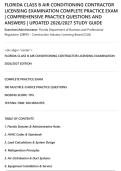
FLORIDA CLASS B AIR CONDITIONING CONTRACTOR
LICENSING EXAMINATION COMPLETE PRACTICE EXAM
| COMPREHENSIVE PRACTICE QUESTIONS AND
ANSWERS | UPDATED 2026/2027 STUDY GUIDE
Examiner/Administrator: Florida Department of Business and Professional
Regulation (DBPR) – Construction Industry Licensing Board (CILB)
<div align="center">
FLORIDA CLASS B AIR CONDITIONING CONTRACTOR LICENSING EXAMINATION
2026/2027 EDITION
COMPLETE PRACTICE EXAM
100 MULTIPLE-CHOICE PRACTICE QUESTIONS
PASSING SCORE: 70%
TESTING TIME: 300 MINUTES
TABLE OF CONTENTS
1. Florida Statutes & Administrative Rules
2. HVAC Codes & Standards
3. Load Calculations & System Design
4. Refrigeration Principles
5. Air Distribution & Duct Systems
6. Equipment Installation & Service
,7. Electrical Systems & Controls
8. Fuel Gas & Mechanical Safety
9. Business Management & Project Administration
10. Jobsite Safety & OSHA Compliance
FLORIDA DEPARTMENT OF BUSINESS AND PROFESSIONAL REGULATION ||
CONSTRUCTION INDUSTRY LICENSING BOARD || ALIGNED WITH CURRENT
FLORIDA LICENSING BLUEPRINTS || MECHANICAL CODE COMPLIANCE ||
PROFESSIONAL STUDY GUIDE || ORIGINAL PRACTICE QUESTIONS WITH VERIFIED
EXPLANATIONS || COMPREHENSIVE LICENSING EXAM PREPARATION ||
PROFESSIONAL EXAMINATION USE
</div>
Questions 1–8 — Florida Laws, Licensing & Regulatory
Requirements
QUESTION 1
A licensed Florida Class B Air Conditioning Contractor is preparing to bid on a
commercial HVAC replacement project. Before executing the contract, which action
best demonstrates compliance with Florida contractor licensing requirements?
A. Allow an unlicensed estimator to sign the contract on behalf of the business.
B. Execute the contract through the qualifying licensed contractor or authorized
business representative acting under applicable licensing requirements.
C. Begin demolition before permit issuance to reduce project duration.
D. Submit permit applications only after equipment has been installed.
Correct Answer: B. Execute the contract through the qualifying licensed contractor
or authorized business representative acting under applicable licensing
,requirements.
Explanation: A qualifying contractor is responsible for ensuring that contracting
activities comply with Florida licensing laws. Beginning work before permits are issued
or allowing unauthorized individuals to perform regulated contracting functions can
result in disciplinary action. Options A, C, and D fail to meet statutory and permitting
requirements.
QUESTION 2
During a routine inspection, an HVAC contractor discovers that field conditions differ
substantially from the approved permit documents. What is the most appropriate
professional response?
A. Continue installation because equipment has already been delivered.
B. Modify the installation without notifying the authority having jurisdiction.
C. Suspend affected work until the revised design is reviewed and approved when
required.
D. Ignore the discrepancy because inspectors rarely verify drawings.
Correct Answer: C. Suspend affected work until the revised design is reviewed and
approved when required.
Explanation: Material deviations from approved plans generally require review before
installation continues. Proceeding without approval may create code violations,
increase liability, and delay project acceptance. The remaining choices disregard
regulatory compliance and professional responsibility.
QUESTION 3
Which document primarily establishes the contractor's legal obligation regarding the
scope of work?
A. Manufacturer's installation brochure
, B. Equipment warranty
C. Executed construction contract
D. Material delivery receipt
Correct Answer: C. Executed construction contract
Explanation: The executed contract defines the agreed scope, pricing, responsibilities,
schedule, and legal obligations. Manufacturer literature provides installation guidance,
while warranties and delivery receipts serve different purposes.
QUESTION 4
A contractor intends to subcontract duct fabrication to another company. Which
statement is most accurate?
A. The qualifying contractor remains responsible for ensuring code compliance.
B. Responsibility transfers entirely to the subcontractor.
C. Building officials become responsible for workmanship.
D. Equipment manufacturers assume liability.
Correct Answer: A. The qualifying contractor remains responsible for ensuring
code compliance.
Explanation: Hiring subcontractors does not eliminate the prime contractor's
responsibility for regulatory compliance and project quality. The qualifying contractor
remains accountable for work performed under the contract.
QUESTION 5
Which circumstance most likely requires obtaining a mechanical permit?
A. Replacing disposable air filters.
LICENSING EXAMINATION COMPLETE PRACTICE EXAM
| COMPREHENSIVE PRACTICE QUESTIONS AND
ANSWERS | UPDATED 2026/2027 STUDY GUIDE
Examiner/Administrator: Florida Department of Business and Professional
Regulation (DBPR) – Construction Industry Licensing Board (CILB)
<div align="center">
FLORIDA CLASS B AIR CONDITIONING CONTRACTOR LICENSING EXAMINATION
2026/2027 EDITION
COMPLETE PRACTICE EXAM
100 MULTIPLE-CHOICE PRACTICE QUESTIONS
PASSING SCORE: 70%
TESTING TIME: 300 MINUTES
TABLE OF CONTENTS
1. Florida Statutes & Administrative Rules
2. HVAC Codes & Standards
3. Load Calculations & System Design
4. Refrigeration Principles
5. Air Distribution & Duct Systems
6. Equipment Installation & Service
,7. Electrical Systems & Controls
8. Fuel Gas & Mechanical Safety
9. Business Management & Project Administration
10. Jobsite Safety & OSHA Compliance
FLORIDA DEPARTMENT OF BUSINESS AND PROFESSIONAL REGULATION ||
CONSTRUCTION INDUSTRY LICENSING BOARD || ALIGNED WITH CURRENT
FLORIDA LICENSING BLUEPRINTS || MECHANICAL CODE COMPLIANCE ||
PROFESSIONAL STUDY GUIDE || ORIGINAL PRACTICE QUESTIONS WITH VERIFIED
EXPLANATIONS || COMPREHENSIVE LICENSING EXAM PREPARATION ||
PROFESSIONAL EXAMINATION USE
</div>
Questions 1–8 — Florida Laws, Licensing & Regulatory
Requirements
QUESTION 1
A licensed Florida Class B Air Conditioning Contractor is preparing to bid on a
commercial HVAC replacement project. Before executing the contract, which action
best demonstrates compliance with Florida contractor licensing requirements?
A. Allow an unlicensed estimator to sign the contract on behalf of the business.
B. Execute the contract through the qualifying licensed contractor or authorized
business representative acting under applicable licensing requirements.
C. Begin demolition before permit issuance to reduce project duration.
D. Submit permit applications only after equipment has been installed.
Correct Answer: B. Execute the contract through the qualifying licensed contractor
or authorized business representative acting under applicable licensing
,requirements.
Explanation: A qualifying contractor is responsible for ensuring that contracting
activities comply with Florida licensing laws. Beginning work before permits are issued
or allowing unauthorized individuals to perform regulated contracting functions can
result in disciplinary action. Options A, C, and D fail to meet statutory and permitting
requirements.
QUESTION 2
During a routine inspection, an HVAC contractor discovers that field conditions differ
substantially from the approved permit documents. What is the most appropriate
professional response?
A. Continue installation because equipment has already been delivered.
B. Modify the installation without notifying the authority having jurisdiction.
C. Suspend affected work until the revised design is reviewed and approved when
required.
D. Ignore the discrepancy because inspectors rarely verify drawings.
Correct Answer: C. Suspend affected work until the revised design is reviewed and
approved when required.
Explanation: Material deviations from approved plans generally require review before
installation continues. Proceeding without approval may create code violations,
increase liability, and delay project acceptance. The remaining choices disregard
regulatory compliance and professional responsibility.
QUESTION 3
Which document primarily establishes the contractor's legal obligation regarding the
scope of work?
A. Manufacturer's installation brochure
, B. Equipment warranty
C. Executed construction contract
D. Material delivery receipt
Correct Answer: C. Executed construction contract
Explanation: The executed contract defines the agreed scope, pricing, responsibilities,
schedule, and legal obligations. Manufacturer literature provides installation guidance,
while warranties and delivery receipts serve different purposes.
QUESTION 4
A contractor intends to subcontract duct fabrication to another company. Which
statement is most accurate?
A. The qualifying contractor remains responsible for ensuring code compliance.
B. Responsibility transfers entirely to the subcontractor.
C. Building officials become responsible for workmanship.
D. Equipment manufacturers assume liability.
Correct Answer: A. The qualifying contractor remains responsible for ensuring
code compliance.
Explanation: Hiring subcontractors does not eliminate the prime contractor's
responsibility for regulatory compliance and project quality. The qualifying contractor
remains accountable for work performed under the contract.
QUESTION 5
Which circumstance most likely requires obtaining a mechanical permit?
A. Replacing disposable air filters.