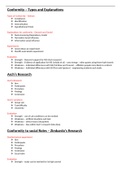
Conformity – Types and Explanations
Types of Conformity – Kelman
Compliance
Identification
Internalisation
Ingratitational (Man)
Explanations for conformity – Deutsch and Gerald
Dual processing Dependency model
Normative Social Influence
Informative social influence
Experiments
Jennes Bean Jar experiment
Sheriffs auto kinetic experiment
Evaluation
Strength – Research support for NSI (Asch research)
Strength – Evidence of application for NSI (schultz et al) – save energy – other guests using fewer bath towels
Weakness – Individual differences with NSI (McGhee and Teevan) – affilation people more likely to conform
Weakness – Individual differences with ISI (Pern and Spencer) – engineering students asch study
Asch’s Research
Asch’s Research
Aim
Participants
Procedure
Findings
Conclusion
Asch’s variations
Group size
Task difficulty
Unanimity
Evaluation
Strength – use of Lab conditions can be merited
Weakness – artificial situations and task
Weakness – ethical issues (deception)
Weakness – bias within Asch’s research (beta bias)
Conformity to social Roles – Zimbardo’s Research
Stanford prison experiment
Aim
Participants
Procedure
Findings
Conclusion
Social roles
Evaluation
Strength – study can be merited for its high control
Types of Conformity – Kelman
Compliance
Identification
Internalisation
Ingratitational (Man)
Explanations for conformity – Deutsch and Gerald
Dual processing Dependency model
Normative Social Influence
Informative social influence
Experiments
Jennes Bean Jar experiment
Sheriffs auto kinetic experiment
Evaluation
Strength – Research support for NSI (Asch research)
Strength – Evidence of application for NSI (schultz et al) – save energy – other guests using fewer bath towels
Weakness – Individual differences with NSI (McGhee and Teevan) – affilation people more likely to conform
Weakness – Individual differences with ISI (Pern and Spencer) – engineering students asch study
Asch’s Research
Asch’s Research
Aim
Participants
Procedure
Findings
Conclusion
Asch’s variations
Group size
Task difficulty
Unanimity
Evaluation
Strength – use of Lab conditions can be merited
Weakness – artificial situations and task
Weakness – ethical issues (deception)
Weakness – bias within Asch’s research (beta bias)
Conformity to social Roles – Zimbardo’s Research
Stanford prison experiment
Aim
Participants
Procedure
Findings
Conclusion
Social roles
Evaluation
Strength – study can be merited for its high control