

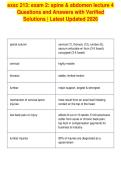
exsc 213: exam 2: spine & abdomen lecture 4
Questions and Answers with Verified
Solutions | Latest Updated 2026
spinal column cervical (7), thoracic (12), lumbar (5),
sacrum articulate w/ ilium (3-5 fused),
coccygeal (3-5 fused)
cervical highly mobile
thoracic stable, limited motion
lumbar major support, largest & strongest
mechanism of cervical spine most result from an axial load initiating
injuries contact w/ the top of the head
low back pain or injury affects 8 out of 10 adults; 5 mill americans
suffer from acute or chronic back pain;
top item in compensation payments for
business & industry
lumbar injuries 80% of injuries are diagnosed as a
sprain/strain
, mechanism of lumbar injuries mechanical disfunction (core or posture),
tightened muscles, lengthened muscles,
rotation/extension, tensile load, repetitive
stress
S&S of lumbar injuries generalized pain, pain increases with
activity, muscle spasms
lumbar disc injuries repetitive extension/rotation (ex:
mechanism of injury: weightlifting)
S&S of lumbar disc injuries numbness & tingling that radiates, pain
that radiates, muscle weakness, standing
is less painful than sitting
spondylolysis & general term for age-related wear & tear
spondylolisthesis of the spinal disks
spondylolysis lumbar vertebra stress fracture which
causes vertebral body to slide forward
on surrounding vertebrae & create
spondylolisthesis
causes of spondylolysis & caused by hypertension activities or
spondylolisthesis genetics
S&S of Spondylolysis and spasm, diffuse pain across lower back,
Spondylolisthesis radiating pain, burning, tingling, or
numbness down legs
injuries to thorax region pneumothorax & hemothorax
Questions and Answers with Verified
Solutions | Latest Updated 2026
spinal column cervical (7), thoracic (12), lumbar (5),
sacrum articulate w/ ilium (3-5 fused),
coccygeal (3-5 fused)
cervical highly mobile
thoracic stable, limited motion
lumbar major support, largest & strongest
mechanism of cervical spine most result from an axial load initiating
injuries contact w/ the top of the head
low back pain or injury affects 8 out of 10 adults; 5 mill americans
suffer from acute or chronic back pain;
top item in compensation payments for
business & industry
lumbar injuries 80% of injuries are diagnosed as a
sprain/strain
, mechanism of lumbar injuries mechanical disfunction (core or posture),
tightened muscles, lengthened muscles,
rotation/extension, tensile load, repetitive
stress
S&S of lumbar injuries generalized pain, pain increases with
activity, muscle spasms
lumbar disc injuries repetitive extension/rotation (ex:
mechanism of injury: weightlifting)
S&S of lumbar disc injuries numbness & tingling that radiates, pain
that radiates, muscle weakness, standing
is less painful than sitting
spondylolysis & general term for age-related wear & tear
spondylolisthesis of the spinal disks
spondylolysis lumbar vertebra stress fracture which
causes vertebral body to slide forward
on surrounding vertebrae & create
spondylolisthesis
causes of spondylolysis & caused by hypertension activities or
spondylolisthesis genetics
S&S of Spondylolysis and spasm, diffuse pain across lower back,
Spondylolisthesis radiating pain, burning, tingling, or
numbness down legs
injuries to thorax region pneumothorax & hemothorax


