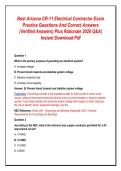
Arizona CR-11 Electrical Contractor Exam
Practice Questions And Correct Answers
(Verified Answers) Plus Rationale 2027/2026 Q&A|
Instant Download Pdf
Exam Format: 110 questions, 240 minutes (4 hours) | Passing Score: 70% | Open Book
(NEC 2017, NFPA 72, OSHA 1926)
SECTION 1: ELECTRICAL THEORY & FUNDAMENTALS (Q1-15)
Q1: What does Ohm's Law state, and what is the relationship between voltage,
current, and resistance?
Answer: Ohm's Law states that voltage equals current multiplied by resistance (V = I × R).
The relationships are:
Voltage (V) = Current (I) × Resistance (R)
Current (I) = Voltage (V) ÷ Resistance (R)
Resistance (R) = Voltage (V) ÷ Current (I)
This law forms the basis of all electrical circuit calculations and troubleshooting .
Q2: What is the unit of electrical power, and how is it calculated?
Answer: Electrical power is measured in watts (W). The formulas are:
DC circuits: P = V × I
Single-phase AC: P = V × I × Power Factor (PF)
Three-phase AC: P = √3 × V × I × PF
Apparent power (S) is measured in volt-amperes (VA) or kVA .
Q3: What is Kirchhoff's Current Law (KCL)?
Answer: Kirchhoff's Current Law states that the sum of currents entering a junction (node)
equals the sum of currents leaving the junction. This law is based on the conservation of
charge, meaning electric charge cannot accumulate at a node .
,Q4: What is Kirchhoff's Voltage Law (KVL)?
Answer: Kirchhoff's Voltage Law states that the sum of all voltage drops around any closed
loop in a circuit equals the total voltage applied to that loop. This law is based on the
conservation of energy .
Q5: What is the total resistance in a series circuit with three resistors of 2 Ω, 4 Ω, and
6 Ω?
Answer: In a series circuit, resistances add directly: Rt = R1 + R2 + R3 = 2 Ω + 4 Ω + 6 Ω =
12 Ω .
Q6: What is the total resistance in a parallel circuit?
Answer: In a parallel circuit, the reciprocal of total resistance equals the sum of the
reciprocals of individual resistances: 1/Rt = 1/R1 + 1/R2 + 1/R3 .
Q7: In a series circuit, how does current flow through each component?
Answer: In a series circuit, there is one continuous path for current, and the current is the
same through all components. Components share the same current .
Q8: In a parallel circuit, how does voltage behave across branches?
Answer: In a parallel circuit, voltage is the same across each branch. Each branch provides
a separate path for current flow, but the voltage remains constant across all branches .
Q9: What is the difference between AC and DC power?
Answer: Direct Current (DC) flows in one direction with constant polarity, while Alternating
Current (AC) periodically reverses direction. AC is used for power distribution because it
can be easily stepped up or down using transformers .
Q10: In a three-phase, four-wire wye system, what is the relationship between line-to-
line voltage and line-to-neutral voltage?
Answer: The line-to-line voltage equals the line-to-neutral voltage multiplied by the square
root of 3 (√3). For example, if the line-to-neutral voltage is 120V, the line-to-line voltage is
120V × 1.732 = 208V. If the line-to-line is 480V, the line-to-neutral is 480V ÷ 1.732 = 277V .
Q11: In a three-phase, four-wire wye system, which conductor provides the return
path for unbalanced loads?
Answer: The neutral conductor carries the vector sum of the unbalanced phase currents in
a wye system. It provides the return path for any imbalance between phases .
Q12: What is impedance in an AC circuit?
Answer: Impedance (Z) is the opposition to current flow in an AC circuit. It includes both
, resistance (R) and reactance (X). Reactance includes inductive reactance (XL) and
capacitive reactance (XC). Impedance = √(R² + X²) .
Q13: What is apparent power and how is it calculated?
Answer: Apparent power (S) is the product of voltage and current in an AC circuit,
measured in VA or kVA. It is calculated as:
Single-phase: S = V × I
Three-phase: S = V × I × √3
True power (P) = S × Power Factor (PF) .
Q14: What is the function of a transformer?
Answer: A transformer transfers electrical energy between circuits through electromagnetic
induction, changing voltage levels. It can be:
Step-up: Increases voltage, decreases current
Step-down: Decreases voltage, increases current
Transformers do not generate power but transfer it between circuits .
Q15: What is the difference between a single-phase and three-phase system?
Answer: A single-phase system has one alternating voltage waveform and is used for
residential and light commercial loads. A three-phase system has three alternating voltage
waveforms 120° apart and is used for commercial and industrial applications because it
provides more constant power and higher efficiency for motors and heavy loads .
SECTION 2: NEC ARTICLES & CODE REFERENCES (Q16-30)
Q16: Which NEC article covers branch circuits, and what is its scope?
Answer: Article 210 covers branch circuits. It includes requirements for:
Branch circuit ratings
Required branch circuits in dwellings
Multi-wire branch circuits
Voltage drop limitations
Receptacle spacing requirements .
Practice Questions And Correct Answers
(Verified Answers) Plus Rationale 2027/2026 Q&A|
Instant Download Pdf
Exam Format: 110 questions, 240 minutes (4 hours) | Passing Score: 70% | Open Book
(NEC 2017, NFPA 72, OSHA 1926)
SECTION 1: ELECTRICAL THEORY & FUNDAMENTALS (Q1-15)
Q1: What does Ohm's Law state, and what is the relationship between voltage,
current, and resistance?
Answer: Ohm's Law states that voltage equals current multiplied by resistance (V = I × R).
The relationships are:
Voltage (V) = Current (I) × Resistance (R)
Current (I) = Voltage (V) ÷ Resistance (R)
Resistance (R) = Voltage (V) ÷ Current (I)
This law forms the basis of all electrical circuit calculations and troubleshooting .
Q2: What is the unit of electrical power, and how is it calculated?
Answer: Electrical power is measured in watts (W). The formulas are:
DC circuits: P = V × I
Single-phase AC: P = V × I × Power Factor (PF)
Three-phase AC: P = √3 × V × I × PF
Apparent power (S) is measured in volt-amperes (VA) or kVA .
Q3: What is Kirchhoff's Current Law (KCL)?
Answer: Kirchhoff's Current Law states that the sum of currents entering a junction (node)
equals the sum of currents leaving the junction. This law is based on the conservation of
charge, meaning electric charge cannot accumulate at a node .
,Q4: What is Kirchhoff's Voltage Law (KVL)?
Answer: Kirchhoff's Voltage Law states that the sum of all voltage drops around any closed
loop in a circuit equals the total voltage applied to that loop. This law is based on the
conservation of energy .
Q5: What is the total resistance in a series circuit with three resistors of 2 Ω, 4 Ω, and
6 Ω?
Answer: In a series circuit, resistances add directly: Rt = R1 + R2 + R3 = 2 Ω + 4 Ω + 6 Ω =
12 Ω .
Q6: What is the total resistance in a parallel circuit?
Answer: In a parallel circuit, the reciprocal of total resistance equals the sum of the
reciprocals of individual resistances: 1/Rt = 1/R1 + 1/R2 + 1/R3 .
Q7: In a series circuit, how does current flow through each component?
Answer: In a series circuit, there is one continuous path for current, and the current is the
same through all components. Components share the same current .
Q8: In a parallel circuit, how does voltage behave across branches?
Answer: In a parallel circuit, voltage is the same across each branch. Each branch provides
a separate path for current flow, but the voltage remains constant across all branches .
Q9: What is the difference between AC and DC power?
Answer: Direct Current (DC) flows in one direction with constant polarity, while Alternating
Current (AC) periodically reverses direction. AC is used for power distribution because it
can be easily stepped up or down using transformers .
Q10: In a three-phase, four-wire wye system, what is the relationship between line-to-
line voltage and line-to-neutral voltage?
Answer: The line-to-line voltage equals the line-to-neutral voltage multiplied by the square
root of 3 (√3). For example, if the line-to-neutral voltage is 120V, the line-to-line voltage is
120V × 1.732 = 208V. If the line-to-line is 480V, the line-to-neutral is 480V ÷ 1.732 = 277V .
Q11: In a three-phase, four-wire wye system, which conductor provides the return
path for unbalanced loads?
Answer: The neutral conductor carries the vector sum of the unbalanced phase currents in
a wye system. It provides the return path for any imbalance between phases .
Q12: What is impedance in an AC circuit?
Answer: Impedance (Z) is the opposition to current flow in an AC circuit. It includes both
, resistance (R) and reactance (X). Reactance includes inductive reactance (XL) and
capacitive reactance (XC). Impedance = √(R² + X²) .
Q13: What is apparent power and how is it calculated?
Answer: Apparent power (S) is the product of voltage and current in an AC circuit,
measured in VA or kVA. It is calculated as:
Single-phase: S = V × I
Three-phase: S = V × I × √3
True power (P) = S × Power Factor (PF) .
Q14: What is the function of a transformer?
Answer: A transformer transfers electrical energy between circuits through electromagnetic
induction, changing voltage levels. It can be:
Step-up: Increases voltage, decreases current
Step-down: Decreases voltage, increases current
Transformers do not generate power but transfer it between circuits .
Q15: What is the difference between a single-phase and three-phase system?
Answer: A single-phase system has one alternating voltage waveform and is used for
residential and light commercial loads. A three-phase system has three alternating voltage
waveforms 120° apart and is used for commercial and industrial applications because it
provides more constant power and higher efficiency for motors and heavy loads .
SECTION 2: NEC ARTICLES & CODE REFERENCES (Q16-30)
Q16: Which NEC article covers branch circuits, and what is its scope?
Answer: Article 210 covers branch circuits. It includes requirements for:
Branch circuit ratings
Required branch circuits in dwellings
Multi-wire branch circuits
Voltage drop limitations
Receptacle spacing requirements .