Written by students who passed Immediately available after payment Read online or as PDF Wrong document? Swap it for free 4.6 TrustPilot
logo-home
Exam (elaborations)

WGU D669 Early Literacy Methods Exam Study Guide (200+ Questions): Science of Reading, Phonics, Phonemic Awareness, Scarborough’s Reading Rope & Structured Literacy | Western Governors University

Rating
-
Sold
-
Pages
10
Grade
A+
Uploaded on
02-07-2026
Written in
2025/2026

Prepare for the Western Governors University (WGU) D669 Early Literacy Methods Exam with this comprehensive study guide featuring 200+ expertly verified exam questions and answers covering the core principles of early literacy instruction, the Science of Reading, structured literacy, phonological awareness, phonemic awareness, phonics, vocabulary development, reading comprehension, writing instruction, and evidence-based teaching practices. This resource provides an in-depth review of letter-sound correspondence, syllable segmentation, phoneme substitution, semantic organizers, reciprocal teaching, summarizing, clarifying strategies, print awareness, handwriting and letter formation, phonology, morphology, lexical semantics, syntax, oral language development, foundational writing, reading fluency, vocabulary instruction, explicit teaching, multisensory instruction, and literacy assessment. The structured question-and-answer format reinforces research-based instructional practices, strengthens pedagogical knowledge, and prepares teacher candidates for the WGU D669 Early Literacy Methods assessment and professional educator licensure examinations. This study guide also provides comprehensive coverage of evidence-based literacy frameworks and instructional methodologies, including Scarborough's Reading Rope, the Simple View of Reading (SVR), the Four-Part Processing Model, phonological processing, semantic processing, orthographic processing, explicit instruction, systematic and cumulative instruction, Orton-Gillingham methodology, multisensory literacy instruction, differentiated instruction, reciprocal teaching, vocabulary acquisition strategies, Tier 2 vocabulary instruction, context clues, grapheme instruction, vowel teams, syllable types, decoding multisyllabic words, comprehension monitoring, oral language development, morphology instruction, writing development, handwriting progression, literacy intervention strategies, classroom assessment, and instructional scaffolding. These topics align with WGU D669 course competencies, current Science of Reading research, and nationally recognized literacy instruction standards, making this guide an excellent preparation resource for elementary education majors, early childhood educators, special education teacher candidates, reading interventionists, literacy coaches, and aspiring teachers seeking success in literacy coursework and teacher certification examinations. Reference (APA 7th Edition) Moats, L. C. (2020). Speech to Print: Language Essentials for Teachers (3rd ed.). Paul H. Brookes Publishing. Scarborough, H. S. (2001). Connecting Early Language and Literacy to Later Reading (Dis)Abilities: Evidence, Theory, and Practice. In S. B. Neuman & D. K. Dickinson (Eds.), Handbook of Early Literacy Research (pp. 97–110). Guilford Press. Relevant Students: Western Governors University (WGU) D669 students, Elementary Education students, Early Childhood Education students, Special Education students, Literacy Education students, Reading Endorsement candidates, Reading Specialists, Reading Interventionists, K–6 teacher candidates, Teacher Preparation students, Curriculum and Instruction students, ESL/ELL educators, Literacy Coaches, Pre-service teachers, Education majors, and students preparing for teacher licensure examinations and Science of Reading assessments. Keywords: WGU D669, D669 Early Literacy Methods, Western Governors University, Early Literacy Methods, Foundations of Literacy, Science of Reading, Structured Literacy, Scarborough Reading Rope, Simple View of Reading, SVR, Four Part Processing Model, Explicit Instruction, Systematic Instruction, Phonological Awareness, Phonemic Awareness, Phonics, Decoding, Letter Sound Correspondence, Grapheme Phoneme Correspondence, Syllables, Syllable Types, Phoneme Substitution, Vocabulary Development, Tier 2 Vocabulary, Semantic Organizers, Reciprocal Teaching, Summarizing, Clarifying, Reading Comprehension, Reading Fluency, Print Awareness, Letter Formation, Handwriting, Foundational Writing, Morphology, Phonology, Syntax, Semantics, Lexical Semantics, Oral Language Development, Context Clues, Multisensory Instruction, Orton Gillingham, Literacy Assessment, Reading Intervention, Teacher Certification, Elementary Reading, Evidence Based Literacy, Literacy Instruction, WGU Exam Questions, Literacy Study Guide

Show more Read less

Content preview

WGU Early Literacy Methods -
D669 2026 Exam Questions and
Correct Answers | New Update


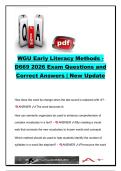
How does the word lip change when the last sound is replaced with /t/? -

ANSWER ✔✔The word becomes lit.


How can semantic organizers be used to enhance comprehension of

complex vocabulary in a text? - ANSWER ✔✔By creating a visual

web that connects the new vocabulary to known words and concepts

Which method should be used to help students identify the number of

syllables in a word like elephant? - ANSWER ✔✔Pronounce the word

, slowly, emphasizing each syllable, and have students tap on their desk

for each syllable

How does incorporating a phonics lesson on letter-sound

correspondence align with Scarborough's Reading Rope in classroom

instruction? - ANSWER ✔✔It supports the word recognition strand by

teaching decoding skills.

What is the purpose of the summarizing strategy in reciprocal teaching?

- ANSWER ✔✔To condense the main ideas and details into a concise

overview

What is an effective method for teaching students proper letter

formation? - ANSWER ✔✔Demonstrate the correct way to write each

letter while students follow along in the air and on paper

What classroom activity would effectively assess young learners' print

awareness? - ANSWER ✔✔A slightly rounded and open mouth


What is the correct mouth shape for the short o sound in cot? -

ANSWER ✔✔A slightly rounded and open mouth


Which strategy helps students identify when they are not understanding

a text? - ANSWER ✔✔Rereading sections of the text

Document information

Uploaded on
July 2, 2026
Number of pages
10
Written in
2025/2026
Type
Exam (elaborations)
Contains
Questions & answers

Subjects

$18.99
Get access to the full document:

Wrong document? Swap it for free Within 14 days of purchase and before downloading, you can choose a different document. You can simply spend the amount again.
Written by students who passed
Immediately available after payment
Read online or as PDF


Also available in package deal

Thumbnail
Package deal
WGU D669 EARLY LITERACY METHODS EXAM COMPLETE PACKAGE DEAL
-
2 2026
$ 22.18 More info

Get to know the seller

Seller avatar
Reputation scores are based on the amount of documents a seller has sold for a fee and the reviews they have received for those documents. There are three levels: Bronze, Silver and Gold. The better the reputation, the more your can rely on the quality of the sellers work.
NinjaNerd Liberty University
View profile
Follow You need to be logged in order to follow users or courses
Sold
376
Member since
2 year
Number of followers
6
Documents
14742
Last sold
1 day ago
NinjaNerd

Here You will All Documents and Package Deals Offered by Seller NinjaNerd.

3.5

74 reviews

5
26
4
14
3
16
2
4
1
14

Why students choose Stuvia

Created by fellow students, verified by reviews

Quality you can trust: written by students who passed their tests and reviewed by others who've used these notes.

Didn't get what you expected? Choose another document

No worries! You can instantly pick a different document that better fits what you're looking for.

Pay as you like, start learning right away

No subscription, no commitments. Pay the way you're used to via credit card and download your PDF document instantly.

Student with book image

“Bought, downloaded, and aced it. It really can be that simple.”

Alisha Student

Working on your references?

Create accurate citations in APA, MLA and Harvard with our free citation generator.

Working on your references?

Frequently asked questions