

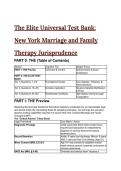
The Elite Universal Test Bank:
New York Marriage and Family
Therapy Jurisprudence
PART 0: THE (Table of Contents)
Section Cognitive Tier Subject Focus
PART I: THE Preview Command & Control Critical Axioms & Exam
Architecture
PART II: THE ELITE TEST
BANK
Tier 1 (Questions 1–15) Foundational Syntax Core Statutes, Timelines, &
Hard Definitions
Tier 2 (Questions 16–35) Complex Application Situation/Variable Modification
& Ethics
Tier 3 (Questions 36–60) Grandmaster Synthesis High-Stakes Clinical & Legal
Triangulation
PART I: THE Preview
Mastering this test bank transforms theoretical regulatory knowledge into an impenetrable legal
and clinical shield. By internalizing these 60 escalating scenarios, you will forge the executive
decision-making capabilities required of a top-tier New York Licensed Marriage and Family
Therapist (LMFT).
The "Critical Axioms" Cheat Sheet
Legal Framework Core Metric / Axiom
Diagnostic Privilege 2,000 supervised direct client contact hours
required post-graduation to independently
diagnose or develop assessment-based
treatment plans.
Record Retention Adults: 6 years post-discharge. Minors: 6 years
AND 1 year past their 21st birthday (Age 22).
Minor Consent (MHL § 33.21) Age 16+ may consent to outpatient mental
health without parents if parental involvement is
clinically detrimental.
SAFE Act (MHL § 9.46) "Imminent and serious harm" requires a
,Legal Framework Core Metric / Axiom
mandatory breach of confidentiality to the
Director of Community Services (DCS).
Fee-Splitting Prohibition Percentage-based rent or marketing kickbacks
are strictly illegal.
CE Requirements 36 hours triennially; max 12 hours self-study; 3
hours professional boundaries mandated.
Sexual Boundaries 5-year strict prohibition on sexual contact
post-termination.
PART II: THE ELITE TEST BANK
Tier 1: Foundational Syntax & Application
Q1: A 15-year-old client successfully terminates therapy. The clinic is updating its physical
archives. Based on the principles of 8 NYCRR 29.2(a)(3) , which action is the MOST
ACCURATE? A) The records may be destroyed exactly six years from the date of the final
session. B) The records must be retained indefinitely due to the client's status as a protected
minor. C) The records must be retained until the client reaches the age of 22. D) The records
may be transferred to the parents upon the client's 18th birthday and deleted locally.
● The Answer: C (The records must be retained until the client reaches the age of 22.)
● Distractor Analysis:
○ A is incorrect: This is the standard retention rule for adult clients, ignoring the minor
extension.
○ B is incorrect: NYSED regulations do not require perpetual, indefinite storage for
any demographic.
○ D is incorrect: Handing over physical records does not absolve the licensee from
the legal mandate to retain the original clinical file.
The Mentor's Analysis: Statutory age clocks supersede general business practices. When
facing minor client archiving, the immediate priority is calculating the "Age 21 + 1 year"
threshold. By utilizing the Minor Retention Rule, you bypass the common trap of premature
clinical destruction. Professional/Academic Intuition: Minor records survive until age 22,
regardless of how long ago the treatment occurred.
Q2: An LMFT is renewing their triennial registration. Based on the principles of Article 163
Mandatory Continuing Education , which conclusion is the MOST ACCURATE regarding their
36 required hours? A) All 36 hours may be completed asynchronously if provided by an
approved university. B) A maximum of 12 hours may be self-study, and 3 hours must focus on
professional boundaries. C) The licensee must dedicate 6 hours specifically to child abuse
identification every cycle. D) The required hours are waived if the licensee works exclusively in
an OMH-regulated facility.
● The Answer: B (A maximum of 12 hours may be self-study, and 3 hours must focus on
professional boundaries.)
● Distractor Analysis:
○ A is incorrect: NYSED strictly caps self-study (asynchronous) learning at 12 hours
per 36-month cycle.
○ C is incorrect: Child abuse training is a mandated one-time certification (with a
specific 2025 update), not a recurring 6-hour triennial requirement.
○ D is incorrect: OMH facility employment does not exempt a practitioner from
, maintaining CE requirements.
The Mentor's Analysis: Registration renewal is a rigid mathematical formula. When facing
audit compliance, the immediate priority is balancing live versus self-study ratios. By utilizing the
1/3 Self-Study Limit, you bypass the common trap of automated CE rejections.
Professional/Academic Intuition: Never exceed 12 hours of self-study, and always secure
your 3 boundary hours.
Q3: An applicant secures a Limited Permit to practice marriage and family therapy. Based on
the principles of NYSED Limited Permits , which parameter is the MOST ACCURATE? A) The
permit allows independent private practice as long as a supervisor is on call. B) The permit is
valid for two years and strictly requires general supervision by a qualified licensee. C) The
permit never expires as long as the applicant remains employed at an OMH facility. D) The
permit allows the holder to supervise up to two master's level interns.
● The Answer: B (The permit is valid for two years and strictly requires general supervision
by a qualified licensee.)
● Distractor Analysis:
○ A is incorrect: A permit holder can never practice independently; General
Supervision is an absolute legal mandate.
○ C is incorrect: The Limited Permit has a strict two-year duration, regardless of the
setting.
○ D is incorrect: A permit holder is a supervisee and possesses no legal authority to
supervise others.
The Mentor's Analysis: The permit is a temporary bridge, not a permanent shield. When facing
pre-licensure practice, the immediate priority is maintaining strict supervisory oversight. By
utilizing General Supervision, you bypass the common trap of unlicensed practice allegations.
Professional/Academic Intuition: A Limited Permit is a 24-month countdown clock
requiring constant qualified oversight.
Q4: An LMFT wishes to add the Diagnostic Privilege to their license. Based on the principles of
Education Law § 8401-a , which action is FIRST required? A) Earning a medical degree or
nursing credential. B) Passing the National Clinical Mental Health Counseling Examination
(NCMHCE). C) Completing 2,000 hours of supervised, direct client contact specifically focused
on diagnosis and assessment-based treatment planning. D) Registering as a dual-licensed
Clinical Social Worker (LCSW).
● The Answer: C (Completing 2,000 hours of supervised, direct client contact specifically
focused on diagnosis and assessment-based treatment planning.)
● Distractor Analysis:
○ A is incorrect: A medical degree is completely outside the scope and requirements
of an LMFT diagnostic privilege.
○ B is incorrect: The NCMHCE is an exam for LMHCs, not the experiential
requirement for the MFT privilege.
○ D is incorrect: Dual licensure is unnecessary; the privilege upgrades the existing
LMFT scope.
The Mentor's Analysis: The 2024 legal update fundamentally altered clinical boundaries.
When facing scope expansion, the immediate priority is logging targeted clinical hours. By
utilizing the 2,000-Hour Diagnostic Threshold, you bypass the common trap of practicing
beyond your designated scope. Professional/Academic Intuition: Diagnostic privilege is
earned through 2,000 specific, supervised clinical hours post-graduation.
Q5: An LMFT forms a professional entity to launch a private practice. Based on the principles of
New York Business Corporation Law Article 15-A , which structure is the MOST ACCURATE for
New York Marriage and Family
Therapy Jurisprudence
PART 0: THE (Table of Contents)
Section Cognitive Tier Subject Focus
PART I: THE Preview Command & Control Critical Axioms & Exam
Architecture
PART II: THE ELITE TEST
BANK
Tier 1 (Questions 1–15) Foundational Syntax Core Statutes, Timelines, &
Hard Definitions
Tier 2 (Questions 16–35) Complex Application Situation/Variable Modification
& Ethics
Tier 3 (Questions 36–60) Grandmaster Synthesis High-Stakes Clinical & Legal
Triangulation
PART I: THE Preview
Mastering this test bank transforms theoretical regulatory knowledge into an impenetrable legal
and clinical shield. By internalizing these 60 escalating scenarios, you will forge the executive
decision-making capabilities required of a top-tier New York Licensed Marriage and Family
Therapist (LMFT).
The "Critical Axioms" Cheat Sheet
Legal Framework Core Metric / Axiom
Diagnostic Privilege 2,000 supervised direct client contact hours
required post-graduation to independently
diagnose or develop assessment-based
treatment plans.
Record Retention Adults: 6 years post-discharge. Minors: 6 years
AND 1 year past their 21st birthday (Age 22).
Minor Consent (MHL § 33.21) Age 16+ may consent to outpatient mental
health without parents if parental involvement is
clinically detrimental.
SAFE Act (MHL § 9.46) "Imminent and serious harm" requires a
,Legal Framework Core Metric / Axiom
mandatory breach of confidentiality to the
Director of Community Services (DCS).
Fee-Splitting Prohibition Percentage-based rent or marketing kickbacks
are strictly illegal.
CE Requirements 36 hours triennially; max 12 hours self-study; 3
hours professional boundaries mandated.
Sexual Boundaries 5-year strict prohibition on sexual contact
post-termination.
PART II: THE ELITE TEST BANK
Tier 1: Foundational Syntax & Application
Q1: A 15-year-old client successfully terminates therapy. The clinic is updating its physical
archives. Based on the principles of 8 NYCRR 29.2(a)(3) , which action is the MOST
ACCURATE? A) The records may be destroyed exactly six years from the date of the final
session. B) The records must be retained indefinitely due to the client's status as a protected
minor. C) The records must be retained until the client reaches the age of 22. D) The records
may be transferred to the parents upon the client's 18th birthday and deleted locally.
● The Answer: C (The records must be retained until the client reaches the age of 22.)
● Distractor Analysis:
○ A is incorrect: This is the standard retention rule for adult clients, ignoring the minor
extension.
○ B is incorrect: NYSED regulations do not require perpetual, indefinite storage for
any demographic.
○ D is incorrect: Handing over physical records does not absolve the licensee from
the legal mandate to retain the original clinical file.
The Mentor's Analysis: Statutory age clocks supersede general business practices. When
facing minor client archiving, the immediate priority is calculating the "Age 21 + 1 year"
threshold. By utilizing the Minor Retention Rule, you bypass the common trap of premature
clinical destruction. Professional/Academic Intuition: Minor records survive until age 22,
regardless of how long ago the treatment occurred.
Q2: An LMFT is renewing their triennial registration. Based on the principles of Article 163
Mandatory Continuing Education , which conclusion is the MOST ACCURATE regarding their
36 required hours? A) All 36 hours may be completed asynchronously if provided by an
approved university. B) A maximum of 12 hours may be self-study, and 3 hours must focus on
professional boundaries. C) The licensee must dedicate 6 hours specifically to child abuse
identification every cycle. D) The required hours are waived if the licensee works exclusively in
an OMH-regulated facility.
● The Answer: B (A maximum of 12 hours may be self-study, and 3 hours must focus on
professional boundaries.)
● Distractor Analysis:
○ A is incorrect: NYSED strictly caps self-study (asynchronous) learning at 12 hours
per 36-month cycle.
○ C is incorrect: Child abuse training is a mandated one-time certification (with a
specific 2025 update), not a recurring 6-hour triennial requirement.
○ D is incorrect: OMH facility employment does not exempt a practitioner from
, maintaining CE requirements.
The Mentor's Analysis: Registration renewal is a rigid mathematical formula. When facing
audit compliance, the immediate priority is balancing live versus self-study ratios. By utilizing the
1/3 Self-Study Limit, you bypass the common trap of automated CE rejections.
Professional/Academic Intuition: Never exceed 12 hours of self-study, and always secure
your 3 boundary hours.
Q3: An applicant secures a Limited Permit to practice marriage and family therapy. Based on
the principles of NYSED Limited Permits , which parameter is the MOST ACCURATE? A) The
permit allows independent private practice as long as a supervisor is on call. B) The permit is
valid for two years and strictly requires general supervision by a qualified licensee. C) The
permit never expires as long as the applicant remains employed at an OMH facility. D) The
permit allows the holder to supervise up to two master's level interns.
● The Answer: B (The permit is valid for two years and strictly requires general supervision
by a qualified licensee.)
● Distractor Analysis:
○ A is incorrect: A permit holder can never practice independently; General
Supervision is an absolute legal mandate.
○ C is incorrect: The Limited Permit has a strict two-year duration, regardless of the
setting.
○ D is incorrect: A permit holder is a supervisee and possesses no legal authority to
supervise others.
The Mentor's Analysis: The permit is a temporary bridge, not a permanent shield. When facing
pre-licensure practice, the immediate priority is maintaining strict supervisory oversight. By
utilizing General Supervision, you bypass the common trap of unlicensed practice allegations.
Professional/Academic Intuition: A Limited Permit is a 24-month countdown clock
requiring constant qualified oversight.
Q4: An LMFT wishes to add the Diagnostic Privilege to their license. Based on the principles of
Education Law § 8401-a , which action is FIRST required? A) Earning a medical degree or
nursing credential. B) Passing the National Clinical Mental Health Counseling Examination
(NCMHCE). C) Completing 2,000 hours of supervised, direct client contact specifically focused
on diagnosis and assessment-based treatment planning. D) Registering as a dual-licensed
Clinical Social Worker (LCSW).
● The Answer: C (Completing 2,000 hours of supervised, direct client contact specifically
focused on diagnosis and assessment-based treatment planning.)
● Distractor Analysis:
○ A is incorrect: A medical degree is completely outside the scope and requirements
of an LMFT diagnostic privilege.
○ B is incorrect: The NCMHCE is an exam for LMHCs, not the experiential
requirement for the MFT privilege.
○ D is incorrect: Dual licensure is unnecessary; the privilege upgrades the existing
LMFT scope.
The Mentor's Analysis: The 2024 legal update fundamentally altered clinical boundaries.
When facing scope expansion, the immediate priority is logging targeted clinical hours. By
utilizing the 2,000-Hour Diagnostic Threshold, you bypass the common trap of practicing
beyond your designated scope. Professional/Academic Intuition: Diagnostic privilege is
earned through 2,000 specific, supervised clinical hours post-graduation.
Q5: An LMFT forms a professional entity to launch a private practice. Based on the principles of
New York Business Corporation Law Article 15-A , which structure is the MOST ACCURATE for


