

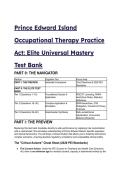
Prince Edward Island
Occupational Therapy Practice
Act: Elite Universal Mastery
Test Bank
PART 0: THE NAVIGATOR
Section Cognitive Tier Focus Area
PART I: THE PREVIEW Axiomatic Framework Core Directives & 2026 PEI
Standards
PART II: THE ELITE TEST
BANK
Tier 1 (Questions 1–15) Foundational Syntax & PEICOT Licensing, RHPA
Application Hard-Deck Rules, Statutory
Definitions
Tier 2 (Questions 16–35) Complex Application & SDM Hierarchies, OTA
Simulation Delegation, Consent & Privacy
Protocols
Tier 3 (Questions 36–60) Grandmaster Synthesis Multi-Jurisdictional
Adjudication, Concurrent
Statutory Breaches
PART I: THE PREVIEW
Mastering this test bank translates directly to elite performance by replacing rote memorization
with a mechanized, first-principles understanding of Prince Edward Island’s specific regulatory
and clinical frameworks. You will forge a clinical intuition that allows you to instantly deconstruct
complex scenarios, ensuring absolute regulatory compliance and unassailable clinical safety.
The "Critical Axioms" Cheat Sheet (2026 PEI Standards)
● The Consent Axiom: Under the PEI Consent to Treatment and Health Care Directives
Act, there is no minimum age for medical consent; capacity is determined entirely by the
, individual's ability to understand the information and appreciate the consequences.
● The OTA Delegation Firewall: An Occupational Therapist may delegate tasks to an
Occupational Therapist Assistant (OTA), but strictly cannot delegate the initiation of
service, interpretation of assessments, or any clinical decision requiring ongoing analysis
and synthesis.
● The Special Authorization Mandate: OTs in PEI cannot perform any of the 13 reserved
activities under the RHPA, with the singular exception of applying for special authorization
to apply electrical energy for treatment.
● The Duty to Report Absolute: Under the Child Protection Act and Adult Protection Act,
the mandate to report suspected abuse or neglect overrides all confidentiality agreements
and privacy laws (including the Health Information Act).
● The SDM Hierarchy Protocol: If a patient lacks capacity, the substitute decision-maker is
assigned by strict statutory hierarchy, prioritizing a formally appointed Proxy (via directive)
above a Guardian, Spouse, or Child.
PART II: THE ELITE TEST BANK
Q1: A practitioner has just fulfilled all requirements for general registration with the Prince
Edward Island College of Occupational Therapists (PEICOT). Based on the Regulated Health
Professions Act (RHPA), which of the following designations is legally authorized for their
professional use? A) O.T. (PEI) B) Registered Occupational Therapist (PEI) C) O.T. Reg. (PEI)
D) Licensed Occupational Therapist
● The Answer: C (O.T. Reg. (PEI))
● Distractor Analysis:
○ A is incorrect: This is an incomplete abbreviation that is not officially recognized
under the Act's specific designation list.
○ B is incorrect: While "registered occupational therapist" is valid, appending "(PEI)"
to the fully spelled-out version is not a codified statutory designation.
○ D is incorrect: "Licensed" is a legacy term; PEI utilizes "Registered" under the
current RHPA framework.
The Mentor's Analysis: Professional identity begins with statutory precision. The RHPA
explicitly designates "O.T. Reg. (PEI)" alongside "occupational therapist" and "O.T." as protected
titles. By utilizing statutorily approved designations, practitioners avoid misrepresentation and
professional misconduct. Professional/Academic Intuition: Never assume global titles
apply locally; strictly utilize the exact designations codified in the PEI RHPA.
Q2: A new graduate applies for registration but has not yet passed the National Occupational
Therapy Certification Examination. They are granted Provisional Registration. Which condition is
an absolute, non-negotiable requirement of this specific registration status? A) The registrant
must complete 30 hours of continuing education within their first year. B) The registration must
be renewed annually until the examination is passed. C) The registrant must practice under the
supervision of a Council-approved OT in the general registration part. D) The registrant is
barred from delegating any tasks to an OTA.
● The Answer: C (The registrant must practice under the supervision of a
Council-approved OT in the general registration part.)
● Distractor Analysis:
○ A is incorrect: CEU requirements are tied to the three-year renewal cycle, not
specifically accelerated for provisional status.
, ○ B is incorrect: Provisional registration is for a limited time and purpose and is
explicitly not subject to renewal.
○ D is incorrect: While supervised, a provisional OT may still assign tasks to an OTA
provided their supervising OT oversees the delegation framework.
The Mentor's Analysis: Provisional registration serves as a temporary bridge, not a permanent
status. Because the practitioner has not yet proven baseline competency via examination,
public safety demands direct oversight. By ensuring Council-approved supervision, the College
mitigates the risk of clinical error. Professional/Academic Intuition: Provisional status is a
ticking clock; it requires an approved supervisor and cannot be renewed.
Q3: An occupational therapist in PEI wishes to utilize functional electrical stimulation (FES) to
address foot drop in a stroke rehabilitation client. Under the PEI Reserved Activities
Regulations, what is the FIRST requisite step before initiating this intervention? A) Obtain
informed consent from the client's substitute decision-maker. B) Ensure a medical practitioner
has provided a direct referral for the FES. C) Successfully complete a Council-approved FES
program and apply for special authorization from the registrar. D) Confirm the OTA is trained to
monitor the equipment during the session.
● The Answer: C (Successfully complete a Council-approved FES program and apply for
special authorization from the registrar.)
● Distractor Analysis:
○ A is incorrect: Obtaining consent is required for all treatments, but the therapist
cannot legally perform a reserved activity without prior authorization.
○ B is incorrect: A medical referral does not override the RHPA's prohibition against
performing a reserved activity without regulatory authorization.
○ D is incorrect: Delegating monitoring to an OTA is irrelevant if the OT themselves is
not legally authorized to apply the energy.
The Mentor's Analysis: Applying electrical energy is a restricted act. OTs are universally
barred from all 13 reserved activities in PEI unless explicitly exempted. By utilizing the special
authorization pathway after approved education, the OT expands their scope legally.
Professional/Academic Intuition: Competence does not equal legal authority. Special
authorization is the absolute prerequisite for electrical energy application.
Q4: According to PEICOT's 2025/2026 Quality Assurance (QA) program, registrants must
complete a Self-Assessment Tool based on the Competencies for Occupational Therapists in
Canada. What is the mandatory protocol regarding the submission of this specific tool? A) It
must be uploaded to the HMS profile by March 15 annually. B) It is retained in the registrant's
personal records and is not submitted to the College. C) It must be co-signed by an employer
and submitted during the registration renewal. D) It must be peer-reviewed by another
registered OT before submission.
● The Answer: B (It is retained in the registrant's personal records and is not submitted to
the College.)
● Distractor Analysis:
○ A is incorrect: The Professional Learning Goals and Completed Activities forms
must be uploaded, but the Self-Assessment Tool itself is explicitly exempt from
upload.
○ C is incorrect: The QA program is a self-directed professional responsibility;
employer validation is not a regulatory requirement here.
○ D is incorrect: Peer review is an excellent learning activity, but it is not a statutory
mandate for the Self-Assessment Tool.
The Mentor's Analysis: The QA program is designed to foster genuine, unpunished
Occupational Therapy Practice
Act: Elite Universal Mastery
Test Bank
PART 0: THE NAVIGATOR
Section Cognitive Tier Focus Area
PART I: THE PREVIEW Axiomatic Framework Core Directives & 2026 PEI
Standards
PART II: THE ELITE TEST
BANK
Tier 1 (Questions 1–15) Foundational Syntax & PEICOT Licensing, RHPA
Application Hard-Deck Rules, Statutory
Definitions
Tier 2 (Questions 16–35) Complex Application & SDM Hierarchies, OTA
Simulation Delegation, Consent & Privacy
Protocols
Tier 3 (Questions 36–60) Grandmaster Synthesis Multi-Jurisdictional
Adjudication, Concurrent
Statutory Breaches
PART I: THE PREVIEW
Mastering this test bank translates directly to elite performance by replacing rote memorization
with a mechanized, first-principles understanding of Prince Edward Island’s specific regulatory
and clinical frameworks. You will forge a clinical intuition that allows you to instantly deconstruct
complex scenarios, ensuring absolute regulatory compliance and unassailable clinical safety.
The "Critical Axioms" Cheat Sheet (2026 PEI Standards)
● The Consent Axiom: Under the PEI Consent to Treatment and Health Care Directives
Act, there is no minimum age for medical consent; capacity is determined entirely by the
, individual's ability to understand the information and appreciate the consequences.
● The OTA Delegation Firewall: An Occupational Therapist may delegate tasks to an
Occupational Therapist Assistant (OTA), but strictly cannot delegate the initiation of
service, interpretation of assessments, or any clinical decision requiring ongoing analysis
and synthesis.
● The Special Authorization Mandate: OTs in PEI cannot perform any of the 13 reserved
activities under the RHPA, with the singular exception of applying for special authorization
to apply electrical energy for treatment.
● The Duty to Report Absolute: Under the Child Protection Act and Adult Protection Act,
the mandate to report suspected abuse or neglect overrides all confidentiality agreements
and privacy laws (including the Health Information Act).
● The SDM Hierarchy Protocol: If a patient lacks capacity, the substitute decision-maker is
assigned by strict statutory hierarchy, prioritizing a formally appointed Proxy (via directive)
above a Guardian, Spouse, or Child.
PART II: THE ELITE TEST BANK
Q1: A practitioner has just fulfilled all requirements for general registration with the Prince
Edward Island College of Occupational Therapists (PEICOT). Based on the Regulated Health
Professions Act (RHPA), which of the following designations is legally authorized for their
professional use? A) O.T. (PEI) B) Registered Occupational Therapist (PEI) C) O.T. Reg. (PEI)
D) Licensed Occupational Therapist
● The Answer: C (O.T. Reg. (PEI))
● Distractor Analysis:
○ A is incorrect: This is an incomplete abbreviation that is not officially recognized
under the Act's specific designation list.
○ B is incorrect: While "registered occupational therapist" is valid, appending "(PEI)"
to the fully spelled-out version is not a codified statutory designation.
○ D is incorrect: "Licensed" is a legacy term; PEI utilizes "Registered" under the
current RHPA framework.
The Mentor's Analysis: Professional identity begins with statutory precision. The RHPA
explicitly designates "O.T. Reg. (PEI)" alongside "occupational therapist" and "O.T." as protected
titles. By utilizing statutorily approved designations, practitioners avoid misrepresentation and
professional misconduct. Professional/Academic Intuition: Never assume global titles
apply locally; strictly utilize the exact designations codified in the PEI RHPA.
Q2: A new graduate applies for registration but has not yet passed the National Occupational
Therapy Certification Examination. They are granted Provisional Registration. Which condition is
an absolute, non-negotiable requirement of this specific registration status? A) The registrant
must complete 30 hours of continuing education within their first year. B) The registration must
be renewed annually until the examination is passed. C) The registrant must practice under the
supervision of a Council-approved OT in the general registration part. D) The registrant is
barred from delegating any tasks to an OTA.
● The Answer: C (The registrant must practice under the supervision of a
Council-approved OT in the general registration part.)
● Distractor Analysis:
○ A is incorrect: CEU requirements are tied to the three-year renewal cycle, not
specifically accelerated for provisional status.
, ○ B is incorrect: Provisional registration is for a limited time and purpose and is
explicitly not subject to renewal.
○ D is incorrect: While supervised, a provisional OT may still assign tasks to an OTA
provided their supervising OT oversees the delegation framework.
The Mentor's Analysis: Provisional registration serves as a temporary bridge, not a permanent
status. Because the practitioner has not yet proven baseline competency via examination,
public safety demands direct oversight. By ensuring Council-approved supervision, the College
mitigates the risk of clinical error. Professional/Academic Intuition: Provisional status is a
ticking clock; it requires an approved supervisor and cannot be renewed.
Q3: An occupational therapist in PEI wishes to utilize functional electrical stimulation (FES) to
address foot drop in a stroke rehabilitation client. Under the PEI Reserved Activities
Regulations, what is the FIRST requisite step before initiating this intervention? A) Obtain
informed consent from the client's substitute decision-maker. B) Ensure a medical practitioner
has provided a direct referral for the FES. C) Successfully complete a Council-approved FES
program and apply for special authorization from the registrar. D) Confirm the OTA is trained to
monitor the equipment during the session.
● The Answer: C (Successfully complete a Council-approved FES program and apply for
special authorization from the registrar.)
● Distractor Analysis:
○ A is incorrect: Obtaining consent is required for all treatments, but the therapist
cannot legally perform a reserved activity without prior authorization.
○ B is incorrect: A medical referral does not override the RHPA's prohibition against
performing a reserved activity without regulatory authorization.
○ D is incorrect: Delegating monitoring to an OTA is irrelevant if the OT themselves is
not legally authorized to apply the energy.
The Mentor's Analysis: Applying electrical energy is a restricted act. OTs are universally
barred from all 13 reserved activities in PEI unless explicitly exempted. By utilizing the special
authorization pathway after approved education, the OT expands their scope legally.
Professional/Academic Intuition: Competence does not equal legal authority. Special
authorization is the absolute prerequisite for electrical energy application.
Q4: According to PEICOT's 2025/2026 Quality Assurance (QA) program, registrants must
complete a Self-Assessment Tool based on the Competencies for Occupational Therapists in
Canada. What is the mandatory protocol regarding the submission of this specific tool? A) It
must be uploaded to the HMS profile by March 15 annually. B) It is retained in the registrant's
personal records and is not submitted to the College. C) It must be co-signed by an employer
and submitted during the registration renewal. D) It must be peer-reviewed by another
registered OT before submission.
● The Answer: B (It is retained in the registrant's personal records and is not submitted to
the College.)
● Distractor Analysis:
○ A is incorrect: The Professional Learning Goals and Completed Activities forms
must be uploaded, but the Self-Assessment Tool itself is explicitly exempt from
upload.
○ C is incorrect: The QA program is a self-directed professional responsibility;
employer validation is not a regulatory requirement here.
○ D is incorrect: Peer review is an excellent learning activity, but it is not a statutory
mandate for the Self-Assessment Tool.
The Mentor's Analysis: The QA program is designed to foster genuine, unpunished


