

New Brunswick Insurance Adjuster
Test Bank: Elite Mastery Protocol
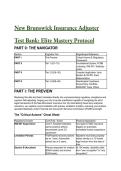
PART 0: THE NAVIGATOR
Section Cognitive Tier Page/Scope Reference
PART I The Preview Critical Axioms & Regulatory
Framework
PART II Tier 1 (Q1–15) Foundational Syntax: FCNB
Licensing, INS-001, Statutory
Limits
PART II Tier 2 (Q16–35) Complex Application: Auto
Section B, DCPD, Fault
Determination
PART II Tier 3 (Q36–60) Grandmaster Synthesis:
Cross-Policy Conflicts,
2026/2027 Caps, Ethics
PART I: THE PREVIEW
Mastering this elite test bank translates directly into uncompromising regulatory compliance and
superior field adjusting, forging you into a top-tier practitioner capable of navigating the strict
legal frameworks of the New Brunswick Insurance Act. By internalizing these sixty analytical
scenarios, you replace novice hesitation with precise, academic intuition, ensuring your practice
operates flawlessly under Financial and Consumer Services Commission (FCNB) oversight.
The "Critical Axioms" Cheat Sheet
Regulatory Domain Core Rule / Axiom Practical Application
INS-001 Supervision Level 1 Assistant Adjusters Any lapse in E&O insurance
cannot practice without triggers an automatic,
documented Level 2/3 immediate license suspension.
supervision.
Limitation Periods Fire/Property recovery actionsAdjusters must diary property
bar at 1 year; Automobile claims strictly to a 12-month
actions bar at 2 years. legal horizon from the date of
loss.
Section B (Accident) Primary responder for medical At 104 weeks, disability shifts
($50k/4 years) and income from "own occupation" to "any
($250/week). occupation".
,Regulatory Domain Core Rule / Axiom Practical Application
Section D & SEF 44 Section D demands physical SEF 44 is strict excess
contact evidence for phantom coverage; it never stacks on top
vehicle property damage. of the tortfeasor's full limit.
2026/2027 Timelines 2026 Minor Personal Injury Cap Bill 15 ban on dealers selling
is indexed strictly at $9,926.59. Q.P.F. #5 is deferred to January
1, 2027.
PART II: THE ELITE TEST BANK
TIER 1: Foundational Syntax & Application
Q1: An individual holding a Level 1 Assistant Adjuster license in New Brunswick has been
actively handling physical damage claims for 11 months. Their supervising Level 3 Senior
Adjuster goes on an unexpected medical leave, leaving no other senior adjusters at the firm.
Based on the principles of FCNB Rule INS-001, which action is IMMEDIATELY required? A)
The Level 1 adjuster may continue adjusting physical damage claims but must pause all bodily
injury claims until the supervisor returns. B) The Level 1 adjuster must submit a temporary
waiver to the Superintendent to act independently for the duration of the leave. C) The Level 1
adjuster must cease all adjusting activities until a qualified replacement supervisor is formally
appointed and documented. D) The Level 1 adjuster may continue working provided all final
settlement offers are reviewed by the firm's legal counsel.
● The Answer: C (The Level 1 adjuster must cease all adjusting activities until a qualified
replacement supervisor is formally appointed and documented.)
● Distractor Analysis:
○ A is incorrect: The prohibition on unsupervised practice for Level 1 adjusters applies
to all classes of insurance, not just bodily injury.
○ B is incorrect: Rule INS-001 does not feature a "temporary waiver" for unsupervised
Level 1 practice; strict continuous supervision is a hard deck regulatory
requirement.
○ D is incorrect: Legal counsel cannot act as a substitute for a licensed Level 2 or
Level 3 supervising adjuster under the Insurance Act.
The Mentor's Analysis: Regulatory authority strictly dictates the boundaries of a provisional
license. When facing the sudden absence of a supervisor, the immediate priority is halting
practice to prevent unauthorized adjusting. By utilizing Section 20 of Rule INS-001, you bypass
the common trap of assuming a grace period exists for supervision. Professional/Academic
Intuition: A Level 1 license is practically void without its tether to an active, qualified supervisor.
Q2: A Fredericton homeowner purchases a comprehensive property insurance policy.
Seventy-five days later, the insurer decides to terminate the contract to reduce regional
exposure. Based on the principles of the New Brunswick Insurance Act (Section 127.1), which
conclusion is the MOST ACCURATE? A) The termination is valid provided the insurer gives 15
days' notice by registered mail. B) The termination is valid if the insurer provides 5 days' written
notice personally delivered. C) The termination is void because the contract has been in effect
for over 60 days, and portfolio restructuring is not a permitted reason for cancellation. D) The
termination is voidable by the insured unless the insurer pays a statutory cancellation penalty
equal to the unearned premium.
● The Answer: C (The termination is void because the contract has been in effect for over
60 days, and portfolio restructuring is not a permitted reason for cancellation.)
, ● Distractor Analysis:
○ A is incorrect: While 15 days registered mail is the standard mechanism under
Statutory Condition 5, Section 127.1 restricts when it can be used for residential
risks past 60 days.
○ B is incorrect: Personal delivery is a valid method, but the underlying reason for
termination remains illegal here.
○ D is incorrect: The action is entirely prohibited by statute, not merely subject to a
financial penalty.
The Mentor's Analysis: Consumer protection laws heavily insulate residential homeowners
from arbitrary drops. When facing residential cancellations post-60 days, the immediate priority
is verifying material change or premium default. By utilizing the Section 127.1 Residential
Termination Lock-In, you bypass the common trap of relying solely on the standard
15-day/5-day notice rules. Professional/Academic Intuition: After day 60, a residential
property policy can only be cancelled by the insurer for non-payment or a material change in
risk.
Q3: A claimant suffers a severe whiplash associated disorder (WAD) in a motor vehicle collision
on March 15, 2026. The claimant does not exhibit any definable or clinically relevant
neurological signs. Based on the provisions of the New Brunswick Injury Regulation (2003-20),
what is the MAXIMUM amount recoverable for non-pecuniary damages? A) $2,500.00 B)
$7,500.00 C) $9,722.42 D) $9,926.59
● The Answer: D ($9,926.59)
● Distractor Analysis:
○ A is incorrect: This was the original historical cap from 2003 to 2013, which has
since been updated and indexed. * B is incorrect: This was the base rate
established in July 2013 prior to subsequent annual inflationary indexing. * C is
incorrect: This was the indexed cap applicable specifically for the 2025 calendar
year.
The Mentor's Analysis: Minor injury claims require precise chronological application of the
index. When facing a soft-tissue claim without neurological impairment, the immediate priority is
matching the date of loss to the corresponding annual indexed limit. By utilizing the 2026
Indexation Notice, you bypass the common trap of applying outdated legacy caps.
Professional/Academic Intuition: Non-pecuniary damages for minor injuries are rigidly capped
and indexed annually; the 2026 limit is $9,926.59.
Q4: A New Brunswick adjuster fails to renew their mandatory Errors and Omissions (E&O)
insurance, resulting in a lapse of coverage for a 48-hour period over the weekend. They conduct
no business during this time. Based on the principles of FCNB Rule INS-001, what is the
IMMEDIATE consequence? A) The adjuster is subject to a $250 administrative fine but retains
their license. B) The adjuster’s license is automatically suspended the moment the coverage
lapses. C) The adjuster must submit a "Duty to Report" within 10 days, after which FCNB will
schedule a disciplinary hearing. D) No action is required since no business was transacted
during the lapse window.
● The Answer: B (The adjuster’s license is automatically suspended the moment the
coverage lapses.)
● Distractor Analysis:
○ A is incorrect: FCNB does not utilize a fine-and-forgive model for E&O lapses; the
suspension is statutory and automatic.
○ C is incorrect: While a Duty to Report exists, the suspension is immediate and
automatic, not pending a future hearing.
, ○ D is incorrect: The requirement to maintain E&O insurance is continuous;
transacting business is irrelevant to the status of the license.
The Mentor's Analysis: E&O insurance is the absolute bedrock of consumer protection and
intermediary licensing. When facing a lapse in coverage, the immediate priority is ceasing all
operations. By utilizing the Automatic Suspension Protocol, you bypass the common trap of
assuming administrative grace periods exist for weekends or non-working days.
Professional/Academic Intuition: Without active E&O, you are not an adjuster; your license is
automatically and instantly suspended.
Q5: An insured's home burns down on May 1, 2024. The insurer formally denies the claim on
August 1, 2024, citing arson. The insured wishes to sue the insurer for breach of contract.
Based on the Statutory Conditions of the New Brunswick Insurance Act, by what date MUST the
insured commence legal action against the insurer? A) May 1, 2025 B) August 1, 2025 C) May
1, 2026 D) August 1, 2026
● The Answer: A (May 1, 2025)
● Distractor Analysis:
○ B is incorrect: The limitation clock starts from the date the loss or damage occurs,
not the date of the claim denial.
○ C is incorrect: A two-year limitation period applies to automobile insurance, not
fire/property insurance.
○ D is incorrect: This combines the error of a two-year limitation with the error of
starting the clock at the denial date.
The Mentor's Analysis: Limitation periods dictate the lifespan of a legal right. When facing a
property loss, the immediate priority is marking the exact date of the incident. By utilizing the
One-Year Fire Limitation Rule, you bypass the common trap of confusing property limits with the
more generous two-year automobile limits. Professional/Academic Intuition: Fire/Property
litigation must commence within one year of the date of loss; Automobile litigation allows two
years.
Q6: Under the New Brunswick Fault Determination Rules (Regulation 2004-141), two vehicles
arrive at an intersection equipped with an all-way stop sign. Vehicle A arrives and stops first.
Vehicle B arrives three seconds later. Vehicle A proceeds, but Vehicle B simultaneously
accelerates, resulting in a collision. How is fault apportioned? A) Both drivers are 50% at fault
because it is an intersection collision. B) Vehicle A is 100% at fault for failing to ensure the
intersection was clear. C) Vehicle B is 100% at fault. D) Fault is determined by ordinary rules of
law because traffic signals were involved.
● The Answer: C (Vehicle B is 100% at fault.)
● Distractor Analysis:
○ A is incorrect: The 50/50 rule only applies if it cannot be established who arrived
first or if they arrived simultaneously without a clear right-of-way.
○ B is incorrect: Vehicle A had the statutory right of way by stopping first.
○ D is incorrect: All-way stop signs are explicitly covered under the Fault
Determination Rules; they do not require defaulting to ordinary rules of law.
The Mentor's Analysis: Fault determination in intersections relies on chronological priority.
When facing an all-way stop scenario, the immediate priority is establishing who arrived and
stopped first. By utilizing Section 16 of the FDR, you bypass the common trap of defaulting to a
50/50 split when clear right-of-way exists. Professional/Academic Intuition: At an all-way stop,
the first vehicle to stop holds the absolute right of way; the second vehicle is 100% at fault for
failing to yield.
Q7: An insured New Brunswick driver is injured in an automobile accident and requires
Test Bank: Elite Mastery Protocol
PART 0: THE NAVIGATOR
Section Cognitive Tier Page/Scope Reference
PART I The Preview Critical Axioms & Regulatory
Framework
PART II Tier 1 (Q1–15) Foundational Syntax: FCNB
Licensing, INS-001, Statutory
Limits
PART II Tier 2 (Q16–35) Complex Application: Auto
Section B, DCPD, Fault
Determination
PART II Tier 3 (Q36–60) Grandmaster Synthesis:
Cross-Policy Conflicts,
2026/2027 Caps, Ethics
PART I: THE PREVIEW
Mastering this elite test bank translates directly into uncompromising regulatory compliance and
superior field adjusting, forging you into a top-tier practitioner capable of navigating the strict
legal frameworks of the New Brunswick Insurance Act. By internalizing these sixty analytical
scenarios, you replace novice hesitation with precise, academic intuition, ensuring your practice
operates flawlessly under Financial and Consumer Services Commission (FCNB) oversight.
The "Critical Axioms" Cheat Sheet
Regulatory Domain Core Rule / Axiom Practical Application
INS-001 Supervision Level 1 Assistant Adjusters Any lapse in E&O insurance
cannot practice without triggers an automatic,
documented Level 2/3 immediate license suspension.
supervision.
Limitation Periods Fire/Property recovery actionsAdjusters must diary property
bar at 1 year; Automobile claims strictly to a 12-month
actions bar at 2 years. legal horizon from the date of
loss.
Section B (Accident) Primary responder for medical At 104 weeks, disability shifts
($50k/4 years) and income from "own occupation" to "any
($250/week). occupation".
,Regulatory Domain Core Rule / Axiom Practical Application
Section D & SEF 44 Section D demands physical SEF 44 is strict excess
contact evidence for phantom coverage; it never stacks on top
vehicle property damage. of the tortfeasor's full limit.
2026/2027 Timelines 2026 Minor Personal Injury Cap Bill 15 ban on dealers selling
is indexed strictly at $9,926.59. Q.P.F. #5 is deferred to January
1, 2027.
PART II: THE ELITE TEST BANK
TIER 1: Foundational Syntax & Application
Q1: An individual holding a Level 1 Assistant Adjuster license in New Brunswick has been
actively handling physical damage claims for 11 months. Their supervising Level 3 Senior
Adjuster goes on an unexpected medical leave, leaving no other senior adjusters at the firm.
Based on the principles of FCNB Rule INS-001, which action is IMMEDIATELY required? A)
The Level 1 adjuster may continue adjusting physical damage claims but must pause all bodily
injury claims until the supervisor returns. B) The Level 1 adjuster must submit a temporary
waiver to the Superintendent to act independently for the duration of the leave. C) The Level 1
adjuster must cease all adjusting activities until a qualified replacement supervisor is formally
appointed and documented. D) The Level 1 adjuster may continue working provided all final
settlement offers are reviewed by the firm's legal counsel.
● The Answer: C (The Level 1 adjuster must cease all adjusting activities until a qualified
replacement supervisor is formally appointed and documented.)
● Distractor Analysis:
○ A is incorrect: The prohibition on unsupervised practice for Level 1 adjusters applies
to all classes of insurance, not just bodily injury.
○ B is incorrect: Rule INS-001 does not feature a "temporary waiver" for unsupervised
Level 1 practice; strict continuous supervision is a hard deck regulatory
requirement.
○ D is incorrect: Legal counsel cannot act as a substitute for a licensed Level 2 or
Level 3 supervising adjuster under the Insurance Act.
The Mentor's Analysis: Regulatory authority strictly dictates the boundaries of a provisional
license. When facing the sudden absence of a supervisor, the immediate priority is halting
practice to prevent unauthorized adjusting. By utilizing Section 20 of Rule INS-001, you bypass
the common trap of assuming a grace period exists for supervision. Professional/Academic
Intuition: A Level 1 license is practically void without its tether to an active, qualified supervisor.
Q2: A Fredericton homeowner purchases a comprehensive property insurance policy.
Seventy-five days later, the insurer decides to terminate the contract to reduce regional
exposure. Based on the principles of the New Brunswick Insurance Act (Section 127.1), which
conclusion is the MOST ACCURATE? A) The termination is valid provided the insurer gives 15
days' notice by registered mail. B) The termination is valid if the insurer provides 5 days' written
notice personally delivered. C) The termination is void because the contract has been in effect
for over 60 days, and portfolio restructuring is not a permitted reason for cancellation. D) The
termination is voidable by the insured unless the insurer pays a statutory cancellation penalty
equal to the unearned premium.
● The Answer: C (The termination is void because the contract has been in effect for over
60 days, and portfolio restructuring is not a permitted reason for cancellation.)
, ● Distractor Analysis:
○ A is incorrect: While 15 days registered mail is the standard mechanism under
Statutory Condition 5, Section 127.1 restricts when it can be used for residential
risks past 60 days.
○ B is incorrect: Personal delivery is a valid method, but the underlying reason for
termination remains illegal here.
○ D is incorrect: The action is entirely prohibited by statute, not merely subject to a
financial penalty.
The Mentor's Analysis: Consumer protection laws heavily insulate residential homeowners
from arbitrary drops. When facing residential cancellations post-60 days, the immediate priority
is verifying material change or premium default. By utilizing the Section 127.1 Residential
Termination Lock-In, you bypass the common trap of relying solely on the standard
15-day/5-day notice rules. Professional/Academic Intuition: After day 60, a residential
property policy can only be cancelled by the insurer for non-payment or a material change in
risk.
Q3: A claimant suffers a severe whiplash associated disorder (WAD) in a motor vehicle collision
on March 15, 2026. The claimant does not exhibit any definable or clinically relevant
neurological signs. Based on the provisions of the New Brunswick Injury Regulation (2003-20),
what is the MAXIMUM amount recoverable for non-pecuniary damages? A) $2,500.00 B)
$7,500.00 C) $9,722.42 D) $9,926.59
● The Answer: D ($9,926.59)
● Distractor Analysis:
○ A is incorrect: This was the original historical cap from 2003 to 2013, which has
since been updated and indexed. * B is incorrect: This was the base rate
established in July 2013 prior to subsequent annual inflationary indexing. * C is
incorrect: This was the indexed cap applicable specifically for the 2025 calendar
year.
The Mentor's Analysis: Minor injury claims require precise chronological application of the
index. When facing a soft-tissue claim without neurological impairment, the immediate priority is
matching the date of loss to the corresponding annual indexed limit. By utilizing the 2026
Indexation Notice, you bypass the common trap of applying outdated legacy caps.
Professional/Academic Intuition: Non-pecuniary damages for minor injuries are rigidly capped
and indexed annually; the 2026 limit is $9,926.59.
Q4: A New Brunswick adjuster fails to renew their mandatory Errors and Omissions (E&O)
insurance, resulting in a lapse of coverage for a 48-hour period over the weekend. They conduct
no business during this time. Based on the principles of FCNB Rule INS-001, what is the
IMMEDIATE consequence? A) The adjuster is subject to a $250 administrative fine but retains
their license. B) The adjuster’s license is automatically suspended the moment the coverage
lapses. C) The adjuster must submit a "Duty to Report" within 10 days, after which FCNB will
schedule a disciplinary hearing. D) No action is required since no business was transacted
during the lapse window.
● The Answer: B (The adjuster’s license is automatically suspended the moment the
coverage lapses.)
● Distractor Analysis:
○ A is incorrect: FCNB does not utilize a fine-and-forgive model for E&O lapses; the
suspension is statutory and automatic.
○ C is incorrect: While a Duty to Report exists, the suspension is immediate and
automatic, not pending a future hearing.
, ○ D is incorrect: The requirement to maintain E&O insurance is continuous;
transacting business is irrelevant to the status of the license.
The Mentor's Analysis: E&O insurance is the absolute bedrock of consumer protection and
intermediary licensing. When facing a lapse in coverage, the immediate priority is ceasing all
operations. By utilizing the Automatic Suspension Protocol, you bypass the common trap of
assuming administrative grace periods exist for weekends or non-working days.
Professional/Academic Intuition: Without active E&O, you are not an adjuster; your license is
automatically and instantly suspended.
Q5: An insured's home burns down on May 1, 2024. The insurer formally denies the claim on
August 1, 2024, citing arson. The insured wishes to sue the insurer for breach of contract.
Based on the Statutory Conditions of the New Brunswick Insurance Act, by what date MUST the
insured commence legal action against the insurer? A) May 1, 2025 B) August 1, 2025 C) May
1, 2026 D) August 1, 2026
● The Answer: A (May 1, 2025)
● Distractor Analysis:
○ B is incorrect: The limitation clock starts from the date the loss or damage occurs,
not the date of the claim denial.
○ C is incorrect: A two-year limitation period applies to automobile insurance, not
fire/property insurance.
○ D is incorrect: This combines the error of a two-year limitation with the error of
starting the clock at the denial date.
The Mentor's Analysis: Limitation periods dictate the lifespan of a legal right. When facing a
property loss, the immediate priority is marking the exact date of the incident. By utilizing the
One-Year Fire Limitation Rule, you bypass the common trap of confusing property limits with the
more generous two-year automobile limits. Professional/Academic Intuition: Fire/Property
litigation must commence within one year of the date of loss; Automobile litigation allows two
years.
Q6: Under the New Brunswick Fault Determination Rules (Regulation 2004-141), two vehicles
arrive at an intersection equipped with an all-way stop sign. Vehicle A arrives and stops first.
Vehicle B arrives three seconds later. Vehicle A proceeds, but Vehicle B simultaneously
accelerates, resulting in a collision. How is fault apportioned? A) Both drivers are 50% at fault
because it is an intersection collision. B) Vehicle A is 100% at fault for failing to ensure the
intersection was clear. C) Vehicle B is 100% at fault. D) Fault is determined by ordinary rules of
law because traffic signals were involved.
● The Answer: C (Vehicle B is 100% at fault.)
● Distractor Analysis:
○ A is incorrect: The 50/50 rule only applies if it cannot be established who arrived
first or if they arrived simultaneously without a clear right-of-way.
○ B is incorrect: Vehicle A had the statutory right of way by stopping first.
○ D is incorrect: All-way stop signs are explicitly covered under the Fault
Determination Rules; they do not require defaulting to ordinary rules of law.
The Mentor's Analysis: Fault determination in intersections relies on chronological priority.
When facing an all-way stop scenario, the immediate priority is establishing who arrived and
stopped first. By utilizing Section 16 of the FDR, you bypass the common trap of defaulting to a
50/50 split when clear right-of-way exists. Professional/Academic Intuition: At an all-way stop,
the first vehicle to stop holds the absolute right of way; the second vehicle is 100% at fault for
failing to yield.
Q7: An insured New Brunswick driver is injured in an automobile accident and requires


