Cell and Molecular Final Exam
Leave the first rating
Save Groups
Students also studied
Flashcard sets Study guides
Neuroscience Final Exam Orgo 1: Functional groups pKa values Cogniti
161 terms 18 terms 13 terms 184 term
allie_0511 Preview allie_0511 Preview allie_0511 Preview allie
Practice questions for this set
Learn 1 /7 Study with Learn
Many proteins are glycosylated in the ER and misfolded proteins trigger an
Choose an answer
1 stop-transfer anchor sequence (sta) 2 nuclear localization signal (nls)
3 unfolded protein response (UPR) 4 signal recognition particle (srp)
Don't know?
Terms in this set (58) Hide definitions
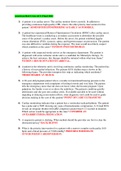
Membranes are critical for cell functions, such as cellularcommunication, transport, growth, and motility
A cell membrane consists of a lipid bilayer packed withphospholipids and embedded with protein
Membrane proteins have diverse functions, such as transporters, anchors, receptors, and enzymes
, membrane proteins can be transmembrane, monolayer-associated, lipid-attached or protein-attached
Solutes cross cell membrane by passive diffusion or active transport by channels, transporters, and pumps
3 types of pumps mediate active transport: gradient-driven, ATP-driven, and light-driven pumps
channels, transformers, and pumps undergo changes in conformations between closed and open
Different types of gated ion channels respond to voltage, ligand, and mechanical
different types of stimuli such as
internal membranes create enclosed compartments in eukaryotic cells that form organelles
Signal sequences direct the transport of proteins to the correct destinations in the cell
the nuclear pore complex forms a gate for selective transport energized by GTP hydrolysis
Many proteins are glycosylated in the ER and misfolded unfolded protein response (UPR)
proteins trigger an
Vesicular transport allows materials to exit and enter the exocytosis and endocytosis
cell by
The regulated and constitutive pathways of exocytosis trans Golgi apparatus
diverge in the
Rab proteins, tethering proteins, and SNAREs proteins direct transport vesicles to target membranes
One can study intracellular transport by signal sequence labeling, GFP tagging or temperature-sensitive mutants
Animal cells use extracellular signal molecules to communicate with each other
Signal molecules are communicated by endocrine, paracrine, neuronal, and contact-dependent ways
Leave the first rating
Save Groups
Students also studied
Flashcard sets Study guides
Neuroscience Final Exam Orgo 1: Functional groups pKa values Cogniti
161 terms 18 terms 13 terms 184 term
allie_0511 Preview allie_0511 Preview allie_0511 Preview allie
Practice questions for this set
Learn 1 /7 Study with Learn
Many proteins are glycosylated in the ER and misfolded proteins trigger an
Choose an answer
1 stop-transfer anchor sequence (sta) 2 nuclear localization signal (nls)
3 unfolded protein response (UPR) 4 signal recognition particle (srp)
Don't know?
Terms in this set (58) Hide definitions
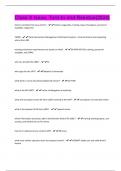
Membranes are critical for cell functions, such as cellularcommunication, transport, growth, and motility
A cell membrane consists of a lipid bilayer packed withphospholipids and embedded with protein
Membrane proteins have diverse functions, such as transporters, anchors, receptors, and enzymes
, membrane proteins can be transmembrane, monolayer-associated, lipid-attached or protein-attached
Solutes cross cell membrane by passive diffusion or active transport by channels, transporters, and pumps
3 types of pumps mediate active transport: gradient-driven, ATP-driven, and light-driven pumps
channels, transformers, and pumps undergo changes in conformations between closed and open
Different types of gated ion channels respond to voltage, ligand, and mechanical
different types of stimuli such as
internal membranes create enclosed compartments in eukaryotic cells that form organelles
Signal sequences direct the transport of proteins to the correct destinations in the cell
the nuclear pore complex forms a gate for selective transport energized by GTP hydrolysis
Many proteins are glycosylated in the ER and misfolded unfolded protein response (UPR)
proteins trigger an
Vesicular transport allows materials to exit and enter the exocytosis and endocytosis
cell by
The regulated and constitutive pathways of exocytosis trans Golgi apparatus
diverge in the
Rab proteins, tethering proteins, and SNAREs proteins direct transport vesicles to target membranes
One can study intracellular transport by signal sequence labeling, GFP tagging or temperature-sensitive mutants
Animal cells use extracellular signal molecules to communicate with each other
Signal molecules are communicated by endocrine, paracrine, neuronal, and contact-dependent ways