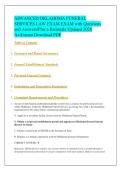
AN ADVANCED [BUSINESS LAW] EXAM WITH
QUESTIONS AND ANSWERS/PLUS A RATIONALE
UPDATED 2026 A+/INSTANT DOWNLOAD PDF
Table of Contents
1. Contract Law: Formation, Performance, and Breach
2. Agency and Employment Law
3. Corporate Governance and Business Organizations
4. Uniform Commercial Code (UCC) Sales and Leases
5. Intellectual Property and Cyber Law
6. Torts, Strict Liability, and Product Liability
7. Ethics, Social Responsibility, and Regulatory Compliance
1. A buyer sends a purchase order for goods, including a clause requiring arbitration for disputes.
The seller sends an acknowledgment form that includes a clause stating that all disputes must be
resolved in court. Under UCC Section 2-207, what is the legal status of the arbitration clause?
A. It is automatically included because it is a material term.
B. It is excluded because the terms conflict and the seller's acceptance was conditional.
C. It is included because the buyer did not object within 10 days.
D. It is excluded because the seller’s form constitutes a counteroffer that the buyer must sign.
, CORRECT ANSWER : B
Rationale: Under UCC 2-207, when terms conflict, they are often referred to as "knock-out"
terms, and the court will supply a gap-filler. Furthermore, because the seller's form expressly
made acceptance conditional on assent to the additional or different terms, it acts as a
counteroffer rather than an acceptance, precluding the inclusion of the buyer's arbitration
clause.
2. A CEO of a corporation authorizes a high-risk venture that results in a significant financial loss.
Shareholders sue the CEO, alleging a breach of the duty of care. Which defense is most likely to
protect the CEO?
A. The Ultra Vires Doctrine.
B. The Business Judgment Rule.
C. The Duty of Loyalty.
D. The Corporate Veil Doctrine.
CORRECT ANSWER : B
Rationale: The Business Judgment Rule protects directors and officers from liability for bad
business decisions as long as they acted on an informed basis, in good faith, and in the honest
belief that the action was in the best interest of the company. A, C, and D are inapplicable; the
duty of loyalty concerns conflicts of interest, not errors in judgment.
3. An employer fires an employee for refusing to engage in illegal price-fixing activities directed by
the manager. The employee sues for wrongful discharge. Which legal principle provides the
strongest basis for the employee’s claim?
A. At-will employment doctrine.
B. Public policy exception to at-will employment.
C. Implied covenant of good faith and fair dealing.
D. The Fair Labor Standards Act.
CORRECT ANSWER : B
Rationale: While at-will employment generally allows termination for any reason, the public
policy exception prevents termination for reasons that violate fundamental societal interests,
such as refusing to commit a crime. A is incorrect because it is the general rule, not the
exception; C is a limited theory not recognized in all jurisdictions; D regulates wages and hours,
not wrongful termination.
,4. A company representative orally promises a supplier a three-year exclusive contract, but the
parties never reduce it to writing. When the company switches to a cheaper supplier after six
months, the original supplier sues. What is the most significant hurdle for the plaintiff?
A. The Parol Evidence Rule.
B. The Statute of Frauds.
C. Consideration doctrine.
D. Promissory Estoppel.
CORRECT ANSWER : B
Rationale: Under the Statute of Frauds, contracts that cannot be performed within one year must
be in writing to be enforceable. A is incorrect because the Parol Evidence Rule applies to written
contracts; C and D are secondary to the primary procedural bar created by the lack of a written
instrument for a multi-year agreement.
5. A partner in a general partnership enters into a contract for the purchase of expensive machinery
without consulting the other partners. Is the partnership bound by this contract?
A. No, unless the machinery was necessary for the daily operations.
B. Yes, because each partner has the implied authority to bind the partnership in the
ordinary course of business.
C. No, because acts exceeding $5,000 require unanimous partner consent.
D. Yes, but only if the third party verified the partnership agreement.
CORRECT ANSWER : B
Rationale: In a general partnership, each partner is an agent of the partnership and has the
authority to bind the partnership to contracts made in the ordinary course of business. A and C
are incorrect because they impose limitations not present in general partnership statutes, and D
is incorrect as third parties are generally not required to inspect private partnership agreements.
6. A firm discovers that a competitor has launched a product with a name nearly identical to its
own, potentially creating consumer confusion. What is the firm's best legal strategy under the
Lanham Act?
A. File for a patent infringement injunction.
B. File for a trademark infringement suit.
, C. Initiate a copyright claim for trade dress.
D. Sue for breach of fiduciary duty.
CORRECT ANSWER : B
Rationale: The Lanham Act provides the framework for trademark protection and allows
companies to sue for trademark infringement when a competitor creates a likelihood of
confusion. A is incorrect as trademarks, not patents, protect branding; C is incorrect because
trade dress is a specific category, and B is the broader, more accurate remedy; D is irrelevant to
competitor disputes.
7. A customer is injured by a defective power tool. The tool had a warning label, but the defect was
a manufacturing error that the company failed to detect during quality control. Under strict
product liability, what must the plaintiff prove?
A. That the company was negligent in its manufacturing process.
B. That the product was defective and unreasonably dangerous, causing the injury.
C. That the consumer used the product exactly as described in the manual.
D. That there was a contractual privity between the consumer and the manufacturer.
CORRECT ANSWER : B
Rationale: Strict product liability focuses on the condition of the product rather than the conduct
of the manufacturer; therefore, negligence does not need to be proven. A is incorrect because
negligence is not required; C is not a strict requirement for liability; D is incorrect because
privity is not required in product liability cases.
8. An LLC member wishes to transfer their ownership interest to a third party. The operating
agreement is silent on transfers. What is the default rule under most state LLC statutes?
A. The member can transfer full membership rights without restriction.
B. The member can transfer only the right to receive distributions, not voting rights.
C. The member must dissolve the LLC before transferring the interest.
D. The transfer is void unless all other members consent.
CORRECT ANSWER : B
Rationale: Default rules for LLCs generally allow the assignment of financial interests (the right
to profits) while restricting the assignment of governance rights (voting) to prevent the
QUESTIONS AND ANSWERS/PLUS A RATIONALE
UPDATED 2026 A+/INSTANT DOWNLOAD PDF
Table of Contents
1. Contract Law: Formation, Performance, and Breach
2. Agency and Employment Law
3. Corporate Governance and Business Organizations
4. Uniform Commercial Code (UCC) Sales and Leases
5. Intellectual Property and Cyber Law
6. Torts, Strict Liability, and Product Liability
7. Ethics, Social Responsibility, and Regulatory Compliance
1. A buyer sends a purchase order for goods, including a clause requiring arbitration for disputes.
The seller sends an acknowledgment form that includes a clause stating that all disputes must be
resolved in court. Under UCC Section 2-207, what is the legal status of the arbitration clause?
A. It is automatically included because it is a material term.
B. It is excluded because the terms conflict and the seller's acceptance was conditional.
C. It is included because the buyer did not object within 10 days.
D. It is excluded because the seller’s form constitutes a counteroffer that the buyer must sign.
, CORRECT ANSWER : B
Rationale: Under UCC 2-207, when terms conflict, they are often referred to as "knock-out"
terms, and the court will supply a gap-filler. Furthermore, because the seller's form expressly
made acceptance conditional on assent to the additional or different terms, it acts as a
counteroffer rather than an acceptance, precluding the inclusion of the buyer's arbitration
clause.
2. A CEO of a corporation authorizes a high-risk venture that results in a significant financial loss.
Shareholders sue the CEO, alleging a breach of the duty of care. Which defense is most likely to
protect the CEO?
A. The Ultra Vires Doctrine.
B. The Business Judgment Rule.
C. The Duty of Loyalty.
D. The Corporate Veil Doctrine.
CORRECT ANSWER : B
Rationale: The Business Judgment Rule protects directors and officers from liability for bad
business decisions as long as they acted on an informed basis, in good faith, and in the honest
belief that the action was in the best interest of the company. A, C, and D are inapplicable; the
duty of loyalty concerns conflicts of interest, not errors in judgment.
3. An employer fires an employee for refusing to engage in illegal price-fixing activities directed by
the manager. The employee sues for wrongful discharge. Which legal principle provides the
strongest basis for the employee’s claim?
A. At-will employment doctrine.
B. Public policy exception to at-will employment.
C. Implied covenant of good faith and fair dealing.
D. The Fair Labor Standards Act.
CORRECT ANSWER : B
Rationale: While at-will employment generally allows termination for any reason, the public
policy exception prevents termination for reasons that violate fundamental societal interests,
such as refusing to commit a crime. A is incorrect because it is the general rule, not the
exception; C is a limited theory not recognized in all jurisdictions; D regulates wages and hours,
not wrongful termination.
,4. A company representative orally promises a supplier a three-year exclusive contract, but the
parties never reduce it to writing. When the company switches to a cheaper supplier after six
months, the original supplier sues. What is the most significant hurdle for the plaintiff?
A. The Parol Evidence Rule.
B. The Statute of Frauds.
C. Consideration doctrine.
D. Promissory Estoppel.
CORRECT ANSWER : B
Rationale: Under the Statute of Frauds, contracts that cannot be performed within one year must
be in writing to be enforceable. A is incorrect because the Parol Evidence Rule applies to written
contracts; C and D are secondary to the primary procedural bar created by the lack of a written
instrument for a multi-year agreement.
5. A partner in a general partnership enters into a contract for the purchase of expensive machinery
without consulting the other partners. Is the partnership bound by this contract?
A. No, unless the machinery was necessary for the daily operations.
B. Yes, because each partner has the implied authority to bind the partnership in the
ordinary course of business.
C. No, because acts exceeding $5,000 require unanimous partner consent.
D. Yes, but only if the third party verified the partnership agreement.
CORRECT ANSWER : B
Rationale: In a general partnership, each partner is an agent of the partnership and has the
authority to bind the partnership to contracts made in the ordinary course of business. A and C
are incorrect because they impose limitations not present in general partnership statutes, and D
is incorrect as third parties are generally not required to inspect private partnership agreements.
6. A firm discovers that a competitor has launched a product with a name nearly identical to its
own, potentially creating consumer confusion. What is the firm's best legal strategy under the
Lanham Act?
A. File for a patent infringement injunction.
B. File for a trademark infringement suit.
, C. Initiate a copyright claim for trade dress.
D. Sue for breach of fiduciary duty.
CORRECT ANSWER : B
Rationale: The Lanham Act provides the framework for trademark protection and allows
companies to sue for trademark infringement when a competitor creates a likelihood of
confusion. A is incorrect as trademarks, not patents, protect branding; C is incorrect because
trade dress is a specific category, and B is the broader, more accurate remedy; D is irrelevant to
competitor disputes.
7. A customer is injured by a defective power tool. The tool had a warning label, but the defect was
a manufacturing error that the company failed to detect during quality control. Under strict
product liability, what must the plaintiff prove?
A. That the company was negligent in its manufacturing process.
B. That the product was defective and unreasonably dangerous, causing the injury.
C. That the consumer used the product exactly as described in the manual.
D. That there was a contractual privity between the consumer and the manufacturer.
CORRECT ANSWER : B
Rationale: Strict product liability focuses on the condition of the product rather than the conduct
of the manufacturer; therefore, negligence does not need to be proven. A is incorrect because
negligence is not required; C is not a strict requirement for liability; D is incorrect because
privity is not required in product liability cases.
8. An LLC member wishes to transfer their ownership interest to a third party. The operating
agreement is silent on transfers. What is the default rule under most state LLC statutes?
A. The member can transfer full membership rights without restriction.
B. The member can transfer only the right to receive distributions, not voting rights.
C. The member must dissolve the LLC before transferring the interest.
D. The transfer is void unless all other members consent.
CORRECT ANSWER : B
Rationale: Default rules for LLCs generally allow the assignment of financial interests (the right
to profits) while restricting the assignment of governance rights (voting) to prevent the