
Illinois EMS Protocols S-Tier
Test Bank
PART 0: THE NAVIGATOR
*(#part-i-the-preview) *(#part-ii-the-elite-test-bank)
*(#tier-1-foundational-syntax--application-questions-110)
*(#tier-2-complex-application--simulation-questions-1120)
*(#tier-3-grandmaster-synthesis-questions-2130)
PART I: THE PREVIEW
Mastering the Region 11 Chicago EMS protocols and the 2026/2027 Illinois statutory mandates
translates directly to elite clinical execution in high-stakes environments, transforming standard
pre-hospital practitioners into critical-thinking medical authorities. By internalizing these rigorous
standards, practitioners guarantee superior patient outcomes and absolute statutory compliance
regardless of the operational chaos.
The "Critical Axioms" Cheat Sheet
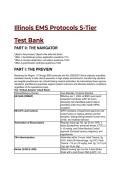
Clinical/Statutory Domain Core Mandate / Protocol Directive
HB 3645 (ODMAP) Effective Jan 1, 2026, all EMS must report
suspected overdoses within 24 hours.
Absolutely NO identifiable patient data is
permitted under this public health HIPAA
exception.
HB 4477 (Just Culture) IDPH mandates a Department-approved Just
Culture policy to replace arbitrary punitive
discipline, distinguishing between human error,
at-risk, and reckless behavior.
Termination of Resuscitation Requires Adult (\ge 18), \ge 20 min CPR, 3
doses Epinephrine, advanced airway, ETCO_2
< 10 mmHg, and Online Medical Control
approval. Excludes trauma, pregnancy, and
hypothermia.
TXA Administration Administer within 3 hours. Adult Trauma: 2g
IV/IO. Adult OB Hemorrhage: 1g IV/IO. Peds
Trauma: <12 yrs (15 mg/kg, max 1g), 12-15 yrs
(1g), \ge 16 yrs (2g).
Stroke (3I-SS & LKW) Patients scoring \ge 4 on the 3-Item Stroke
Scale with a Last Known Well (LKW) < 24
,Clinical/Statutory Domain Core Mandate / Protocol Directive
hours MUST bypass to a Thrombectomy (TSC)
or Comprehensive Stroke Center (CSC).
Behavioral (CESSA) Mental health crises require de-escalation.
Chemical restraint (Midazolam 2mg IV / 5mg
IN/IM) is strictly reserved for patients posing
immediate physical danger, never for
cooperative patients.
PART II: THE ELITE TEST BANK
Tier 1: Foundational Syntax & Application (Questions 1–10)
Q1: A paramedic evaluates a 42-year-old male who has been revived from a suspected heroin
overdose using 2 mg of intranasal naloxone. The patient is now alert and legally refuses
transport. Under the provisions of Illinois HB 3645 (effective January 1, 2026), which action
regarding documentation and reporting is the MOST ACCURATE? A) The event must be
reported to the Overdose Detection Mapping Application Program (ODMAP) within 72 hours,
including the patient’s full name and date of birth for tracking. B) The event must be reported to
ODMAP within 24 hours, strictly prohibiting the inclusion of any identifiable patient data. C) The
event is exempt from ODMAP reporting because the patient refused transport, meaning a
formal hospital transfer of care did not occur. D) The event must be reported directly to the
Chicago Police Department within 24 hours to initiate a behavioral health CESSA response.
● The Answer: B (The event must be reported to ODMAP within 24 hours, strictly
prohibiting the inclusion of any identifiable patient data.)
● Distractor Analysis:
○ A is incorrect: HB 3645 mandates a 24-hour reporting window, not 72 hours, and
strictly forbids identifiable data to protect civil liberties.
○ C is incorrect: The statute requires reporting of all suspected overdose events
encountered by EMS, regardless of the patient's transport status or refusal of care.
○ D is incorrect: ODMAP is a public health surveillance tool utilized for mapping
spikes and clusters under HIPAA exceptions; it is not a law enforcement dispatch
protocol or related to CESSA.
The Mentor's Analysis: Statutory compliance in the modern EMS ecosystem demands
balancing aggressive public health surveillance with strict patient privacy. When facing
suspected opioid overdoses, the immediate priority is submitting de-identified epidemiological
data to track community spikes. By utilizing HIPAA-exempt public health reporting, the
practitioner bypasses the common trap of either breaching confidentiality or failing to report
non-transports. Professional/Academic Intuition: The metal's arrival on scene triggers the
ODMAP mandate; the patient's refusal of transport does not cancel the state's requirement to
track the poison.
Q2: During a complex multi-casualty extrication, an Advanced Care Paramedic inadvertently
administers 1 gram of Tranexamic Acid (TXA) instead of the protocol-mandated 2 grams to a
35-year-old male with massive blunt trauma. The paramedic immediately realizes the calculation
error, administers the remaining 1 gram, and self-reports the incident. Under the Illinois EMS
Systems Act amended by HB 4477, how MUST the EMS Medical Director evaluate this event?
A) By utilizing the Department-approved Just Culture policy to evaluate the human error prior to
applying any EMS System discipline or suspension. B) By immediately suspending the
, paramedic's physical license for 30 days due to a critical pharmacological dosage deviation. C)
By referring the paramedic to the State Medical Board for a mandatory peer-review hearing
regarding reckless clinical behavior. D) By issuing a standard written warning, as the Just
Culture Matrix inherently prohibits formal discipline for self-reported medication errors.
● The Answer: A (By utilizing the Department-approved Just Culture policy to evaluate the
human error prior to applying any EMS System discipline or suspension.)
● Distractor Analysis:
○ B is incorrect: HB 4477 specifically targets the elimination of automatic,
zero-tolerance punitive suspensions for genuine human error, mandating the Just
Culture framework instead.
○ C is incorrect: The local EMS System review board handles these evaluations
utilizing the matrix; the State Medical Board does not conduct immediate
peer-review for pre-hospital calculation slips.
○ D is incorrect: The Just Culture Matrix does not grant absolute immunity; it
differentiates between human error, at-risk behavior, and reckless behavior,
allowing for appropriate remediation, system redesign, or discipline.
The Mentor's Analysis: The evolution of clinical governance, heavily derived from aviation
safety protocols, views errors through a systems-based lens rather than immediate punitive
action. When facing a self-reported protocol deviation, the immediate priority is categorizing the
behavioral choice that led to the error. By utilizing the Just Culture framework, the system
bypasses the common trap of driving errors underground due to fear of arbitrary termination.
Professional/Academic Intuition: Just Culture protects the honest mistake to promote
transparency and system redesign, but it never shields reckless negligence.
Q3: A 28-year-old female presents with massive postpartum hemorrhage following an
out-of-hospital birth. She exhibits clinical signs of hypovolemic shock (heart rate 130 bpm, blood
pressure 80/50 mmHg). The estimated time of symptom onset is 45 minutes prior to EMS
arrival. Based on the Region 11 Chicago EMS Medication Table, which pharmacological
intervention is the MOST APPROPRIATE? A) Administer Tranexamic Acid 2 grams IV/IO push.
B) Administer Tranexamic Acid 1 gram IV/IO push. C) Administer a 500 mL Normal Saline bolus
and withhold Tranexamic Acid, as it is strictly contraindicated in all obstetric patients. D)
Administer Tranexamic Acid 15 mg/kg IV/IO push to prevent systemic toxicity.
● The Answer: B (Administer Tranexamic Acid 1 gram IV/IO push.)
● Distractor Analysis:
○ A is incorrect: The 2-gram dose is specifically indicated for adult trauma (blunt or
penetrating), not obstetric hemorrhage.
○ C is incorrect: TXA is explicitly indicated and safe for obstetric hemorrhage with
signs of shock in Region 11 protocols; withholding it allows hyperfibrinolysis to
proceed unchecked.
○ D is incorrect: 15 mg/kg is the weight-based pediatric trauma dose for patients
under 12 years of age, entirely inappropriate for a 28-year-old adult.
The Mentor's Analysis: Hemorrhage control requires precise pharmacological dosing
dependent entirely on the etiology of the bleeding. When facing obstetric hemorrhage, the
immediate priority is fibrinolysis inhibition (displacing plasminogen from fibrin) without causing
secondary hypercoagulable complications. By utilizing the 1-gram obstetric dose, the
practitioner bypasses the common trap of defaulting to the heavy 2-gram trauma bolus.
Professional/Academic Intuition: In the Region 11 TXA protocol, traumatic destruction takes
two grams, but obstetric hemorrhage takes one.
Q4: A 65-year-old male is in cardiac arrest. The cardiac monitor shows Asystole in two distinct
Test Bank
PART 0: THE NAVIGATOR
*(#part-i-the-preview) *(#part-ii-the-elite-test-bank)
*(#tier-1-foundational-syntax--application-questions-110)
*(#tier-2-complex-application--simulation-questions-1120)
*(#tier-3-grandmaster-synthesis-questions-2130)
PART I: THE PREVIEW
Mastering the Region 11 Chicago EMS protocols and the 2026/2027 Illinois statutory mandates
translates directly to elite clinical execution in high-stakes environments, transforming standard
pre-hospital practitioners into critical-thinking medical authorities. By internalizing these rigorous
standards, practitioners guarantee superior patient outcomes and absolute statutory compliance
regardless of the operational chaos.
The "Critical Axioms" Cheat Sheet
Clinical/Statutory Domain Core Mandate / Protocol Directive
HB 3645 (ODMAP) Effective Jan 1, 2026, all EMS must report
suspected overdoses within 24 hours.
Absolutely NO identifiable patient data is
permitted under this public health HIPAA
exception.
HB 4477 (Just Culture) IDPH mandates a Department-approved Just
Culture policy to replace arbitrary punitive
discipline, distinguishing between human error,
at-risk, and reckless behavior.
Termination of Resuscitation Requires Adult (\ge 18), \ge 20 min CPR, 3
doses Epinephrine, advanced airway, ETCO_2
< 10 mmHg, and Online Medical Control
approval. Excludes trauma, pregnancy, and
hypothermia.
TXA Administration Administer within 3 hours. Adult Trauma: 2g
IV/IO. Adult OB Hemorrhage: 1g IV/IO. Peds
Trauma: <12 yrs (15 mg/kg, max 1g), 12-15 yrs
(1g), \ge 16 yrs (2g).
Stroke (3I-SS & LKW) Patients scoring \ge 4 on the 3-Item Stroke
Scale with a Last Known Well (LKW) < 24
,Clinical/Statutory Domain Core Mandate / Protocol Directive
hours MUST bypass to a Thrombectomy (TSC)
or Comprehensive Stroke Center (CSC).
Behavioral (CESSA) Mental health crises require de-escalation.
Chemical restraint (Midazolam 2mg IV / 5mg
IN/IM) is strictly reserved for patients posing
immediate physical danger, never for
cooperative patients.
PART II: THE ELITE TEST BANK
Tier 1: Foundational Syntax & Application (Questions 1–10)
Q1: A paramedic evaluates a 42-year-old male who has been revived from a suspected heroin
overdose using 2 mg of intranasal naloxone. The patient is now alert and legally refuses
transport. Under the provisions of Illinois HB 3645 (effective January 1, 2026), which action
regarding documentation and reporting is the MOST ACCURATE? A) The event must be
reported to the Overdose Detection Mapping Application Program (ODMAP) within 72 hours,
including the patient’s full name and date of birth for tracking. B) The event must be reported to
ODMAP within 24 hours, strictly prohibiting the inclusion of any identifiable patient data. C) The
event is exempt from ODMAP reporting because the patient refused transport, meaning a
formal hospital transfer of care did not occur. D) The event must be reported directly to the
Chicago Police Department within 24 hours to initiate a behavioral health CESSA response.
● The Answer: B (The event must be reported to ODMAP within 24 hours, strictly
prohibiting the inclusion of any identifiable patient data.)
● Distractor Analysis:
○ A is incorrect: HB 3645 mandates a 24-hour reporting window, not 72 hours, and
strictly forbids identifiable data to protect civil liberties.
○ C is incorrect: The statute requires reporting of all suspected overdose events
encountered by EMS, regardless of the patient's transport status or refusal of care.
○ D is incorrect: ODMAP is a public health surveillance tool utilized for mapping
spikes and clusters under HIPAA exceptions; it is not a law enforcement dispatch
protocol or related to CESSA.
The Mentor's Analysis: Statutory compliance in the modern EMS ecosystem demands
balancing aggressive public health surveillance with strict patient privacy. When facing
suspected opioid overdoses, the immediate priority is submitting de-identified epidemiological
data to track community spikes. By utilizing HIPAA-exempt public health reporting, the
practitioner bypasses the common trap of either breaching confidentiality or failing to report
non-transports. Professional/Academic Intuition: The metal's arrival on scene triggers the
ODMAP mandate; the patient's refusal of transport does not cancel the state's requirement to
track the poison.
Q2: During a complex multi-casualty extrication, an Advanced Care Paramedic inadvertently
administers 1 gram of Tranexamic Acid (TXA) instead of the protocol-mandated 2 grams to a
35-year-old male with massive blunt trauma. The paramedic immediately realizes the calculation
error, administers the remaining 1 gram, and self-reports the incident. Under the Illinois EMS
Systems Act amended by HB 4477, how MUST the EMS Medical Director evaluate this event?
A) By utilizing the Department-approved Just Culture policy to evaluate the human error prior to
applying any EMS System discipline or suspension. B) By immediately suspending the
, paramedic's physical license for 30 days due to a critical pharmacological dosage deviation. C)
By referring the paramedic to the State Medical Board for a mandatory peer-review hearing
regarding reckless clinical behavior. D) By issuing a standard written warning, as the Just
Culture Matrix inherently prohibits formal discipline for self-reported medication errors.
● The Answer: A (By utilizing the Department-approved Just Culture policy to evaluate the
human error prior to applying any EMS System discipline or suspension.)
● Distractor Analysis:
○ B is incorrect: HB 4477 specifically targets the elimination of automatic,
zero-tolerance punitive suspensions for genuine human error, mandating the Just
Culture framework instead.
○ C is incorrect: The local EMS System review board handles these evaluations
utilizing the matrix; the State Medical Board does not conduct immediate
peer-review for pre-hospital calculation slips.
○ D is incorrect: The Just Culture Matrix does not grant absolute immunity; it
differentiates between human error, at-risk behavior, and reckless behavior,
allowing for appropriate remediation, system redesign, or discipline.
The Mentor's Analysis: The evolution of clinical governance, heavily derived from aviation
safety protocols, views errors through a systems-based lens rather than immediate punitive
action. When facing a self-reported protocol deviation, the immediate priority is categorizing the
behavioral choice that led to the error. By utilizing the Just Culture framework, the system
bypasses the common trap of driving errors underground due to fear of arbitrary termination.
Professional/Academic Intuition: Just Culture protects the honest mistake to promote
transparency and system redesign, but it never shields reckless negligence.
Q3: A 28-year-old female presents with massive postpartum hemorrhage following an
out-of-hospital birth. She exhibits clinical signs of hypovolemic shock (heart rate 130 bpm, blood
pressure 80/50 mmHg). The estimated time of symptom onset is 45 minutes prior to EMS
arrival. Based on the Region 11 Chicago EMS Medication Table, which pharmacological
intervention is the MOST APPROPRIATE? A) Administer Tranexamic Acid 2 grams IV/IO push.
B) Administer Tranexamic Acid 1 gram IV/IO push. C) Administer a 500 mL Normal Saline bolus
and withhold Tranexamic Acid, as it is strictly contraindicated in all obstetric patients. D)
Administer Tranexamic Acid 15 mg/kg IV/IO push to prevent systemic toxicity.
● The Answer: B (Administer Tranexamic Acid 1 gram IV/IO push.)
● Distractor Analysis:
○ A is incorrect: The 2-gram dose is specifically indicated for adult trauma (blunt or
penetrating), not obstetric hemorrhage.
○ C is incorrect: TXA is explicitly indicated and safe for obstetric hemorrhage with
signs of shock in Region 11 protocols; withholding it allows hyperfibrinolysis to
proceed unchecked.
○ D is incorrect: 15 mg/kg is the weight-based pediatric trauma dose for patients
under 12 years of age, entirely inappropriate for a 28-year-old adult.
The Mentor's Analysis: Hemorrhage control requires precise pharmacological dosing
dependent entirely on the etiology of the bleeding. When facing obstetric hemorrhage, the
immediate priority is fibrinolysis inhibition (displacing plasminogen from fibrin) without causing
secondary hypercoagulable complications. By utilizing the 1-gram obstetric dose, the
practitioner bypasses the common trap of defaulting to the heavy 2-gram trauma bolus.
Professional/Academic Intuition: In the Region 11 TXA protocol, traumatic destruction takes
two grams, but obstetric hemorrhage takes one.
Q4: A 65-year-old male is in cardiac arrest. The cardiac monitor shows Asystole in two distinct


