

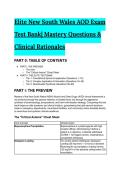
Elite New South Wales AOD Exam
Test Bank| Mastery Questions &
Clinical Rationales
PART 0: TABLE OF CONTENTS
● PART I: THE PREVIEW
○ The Intro
○ The "Critical Axioms" Cheat Sheet
● PART II: THE ELITE TEST BANK
○ Tier 1: Foundational Syntax & Application (Questions 1–15)
○ Tier 2: Complex Application & Simulation (Questions 16–35)
○ Tier 3: Grandmaster Synthesis (Questions 36–60)
PART I: THE PREVIEW
Mastery of the New South Wales (NSW) Alcohol and Other Drugs (AOD) clinical frameworks is
not achieved through the passive retention of isolated facts, but through the aggressive
synthesis of pharmacology, jurisprudence, and harm-minimization strategy. Conquering this test
bank forges an elite academic and clinical intuition, guaranteeing that split-second decisions
made in emergency departments, correctional facilities, and community clinics translate directly
to saved lives and systemic clinical excellence.
The "Critical Axioms" Cheat Sheet
Core Concept Clinical Axiom
Buprenorphine Precipitation Buprenorphine is a partial agonist with high
receptor affinity. Administering it before a
patient is in objective, moderate withdrawal
(COWS > 12) triggers severe, instantaneous
precipitated withdrawal.
Diazepam Loading For severe alcohol withdrawal, Diazepam
Loading (20 mg every 1–2 hours) is standard.
Reaching 80 mg mandates a medical review.
120 mg/24 hr is the absolute ceiling before ICU
consultation.
,Core Concept Clinical Axiom
Thiamine-Glucose Sequence Intravenous/intramuscular thiamine must
ALWAYS precede glucose administration in
dependent patients to prevent rapid
precipitation of irreversible Wernicke's
encephalopathy.
LAIB Initiation Buvidal can be initiated directly from
short-acting opioids. Sublocade strictly requires
a minimum 7-day induction phase on sublingual
buprenorphine.
MERIT Eligibility The Magistrates Early Referral Into Treatment
program is a pre-plea diversionary framework.
It is absolutely contraindicated for defendants
facing sexual assault or strictly indictable
matters.
Takeaway Ceilings Stable methadone patients may receive a
maximum of 4 takeaways per week. Suboxone
patients may receive up to 6 due to partial
agonist safety and naloxone diversion
deterrence.
PART II: THE ELITE TEST BANK
Tier 1: Foundational Syntax & Application (Questions 1–15)
Q1: A 42-year-old alcohol-dependent patient presents to the emergency department
malnourished and hypoglycemic. Based on the principles of acute alcohol withdrawal
management, which action is the FIRST priority? A) Administer a rapid 50% dextrose
intravenous bolus to correct hypoglycemia. B) Initiate a symptom-triggered diazepam regimen
based on the CIWA-Ar scale. C) Administer intramuscular or intravenous thiamine prior to any
glucose infusion. D) Administer oral diazepam 20 mg immediately to prevent withdrawal
seizures.
● The Answer: C (Administer intramuscular or intravenous thiamine prior to any glucose
infusion.)
● Distractor Analysis:
○ A is incorrect: Administering glucose before thiamine depletes remaining thiamine
reserves, instantly precipitating Wernicke's encephalopathy.
○ B is incorrect: While treating withdrawal is critical, preventing irreversible brain
damage from Wernicke's takes immediate physiological precedence.
○ D is incorrect: Diazepam loading is required for seizure history, but it does not
supersede the metabolic imperative of the thiamine-glucose sequence.
The Mentor's Analysis: Nutritional deficits in chronic alcohol dependence severely
compromise thiamine levels. When facing concurrent hypoglycemia and withdrawal, the
immediate priority is protecting the central nervous system from permanent damage. By utilizing
the thiamine-glucose sequence, you bypass the common trap of precipitating Wernicke's
encephalopathy. Professional/Academic Intuition: Thiamine always precedes glucose;
failing this rule guarantees catastrophic neurological harm.
Q2: A patient seeking to transition from heroin to opioid agonist treatment (OAT) arrives at the
,clinic. They last used heroin 4 hours ago and show no signs of withdrawal. Based on the
pharmacodynamics of buprenorphine, what is the MOST ACCURATE clinical action? A)
Administer a 2 mg sublingual buprenorphine test dose immediately to gauge tolerance. B) Delay
buprenorphine induction until the patient exhibits objective signs of moderate withdrawal
(COWS > 12). C) Initiate a diazepam loading dose to sedate the patient during the 24-hour
waiting period. D) Administer intramuscular naloxone to clear the opioid receptors before
buprenorphine induction.
● The Answer: B (Delay buprenorphine induction until the patient exhibits objective signs
of moderate withdrawal (COWS > 12).)
● Distractor Analysis:
○ A is incorrect: Administering a partial agonist while full agonists occupy the
receptors will immediately strip them, causing precipitated withdrawal.
○ C is incorrect: Diazepam is a CNS depressant not indicated as a primary bridging
agent for routine buprenorphine inductions.
○ D is incorrect: Administering naloxone will maliciously trigger severe, immediate
opioid withdrawal and violates ethical standards of care.
The Mentor's Analysis: Buprenorphine possesses a higher receptor affinity but lower intrinsic
activity than full agonists like heroin. When facing induction, the immediate priority is ensuring
receptor clearance of full agonists. By utilizing the COWS scale to verify withdrawal, you bypass
the common trap of iatrogenic precipitated withdrawal. Professional/Academic Intuition:
Never induce a partial agonist over a full agonist without objective evidence of moderate
withdrawal.
Q3: During inpatient alcohol withdrawal management, a patient with a history of delirium
tremens is placed on a diazepam loading protocol. The patient has received 80 mg of diazepam
over 8 hours but remains highly agitated. Which action is the MOST APPROPRIATE next step?
A) Continue administering diazepam 20 mg every 2 hours until the patient is sedated. B)
Immediately switch to an antipsychotic such as olanzapine to control the agitation. C) Cease all
diazepam and transition to a symptom-triggered CIWA-Ar regimen. D) Withhold further
diazepam and mandate an immediate medical review to exclude other pathologies.
● The Answer: D (Withhold further diazepam and mandate an immediate medical review to
exclude other pathologies.)
● Distractor Analysis:
○ A is incorrect: 80 mg is the hard-deck clinical threshold for mandatory medical
assessment; continuing without review is a major safety violation.
○ B is incorrect: Antipsychotics lower the seizure threshold and are not first-line
agents without ruling out head injury or infection first.
○ C is incorrect: Transitioning to symptom-triggered dosing while the patient is highly
agitated and under-sedated will result in clinical deterioration.
The Mentor's Analysis: High-dose benzodiazepine administration requires strict physiological
monitoring to prevent respiratory depression. When facing refractory agitation after 80 mg of
diazepam, the immediate priority is diagnostic clarity. By utilizing a mandatory medical review,
you bypass the common trap of masking a subdural hematoma, sepsis, or hepatic
encephalopathy with continuous sedation. Professional/Academic Intuition: 80 mg of
diazepam is a definitive stop-and-assess threshold; agitation beyond this point strongly
suggests alternative pathology.
Q4: A patient is preparing to commence long-acting injectable buprenorphine (LAIB). The
prescriber has selected Sublocade. Based on NSW Health guidelines, what is an absolute
prerequisite for initiating this specific formulation? A) The patient must undergo a 7-day
, minimum induction on sublingual buprenorphine. B) The patient must be transferred directly
from a methadone dose of at least 60 mg. C) The patient must first receive a test dose of
Buvidal to confirm tolerability. D) The patient must remain in a supervised inpatient unit for the
first 28 days.
● The Answer: A (The patient must undergo a 7-day minimum induction on sublingual
buprenorphine.)
● Distractor Analysis:
○ B is incorrect: Sublocade requires sublingual buprenorphine stabilization; direct
transfer from high-dose methadone requires complex microdosing.
○ C is incorrect: Buvidal and Sublocade are different formulations; a Buvidal test dose
is not a pharmacological prerequisite for Sublocade.
○ D is incorrect: LAIB formulations are designed specifically to facilitate
community-based outpatient care, negating the need for inpatient holds.
The Mentor's Analysis: Sublocade utilizes a unique delivery system that results in slower initial
peak plasma concentrations compared to Buvidal. When facing a Sublocade initiation, the
immediate priority is establishing steady-state tolerance. By utilizing a 7-day sublingual
buprenorphine induction, you bypass the common trap of leaving the patient in a
sub-therapeutic, withdrawal-vulnerable state. Professional/Academic Intuition: Sublocade
demands a 7-day sublingual runway; Buvidal allows for direct induction.
Q5: The Magistrates Early Referral Into Treatment (MERIT) program serves to divert
defendants with substance use disorders into treatment. Which of the following charges
represents an absolute CONTRAINDICATION for MERIT eligibility? A) Possession of a
prohibited drug (Schedule 1). B) Shoplifting to fund a heroin dependency. C) Assault
occasioning actual bodily harm with a strictly indictable charge. D) Driving under the influence of
an illicit substance.
● The Answer: C (Assault occasioning actual bodily harm with a strictly indictable charge.)
● Distractor Analysis:
○ A is incorrect: Simple drug possession is the archetype of a MERIT-eligible offense.
○ B is incorrect: Minor property crime driven by dependency is the precise target
demographic for MERIT diversion.
○ D is incorrect: Driving offences, while serious, do not automatically exclude a
defendant from MERIT unless they cross into strictly indictable territories.
The Mentor's Analysis: MERIT is designed to address the root cause of minor,
dependency-driven criminality within the Local Court system. When facing program assessment,
the immediate priority is verifying jurisdictional and statutory eligibility. By utilizing the strictly
indictable exclusion rule, you bypass the common trap of misallocating pre-plea diversion
resources to severe, higher-court violent crimes. Professional/Academic Intuition: MERIT
jurisdiction ends where strictly indictable and sexual offences begin.
Q6: A 28-year-old pregnant patient presents for OAT induction. She is currently using
intravenous heroin daily. According to NSW clinical guidelines for substance use in pregnancy,
which pharmacological approach is MOST ACCURATE? A) Induce with Suboxone
(buprenorphine/naloxone) to prevent intravenous diversion. B) Induce with Subutex
(buprenorphine mono-product) as the preferred first-line buprenorphine agent. C) Require the
patient to undergo a rapid, 7-day inpatient detoxification to protect the fetus. D) Delay all OAT
induction until the second trimester to avoid teratogenic effects.
● The Answer: B (Induce with Subutex (buprenorphine mono-product) as the preferred
first-line buprenorphine agent.)
● Distractor Analysis:
Test Bank| Mastery Questions &
Clinical Rationales
PART 0: TABLE OF CONTENTS
● PART I: THE PREVIEW
○ The Intro
○ The "Critical Axioms" Cheat Sheet
● PART II: THE ELITE TEST BANK
○ Tier 1: Foundational Syntax & Application (Questions 1–15)
○ Tier 2: Complex Application & Simulation (Questions 16–35)
○ Tier 3: Grandmaster Synthesis (Questions 36–60)
PART I: THE PREVIEW
Mastery of the New South Wales (NSW) Alcohol and Other Drugs (AOD) clinical frameworks is
not achieved through the passive retention of isolated facts, but through the aggressive
synthesis of pharmacology, jurisprudence, and harm-minimization strategy. Conquering this test
bank forges an elite academic and clinical intuition, guaranteeing that split-second decisions
made in emergency departments, correctional facilities, and community clinics translate directly
to saved lives and systemic clinical excellence.
The "Critical Axioms" Cheat Sheet
Core Concept Clinical Axiom
Buprenorphine Precipitation Buprenorphine is a partial agonist with high
receptor affinity. Administering it before a
patient is in objective, moderate withdrawal
(COWS > 12) triggers severe, instantaneous
precipitated withdrawal.
Diazepam Loading For severe alcohol withdrawal, Diazepam
Loading (20 mg every 1–2 hours) is standard.
Reaching 80 mg mandates a medical review.
120 mg/24 hr is the absolute ceiling before ICU
consultation.
,Core Concept Clinical Axiom
Thiamine-Glucose Sequence Intravenous/intramuscular thiamine must
ALWAYS precede glucose administration in
dependent patients to prevent rapid
precipitation of irreversible Wernicke's
encephalopathy.
LAIB Initiation Buvidal can be initiated directly from
short-acting opioids. Sublocade strictly requires
a minimum 7-day induction phase on sublingual
buprenorphine.
MERIT Eligibility The Magistrates Early Referral Into Treatment
program is a pre-plea diversionary framework.
It is absolutely contraindicated for defendants
facing sexual assault or strictly indictable
matters.
Takeaway Ceilings Stable methadone patients may receive a
maximum of 4 takeaways per week. Suboxone
patients may receive up to 6 due to partial
agonist safety and naloxone diversion
deterrence.
PART II: THE ELITE TEST BANK
Tier 1: Foundational Syntax & Application (Questions 1–15)
Q1: A 42-year-old alcohol-dependent patient presents to the emergency department
malnourished and hypoglycemic. Based on the principles of acute alcohol withdrawal
management, which action is the FIRST priority? A) Administer a rapid 50% dextrose
intravenous bolus to correct hypoglycemia. B) Initiate a symptom-triggered diazepam regimen
based on the CIWA-Ar scale. C) Administer intramuscular or intravenous thiamine prior to any
glucose infusion. D) Administer oral diazepam 20 mg immediately to prevent withdrawal
seizures.
● The Answer: C (Administer intramuscular or intravenous thiamine prior to any glucose
infusion.)
● Distractor Analysis:
○ A is incorrect: Administering glucose before thiamine depletes remaining thiamine
reserves, instantly precipitating Wernicke's encephalopathy.
○ B is incorrect: While treating withdrawal is critical, preventing irreversible brain
damage from Wernicke's takes immediate physiological precedence.
○ D is incorrect: Diazepam loading is required for seizure history, but it does not
supersede the metabolic imperative of the thiamine-glucose sequence.
The Mentor's Analysis: Nutritional deficits in chronic alcohol dependence severely
compromise thiamine levels. When facing concurrent hypoglycemia and withdrawal, the
immediate priority is protecting the central nervous system from permanent damage. By utilizing
the thiamine-glucose sequence, you bypass the common trap of precipitating Wernicke's
encephalopathy. Professional/Academic Intuition: Thiamine always precedes glucose;
failing this rule guarantees catastrophic neurological harm.
Q2: A patient seeking to transition from heroin to opioid agonist treatment (OAT) arrives at the
,clinic. They last used heroin 4 hours ago and show no signs of withdrawal. Based on the
pharmacodynamics of buprenorphine, what is the MOST ACCURATE clinical action? A)
Administer a 2 mg sublingual buprenorphine test dose immediately to gauge tolerance. B) Delay
buprenorphine induction until the patient exhibits objective signs of moderate withdrawal
(COWS > 12). C) Initiate a diazepam loading dose to sedate the patient during the 24-hour
waiting period. D) Administer intramuscular naloxone to clear the opioid receptors before
buprenorphine induction.
● The Answer: B (Delay buprenorphine induction until the patient exhibits objective signs
of moderate withdrawal (COWS > 12).)
● Distractor Analysis:
○ A is incorrect: Administering a partial agonist while full agonists occupy the
receptors will immediately strip them, causing precipitated withdrawal.
○ C is incorrect: Diazepam is a CNS depressant not indicated as a primary bridging
agent for routine buprenorphine inductions.
○ D is incorrect: Administering naloxone will maliciously trigger severe, immediate
opioid withdrawal and violates ethical standards of care.
The Mentor's Analysis: Buprenorphine possesses a higher receptor affinity but lower intrinsic
activity than full agonists like heroin. When facing induction, the immediate priority is ensuring
receptor clearance of full agonists. By utilizing the COWS scale to verify withdrawal, you bypass
the common trap of iatrogenic precipitated withdrawal. Professional/Academic Intuition:
Never induce a partial agonist over a full agonist without objective evidence of moderate
withdrawal.
Q3: During inpatient alcohol withdrawal management, a patient with a history of delirium
tremens is placed on a diazepam loading protocol. The patient has received 80 mg of diazepam
over 8 hours but remains highly agitated. Which action is the MOST APPROPRIATE next step?
A) Continue administering diazepam 20 mg every 2 hours until the patient is sedated. B)
Immediately switch to an antipsychotic such as olanzapine to control the agitation. C) Cease all
diazepam and transition to a symptom-triggered CIWA-Ar regimen. D) Withhold further
diazepam and mandate an immediate medical review to exclude other pathologies.
● The Answer: D (Withhold further diazepam and mandate an immediate medical review to
exclude other pathologies.)
● Distractor Analysis:
○ A is incorrect: 80 mg is the hard-deck clinical threshold for mandatory medical
assessment; continuing without review is a major safety violation.
○ B is incorrect: Antipsychotics lower the seizure threshold and are not first-line
agents without ruling out head injury or infection first.
○ C is incorrect: Transitioning to symptom-triggered dosing while the patient is highly
agitated and under-sedated will result in clinical deterioration.
The Mentor's Analysis: High-dose benzodiazepine administration requires strict physiological
monitoring to prevent respiratory depression. When facing refractory agitation after 80 mg of
diazepam, the immediate priority is diagnostic clarity. By utilizing a mandatory medical review,
you bypass the common trap of masking a subdural hematoma, sepsis, or hepatic
encephalopathy with continuous sedation. Professional/Academic Intuition: 80 mg of
diazepam is a definitive stop-and-assess threshold; agitation beyond this point strongly
suggests alternative pathology.
Q4: A patient is preparing to commence long-acting injectable buprenorphine (LAIB). The
prescriber has selected Sublocade. Based on NSW Health guidelines, what is an absolute
prerequisite for initiating this specific formulation? A) The patient must undergo a 7-day
, minimum induction on sublingual buprenorphine. B) The patient must be transferred directly
from a methadone dose of at least 60 mg. C) The patient must first receive a test dose of
Buvidal to confirm tolerability. D) The patient must remain in a supervised inpatient unit for the
first 28 days.
● The Answer: A (The patient must undergo a 7-day minimum induction on sublingual
buprenorphine.)
● Distractor Analysis:
○ B is incorrect: Sublocade requires sublingual buprenorphine stabilization; direct
transfer from high-dose methadone requires complex microdosing.
○ C is incorrect: Buvidal and Sublocade are different formulations; a Buvidal test dose
is not a pharmacological prerequisite for Sublocade.
○ D is incorrect: LAIB formulations are designed specifically to facilitate
community-based outpatient care, negating the need for inpatient holds.
The Mentor's Analysis: Sublocade utilizes a unique delivery system that results in slower initial
peak plasma concentrations compared to Buvidal. When facing a Sublocade initiation, the
immediate priority is establishing steady-state tolerance. By utilizing a 7-day sublingual
buprenorphine induction, you bypass the common trap of leaving the patient in a
sub-therapeutic, withdrawal-vulnerable state. Professional/Academic Intuition: Sublocade
demands a 7-day sublingual runway; Buvidal allows for direct induction.
Q5: The Magistrates Early Referral Into Treatment (MERIT) program serves to divert
defendants with substance use disorders into treatment. Which of the following charges
represents an absolute CONTRAINDICATION for MERIT eligibility? A) Possession of a
prohibited drug (Schedule 1). B) Shoplifting to fund a heroin dependency. C) Assault
occasioning actual bodily harm with a strictly indictable charge. D) Driving under the influence of
an illicit substance.
● The Answer: C (Assault occasioning actual bodily harm with a strictly indictable charge.)
● Distractor Analysis:
○ A is incorrect: Simple drug possession is the archetype of a MERIT-eligible offense.
○ B is incorrect: Minor property crime driven by dependency is the precise target
demographic for MERIT diversion.
○ D is incorrect: Driving offences, while serious, do not automatically exclude a
defendant from MERIT unless they cross into strictly indictable territories.
The Mentor's Analysis: MERIT is designed to address the root cause of minor,
dependency-driven criminality within the Local Court system. When facing program assessment,
the immediate priority is verifying jurisdictional and statutory eligibility. By utilizing the strictly
indictable exclusion rule, you bypass the common trap of misallocating pre-plea diversion
resources to severe, higher-court violent crimes. Professional/Academic Intuition: MERIT
jurisdiction ends where strictly indictable and sexual offences begin.
Q6: A 28-year-old pregnant patient presents for OAT induction. She is currently using
intravenous heroin daily. According to NSW clinical guidelines for substance use in pregnancy,
which pharmacological approach is MOST ACCURATE? A) Induce with Suboxone
(buprenorphine/naloxone) to prevent intravenous diversion. B) Induce with Subutex
(buprenorphine mono-product) as the preferred first-line buprenorphine agent. C) Require the
patient to undergo a rapid, 7-day inpatient detoxification to protect the fetus. D) Delay all OAT
induction until the second trimester to avoid teratogenic effects.
● The Answer: B (Induce with Subutex (buprenorphine mono-product) as the preferred
first-line buprenorphine agent.)
● Distractor Analysis:


