

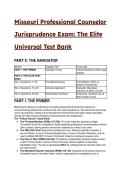
Missouri Professional Counselor
Jurisprudence Exam: The Elite
Universal Test Bank
PART 0: THE NAVIGATOR
Section Cognitive Tier Focus Area
PART I: THE PRIMER Axiomatic Theory Critical Directives & 2026 Legal
Updates
PART II: THE ELITE TEST
BANK
Tier 1 (Questions 1–15) Foundational Syntax Core Statutes, CEUs, &
Baseline Frameworks
Tier 2 (Questions 16–35) Complex Application Telehealth, Mandatory
Reporting, & Minor Consent
Tier 3 (Questions 36–60) Grandmaster Synthesis Subpoenas, Compact Law, &
Multi-Variable Crises
PART I: THE PRIMER
Mastering the Missouri professional counseling jurisprudence framework requires an
uncompromising adherence to statutory law over clinical preference. This document strips away
novice assumptions, forging A-level practitioners whose ethical and legal mastery translates
directly into elite clinical competence and board-level risk management.
The "Critical Axioms" Cheat Sheet
● The Privilege Mandate (RSMo 337.540): The client holds the absolute privilege.
Counselors cannot be compelled to testify regarding professional communications without
client consent, barring explicit criminal law violations or a direct court order.
● The 2026 CEU Triad: Beyond the standard 40 hours, Missouri explicitly mandates 3
hours of Ethics, 3 hours of Diversity/Implicit Bias, 2 hours of Suicide Prevention, and the
newly codified (HB 3007) 2 hours of Domestic Violence training per renewal cycle.
● The Duty to Warn (RSMo 632.443): Therapeutic confidentiality instantly dissolves when
a client communicates a serious threat of physical violence against a reasonably
identifiable victim. The duty is discharged ONLY by notifying both the intended victim and
law enforcement.
● The Mandated Reporter Absolute (RSMo 210.115): Suspected child abuse requires an
immediate report to the state hotline. Internal organizational investigations prior to
, reporting are strictly prohibited by law.
● The Telehealth Location Anchor: Jurisdiction is determined by the physical location of
the client. A Missouri-licensed counselor cannot treat a client physically located in another
state unless they also hold licensure or compact privileges in that specific state.
PART II: THE ELITE TEST BANK
Tier 1: Foundational Syntax & Application
Q1: A post-graduate counseling applicant is registering their supervised experience with the
Missouri Committee for Professional Counselors. Under 20 CSR 2095-2.020, what is the
ABSOLUTE MINIMUM duration required to complete the 3,000 hours of supervised counseling
experience? A) 12 calendar months of accelerated continuous supervised experience. B) 24
calendar months of continuous supervised counseling experience. C) 36 calendar months of
continuous supervised counseling experience. D) 60 calendar months of continuous supervised
counseling experience.
● The Answer: B (24 calendar months of continuous supervised counseling experience.)
● Distractor Analysis:
○ A is incorrect: Missouri law explicitly prevents acceleration below 24 months to
ensure longitudinal clinical development.
○ C is incorrect: This is a plausible timeline for many, but not the statutory minimum.
○ D is incorrect: Sixty months is the maximum allowable time frame to complete the
hours, not the minimum.
The Mentor's Analysis: The state demands seasoned maturation, not rushed hours. When
evaluating licensure timelines, the immediate priority is understanding the floor and ceiling of the
regulatory framework. By utilizing the 24-month minimum statutory floor, you bypass the
common trap of believing intense hour-stacking accelerates licensure. Professional/Academic
Intuition: Clinical competence requires temporal maturation; 3,000 hours cannot be legally
condensed into less than two years.
Q2: A Provisional Licensed Professional Counselor (PLPC) is completing their 3,000 supervised
hours. According to 20 CSR 2095-2.020, how many of these total hours must strictly consist of
direct client contact? A) 600 hours B) 1,000 hours C) 1,200 hours D) 1,500 hours
● The Answer: C (1,200 hours)
● Distractor Analysis:
○ A is incorrect: 600 hours is the requirement for the graduate-level
practicum/internship, not the post-graduate PLPC phase.
○ B is incorrect: This is a legacy estimate often confused with other state jurisdictions.
○ D is incorrect: 1,500 hours is the total required hours for those holding a specialist
or doctoral degree, not the direct contact requirement for a master's-level PLPC.
The Mentor's Analysis: The distinction between administrative clinical work and therapeutic
contact is heavily regulated. When logging hours, the immediate priority is isolating face-to-face
therapeutic interaction from indirect services. By utilizing the 1,200-hour direct client contact
metric, you bypass the common trap of over-logging administrative duties.
Professional/Academic Intuition: Only direct, in-the-room therapeutic contact fulfills the
1,200-hour mandate.
Q3: During the mandatory face-to-face supervision for a PLPC, the supervisor decides to utilize
group supervision to maximize efficiency. According to Missouri regulations, what is the
, MAXIMUM number of weeks per month that group supervision may replace individual
face-to-face supervision? A) One week per month. B) Two weeks per month. C) Three weeks
per month. D) Group supervision is strictly forbidden; all supervision must be individual.
● The Answer: B (Two weeks per month.)
● Distractor Analysis:
○ A is incorrect: While plausible, the board allows up to two weeks, not just one.
○ C is incorrect: Allowing three weeks would violate the mandate that at least two
weeks per month must be individual supervision.
○ D is incorrect: Group supervision is explicitly permitted, provided the group does not
exceed three PLPCs.
The Mentor's Analysis: Supervision must remain intimately focused on the individual
practitioner's development. When structuring supervision schedules, the immediate priority is
maintaining the statutory 50/50 split between individual and group formats. By utilizing the
two-week group maximum limit, you bypass the common trap of diluting clinical oversight
through excessive group work. Professional/Academic Intuition: Group supervision is a
supplement, never a replacement, for individual clinical oversight.
Q4: To qualify for licensure as a professional counselor in Missouri, an applicant enrolled in a
graduate program after August 28, 2023, must present an official transcript verifying a degree
containing a minimum of how many semester hours? A) 30 semester hours B) 48 semester
hours C) 60 semester hours D) 72 semester hours
● The Answer: C (60 semester hours)
● Distractor Analysis:
○ A is incorrect: 30 hours is the post-master's requirement for a specific alternative
supervision track, not the primary degree requirement.
○ B is incorrect: 48 hours is the legacy requirement for applicants enrolled prior to
August 28, 2023.
○ D is incorrect: 72 hours represents quarter hours, not semester hours.
The Mentor's Analysis: Academic rigor has escalated to match national standards. When
verifying educational credentials, the immediate priority is identifying the enrollment date. By
utilizing the 60-semester-hour benchmark for post-2023 enrollees, you bypass the common trap
of operating on outdated educational frameworks. Professional/Academic Intuition: 2023
marked the regulatory shift; 60 hours is the new baseline for counseling mastery.
Q5: An LPC is preparing for their biennial license renewal in 2026. Synthesizing standard
requirements and recent legislative updates (HB 3007), which combination of continuing
education units (CEUs) is MANDATORY within their 40-hour requirement? A) 2 hours in Suicide
Prevention, 3 hours in Ethics, 3 hours in Diversity, 2 hours in Domestic Violence. B) 3 hours in
Ethics, 3 hours in Supervision, 2 hours in Domestic Violence. C) 40 hours of general clinical
skills with no specific categorical mandates. D) 2 hours in Suicide Prevention, 2 hours in Ethics,
2 hours in HIPAA compliance.
● The Answer: A (2 hours in Suicide Prevention, 3 hours in Ethics, 3 hours in Diversity, 2
hours in Domestic Violence.)
● Distractor Analysis:
○ B is incorrect: Supervision is not a universally mandated CEU category for all LPCs.
○ C is incorrect: This reflects a severe lack of awareness regarding Missouri's specific
statutory CEU mandates.
○ D is incorrect: Ethics requires 3 hours, not 2, and HIPAA is not a state-mandated
CEU category, while Diversity and Domestic Violence are completely omitted.
The Mentor's Analysis: The board actively targets systemic societal crises through continuing
Jurisprudence Exam: The Elite
Universal Test Bank
PART 0: THE NAVIGATOR
Section Cognitive Tier Focus Area
PART I: THE PRIMER Axiomatic Theory Critical Directives & 2026 Legal
Updates
PART II: THE ELITE TEST
BANK
Tier 1 (Questions 1–15) Foundational Syntax Core Statutes, CEUs, &
Baseline Frameworks
Tier 2 (Questions 16–35) Complex Application Telehealth, Mandatory
Reporting, & Minor Consent
Tier 3 (Questions 36–60) Grandmaster Synthesis Subpoenas, Compact Law, &
Multi-Variable Crises
PART I: THE PRIMER
Mastering the Missouri professional counseling jurisprudence framework requires an
uncompromising adherence to statutory law over clinical preference. This document strips away
novice assumptions, forging A-level practitioners whose ethical and legal mastery translates
directly into elite clinical competence and board-level risk management.
The "Critical Axioms" Cheat Sheet
● The Privilege Mandate (RSMo 337.540): The client holds the absolute privilege.
Counselors cannot be compelled to testify regarding professional communications without
client consent, barring explicit criminal law violations or a direct court order.
● The 2026 CEU Triad: Beyond the standard 40 hours, Missouri explicitly mandates 3
hours of Ethics, 3 hours of Diversity/Implicit Bias, 2 hours of Suicide Prevention, and the
newly codified (HB 3007) 2 hours of Domestic Violence training per renewal cycle.
● The Duty to Warn (RSMo 632.443): Therapeutic confidentiality instantly dissolves when
a client communicates a serious threat of physical violence against a reasonably
identifiable victim. The duty is discharged ONLY by notifying both the intended victim and
law enforcement.
● The Mandated Reporter Absolute (RSMo 210.115): Suspected child abuse requires an
immediate report to the state hotline. Internal organizational investigations prior to
, reporting are strictly prohibited by law.
● The Telehealth Location Anchor: Jurisdiction is determined by the physical location of
the client. A Missouri-licensed counselor cannot treat a client physically located in another
state unless they also hold licensure or compact privileges in that specific state.
PART II: THE ELITE TEST BANK
Tier 1: Foundational Syntax & Application
Q1: A post-graduate counseling applicant is registering their supervised experience with the
Missouri Committee for Professional Counselors. Under 20 CSR 2095-2.020, what is the
ABSOLUTE MINIMUM duration required to complete the 3,000 hours of supervised counseling
experience? A) 12 calendar months of accelerated continuous supervised experience. B) 24
calendar months of continuous supervised counseling experience. C) 36 calendar months of
continuous supervised counseling experience. D) 60 calendar months of continuous supervised
counseling experience.
● The Answer: B (24 calendar months of continuous supervised counseling experience.)
● Distractor Analysis:
○ A is incorrect: Missouri law explicitly prevents acceleration below 24 months to
ensure longitudinal clinical development.
○ C is incorrect: This is a plausible timeline for many, but not the statutory minimum.
○ D is incorrect: Sixty months is the maximum allowable time frame to complete the
hours, not the minimum.
The Mentor's Analysis: The state demands seasoned maturation, not rushed hours. When
evaluating licensure timelines, the immediate priority is understanding the floor and ceiling of the
regulatory framework. By utilizing the 24-month minimum statutory floor, you bypass the
common trap of believing intense hour-stacking accelerates licensure. Professional/Academic
Intuition: Clinical competence requires temporal maturation; 3,000 hours cannot be legally
condensed into less than two years.
Q2: A Provisional Licensed Professional Counselor (PLPC) is completing their 3,000 supervised
hours. According to 20 CSR 2095-2.020, how many of these total hours must strictly consist of
direct client contact? A) 600 hours B) 1,000 hours C) 1,200 hours D) 1,500 hours
● The Answer: C (1,200 hours)
● Distractor Analysis:
○ A is incorrect: 600 hours is the requirement for the graduate-level
practicum/internship, not the post-graduate PLPC phase.
○ B is incorrect: This is a legacy estimate often confused with other state jurisdictions.
○ D is incorrect: 1,500 hours is the total required hours for those holding a specialist
or doctoral degree, not the direct contact requirement for a master's-level PLPC.
The Mentor's Analysis: The distinction between administrative clinical work and therapeutic
contact is heavily regulated. When logging hours, the immediate priority is isolating face-to-face
therapeutic interaction from indirect services. By utilizing the 1,200-hour direct client contact
metric, you bypass the common trap of over-logging administrative duties.
Professional/Academic Intuition: Only direct, in-the-room therapeutic contact fulfills the
1,200-hour mandate.
Q3: During the mandatory face-to-face supervision for a PLPC, the supervisor decides to utilize
group supervision to maximize efficiency. According to Missouri regulations, what is the
, MAXIMUM number of weeks per month that group supervision may replace individual
face-to-face supervision? A) One week per month. B) Two weeks per month. C) Three weeks
per month. D) Group supervision is strictly forbidden; all supervision must be individual.
● The Answer: B (Two weeks per month.)
● Distractor Analysis:
○ A is incorrect: While plausible, the board allows up to two weeks, not just one.
○ C is incorrect: Allowing three weeks would violate the mandate that at least two
weeks per month must be individual supervision.
○ D is incorrect: Group supervision is explicitly permitted, provided the group does not
exceed three PLPCs.
The Mentor's Analysis: Supervision must remain intimately focused on the individual
practitioner's development. When structuring supervision schedules, the immediate priority is
maintaining the statutory 50/50 split between individual and group formats. By utilizing the
two-week group maximum limit, you bypass the common trap of diluting clinical oversight
through excessive group work. Professional/Academic Intuition: Group supervision is a
supplement, never a replacement, for individual clinical oversight.
Q4: To qualify for licensure as a professional counselor in Missouri, an applicant enrolled in a
graduate program after August 28, 2023, must present an official transcript verifying a degree
containing a minimum of how many semester hours? A) 30 semester hours B) 48 semester
hours C) 60 semester hours D) 72 semester hours
● The Answer: C (60 semester hours)
● Distractor Analysis:
○ A is incorrect: 30 hours is the post-master's requirement for a specific alternative
supervision track, not the primary degree requirement.
○ B is incorrect: 48 hours is the legacy requirement for applicants enrolled prior to
August 28, 2023.
○ D is incorrect: 72 hours represents quarter hours, not semester hours.
The Mentor's Analysis: Academic rigor has escalated to match national standards. When
verifying educational credentials, the immediate priority is identifying the enrollment date. By
utilizing the 60-semester-hour benchmark for post-2023 enrollees, you bypass the common trap
of operating on outdated educational frameworks. Professional/Academic Intuition: 2023
marked the regulatory shift; 60 hours is the new baseline for counseling mastery.
Q5: An LPC is preparing for their biennial license renewal in 2026. Synthesizing standard
requirements and recent legislative updates (HB 3007), which combination of continuing
education units (CEUs) is MANDATORY within their 40-hour requirement? A) 2 hours in Suicide
Prevention, 3 hours in Ethics, 3 hours in Diversity, 2 hours in Domestic Violence. B) 3 hours in
Ethics, 3 hours in Supervision, 2 hours in Domestic Violence. C) 40 hours of general clinical
skills with no specific categorical mandates. D) 2 hours in Suicide Prevention, 2 hours in Ethics,
2 hours in HIPAA compliance.
● The Answer: A (2 hours in Suicide Prevention, 3 hours in Ethics, 3 hours in Diversity, 2
hours in Domestic Violence.)
● Distractor Analysis:
○ B is incorrect: Supervision is not a universally mandated CEU category for all LPCs.
○ C is incorrect: This reflects a severe lack of awareness regarding Missouri's specific
statutory CEU mandates.
○ D is incorrect: Ethics requires 3 hours, not 2, and HIPAA is not a state-mandated
CEU category, while Diversity and Domestic Violence are completely omitted.
The Mentor's Analysis: The board actively targets systemic societal crises through continuing


