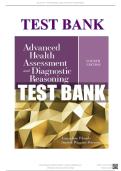
Introductory Clinical
Pharmacology
12th Edition
• Author(s)Susan Ford
• Print ISBN: 9781975163730
TEST BANK
C. Adverse reaction
D. Toxic effect
Correct Answer: B
,Rationale: The therapeutic effect is the intended beneficial
action of a medication. Contraindications identify situations in
which a drug should not be used. Adverse and toxic effects are
unintended harmful responses.
Question 3
A client reports developing mild nausea after starting a newly
prescribed medication. Which nursing response is most
appropriate?
A. Instruct the client to stop taking the medication immediately.
B. Document the symptom, assess its severity, and notify the
provider if it persists or worsens.
C. Tell the client that nausea always indicates an allergy.
D. Double the medication dose to improve tolerance.
Correct Answer: B
Rationale: Mild nausea is a common adverse effect of many
medications and should be assessed and monitored. Immediate
discontinuation without provider guidance may interrupt
therapy. Nausea alone does not indicate an allergy, and
increasing the dose is unsafe.
Question 4
,A nurse is teaching a client about the importance of taking
medications exactly as prescribed. Which client statement
indicates correct understanding?
A. "I'll stop taking the medication once I begin to feel better."
B. "I'll take extra doses if my symptoms return."
C. "I'll follow the prescribed schedule even if my symptoms
improve."
D. "I'll skip doses whenever I experience mild side effects."
Correct Answer: C
Rationale: Consistent adherence to the prescribed regimen
promotes therapeutic effectiveness and reduces complications.
Stopping, skipping, or increasing doses without provider
approval can lead to treatment failure or toxicity.
Question 5
Before administering a medication, the nurse reviews the
client's documented allergy to sulfonamide antibiotics. Which
principle is being demonstrated?
A. Evaluation of therapeutic response
B. Prevention of adverse drug events
C. Assessment of medication cost
, D. Promotion of placebo effect
Correct Answer: B
Rationale: Reviewing allergies before medication administration
helps prevent allergic reactions and serious adverse drug
events. Allergy assessment is an essential component of safe
nursing practice.
Question 6
A client asks why laboratory tests are ordered while receiving a
medication with a narrow therapeutic range. What is the
nurse's best response?
A. "The tests help determine whether the medication remains
within a safe and effective range."
B. "The tests are performed only if side effects occur."
C. "The tests are used to decide whether surgery is necessary."
D. "Laboratory monitoring is required for every medication."
Correct Answer: A
Rationale: Drugs with a narrow therapeutic range require
monitoring to ensure blood concentrations remain effective
without becoming toxic. Not all medications require routine
laboratory monitoring.
Pharmacology
12th Edition
• Author(s)Susan Ford
• Print ISBN: 9781975163730
TEST BANK
C. Adverse reaction
D. Toxic effect
Correct Answer: B
,Rationale: The therapeutic effect is the intended beneficial
action of a medication. Contraindications identify situations in
which a drug should not be used. Adverse and toxic effects are
unintended harmful responses.
Question 3
A client reports developing mild nausea after starting a newly
prescribed medication. Which nursing response is most
appropriate?
A. Instruct the client to stop taking the medication immediately.
B. Document the symptom, assess its severity, and notify the
provider if it persists or worsens.
C. Tell the client that nausea always indicates an allergy.
D. Double the medication dose to improve tolerance.
Correct Answer: B
Rationale: Mild nausea is a common adverse effect of many
medications and should be assessed and monitored. Immediate
discontinuation without provider guidance may interrupt
therapy. Nausea alone does not indicate an allergy, and
increasing the dose is unsafe.
Question 4
,A nurse is teaching a client about the importance of taking
medications exactly as prescribed. Which client statement
indicates correct understanding?
A. "I'll stop taking the medication once I begin to feel better."
B. "I'll take extra doses if my symptoms return."
C. "I'll follow the prescribed schedule even if my symptoms
improve."
D. "I'll skip doses whenever I experience mild side effects."
Correct Answer: C
Rationale: Consistent adherence to the prescribed regimen
promotes therapeutic effectiveness and reduces complications.
Stopping, skipping, or increasing doses without provider
approval can lead to treatment failure or toxicity.
Question 5
Before administering a medication, the nurse reviews the
client's documented allergy to sulfonamide antibiotics. Which
principle is being demonstrated?
A. Evaluation of therapeutic response
B. Prevention of adverse drug events
C. Assessment of medication cost
, D. Promotion of placebo effect
Correct Answer: B
Rationale: Reviewing allergies before medication administration
helps prevent allergic reactions and serious adverse drug
events. Allergy assessment is an essential component of safe
nursing practice.
Question 6
A client asks why laboratory tests are ordered while receiving a
medication with a narrow therapeutic range. What is the
nurse's best response?
A. "The tests help determine whether the medication remains
within a safe and effective range."
B. "The tests are performed only if side effects occur."
C. "The tests are used to decide whether surgery is necessary."
D. "Laboratory monitoring is required for every medication."
Correct Answer: A
Rationale: Drugs with a narrow therapeutic range require
monitoring to ensure blood concentrations remain effective
without becoming toxic. Not all medications require routine
laboratory monitoring.