

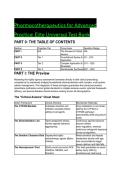
Pharmacotherapeutics for Advanced
Practice: Elite Universal Test Bank
PART 0: THE TABLE OF CONTENTS
Section Cognitive Tier Focus Area Question Range
PART I N/A The Preview & Critical N/A
Axioms
PART II Tier 1 Foundational Syntax & Q1 – Q10
Application
PART II Tier 2 Complex Application & Q11 – Q20
Simulation
PART II Tier 3 Grandmaster Synthesis Q21 – Q30
PART I: THE Preview
Mastering this highly rigorous assessment translates directly to elite clinical prescribing
competence by seamlessly bridging foundational pharmacokinetics with complex, multi-system
patient management. The integration of these principles guarantees that advanced practice
prescribers synthesize current global standards to mitigate adverse events, optimize therapeutic
efficacy, and execute flawless clinical decision-making across all demographics.
The "Critical Axioms" Cheat Sheet
Axiom Framework Clinical Directive Mechanistic Rationale
The CYP450 Mandate Anticipate induction and Drug metabolism is non-linear;
inhibition cascades before altering the CYP3A4 or
adding novel agents. CYP2D6 pathways
exponentially shifts drug serum
levels.
The Desensitization Law Taper antagonists slowly; Continuous agonist exposure
monitor agonist tolerance induces cellular
aggressively. down-regulation, whereas
continuous antagonist exposure
forces up-regulation.
The Geriatric Clearance Rule Deprescribe highly Renal excretion and hepatic
anticholinergic agents (Beers metabolism decline with age;
Criteria). toxic accumulations trigger
severe delirium and fatal falls.
The Hemodynamic Triad Strictly avoid concurrent ACE This triad guarantees an acute
Inhibitors, NSAIDs, and kidney injury (AKI) by
Diuretics. simultaneously destroying
,Axiom Framework Clinical Directive Mechanistic Rationale
afferent and efferent glomerular
pressure.
The Evidence-Based Base prescribing logic strictly Clinical intuition must map to
Imperative on ADA, GINA, and ACC/AHA algorithmic, universally
guidelines. accepted frameworks to ensure
standardized mortality
reduction.
PART II: THE ELITE TEST BANK
Q1: A 58-year-old male presents with severe, chronic stable angina. The prescriber initiates oral
propranolol, a non-selective beta-adrenergic antagonist. The clinician notes that the required
oral dose is 40 mg every 6 hours, whereas the intravenous equivalent would be approximately 1
to 3 mg. Based on the principles of pharmacokinetic absorption and distribution, which
physiological phenomenon is PRIMARILY responsible for this massive dose discrepancy? A)
Propranolol is highly hydrophilic, requiring massive oral loading doses to penetrate the lipid
bilayer of the gastrointestinal tract. B) The drug aggressively binds to gastric acid, permanently
neutralizing the majority of the active compound before it reaches the duodenum. C) The drug
undergoes extensive hepatic first-pass metabolism, wherein the liver extracts and destroys a
significant percentage of the drug before it reaches systemic circulation. D) Orally administered
propranolol induces its own metabolism via Cytochrome P450 3A4 up-regulation, demanding
exponentially higher maintenance doses.
● The Answer: C (The drug undergoes extensive hepatic first-pass metabolism, wherein
the liver extracts and destroys a significant percentage of the drug before it reaches
systemic circulation.)
● Distractor Analysis:
○ A is incorrect: Propranolol is highly lipophilic, not hydrophilic. Its lipophilicity allows it
to easily cross cellular membranes, including the blood-brain barrier.
○ B is incorrect: Propranolol absorption is not critically bottlenecked by gastric acid
neutralization; the primary loss occurs post-absorption via the portal vein.
○ D is incorrect: While some drugs auto-induce their own metabolism over weeks,
propranolol's oral-to-IV dose discrepancy is an immediate consequence of
anatomical portal circulation, not delayed enzymatic induction.
The Mentor's Analysis: Mastery of bioavailability is the bedrock of precise dosing. First-pass
metabolism acts as an initial hepatic tollbooth; a massive percentage of an orally administered
drug is absorbed into the portal vein and immediately metabolized by the liver before it can ever
act systemically. By understanding this, the practitioner calculates oral doses that are
proportionally larger than intravenous doses. Professional/Academic Intuition: Always
evaluate the route of administration; if a drug undergoes heavy hepatic first-pass
extraction, oral administration demands a significantly higher dosage than parenteral
routes to survive the portal transit.
Q2: A 62-year-old patient is prescribed a beta-adrenergic antagonist (beta-blocker) for the
management of chronic stable angina. After six months of flawless adherence, the patient
abruptly discontinues the medication due to insurance issues. Within 48 hours, the patient
experiences severe tachycardia, diaphoresis, and unstable angina. Based on pharmacodynamic
principles, which cellular mechanism is MOST LIKELY responsible for this acute crisis? A)
Continuous blockade of the beta receptors led to cellular up-regulation, creating a
, hypersensitive state upon drug withdrawal. B) Continuous blockade of the beta receptors
induced desensitization, rendering endogenous catecholamines hyper-effective. C) The abrupt
cessation caused irreversible binding of circulating catecholamines to the myocardium. D) The
absence of the drug triggered an immediate increase in Cytochrome P450 enzymatic synthesis,
clearing natural vasodilators.
● The Answer: A (Continuous blockade of the beta receptors led to cellular up-regulation,
creating a hypersensitive state upon drug withdrawal.)
● Distractor Analysis:
○ B is incorrect: Desensitization or down-regulation occurs with continuous exposure
to receptor agonists, not antagonists.
○ C is incorrect: Endogenous catecholamines bind reversibly, not irreversibly.
Irreversible binding is a characteristic of specific toxic agents.
○ D is incorrect: Cytochrome P450 enzymes metabolize exogenous substances
(drugs/toxins); they do not acutely synthesize in response to beta-blocker
withdrawal to clear endogenous vasodilators.
The Mentor's Analysis: The human body operates as a dynamic equilibrium engine. When a
receptor is continuously blocked by an antagonist, the body responds by synthesizing more
receptors (up-regulation) to capture any available neurotransmitter. When the blockade is
abruptly removed, the flooded system overreacts to normal levels of endogenous
catecholamines, triggering a severe rebound effect. Professional/Academic Intuition: Never
abruptly discontinue a receptor antagonist; physiological up-regulation demands a slow,
deliberate taper to avert rebound cardiovascular toxicity.
Q3: An 82-year-old patient presents to the emergency department with acute delirium, severe
visual disturbances, and acute urinary retention. A review of the patient's medication profile
reveals the recent addition of a first-generation antihistamine for seasonal allergies. According
to the updated Beers Criteria, which underlying pharmacokinetic/pharmacodynamic shift in the
older adult MOST LIKELY precipitated this adverse event? A) Enhanced renal clearance
resulting in toxic metabolite accumulation in the detrusor muscle. B) Age-related increases in
total body water leading to the rapid systemic distribution of hydrophilic drugs. C) A reduction in
hepatic mass and blood flow combined with heightened central nervous system sensitivity to
anticholinergic burden. D) Accelerated Cytochrome P450 induction causing rapid drug
metabolism and subsequent abrupt withdrawal symptoms.
● The Answer: C (A reduction in hepatic mass and blood flow combined with heightened
central nervous system sensitivity to anticholinergic burden.)
● Distractor Analysis:
○ A is incorrect: Older adults experience a progressive decline in glomerular filtration
rate (GFR) and renal clearance, not an enhancement.
○ B is incorrect: Aging is associated with a decrease in total body water and an
increase in total body fat, causing lipophilic (not hydrophilic) drugs to accumulate
and exhibit prolonged half-lives.
○ D is incorrect: First-generation antihistamines do not typically induce rapid
withdrawal via P450 acceleration; the delirium is a direct consequence of active
drug toxicity.
The Mentor's Analysis: Geriatric pharmacotherapy requires defensive prescribing. The older
adult experiences diminished hepatic clearance, rendering standard doses toxic, paired with an
exquisitely sensitive central nervous system. First-generation antihistamines carry a massive
anticholinergic load, which crosses the blood-brain barrier and triggers classic toxicity: "mad as
a hatter, blind as a bat, red as a beet, hot as a hare, dry as a bone." Professional/Academic
Practice: Elite Universal Test Bank
PART 0: THE TABLE OF CONTENTS
Section Cognitive Tier Focus Area Question Range
PART I N/A The Preview & Critical N/A
Axioms
PART II Tier 1 Foundational Syntax & Q1 – Q10
Application
PART II Tier 2 Complex Application & Q11 – Q20
Simulation
PART II Tier 3 Grandmaster Synthesis Q21 – Q30
PART I: THE Preview
Mastering this highly rigorous assessment translates directly to elite clinical prescribing
competence by seamlessly bridging foundational pharmacokinetics with complex, multi-system
patient management. The integration of these principles guarantees that advanced practice
prescribers synthesize current global standards to mitigate adverse events, optimize therapeutic
efficacy, and execute flawless clinical decision-making across all demographics.
The "Critical Axioms" Cheat Sheet
Axiom Framework Clinical Directive Mechanistic Rationale
The CYP450 Mandate Anticipate induction and Drug metabolism is non-linear;
inhibition cascades before altering the CYP3A4 or
adding novel agents. CYP2D6 pathways
exponentially shifts drug serum
levels.
The Desensitization Law Taper antagonists slowly; Continuous agonist exposure
monitor agonist tolerance induces cellular
aggressively. down-regulation, whereas
continuous antagonist exposure
forces up-regulation.
The Geriatric Clearance Rule Deprescribe highly Renal excretion and hepatic
anticholinergic agents (Beers metabolism decline with age;
Criteria). toxic accumulations trigger
severe delirium and fatal falls.
The Hemodynamic Triad Strictly avoid concurrent ACE This triad guarantees an acute
Inhibitors, NSAIDs, and kidney injury (AKI) by
Diuretics. simultaneously destroying
,Axiom Framework Clinical Directive Mechanistic Rationale
afferent and efferent glomerular
pressure.
The Evidence-Based Base prescribing logic strictly Clinical intuition must map to
Imperative on ADA, GINA, and ACC/AHA algorithmic, universally
guidelines. accepted frameworks to ensure
standardized mortality
reduction.
PART II: THE ELITE TEST BANK
Q1: A 58-year-old male presents with severe, chronic stable angina. The prescriber initiates oral
propranolol, a non-selective beta-adrenergic antagonist. The clinician notes that the required
oral dose is 40 mg every 6 hours, whereas the intravenous equivalent would be approximately 1
to 3 mg. Based on the principles of pharmacokinetic absorption and distribution, which
physiological phenomenon is PRIMARILY responsible for this massive dose discrepancy? A)
Propranolol is highly hydrophilic, requiring massive oral loading doses to penetrate the lipid
bilayer of the gastrointestinal tract. B) The drug aggressively binds to gastric acid, permanently
neutralizing the majority of the active compound before it reaches the duodenum. C) The drug
undergoes extensive hepatic first-pass metabolism, wherein the liver extracts and destroys a
significant percentage of the drug before it reaches systemic circulation. D) Orally administered
propranolol induces its own metabolism via Cytochrome P450 3A4 up-regulation, demanding
exponentially higher maintenance doses.
● The Answer: C (The drug undergoes extensive hepatic first-pass metabolism, wherein
the liver extracts and destroys a significant percentage of the drug before it reaches
systemic circulation.)
● Distractor Analysis:
○ A is incorrect: Propranolol is highly lipophilic, not hydrophilic. Its lipophilicity allows it
to easily cross cellular membranes, including the blood-brain barrier.
○ B is incorrect: Propranolol absorption is not critically bottlenecked by gastric acid
neutralization; the primary loss occurs post-absorption via the portal vein.
○ D is incorrect: While some drugs auto-induce their own metabolism over weeks,
propranolol's oral-to-IV dose discrepancy is an immediate consequence of
anatomical portal circulation, not delayed enzymatic induction.
The Mentor's Analysis: Mastery of bioavailability is the bedrock of precise dosing. First-pass
metabolism acts as an initial hepatic tollbooth; a massive percentage of an orally administered
drug is absorbed into the portal vein and immediately metabolized by the liver before it can ever
act systemically. By understanding this, the practitioner calculates oral doses that are
proportionally larger than intravenous doses. Professional/Academic Intuition: Always
evaluate the route of administration; if a drug undergoes heavy hepatic first-pass
extraction, oral administration demands a significantly higher dosage than parenteral
routes to survive the portal transit.
Q2: A 62-year-old patient is prescribed a beta-adrenergic antagonist (beta-blocker) for the
management of chronic stable angina. After six months of flawless adherence, the patient
abruptly discontinues the medication due to insurance issues. Within 48 hours, the patient
experiences severe tachycardia, diaphoresis, and unstable angina. Based on pharmacodynamic
principles, which cellular mechanism is MOST LIKELY responsible for this acute crisis? A)
Continuous blockade of the beta receptors led to cellular up-regulation, creating a
, hypersensitive state upon drug withdrawal. B) Continuous blockade of the beta receptors
induced desensitization, rendering endogenous catecholamines hyper-effective. C) The abrupt
cessation caused irreversible binding of circulating catecholamines to the myocardium. D) The
absence of the drug triggered an immediate increase in Cytochrome P450 enzymatic synthesis,
clearing natural vasodilators.
● The Answer: A (Continuous blockade of the beta receptors led to cellular up-regulation,
creating a hypersensitive state upon drug withdrawal.)
● Distractor Analysis:
○ B is incorrect: Desensitization or down-regulation occurs with continuous exposure
to receptor agonists, not antagonists.
○ C is incorrect: Endogenous catecholamines bind reversibly, not irreversibly.
Irreversible binding is a characteristic of specific toxic agents.
○ D is incorrect: Cytochrome P450 enzymes metabolize exogenous substances
(drugs/toxins); they do not acutely synthesize in response to beta-blocker
withdrawal to clear endogenous vasodilators.
The Mentor's Analysis: The human body operates as a dynamic equilibrium engine. When a
receptor is continuously blocked by an antagonist, the body responds by synthesizing more
receptors (up-regulation) to capture any available neurotransmitter. When the blockade is
abruptly removed, the flooded system overreacts to normal levels of endogenous
catecholamines, triggering a severe rebound effect. Professional/Academic Intuition: Never
abruptly discontinue a receptor antagonist; physiological up-regulation demands a slow,
deliberate taper to avert rebound cardiovascular toxicity.
Q3: An 82-year-old patient presents to the emergency department with acute delirium, severe
visual disturbances, and acute urinary retention. A review of the patient's medication profile
reveals the recent addition of a first-generation antihistamine for seasonal allergies. According
to the updated Beers Criteria, which underlying pharmacokinetic/pharmacodynamic shift in the
older adult MOST LIKELY precipitated this adverse event? A) Enhanced renal clearance
resulting in toxic metabolite accumulation in the detrusor muscle. B) Age-related increases in
total body water leading to the rapid systemic distribution of hydrophilic drugs. C) A reduction in
hepatic mass and blood flow combined with heightened central nervous system sensitivity to
anticholinergic burden. D) Accelerated Cytochrome P450 induction causing rapid drug
metabolism and subsequent abrupt withdrawal symptoms.
● The Answer: C (A reduction in hepatic mass and blood flow combined with heightened
central nervous system sensitivity to anticholinergic burden.)
● Distractor Analysis:
○ A is incorrect: Older adults experience a progressive decline in glomerular filtration
rate (GFR) and renal clearance, not an enhancement.
○ B is incorrect: Aging is associated with a decrease in total body water and an
increase in total body fat, causing lipophilic (not hydrophilic) drugs to accumulate
and exhibit prolonged half-lives.
○ D is incorrect: First-generation antihistamines do not typically induce rapid
withdrawal via P450 acceleration; the delirium is a direct consequence of active
drug toxicity.
The Mentor's Analysis: Geriatric pharmacotherapy requires defensive prescribing. The older
adult experiences diminished hepatic clearance, rendering standard doses toxic, paired with an
exquisitely sensitive central nervous system. First-generation antihistamines carry a massive
anticholinergic load, which crosses the blood-brain barrier and triggers classic toxicity: "mad as
a hatter, blind as a bat, red as a beet, hot as a hare, dry as a bone." Professional/Academic


