

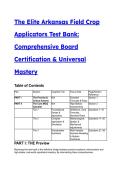
The Elite Arkansas Field Crop
Applicators Test Bank:
Comprehensive Board
Certification & Universal
Mastery
Table of Contents
Part Section Cognitive Tier Focus Area Page/Section
Reference
PART I The Preview & N/A Essential Section 1
Critical Axioms Formulas & Rules
PART II The Core MCQ N/A High-Stakes Section 2
Gauntlet Assessments
Tier 1 Foundational Definitions, Core Questions 1–10
Syntax & Formulas,
Application Standard Rules
Tier 2 Complex Meteorological, Questions 11–20
Application & Spatial, &
Simulation Mechanical
Adjustments
Tier 3 Grandmaster Multi-Variable Questions 21–30
Synthesis Scenario Modeling
& System
Overhauls
PART I: THE Preview
Mastering this test bank is the definitive bridge between passive academic memorization and
high-stakes, real-world operational mastery. By internalizing these comprehensive,
,multi-variable scenarios, you will transform raw regulatory and mathematical inputs into flawless,
legally compliant field-level executions under the jurisdiction of the Arkansas State Plant Board.
The "Critical Axioms" Cheat Sheet
● Hydrologic Flow Rate Formula (Per Nozzle): Where \text{GPM} is gallons per minute,
\text{GPA} is gallons per acre, \text{mph} is travel speed, and W is nozzle spacing in
inches (or directed row spacing divided by nozzles per row).
● The Ounce Method Distance Constant: The total discharge caught in fluid ounces over
this specific distance directly equals the system's applied \text{GPA}.
● Temperature Inversion Validation Window: An inversion layer is considered highly
unlikely to exist if ambient temperature measurements at the working airstrip have either
increased by at least 3^\circ\text{F} from the morning low (for pre-noon applications) or
have not decreased by more than 3^\circ\text{F} from the afternoon high (for post-noon
applications).
● State Restricted Use Pesticide (RUP) Retention Mandates: Federal RUP applications
require a 2\text{-year} record retention period. However, Arkansas state-classified Class F
(2,4-D) and Class H (dicamba) applications require a strict 3\text{-year} retention period
with localized meteorological and equipment logs.
PART II: THE ELITE TEST BANK
Tier 1: Foundational Syntax & Application (Questions 1–10)
Q1: A soybean breeder selectively crosses wild glycine accessions to express extreme
tolerance to systemic pathotypes of Phytophthora sojae. Under the integrated pest management
(IPM) taxonomy of the Arkansas State Plant Board, which classification BEST describes this
control strategy? A) Biological control B) Mechanical control C) Genetic control D)
Physical/environmental modification
● The Answer: C (Genetic control)
● Distractor Analysis:
○ A is incorrect: Biological control relies on the introduction of natural predators,
parasitoids, or pathogens to suppress pest populations, not host-genome
manipulation.
○ B is incorrect: Mechanical control involves physical interventions, such as tillage or
mowing, to destroy pests.
○ D is incorrect: Physical/environmental modification entails altering ambient
conditions, such as crop spacing, irrigation scheduling, or storage temperature, to
suppress pest survival.
The Mentor's Analysis: Genetic control represents the proactive insertion of host-defense
traits through selective breeding or genetic engineering. When facing systemic disease
pressures, utilizing host resistance minimizes reliance on chemical intervention.
Professional/Academic Intuition: Breeding or selecting varieties with intrinsic resistance
to pathotypes is classified strictly as genetic control.
Double-space
Q2: A producer in Clay County operates a moldboard plow to uproot and bury dense flushes of
glyphosate-resistant Italian ryegrass (Lolium multidictum) prior to planting. According to state
, IPM definitions, this action is classified under which category of mechanical control? A)
Exclusion B) Trapping C) Cultivation D) Irrigation
● The Answer: C (Cultivation)
● Distractor Analysis:
○ A is incorrect: Exclusion uses physical barriers, such as netting or fences, to
prevent pests from entering a designated area.
○ B is incorrect: Trapping captures pests mechanically to evaluate populations or
reduce density, which is ineffective for uniform weed infestations.
○ D is incorrect: Irrigation manipulation manages pest biology via water levels (e.g.,
flooding rice fields), rather than physically disrupting root systems in the soil profile.
The Mentor's Analysis: Mechanical cultivation physically shears root systems from the soil
matrix, inducing rapid desiccation of weed species. This is a primary mechanical suppressive
tactic used to disrupt weed life cycles before crop emergence. Professional/Academic
Intuition: Utilizing physical implements like plows, disks, or harrows to destroy weed
populations falls under the IPM mechanical classification of cultivation.
Double-space
Q3: During systematic scouting of an Arkansas cotton field, an agronomic consultant
determines that the tarnished plant bug (Lygus lineolaris) population has reached the exact
density where the projected financial loss from their feeding damage equals the cost of a
chemical application. What regulatory and agronomic term BEST defines this biological
transition point? A) Economic injury level B) Economic threshold C) Action threshold D) Pest
injury index
● The Answer: B (Economic threshold)
● Distractor Analysis:
○ A is incorrect: The economic injury level (EIL) is the lowest pest population density
that will cause actual economic damage exceeding the cost of control, whereas the
threshold is the operational trigger point.
○ C is incorrect: An action threshold is a generic point where pest control is initiated,
which may be based on aesthetic or comfort parameters rather than precise
financial parity.
○ D is incorrect: Pest injury index is a non-standard metric used to measure
anatomical plant tissue damage, not economic population dynamics.
The Mentor's Analysis: The economic threshold is the decision-making pivot point for the
applicator. Initiating chemical control at this density prevents pest populations from reaching the
actual economic injury level. Professional/Academic Intuition: The economic threshold is
defined as the pest population density that causes losses equal to the cost of control
measures, serving as the ultimate trigger for chemical applications.
Double-space
Q4: An agricultural pesticide label exhibits a prominent graphic of a skull and crossbones
flanked by the signal word "DANGER—POISON." Which acute toxicity profile is MOST
ACCURATE for this formulation? A) Low acute dermal toxicity requiring Class III protective
equipment B) Moderate systemic toxicity where a medium dose causes skin or respiratory
damage C) High acute toxicity where a microscopic or extremely small dose can cause death D)
Minimal environmental toxicity requiring only standard agricultural buffer zones
● The Answer: C (High acute toxicity where a microscopic or extremely small dose can
cause death)
● Distractor Analysis:
○ A is incorrect: Class III products are low-toxicity formulations requiring a
Applicators Test Bank:
Comprehensive Board
Certification & Universal
Mastery
Table of Contents
Part Section Cognitive Tier Focus Area Page/Section
Reference
PART I The Preview & N/A Essential Section 1
Critical Axioms Formulas & Rules
PART II The Core MCQ N/A High-Stakes Section 2
Gauntlet Assessments
Tier 1 Foundational Definitions, Core Questions 1–10
Syntax & Formulas,
Application Standard Rules
Tier 2 Complex Meteorological, Questions 11–20
Application & Spatial, &
Simulation Mechanical
Adjustments
Tier 3 Grandmaster Multi-Variable Questions 21–30
Synthesis Scenario Modeling
& System
Overhauls
PART I: THE Preview
Mastering this test bank is the definitive bridge between passive academic memorization and
high-stakes, real-world operational mastery. By internalizing these comprehensive,
,multi-variable scenarios, you will transform raw regulatory and mathematical inputs into flawless,
legally compliant field-level executions under the jurisdiction of the Arkansas State Plant Board.
The "Critical Axioms" Cheat Sheet
● Hydrologic Flow Rate Formula (Per Nozzle): Where \text{GPM} is gallons per minute,
\text{GPA} is gallons per acre, \text{mph} is travel speed, and W is nozzle spacing in
inches (or directed row spacing divided by nozzles per row).
● The Ounce Method Distance Constant: The total discharge caught in fluid ounces over
this specific distance directly equals the system's applied \text{GPA}.
● Temperature Inversion Validation Window: An inversion layer is considered highly
unlikely to exist if ambient temperature measurements at the working airstrip have either
increased by at least 3^\circ\text{F} from the morning low (for pre-noon applications) or
have not decreased by more than 3^\circ\text{F} from the afternoon high (for post-noon
applications).
● State Restricted Use Pesticide (RUP) Retention Mandates: Federal RUP applications
require a 2\text{-year} record retention period. However, Arkansas state-classified Class F
(2,4-D) and Class H (dicamba) applications require a strict 3\text{-year} retention period
with localized meteorological and equipment logs.
PART II: THE ELITE TEST BANK
Tier 1: Foundational Syntax & Application (Questions 1–10)
Q1: A soybean breeder selectively crosses wild glycine accessions to express extreme
tolerance to systemic pathotypes of Phytophthora sojae. Under the integrated pest management
(IPM) taxonomy of the Arkansas State Plant Board, which classification BEST describes this
control strategy? A) Biological control B) Mechanical control C) Genetic control D)
Physical/environmental modification
● The Answer: C (Genetic control)
● Distractor Analysis:
○ A is incorrect: Biological control relies on the introduction of natural predators,
parasitoids, or pathogens to suppress pest populations, not host-genome
manipulation.
○ B is incorrect: Mechanical control involves physical interventions, such as tillage or
mowing, to destroy pests.
○ D is incorrect: Physical/environmental modification entails altering ambient
conditions, such as crop spacing, irrigation scheduling, or storage temperature, to
suppress pest survival.
The Mentor's Analysis: Genetic control represents the proactive insertion of host-defense
traits through selective breeding or genetic engineering. When facing systemic disease
pressures, utilizing host resistance minimizes reliance on chemical intervention.
Professional/Academic Intuition: Breeding or selecting varieties with intrinsic resistance
to pathotypes is classified strictly as genetic control.
Double-space
Q2: A producer in Clay County operates a moldboard plow to uproot and bury dense flushes of
glyphosate-resistant Italian ryegrass (Lolium multidictum) prior to planting. According to state
, IPM definitions, this action is classified under which category of mechanical control? A)
Exclusion B) Trapping C) Cultivation D) Irrigation
● The Answer: C (Cultivation)
● Distractor Analysis:
○ A is incorrect: Exclusion uses physical barriers, such as netting or fences, to
prevent pests from entering a designated area.
○ B is incorrect: Trapping captures pests mechanically to evaluate populations or
reduce density, which is ineffective for uniform weed infestations.
○ D is incorrect: Irrigation manipulation manages pest biology via water levels (e.g.,
flooding rice fields), rather than physically disrupting root systems in the soil profile.
The Mentor's Analysis: Mechanical cultivation physically shears root systems from the soil
matrix, inducing rapid desiccation of weed species. This is a primary mechanical suppressive
tactic used to disrupt weed life cycles before crop emergence. Professional/Academic
Intuition: Utilizing physical implements like plows, disks, or harrows to destroy weed
populations falls under the IPM mechanical classification of cultivation.
Double-space
Q3: During systematic scouting of an Arkansas cotton field, an agronomic consultant
determines that the tarnished plant bug (Lygus lineolaris) population has reached the exact
density where the projected financial loss from their feeding damage equals the cost of a
chemical application. What regulatory and agronomic term BEST defines this biological
transition point? A) Economic injury level B) Economic threshold C) Action threshold D) Pest
injury index
● The Answer: B (Economic threshold)
● Distractor Analysis:
○ A is incorrect: The economic injury level (EIL) is the lowest pest population density
that will cause actual economic damage exceeding the cost of control, whereas the
threshold is the operational trigger point.
○ C is incorrect: An action threshold is a generic point where pest control is initiated,
which may be based on aesthetic or comfort parameters rather than precise
financial parity.
○ D is incorrect: Pest injury index is a non-standard metric used to measure
anatomical plant tissue damage, not economic population dynamics.
The Mentor's Analysis: The economic threshold is the decision-making pivot point for the
applicator. Initiating chemical control at this density prevents pest populations from reaching the
actual economic injury level. Professional/Academic Intuition: The economic threshold is
defined as the pest population density that causes losses equal to the cost of control
measures, serving as the ultimate trigger for chemical applications.
Double-space
Q4: An agricultural pesticide label exhibits a prominent graphic of a skull and crossbones
flanked by the signal word "DANGER—POISON." Which acute toxicity profile is MOST
ACCURATE for this formulation? A) Low acute dermal toxicity requiring Class III protective
equipment B) Moderate systemic toxicity where a medium dose causes skin or respiratory
damage C) High acute toxicity where a microscopic or extremely small dose can cause death D)
Minimal environmental toxicity requiring only standard agricultural buffer zones
● The Answer: C (High acute toxicity where a microscopic or extremely small dose can
cause death)
● Distractor Analysis:
○ A is incorrect: Class III products are low-toxicity formulations requiring a


