Introductory Clinical
Pharmacology
12th Edition
• Author(s)Susan Ford
• Print ISBN: 9781975163730
TEST BANK
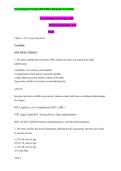
Question 1
,A nurse is teaching a patient about the purpose of
pharmacology. Which statement by the patient indicates
correct understanding?
A. "Pharmacology is the study of diseases only."
B. "Pharmacology focuses on how medications interact with the
body to produce therapeutic effects."
C. "Pharmacology is limited to herbal products."
D. "Pharmacology only applies to medications given in
hospitals."
Correct Answer: B
Rationale:
Pharmacology is the study of drugs and their interactions with
living organisms, including how medications produce
therapeutic effects, adverse effects, metabolism, and
elimination. It applies to all medication settings, including
hospitals, clinics, and home care. The other statements
incorrectly limit the scope of pharmacology.
Question 2
A nurse explains the difference between a generic medication
and a brand-name medication. Which response by the patient
demonstrates understanding?
,A. "Generic medications are less effective than brand-name
medications."
B. "Generic medications contain the same active ingredient as
the brand-name medication."
C. "Brand-name medications are always safer than generic
medications."
D. "Generic medications require larger doses."
Correct Answer: B
Rationale:
Generic medications contain the same active ingredient,
strength, dosage form, and therapeutic effect as their brand-
name counterparts. They may differ in inactive ingredients,
appearance, or manufacturer but must meet regulatory
standards for safety and effectiveness.
Question 3
A nurse administers an oral medication. Which factor primarily
determines how quickly the medication begins to produce its
effect?
A. Patient's eye color
B. Route of administration
C. Time of day
, D. Nurse's years of experience
Correct Answer: B
Rationale:
The route of administration greatly influences the onset of
action. Intravenous medications act almost immediately,
whereas oral medications require absorption through the
gastrointestinal tract before entering the bloodstream.
Question 4
A patient asks why a medication must be taken exactly as
prescribed. Which explanation by the nurse is most
appropriate?
A. "It keeps the medication level within the therapeutic range."
B. "It prevents the medication from changing color."
C. "It guarantees the disease will be cured."
D. "It eliminates all medication side effects."
Correct Answer: A
Rationale:
Maintaining medication concentrations within the therapeutic
range maximizes effectiveness while minimizing toxicity.
Skipping doses or taking extra doses can lead to treatment
Pharmacology
12th Edition
• Author(s)Susan Ford
• Print ISBN: 9781975163730
TEST BANK
Question 1
,A nurse is teaching a patient about the purpose of
pharmacology. Which statement by the patient indicates
correct understanding?
A. "Pharmacology is the study of diseases only."
B. "Pharmacology focuses on how medications interact with the
body to produce therapeutic effects."
C. "Pharmacology is limited to herbal products."
D. "Pharmacology only applies to medications given in
hospitals."
Correct Answer: B
Rationale:
Pharmacology is the study of drugs and their interactions with
living organisms, including how medications produce
therapeutic effects, adverse effects, metabolism, and
elimination. It applies to all medication settings, including
hospitals, clinics, and home care. The other statements
incorrectly limit the scope of pharmacology.
Question 2
A nurse explains the difference between a generic medication
and a brand-name medication. Which response by the patient
demonstrates understanding?
,A. "Generic medications are less effective than brand-name
medications."
B. "Generic medications contain the same active ingredient as
the brand-name medication."
C. "Brand-name medications are always safer than generic
medications."
D. "Generic medications require larger doses."
Correct Answer: B
Rationale:
Generic medications contain the same active ingredient,
strength, dosage form, and therapeutic effect as their brand-
name counterparts. They may differ in inactive ingredients,
appearance, or manufacturer but must meet regulatory
standards for safety and effectiveness.
Question 3
A nurse administers an oral medication. Which factor primarily
determines how quickly the medication begins to produce its
effect?
A. Patient's eye color
B. Route of administration
C. Time of day
, D. Nurse's years of experience
Correct Answer: B
Rationale:
The route of administration greatly influences the onset of
action. Intravenous medications act almost immediately,
whereas oral medications require absorption through the
gastrointestinal tract before entering the bloodstream.
Question 4
A patient asks why a medication must be taken exactly as
prescribed. Which explanation by the nurse is most
appropriate?
A. "It keeps the medication level within the therapeutic range."
B. "It prevents the medication from changing color."
C. "It guarantees the disease will be cured."
D. "It eliminates all medication side effects."
Correct Answer: A
Rationale:
Maintaining medication concentrations within the therapeutic
range maximizes effectiveness while minimizing toxicity.
Skipping doses or taking extra doses can lead to treatment